Tractors and wood! Show your pics

   / Tractors and wood! Show your pics #6,661  
Here is a video of my logging winch. I have other videos as well but here is one of them. My winch is a wallenstine fx6500. I use it for logging, demo buildings etc.
Good morning folks! Those of you who have/use a three point logging skidding winch - do you mind to post a few up close pics showing the front and back? I haven稚 ever seen one in person and seeing them in your posts has my curiosity up.

Thank you in advance!
 
   / Tractors and wood! Show your pics #6,662  
That last paragraph describes why it is that OSHA does not like this method: "You cut carefully watching the twist. As it twists around to where you want it you time the cut so the thees stops twisting and falls at the right spot." Doing this requires remaining at the stump as the tree is falling. OSHA really wants to see the faller get the heck out of there as soon as the tree starts to move. Logging is a dangerous past time, and most injuries happen within about 15 feet of the stump (I wish I could remember where I read that). The technique is wonderful in the hands of someone who really knows what they are doing and is alert and "firing on all cylinders". I have a lot of respect for folks who can do it right. It's also why I urge people who want to learn advanced cuts such as this to do it live & in person with someone experienced at it, don't just watch a YouTube video by someone whose background you don't know and assume you've got all you need to do it right. (For things like this, I don't even trust a YouTube video form someone I know is a very good at what they are doing. There is too much you just can't see/sense in a video as compared to real life.)
I have done those cuts and John_mc that is very well put. It is the worlds most dangerous profession. I have been doing it since I was 14 with my father who was a very good small scale logger. He always said that is is unbelievable the number of things that can happen when logging. I had several close calls and no youtube video can make somebody proficient and understand the complexity and dangers when logging. It take a lot of experience and hands on training. I am 56 now and I have logged since I was 14. Even after I went to college and had a computer career, on my days off I always had a wood lot. I loved logging but disliked my computer career but kept doing it until it sent me batty. There wasn't much money in small scale logging. Now I am semi retire and mostly what I do is small scale logging.
 
   / Tractors and wood! Show your pics #6,663  
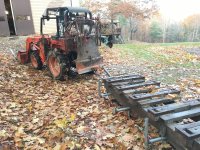
My ever faithful, 2003, Mahindra 2615 in action.
 

Attachments

  • 20180928_094500.jpg
    20180928_094500.jpg
    1.7 MB · Views: 220
  • 20180928_094425.jpg
    20180928_094425.jpg
    1.6 MB · Views: 259
  • 20180928_094846.jpg
    20180928_094846.jpg
    1.8 MB · Views: 376
   / Tractors and wood! Show your pics #6,664  
That's a hefty looking set of forks that you have on that!!!
 
   / Tractors and wood! Show your pics #6,665  
That's a hefty looking set of forks that you have on that!!!
Those are Rankin forks, 3,600 lb. capacity. A bit heavy for than I need for most jobs, but when lifting logs from the pile, I wouldn't want a lighter duty set. My dealer had these for $700.00.

I have them set up to go on the 3 point hitch, too.
 
   / Tractors and wood! Show your pics #6,666  
I have the least expensive Titan brand. They aren't bad for the price but way too narrow for piling up tree length wood. I may mount the forks in my bucket and use the backing plate for something else.
 
   / Tractors and wood! Show your pics #6,667  
When I worked for the NYS Park commission I watched a coworker do some stuff with trees that seemed to defy gravity, logic, & physics. He was a true technician, he would walk out, stand in a specific location draw a line in the dirt with his boot, & say, "the top is landing here." & Everytime he nailed it, not just direction, but distance within about a foot. No tape, no inverted pans of water, just a great eye. I didn't get to work with him often enough to get all his tricks, but I sure payed attention when we did. I saw him do what you speak of, but it looked like wizzardry, not something I'd try unless I was far in the woods, & had something very solid to run behind!

I just love watching somebody who is so good at what they do that they make everything look easy. It does not matter what they are doing - it is just second nature to them.
 
   / Tractors and wood! Show your pics #6,668  
When I worked for the NYS Park commission I watched a coworker do some stuff with trees that seemed to defy gravity, logic, & physics. He was a true technician, he would walk out, stand in a specific location draw a line in the dirt with his boot, & say, "the top is landing here." & Everytime he nailed it, not just direction, but distance within about a foot. No tape, no inverted pans of water, just a great eye. I didn't get to work with him often enough to get all his tricks, but I sure payed attention when we did. I saw him do what you speak of, but it looked like wizzardry, not something I'd try unless I was far in the woods, & had something very solid to run behind!

OK, you got me. What's the "inverted pan of water" used for?

My favorite method for finding the height & how far out the top of the tree will land is the stick method:
  1. Find a straight stick several feet long
  2. grab stick at a point where when your arm is outstretched parallel to the ground, the length of the stick above your hand is equal to the distance from your hand to your eye (just twist your wrist back toward you to point the stick back at your face and adjust grip as needed)
  3. point the stick straight up, and back away from the tree with your arm outstretched toward the tree until the part of the stick above your hand exactly masks the tree (top of hand aligns with bottom of tree, and top of stick aligns with top of tree
  4. You are now standing at a distance from the stump equal to the height of the tree.

Other tricks/notes:
  • If you can't back up in the direction of intended fall due to obstacles or whatever, you can move in another direction and measure or pace off the resulting distance to the stump to get the length of the tree.
  • If you want to know how far a tree will reach in a direction that you can't really get to, measure using the stick method above in a direction 90˚ to the direction of intended fall. When you have completed step 4 above and are at that distance where the stick masks the tree, rotate your wrist sideways so it is parallel to the ground and make sure the free end of the stick is not slanted toward or away from you. (Basically, you are felling the stick in a plane parallel to how the tree will fall.) Line up the top of your hand with the bottom of the tree. The top of the stick will indicate the reach of the tree when on the ground.
  • If you find that "dang! that tree is just a few feet too tall to fit where I want it to drop", you can always cut a high stump. 4 feet left on the stump is 4 feet of reach the tree no longer has when it's down.
  • If the reach of that tree is critical, you probably want the tree to remain attached to the stump as long as possible - all the way to the ground, if you can. "Jumping the stump" cold be a real bummer here. You can improve the chances of it staying attached by cutting an open faced notch (so the included angle of the notch is 70˚ to 90˚ or more). Once that notch closes during the fall, the tree starts to break off from the stump. In a similar vein: the notch should be clean, both cuts meeting to form a V with no "bypass" in the cuts (bypass makes its own "mini-notch" which could cause hinge to break when that mini-notch closes.)

Disclaimer: The methods above will not guarantee that you are not going to hit your house or that nearby powerline. When done right, the stick method can give you the height of a tree rather accurately. When not done properly, the method can have significant errors. If the tree is not vertical, you will most likely not get an accurate read. Also, a lot can happen when a tree falls, terrain, obstacles, or just bad luck can cause the tree to move in unexpected ways. I use this all the time, but I'm mainly cutting in the woods. An error might mean I broke a branch off that nice apple tree I was trying to save for wildlife. If an error would mean I don't have a place to sleep that night (either because I destroyed my house, or because I got thrown out for messing up my wife's favorite something-or-other), I take other precautions or hire a pro with a lot of experience, better equipment, and good liability insurance.
 
   / Tractors and wood! Show your pics #6,669  
Well here is a big monster we have to cut. It can fall safely in the direction I am standing when I took this picture. However, I am worried that it might bounce to the left and hit the building. What I’m thinking is maybe I should chain the bottom to that big tree over to the right so that when it falls, it cannot go any farther over towards the building. View attachment 576835

I have a closer look today, and there are a lot of branches on the side where the building is. So, when it is coming down I Gotta make sure that it moves fast enough because it will fall to the left a bit. Rope attached to the trailer ball of my pick up truck should do it.
 
   / Tractors and wood! Show your pics #6,670  
Personally that close to a structure I would have a professional come in and fall it. No limb cleanup or anything, just fall it and go. Cannot cost that much if you can get someone to do a little job like that.

My thought too. Just be sure they have insurance.
 
   / Tractors and wood! Show your pics #6,671  
If you can trim branches off the side opposite of the direction you want it to fall, that helps a lot. Not always practical, but if you can do it, it changes the center of gravity of the tree in your favor drastically. I've done it many times with a pole saw from the ground.
 
   / Tractors and wood! Show your pics #6,672  
And I might be mistaken, but from that picture, it looks like about half way up the top had been broken off the tree and a branch turning into the main trunk from that point up, putting a lot of the top weight in the direction you want it to fall. Without seeing a picture from 90 degrees to the left, it looks like the weight is already in your favor.
 
   / Tractors and wood! Show your pics #6,673  
I have a closer look today, and there are a lot of branches on the side where the building is. So, when it is coming down I Gotta make sure that it moves fast enough because it will fall to the left a bit. Rope attached to the trailer ball of my pick up truck should do it.

A large tree can be "encouraged" to fall in a certain direction with a rope and pickup, but if it decides to go somewhere else, it will fling the pickup around like a toy unless the rope breaks first.

Be careful.

Bruce
 
   / Tractors and wood! Show your pics #6,674  
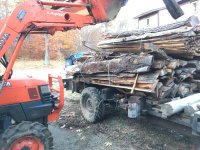
Wanted to get some slabs in so when I hooked on my trailer a small tab broke off that locks the pin in that lock the hitch in position, dont know where that piece went so I cut another piece out of old truck spring, another two hr delay. Once the hitch is locked in straight I can run a 1/2" case harden bolt through for heavy loads, the load must of caught on something a I suppose after ten years of use, metal/weld fatigue set in, bout like I get at times....
InkedIMG-1511_LI.jpg IMG-1512.JPG

Now I get to load the slabs just before dark, so now they'll be ready to cut next weekend........
IMG-1518.JPG IMG-1519.JPG IMG-1520.JPG

IMG-1524.JPG IMG-1525.JPG
 
   / Tractors and wood! Show your pics #6,675  
OK, you got me. What's the "inverted pan of water" used for?


When u was in the boy scouts, the handbook references a trick to guage the height of a tree.
1. Place a pan of water on ground away from a tree approx the distance you think it is tall. So you guess the tree is 40 feet tall, then place pan 40 feet away from tree.
2. If you are say 6 feet tall, then you stand 6 feet away from the pan of water on the opposite side of tree. So pan is between you & tree in a straight line.
3. Look into pan & the reflection will be 40 feet in air, so if you see top of tree, then tree is in fact 40 feet tall. If you see below top, then move pan back & reset. If you see over tree, then move closer to tree & reset. Once you find sweet spot, measure distance from pan to tree, that is the height of tree.
Now as you stated, this is hard to be accurate with this method, technically it's not your actual height, it's where your eyes are off ground, so 2-3 inch error here could result in being off true height of tree by feet. If it cloudy, this is useless, if the sun is directly behind the tree, you are now blind. If it's breezy, then the pan could have ripples so you can't see anything in the reflection, ground needs to be level etc... I think it was more of a lesson to try new things, maybe get us kids to think outside the box. Either way, it stuck with me for over 30 years. Still not something I'm willing to try anywhere near mine or your house. Nor do I recommend anyone to try it near theirs.
 
   / Tractors and wood! Show your pics #6,676  
OK, you got me. What's the "inverted pan of water" used for?


When u was in the boy scouts, the handbook references a trick to guage the height of a tree.
1. Place a pan of water on ground away from a tree approx the distance you think it is tall. So you guess the tree is 40 feet tall, then place pan 40 feet away from tree.
2. If you are say 6 feet tall, then you stand 6 feet away from the pan of water on the opposite side of tree. So pan is between you & tree in a straight line.
3. Look into pan & the reflection will be 40 feet in air, so if you see top of tree, then tree is in fact 40 feet tall. If you see below top, then move pan back & reset. If you see over tree, then move closer to tree & reset. Once you find sweet spot, measure distance from pan to tree, that is the height of tree.

Now as you stated, this is hard to be accurate with this method, technically it's not your actual height, it's where your eyes are off ground, so 2-3 inch error here could result in being off true height of tree by feet. If it cloudy, this is useless, if the sun is directly behind the tree, you are now blind. If it's breezy, then the pan could have ripples so you can't see anything in the reflection, ground needs to be level etc... I think it was more of a lesson to try new things, maybe get us kids to think outside the box. Either way, it stuck with me for over 30 years. Still not something I'm willing to try anywhere near mine or your house. Nor do I recommend anyone to try it near theirs.

Ingenious - never heard that one. I like John's stick method better. Easier to find a stick in the woods than a pan of clear water. :D

gg
 
   / Tractors and wood! Show your pics #6,677  
Ingenious - never heard that one. I like John's stick method better. Easier to find a stick in the woods than a pan of clear water. :D

gg

I didn't say it was practical, or easy �� but maybe it was just something the handbook authors thought up to keep kids busy while on camping trips!
 
   / Tractors and wood! Show your pics #6,678  
I didn't say it was practical, or easy �� but maybe it was just something the handbook authors thought up to keep kids busy while on camping trips!

No no - I really like it. It is based on optical physics and good old geometry. That makes it pretty neat in my book. Everyone knows physicists and mathematicians don't have to worry about being practical.

gg
 
   / Tractors and wood! Show your pics #6,679  
Stand next to the tree and put you're hand on top of your head to mark your height on the side of the tree.

Walk away from the tree a ways, face the tree and stick your arm straight out, make a fist and put your thumb straight up.

Look at the tree and move your arm so that the base of your thumb is at the base of the tree, and adjust your distance from the tree towards or away until the tip of your thumb is at the point you marked on the tree. One thumb high.

So now move your hand up so the base of your thumb is at the point where your head was on the trunk and look at where the tip of your thumb is now. Two thumbs high. Repeat up the tree and count how many thumbs it takes to get to the top. 8.5 thumbs high, for example.

We all know our approximate height. I'm a convenient 6' tall, so 8.5 thumbs times 6' = 51' high. Piece of cake. :thumbsup:
 
   / Tractors and wood! Show your pics #6,680  
If you can trim branches off the side opposite of the direction you want it to fall, that helps a lot. Not always practical, but if you can do it, it changes the center of gravity of the tree in your favor drastically. I've done it many times with a pole saw from the ground.

On a tree that size a pole saw is not going to up proportionally very high.
 

Marketplace Items

2018 MACK CHU613 (INOPERABLE) (A58214)
2018 MACK CHU613...
Alamo SHD96 Flail Mower
Alamo SHD96 Flail...
2017 Toro Sand Pro 5040 Bunker Rake (A59228)
2017 Toro Sand Pro...
WOODS 9021 BATWING MOWER (A60430)
WOODS 9021 BATWING...
2000 Thomas Built Saf-T-Liner Transit Passenger Bus (A59230)
2000 Thomas Built...
2020 PETERBILT 567 (A58214)
2020 PETERBILT 567...
 
Top