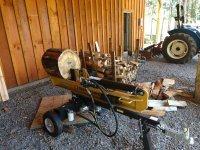
Tractors and wood! Show your pics

   / Tractors and wood! Show your pics #6,641  
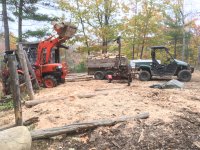
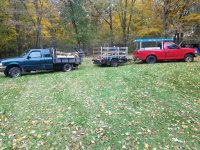
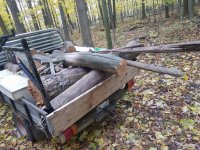
No tractors yet in the woods but I figured I would show off our loads.

The ranger is all from one dead elm tree and trailer is a mix of ash and cherry. Would have loaded the trailer more but was in a wet spot and truck is only 2wd and frame is not great. Had one more load earlier in the ranger and a ranger bed as a trailer but no pictures. Chainsaw got dull and didnt have the right file and the other chainsaw snapped a chain. 20181027_161458.jpeg20181027_161315.jpeg
 
   / Tractors and wood! Show your pics #6,642  
I manage to get some extra firewood in this past weekend, had to work between the rain drops, one load for the house and 4 bundles of 4 year old sawmill slabs for the garage. I'll work up the slab next Saturday between raindrops and deer hunting, where did all this rainy weather come from lately.............
IMG-1485.JPG IMG-1487.JPG
 
   / Tractors and wood! Show your pics #6,643  
Are those slabs all cedar? There's nothing better to make a hot fire quick on a cold morning. :thumbsup:
 
   / Tractors and wood! Show your pics #6,644  
That is interesting - never realized the strong distinction between White and Grey. If you blow up this picture and look at all the birch you see to me what I have is all White Birch but I am never sure.

View attachment 576307

gg

Ok now from where I'm sitting those two standing trees look like white birch to me. John Mc and Jstpssng describes the trees in better english then I could of what I go by, probably ex school teachers.
 
   / Tractors and wood! Show your pics #6,645  
No, but I've explained the difference to a lot of timber cruisers over the years... and also have split a lot of each for firewood.
 
   / Tractors and wood! Show your pics #6,646  
Mr. Gould - educate me on a Swinging Dutchman please! I値l google it in the meantime!

If I understand it properly, It's a technique used to start a tree falling in one direction, then get it to redirect to another direction during the fall (usually in some direction other than the original lean). It can be useful if you need to get your tree around the crown of a nearby tree, but don't want it to land in that starting direction (and smash some other tree which is standing there).

I've never learned to do it myself. I'd like to learn, mostly because I'm curious. I've been told it's not something you want to learn just by experimenting on your own (there is a reason OSHA considers the Swinging Dutchman an unacceptable practice). It's best to have someone who really knows what they are doing show you. I'm not saying don't do it, or trying to tell someone who really knows what they are doing to give up the practice. It has its place and can be handy at times. I usually just figure out some other way to solve the problem.

If you look in the diagram of the link above, that single saw kerf is one of the keys: The tree starts to fall in one direction. When that kerf closes, it tends to bump the tree over in another direction. The hinge is generally tapered: narrower on the side where that extra saw kerf was cut. This encourages that side of the hinge to break, allowing the tree to move in the new direction. (Gordon, did I get that description right?)

A related cut is the "Soft Dutchman". I've only seen it done once. It required the faller to spend way too much time at the stump after the tree started moving for my taste. I prefer to get out of there once the tree is in motion. I don't think the same is the case for the Swinging Dutchman: I think you can set it up and get out when the tree start to move, but I'll defer to Gordon on this (and maybe someday I'll get up his way and get him to show me how it's done in person. I tend not to trust YouTube videos on this stuff: if you don't already know the technique, how do you know you are choosing a good video from which to learn?)
 
   / Tractors and wood! Show your pics #6,647  
Thank you John for taking the time to explain in detail about the cut. I did look it up and like you - I’m curious and would like to see it done in person. My time with a chainsaw has been limited to cleanup after a storm primarily so I enjoy these logging terms I see frequently see on tbn. I have never been in a situation or need to have a tree maneuver in such a way. It just needed to miss something and there has always been room for a rope tied to a truck for the needed persuasion.

Thank you again and good morning!
 
   / Tractors and wood! Show your pics #6,648  
Thank you John for taking the time to explain in detail about the cut. I did look it up and like you - I’m curious and would like to see it done in person. My time with a chainsaw has been limited to cleanup after a storm primarily so I enjoy these logging terms I see frequently see on tbn. I have never been in a situation or need to have a tree maneuver in such a way. It just needed to miss something and there has always been room for a rope tied to a truck for the needed persuasion.

Thank you again and good morning!

Unfortunately, there doesn't seem to be anyone offering it in your area, but if you get the chance, I highly recommend looking in to the Game of Logging classes. It focuses on felling trees safely and efficiently, including getting them to fall in directions other than what they "want" to go. The classes progress into dealing with more and more difficult situations (in my level 4 class, we spent the day intentionally hanging up trees, then getting them free using a wide variety of techniques.) We have a great group instructing these classes here in Vermont. There are others offering GOL training, but most seem to be concentrated in the Northeast.

Tim Ard of Forest Applications Training offers similar training.. I have no personal experience with him, just read a bit about what he does. He was formerly a partner in the Game of Logging organization. He seems to be mainly in the Southeast, but does travel.
 
   / Tractors and wood! Show your pics #6,649  
That sounds pretty interesting. I appreciate that! Something to look into!
 
   / Tractors and wood! Show your pics #6,650  
Thank you John for taking the time to explain in detail about the cut. I did look it up and like you - I’m curious and would like to see it done in person. My time with a chainsaw has been limited to cleanup after a storm primarily so I enjoy these logging terms I see frequently see on tbn. I have never been in a situation or need to have a tree maneuver in such a way. It just needed to miss something and there has always been room for a rope tied to a truck for the needed persuasion.

Thank you again and good morning!

Thank you John - you did good. SplitHoof, Your rope method or a winch is the safest way to handle a tree that leans like that. I used the dutchman because from my experience and judgement on that particular tree I considered it a safe and easier way to fell it.

I will add to Johns description of how it works and differs from a fall that is directed by a full hinge across the stump. Imagine a tree like that one that rises at a slant and then the top droops a little so the tree is shaped like an upside down lazy J at a slant. If you fell that tree 90 degrees to it's lean by making a notch, boring the back cut while leaving a nice strong hinge to hold the side weight, and then pulled it over with a rope or wedged it over ( which might be tough with the fat hinge required to hold it safely ) you would find that the tree on the ground looks like a J laying on it's side. And, as it fell the curve of the J would carve in a wide swath as it went down.

With the Dutchman it is different. Basicly and simplified - the holding wood, not really a hinge, is left heavy on the back to hold the lean. On the lean side there is an open saw kerf where the hinge would normally be. As you make the back cut the holding wood weakens and the lean causes the the kerf to close. Once that kerf is closed tight the tree cannot tip into the lean anymore as long as the holding wood can hold it. Instead it starts to twist so the tree rotates. The butt almost slides down the open Humboldt face cut. You cut carefully watching the twist. As it twists around to where you want it you time the cut so the thees stops twisting and falls at the right spot. So now when you look at the tree on the ground instead of a J on it's side it is a tipped over J with the humped part up and the lower point into the ground. And instead of cutting a wide swath the with of the J as it fell it pretty much falls in line because it rotated around.

gg
 
   / Tractors and wood! Show your pics #6,651  
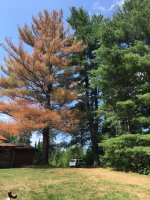
Well here is a big monster we have to cut. It can fall safely in the direction I am standing when I took this picture. However, I am worried that it might bounce to the left and hit the building. What I’m thinking is maybe I should chain the bottom to that big tree over to the right so that when it falls, it cannot go any farther over towards the building. IMG_9713.JPG
 
   / Tractors and wood! Show your pics #6,652  
... With the Dutchman it is different. Basicly and simplified - the holding wood, not really a hinge, is left heavy on the back to hold the lean. On the lean side there is an open saw kerf where the hinge would normally be. As you make the back cut the holding wood weakens and the lean causes the the kerf to close. Once that kerf is closed tight the tree cannot tip into the lean anymore as long as the holding wood can hold it. Instead it starts to twist so the tree rotates. The butt almost slides down the open Humboldt face cut. You cut carefully watching the twist. As it twists around to where you want it you time the cut so the thees stops twisting and falls at the right spot. So now when you look at the tree on the ground instead of a J on it's side it is a tipped over J with the humped part up and the lower point into the ground. And instead of cutting a wide swath the with of the J as it fell it pretty much falls in line because it rotated around.

gg

That last paragraph describes why it is that OSHA does not like this method: "You cut carefully watching the twist. As it twists around to where you want it you time the cut so the thees stops twisting and falls at the right spot." Doing this requires remaining at the stump as the tree is falling. OSHA really wants to see the faller get the heck out of there as soon as the tree starts to move. Logging is a dangerous past time, and most injuries happen within about 15 feet of the stump (I wish I could remember where I read that). The technique is wonderful in the hands of someone who really knows what they are doing and is alert and "firing on all cylinders". I have a lot of respect for folks who can do it right. It's also why I urge people who want to learn advanced cuts such as this to do it live & in person with someone experienced at it, don't just watch a YouTube video by someone whose background you don't know and assume you've got all you need to do it right. (For things like this, I don't even trust a YouTube video form someone I know is a very good at what they are doing. There is too much you just can't see/sense in a video as compared to real life.)
 
   / Tractors and wood! Show your pics #6,653  
That last paragraph describes why it is that OSHA does not like this method: "You cut carefully watching the twist. As it twists around to where you want it you time the cut so the thees stops twisting and falls at the right spot." Doing this requires remaining at the stump as the tree is falling. OSHA really wants to see the faller get the heck out of there as soon as the tree starts to move. Logging is a dangerous past time, and most injuries happen within about 15 feet of the stump (I wish I could remember where I read that). The technique is wonderful in the hands of someone who really knows what they are doing and is alert and "firing on all cylinders". I have a lot of respect for folks who can do it right. It's also why I urge people who want to learn advanced cuts such as this to do it live & in person with someone experienced at it, don't just watch a YouTube video by someone whose background you don't know and assume you've got all you need to do it right. (For things like this, I don't even trust a YouTube video form someone I know is a very good at what they are doing. There is too much you just can't see/sense in a video as compared to real life.)

Your entire statement is 100% good advise John. I agree.

gg
 
   / Tractors and wood! Show your pics #6,654  
When I worked for the NYS Park commission I watched a coworker do some stuff with trees that seemed to defy gravity, logic, & physics. He was a true technician, he would walk out, stand in a specific location draw a line in the dirt with his boot, & say, "the top is landing here." & Everytime he nailed it, not just direction, but distance within about a foot. No tape, no inverted pans of water, just a great eye. I didn't get to work with him often enough to get all his tricks, but I sure payed attention when we did. I saw him do what you speak of, but it looked like wizzardry, not something I'd try unless I was far in the woods, & had something very solid to run behind!
 
   / Tractors and wood! Show your pics #6,655  
She ain't gonna bounce,just cut it down.
 
   / Tractors and wood! Show your pics #6,656  
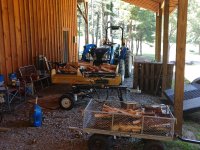
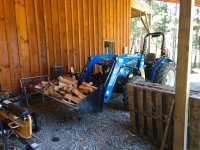
I have been wanting to post on this thread for quite some time. I had the opportunity to work with my parents over this past summer seeing that I am a teacher I have several weeks off. Part of my responsibilities were using my dad's New Holland WorkMaster 50 to collect split with his new log splitter and stack firewood that we have been drying for years. I look forward to sitting by the new wood stove this winter knowing that I put many hard hours in that wood that is now making me warmIMG_20180703_145352217.jpegIMG_20180703_145408442.jpegIMG_20180703_145320107.jpegIMG_20180616_201324617.jpegIMG_20180623_123754326.jpeg
 
   / Tractors and wood! Show your pics #6,657  
Are those slabs all cedar? There's nothing better to make a hot fire quick on a cold morning. :thumbsup:

No mostly hemlock slabs. My son puts cedar slabs in separate bundles, some are cedar shingle length, most people like buying the pre cut length cedar slabs. The rest are log length cedar slabs, and for the past 3 years he's been heating his house on cedar buttons and shingle length slabs, one of the ways he gets rid of so much by-product.
 
   / Tractors and wood! Show your pics #6,658  
Well here is a big monster we have to cut. It can fall safely in the direction I am standing when I took this picture. However, I am worried that it might bounce to the left and hit the building. What I’m thinking is maybe I should chain the bottom to that big tree over to the right so that when it falls, it cannot go any farther over towards the building. View attachment 576835

Yep sure looks like that tree should come down, looks deader then a door nail. Probably a good idea to chain it, sometimes when tree falls and has big limbs those limbs could throw it, chain cut and run but before that set the video camera up I like seeing big trees fall.
 
   / Tractors and wood! Show your pics #6,659  
John and Gordon, thanks to you both for the responses! I read through your words and was trying to picture staying that close to the tree when it starts moving to continue your cut - And while I would to see it done, I don’t think I want to be that person!

Good info and thank you again!
 
   / Tractors and wood! Show your pics #6,660  
Personally that close to a structure I would have a professional come in and fall it. No limb cleanup or anything, just fall it and go. Cannot cost that much if you can get someone to do a little job like that.
 

Marketplace Items

2013 ORTEQ ENERGY GN182 GOOSENECK HOSE TRAILER (A58214)
2013 ORTEQ ENERGY...
2010 MAXEY WELDING 20 T/A GOOSENECK TRAILER (A55745)
2010 MAXEY WELDING...
ANTHONY CARTS 94LFW-24 OXY/ACCELYNE TANK CART (A60432)
ANTHONY CARTS...
MARATHON 20KW GENERATOR (A55745)
MARATHON 20KW...
12' CONTAINER (A60432)
500 BBL WHEELED FRAC TANK (A55745)
500 BBL WHEELED...
 
Top