YM240D front axle leak repair progress post

/ YM240D front axle leak repair progress post #1  

oksanaut

Member
Joined
May 21, 2018
Messages
33
Location
Upper Nevada Triangle
Tractor
Yanmar YM155D, Yanmar YM240D
Got a YM240D with FEL over a month ago - it looked very used, but worked great, and I really did not want to pass on a green one. I have been asking questions in another, more specific, topic, and figured I'd share overall progress here.

The 240 came with a long list of issues and, from lurking on the forum, I figured I could try to fix them (worst case scenario, I thought, I'd tow it to a nearby shop). I started with the worst problem on the tractor - wobbly and very leaky front end. Having the help I have got so far on the forum is very helpful and encouraging as the most mechanical experience I have had previously was working on old German cars 15 years ago.

It also came with an I&T manual, but I liked the original parts and service manuals that the YM155D came with, so I found those on eBay. Once I got the Service Manual, I realized that it doesn't cover 4WD front end at all, and I&T felt a little too condensed for me. I found a drivetrain manual, but have not received it yet - hopefully it will teach me some secrets not covered in the library I collected.

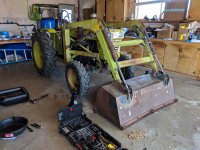
Here, in the garage, it looks a little bruised but in general nice and dry.
IMG_20180609_115950.jpg

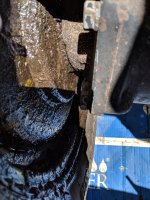
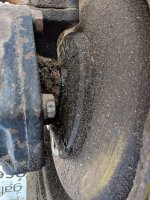
The inner side of the wheels:
IMG_20180603_140534.jpgIMG_20180603_140526.jpg

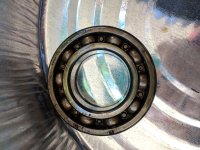
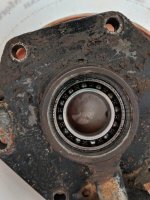
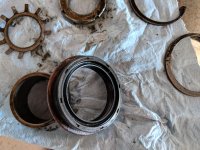
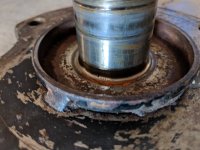
I preemptively got some parts based on the parts diagram and tried to deduce how to take apart those hubs. PO probably did not realize that the front axle had three separate reservoirs and only checked level in the center because very little oil drained out of the knuckles (I've only had the tractor for 2 weeks prior to putting it on the stands). Not knowing that the knuckle comes out all at once and comes together like a puzzle, I did not order enough replacement seals/gaskets. Good thing that Hoye's shipments always make it in by Friday. :D While waiting we tried to clean up the parts and make sense of what we saw.
IMG_20180616_094140.jpg
IMG_20180610_094618.jpg
IMG_20180610_094627.jpg
IMG_20180610_094742.jpg
IMG_20180610_094801.jpg
IMG_20180609_162804.jpg

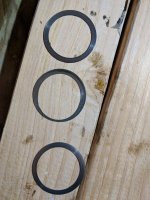
The unusual wear in the shims seemed very wrong, I posted about it, and there was a very insightful discussion here: http://www.tractorbynet.com/forums/yanmar/397659-ym240d-front-axle-shim-wear.html . So based on what I learned in that thread, I thought that I probably will need to re-measure and add more shims. I decided to do this without the knuckle body to get a nice clear view of how things were meshing together.

I cleaned up, painted, and re-assembled the knuckle cover with the stub axle to see how the gears are aligning (thanks to encouragement and advice from rScotty, winston1)
IMG_20180617_170842.jpg
IMG_20180617_162231.jpg

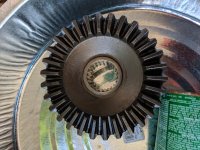
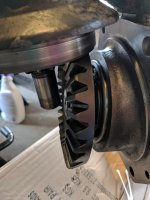
Here is the result of trying to figure out how mechanic's dye works. Not quite sure how to read this yet, to me it appears that the vertical gear could be closer, ie need more shims.
IMG_20180617_162714.jpg

And cleaned up/started on the other side (this used to be a ball of oily dirt):
IMG_20180617_170904_1.jpg

Will post an update when I am back at it (probably next weekend).

Advice, comments, all appreciated! Thank you
 
/ YM240D front axle leak repair progress post #2  
What was the backlash when you assembled and put on bluing?
 
/ YM240D front axle leak repair progress post #3  
I would not be too concerned with backlash at the low speeds you are going to be using it, . Minimal backlash but free-turning is perfect. (Snug but free).
 
/ YM240D front axle leak repair progress post
  • Thread Starter
#4  
What was the backlash when you assembled and put on bluing?

I don't have a measurement I am comfortable with to share. Seemed very loose, I could rotate a few degrees before I heard a "click". What do you think?
 
/ YM240D front axle leak repair progress post #5  
I would tighten it up a bit.
 
/ YM240D front axle leak repair progress post #7  
Looking at your photos reminds me that I never did have good luck with that type of grease-based mechanic's dye. It was always too little, too much, or too difficult.

I prefer to use something similar but non-greasey. Something that dries fast, leaving a very thin coating easily rubbed away. My favorite is Dykem brand blue layout dye. It is basically blue dye in an acetone base. Dries in less than a minute, runs everywhere, and permanently dyes anything it touches. It rubs away easily. I find it easier to "read".

As a cheaper and more controllable alternative I've also used black or blue felt tipped pens. Give it a try.

Do any of your shop manuals show the typical wear patterns for bevel gear engagement? Some Yanmar manuals did, others did not.

If the backlash is a couple of degrees, that will work too. If you can set up a degree wheel you could convert degrees into thousanths of inches. It's doable, though dial indicator would be more accurate. I agree that what you are looking for mainly is to have some clearance and no binding - but if you can accomplish that while also putting the gear tooth torque onto the proper part of the gear then why not do it?
rScotty
 
Last edited:
/ YM240D front axle leak repair progress post #8  
" I agree that what you are looking for mainly is to have some clearance and no binding"

In the cash register biz we called that "snug but free":)
.
 
/ YM240D front axle leak repair progress post
  • Thread Starter
#9  
Looking at your photos reminds me that I never did have good luck with that type of grease-based mechanic's dye. It was always too little, too much, or too difficult.

I prefer to use something similar but non-greasey. Something that dries fast, leaving a very thin coating easily rubbed away. My favorite is Dykem brand blue layout dye. It is basically blue dye in an acetone base. Dries in less than a minute, runs everywhere, and permanently dyes anything it touches. It rubs away easily. I find it easier to "read".

As a cheaper and more controllable alternative I've also used black or blue felt tipped pens. Give it a try.

Do any of your shop manuals show the typical wear patterns for bevel gear engagement? Some Yanmar manuals did, others did not.

If the backlash is a couple of degrees, that will work too. If you can set up a degree wheel you could convert degrees into thousanths of inches. It's doable, though dial indicator would be more accurate. I agree that what you are looking for mainly is to have some clearance and no binding - but if you can accomplish that while also putting the gear tooth torque onto the proper part of the gear then why not do it?
rScotty

Heh, I had similar feelings about prussian blue. Found and ordered Dykem on Amazon, should come by Friday.

I noted that I need proper tools, but... researching how to use dial indicator on this type of gear and how to use it to measure backlash caused more confusion rather than clarified things for me. :confused::confused::confused: Any pointers/youtube videos/articles with good visuals are appreciated.

My shop manual has illustrations for this type of gear, but not in a section about front end (I also don't have that section in my service manual). It talks about things being too close or too far, but I didn't know how to use the dye correctly until I read How to Set up Your Rear Gear Correctly – RacingJunk News a few days later, so I did not quite grasp the meaning of what I saw at the time. This weekend we try again :D
 
/ YM240D front axle leak repair progress post #10  
Since you are going to be checking your backlash with the housing put together here is how I would do it. I would put a bolt in one of the stub axle holes that the wheel bolts to. That should be the appx diameter of the front drive gear. With your indicator fastened to housing with magnet base, c-clamp or whatever, then put the point of the indicator against the installed bolt. You can then measure the movement back and forth while feeling the gear contact. You need to be measuring at a distance close to the diameter of the front drive gear. Anything further will give a larger reading, anything closer will give a smaller reading. Hope this makes some sense to you.
 
/ YM240D front axle leak repair progress post
  • Thread Starter
#11  
Since you are going to be checking your backlash with the housing put together here is how I would do it. I would put a bolt in one of the stub axle holes that the wheel bolts to. That should be the appx diameter of the front drive gear. With your indicator fastened to housing with magnet base, c-clamp or whatever, then put the point of the indicator against the installed bolt. You can then measure the movement back and forth while feeling the gear contact. You need to be measuring at a distance close to the diameter of the front drive gear. Anything further will give a larger reading, anything closer will give a smaller reading. Hope this makes some sense to you.

Do you not recommend checking backlash with the housing off? (it is currently assembled with the housing off)
 
/ YM240D front axle leak repair progress post #12  
I guess I am lost here. I thought everything was assembled except the stub axle. What gears are you wanting to check backlash on?

Back again, I am not sure you would get an accurate backlash reading without the lower front gear case being installed. The spindle shaft would not be located in the bottom bearing and just to much possibility of something moving. I am not there and have never done this, only stating what I feel based on drawings and lifes experiences. I am going to look in my I&T manual to see if I am missing something.

And again. The I&T manual is certainly not detailed in the procedure. If you feel the spindle shaft and stub shaft are held ridged enough without the lower front gear case installed then you can use the outer perimeter of the stub shaft gear to put your indicator against. I&T calls for .004 to .006".
 
Last edited:
/ YM240D front axle leak repair progress post #13  
Heh, I had similar feelings about prussian blue. Found and ordered Dykem on Amazon, should come by Friday.

I noted that I need proper tools, but... researching how to use dial indicator on this type of gear and how to use it to measure backlash caused more confusion rather than clarified things for me. :confused::confused::confused: Any pointers/youtube videos/articles with good visuals are appreciated.

My shop manual has illustrations for this type of gear, but not in a section about front end (I also don't have that section in my service manual). It talks about things being too close or too far, but I didn't know how to use the dye correctly until I read How to Set up Your Rear Gear Correctly RacingJunk News a few days later, so I did not quite grasp the meaning of what I saw at the time. This weekend we try again :D

OK. You're progressing on the dyes, that's good.
Dial indicators measure small movements of at the end of an arm by transmitting that movement via gears and shafts to a clockface dial. Hence the name.
Generally the dial indicator is mounted rigidly to something like a table or vise and the moveable arm placed against what is to be measured
There are two types of dial indicators, which one you use depends on what kind of motion you are measuring and how you can get set up to measure it.

The first type has a has a spring-loaded telescoping rod that reports movement of the tip of the rod toward or away from the dial face. I think that is the type in your video. It typically has a range of several inches and will measure in resolutions of thousanths of an inch = .001. It is commonly used in mechanical shops. To use it on a gear you might tape of glue some little piece of metal to the outer edge of the larger gear and rest the tip of the rod against it. Or maybe reach down with the tip and try to put it directly on the curved surface of the bevel gear. Is that what they are doing in the video? How weird if true. I can't tell what they are thinking they are doing in that video!!


The other type of dial indicator has a rigid (not telescoping) rod, but at the tip of that rod is another much smaller arm set a an adjustable angle to the rod. It reports movement of that smaller arm. In general, this type can fit in more places than the first telescoping type, but has a smaller range of motion. It will typically measure a full scale of less than a tenth of an inch in units such as +/- .015" or sometimes +/-.030" or +/- .050. But the resolution can be as small as in tenths of thousanths of an inch = .0001"
This type of dial indicator is more likely to be found in a machine shop instead of an mechanic's shop. It is actually more versatile in how you can use it, but delicate to set up.

Both types of dial indicator are commonly mounted to a magnetic base that is clamped onto any convenient piece of steel. Older types used C clamps.

That reminds me that when measuring backlash you need to figure out just where the shop manual wants you to measure that backlash. You are actually measuring rotational degrees - just as you mentioned previously. How many inches those rotational degrees span can be a function of how far away the tip of the dial indicator is away from the gear faces themselves. If the shop manual say backlash of only a few thou, it is probably right at the gear faces themselves. In that case, set the shims for the right dye pattern and double check that by doing just what everyone has said: give it some clearance, definitely not tight at all, and don't give it sloppy clearance. No need for the dial indicator in that case unless you just want to get one and play with it.
luck,
rScotty
 
/ YM240D front axle leak repair progress post #14  
Here is a selection of mechanical dial gauges for precision measurement and setting up backlash. One tends to accumulate these things. Today most measurement is via laser. These old mechanical style gauges last forever and with luck can be picked up cheap at used tool stores. I bought these in the 1960s - and most were used at the time.

As several others here have posted, after you have set up a few things you will get used to the "feel" of backlash and then the dial gauges become almost superfluous. One simply substitutes feel for measurement - as in "some play, but not too much". For the experienced person that says it all. But I still like to use dye to confirm that the engagement of the gears is roughly across the center of the mating teeth. The shop manuals and that video you posted show examples of tooth engagement. It's an art as well as a science.
rScotty
 

Attachments

  • IMG_8433.JPG
    IMG_8433.JPG
    637.8 KB · Views: 117
/ YM240D front axle leak repair progress post
  • Thread Starter
#15  
I guess I am lost here. I thought everything was assembled except the stub axle. What gears are you wanting to check backlash on?

Back again, I am not sure you would get an accurate backlash reading without the lower front gear case being installed. The spindle shaft would not be located in the bottom bearing and just to much possibility of something moving. I am not there and have never done this, only stating what I feel based on drawings and lifes experiences. I am going to look in my I&T manual to see if I am missing something.

And again. The I&T manual is certainly not detailed in the procedure. If you feed the spindle shaft and stub shaft are held ridged enough without the lower front gear case installed then you can use the outer perimeter of the stub shaft gear to put your indicator against. I&T calls for .004 to .006".

Trying to check the backlash on the gear on stub axle. Didn't take the entire front end apart as the rest of that area appears ok/untouched.

I assembled everything on the stub axle with housing cover, and attached the without the knuckle housing. Stuff (gear, shims, bearing, spacers) on the stub axle + the housing cover (bearings, seal) seems to be firmly held in place by the axle nut. In this stage, I will try to get it close. Then put the whole thing together, re-measure the backlash and adjust if necessary. I don't want to keep disassembling and re-assembling the gear case, and I think this approach will minimize that.
 
/ YM240D front axle leak repair progress post #16  
Good plan. :thumbsup:
 
/ YM240D front axle leak repair progress post
  • Thread Starter
#17  
So, I am back!

And just realized that there were 4 shims on each side (2 were very stuck together): 2 x 0.2mm and 2 x 0.3mm. That added up to 1mm!! And still left what feels like a lot of backlash (still don't have a tool or correct service manual with directions to measure this properly). I have a plethora of shim choices now, so I am wondering if adding (a theoretical number) enough shims to add up to 2mm sounds reasonable?
 
/ YM240D front axle leak repair progress post #18  
Without seeing or feeling the backlash I have no idea. Just add some and see what happens, may have to do this several times.
 
/ YM240D front axle leak repair progress post #19  
So, I am back!

And just realized that there were 4 shims on each side (2 were very stuck together): 2 x 0.2mm and 2 x 0.3mm. That added up to 1mm!! And still left what feels like a lot of backlash (still don't have a tool or correct service manual with directions to measure this properly). I have a plethora of shim choices now, so I am wondering if adding (a theoretical number) enough shims to add up to 2mm sounds reasonable?

I think that 2 mm is reasonable. As Winston say, you may have to assemble it many times. Shims don't have any upper limit, they just gradually become known as "parallel face ground washers" as they get thicker. But I've seen them considered as "shims" all the way up to about a quarter inch (6mm) thickness. Basically I would shim to whatever it takes for the engagement backlash to be loose ... but small.

I like to think of the thickness (width) of the ball bearing shell itself as being part of the shim thickness - and it's a pretty thick shim itself, often being in the 15 to 20 mm range. Designers use bearing width as part of the shim calculation since bearing width is very, very flat & consistent.

Don't forget any paper gasket thinkness. Thin paper gaskets can be as thin as .1mm thickness (.004") and the thick black fiber gaskets with the punched out holes can easily be .5mm (.020"). Hmm... Are there any paper gaskets in there? I've forgotten just what combination of gaskets and seals Yanmar used.
Maybe it's time to think about gasket goo, though.

It would be interesting to track how the sealing of that bevel gear front axle has evolved from the time that Yanmar first brought it out as a Yanmar exclusive - until today when it is the type of front steering axle used by most every 4wd tractor on the market.
luck, rScotty
 
/ YM240D front axle leak repair progress post #20  
Anything other than "snug but free" is serious overkill, when considering a maximum speed of 7-8 mph. Backlash is mostly concerning "whine" at speed.
 
 
Top