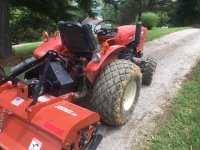
YM276D located and in garage

/ YM276D located and in garage #1  

richriddle

Gold Member
Joined
Feb 6, 2017
Messages
263
Location
Taylorsport, Kentucky
Tractor
Kubota L4330 with LA853 Loader, Yanmar YM276D with YFL1000 Loader, Yanmar YM276D, Yanmar YM147D, Case 1845C
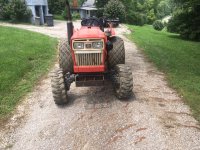
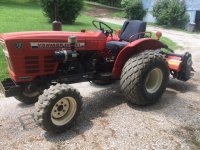
You folks provided a lot of information and suggestions for slightly larger Yanmar tractors. After all the information, I decided to stay with the American models and found a YM276D that can sit in the garage for a while. It's been well used and seems to have a lot of outdoor time based on the faded paint but it runs great. Terrible pictures are better than nothing.
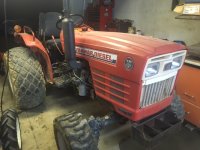
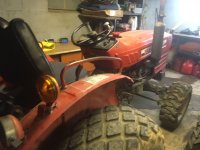
YM276D Front.jpg YM276D Side.JPG
 
/ YM276D located and in garage #2  
Nice looking ride. Interesting turfs rear, ags front.
 
/ YM276D located and in garage #3  
You folks provided a lot of information and suggestions for slightly larger Yanmar tractors. After all the information, I decided to stay with the American models and found a YM276D that can sit in the garage for a while. It's been well used and seems to have a lot of outdoor time based on the faded paint but it runs great. ]

Nice tractor. Do you have any particular questions? I've a lot of literature from "back in the day". When the oriental - mostly Japanese - tractors started coming into the US, Yanmar was by far the technical leader. Those old models still represent some of the best engineering.

Those tires are interesting. Looks like the OEM rears and some sort of replacement fronts. You should make every effort to keep the Front to Rear
rolling circumference ratio (tires) within strict limits compared with the front and rear axle ratios. Keeping the ratios right will really reduce the wear on the 4WD.

At one time I wrote a lot on this - and other Yanmar subjects - mostly for the Yanmartractorownersgroup@yahoo.com.
luck,
rScotty
 
/ YM276D located and in garage
  • Thread Starter
#5  
Both of the tires are set up on the turf sized wheels/rims. The seller indicated the front tires are "industrial" and the rears are turf. I just purchased ag wheels/rims for the YM147 and love them. I might look up a set of new tires for this tractor and prefer the ag type.

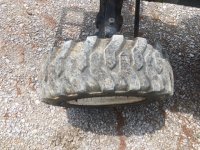
Upon further review those "industrial tires" are skid steer tires.
 
/ YM276D located and in garage #6  
If you don't have it and are interested pm me with your email address and I will send you something showing original tire and wheel size choices.
 
/ YM276D located and in garage
  • Thread Starter
#7  
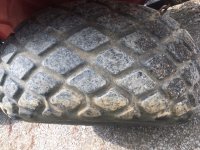
Here are some pictures that better illustrate the condition and the tires on the tractor at this time.

Front Tire.JPG
This the front tire.
Back Tire.JPG
That is the back tire.

Here are general pictures.

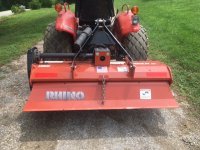
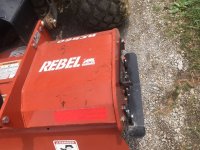
Front.JPG Side.jpg Back.JPG Rear.JPG Rhino.JPG

As you can see, it has a Rhino gear-driven tiller. Some think it's a superior style compared to the older Yanmar chain models.
 
/ YM276D located and in garage #8  
Both of the tires are set up on the turf sized wheels/rims. The seller indicated the front tires are "industrial" and the rears are turf. I just purchased ag wheels/rims for the YM147 and love them. I might look up a set of new tires for this tractor and prefer the ag type.

Upon further review those "industrial tires" are skid steer tires.

So I guess you know that Turf and Ag tires require different rims. Almost all of the original Yanmars were sold with the Ag rims an tires - which are more available and a lot less expensive than the turfs. The big advantage to turfs - other than low psi to the ground - lies in their width and stability. Especially noticible with a loader.
If you have room to store them, consider keeping the turfs. You can always sell a set of turfs on rims because they are rare & hard to find used. Tractor tire shops will try to talk you out of the old ones because new turf rims are pretty expensive and new rear turf tires in any condition are ridiculously expensive.
Turf tires for the front of that tractor are much easier on the pocket book. Not hard to find, and generally less expensive than skid steer tires.
You can look up the original tires - either turf or ags - and by comparing manufacturers specs on "rolling circumference" come up with a pretty good idea if the skid steer tires are something you want to keep.

I'll look around and see what kind of old YM276 literature I have, if any.
rScotty
 
/ YM276D located and in garage #9  
I don't think it hs been emphasized enough yet - you have to get the front/rear ratio of rolling circumference right or you will put extreme stress on the driveline. With those dissimilar tires, its not clear that your prior owner got this right.

There's a photo here showing the difference in height (difference in circumference would be 3x that) I found comparing what should have been on my little Yanmar, and what was actually mounted when I bought it. You could see the front end clawing its way forward trying to exceed the distance travelled compared to the rear when it was in 4x4. After buying the correct tires I never see this 'clawing' behavior.

You can mark the tires and experiment driving one side on wax paper or something to see if the front is trying to lead or drag relative to the rear.
 
/ YM276D located and in garage #10  
As you can see, it has a Rhino gear-driven tiller. Some think it's a superior style compared to the older Yanmar chain models.
That tiller may well be preferable in our typical application here. It should till ordinary ground to small clods with air space in between which is better for growing, while the (Japanese import) Yanmar tillers were designed for muck in rice paddies. I think their action is more oriented toward slicing to break up root clumps. They definitely will till ordinary soil to a fine flour, which I think makes a seedbed more like adobe compared to what this tillers with its wide blades will do.

In terms of durability - Yanmar is probably at least equal.

Note I'm making the comparison to the rice paddy tillers that came over attached to many gray-market Yanmars, not to the US-made tillers sold by US-Yanmar dealers back in the day.
 
/ YM276D located and in garage #11  
Old Yanmar tillers came with both chain and gear driven tillers. Depends on model.
 
/ YM276D located and in garage
  • Thread Starter
#12  
If anyone has any idea which proper front tire mounts with those rear Goodyear tires, give your opinions. The tire sizes for the tractor are correct. I haven't seen any Goodyear in the 25 8.5 x 14 to match the rear. That said my initial quest for agricultural tires/rims will start. As stated earlier, those should be easier to find.
 
/ YM276D located and in garage #13  
I don't think it hs been emphasized enough yet - you have to get the front/rear ratio of rolling circumference right or you will put extreme stress on the driveline. With those dissimilar tires, its not clear that your prior owner got this right.

There's a photo here showing the difference in height (difference in circumference would be 3x that) I found comparing what should have been on my little Yanmar, and what was actually mounted when I bought it. You could see the front end clawing its way forward trying to exceed the distance travelled compared to the rear when it was in 4x4. After buying the correct tires I never see this 'clawing' behavior.

You can mark the tires and experiment driving one side on wax paper or something to see if the front is trying to lead or drag relative to the rear.

We also need to emphasize that although front to rear ratio is important - even critical - to reduce stress in 4wd mode, that doesn't apply to 2wd....there is no problem that carries over into 2wd mode.
And if you have any doubts about the tire front to rear ratio on your tractor not matching the manufactured requirements, don't worry about using the machine....just be careful not to use 4wd on high traction surfaces. If a tire can slip, like on ice or wet grass, that slippage will protect the drive train. In fact, some slippage in 4wd is necessary to protect the drive train because manufacturers deliberately build a slight mismatch into every 4wd. They mismatch it deliberately so that the front wheels will always be slightly pulling and therefore will steer instead of being pushed through a corner by by the rears.
This is another reason why you shouldn't ever be in 4wd when on high traction surfaces like paved roads even if the ratio is OEM.
So just paying attention to the tractor and the traction will do more for it than getting the ratios perfectly right.
rScotty
 
/ YM276D located and in garage #14  
Agreed, operating thoughtfully is the most important ingredient to long life of the equipment, and satisfaction to the user. But I think we give the Yanmar a fighting chance to show what it can do when we keep it in conformance to the original engineering specs.
 
/ YM276D located and in garage #15  
I found this information on tractorsdata.com. for ym276d. Ag tires rear 11.2-24/front tires 7-14. Turf rear tires 16.5-16.1.Turf front tires 25x8.5-14 . 2 wheel drive model uses something different.
 
/ YM276D located and in garage
  • Thread Starter
#16  
After a discussion with a tire store clerk who's been in the business a few decades, he explained that the "25" in the tire dimension 25/8.50x14 means that a tire will be between 25" and 25.9" in diameter depending on the tread. The 24/8.50x14 is between 24" and 24.9" in diameter.

The tires on the front of the tractor appear to be 25.75" in diameter. Does anyone have the formula for the size ratio for the front/rear for the YM276D? I can get replacement tires from about 24.5" in diameter all the way up to 25.9" in diameter. Does it really matter if it has industrial tread on the front tires since the rear tires have a deep tread? All the "turf" tires for the front have very little tread. Thank you again.
 
/ YM276D located and in garage #17  
Page 250-00-2 in repair manual states 1.638 to 1 front to rear ratio. 0% runout with 0 and 6% wear limit.

Parts manual shows different wheel and rim size options starting on figure 92. The 276 actually had the option of standard or large ag tire options.
 
Last edited:
/ YM276D located and in garage #18  
After a discussion with a tire store clerk who's been in the business a few decades, he explained that the "25" in the tire dimension 25/8.50x14 means that a tire will be between 25" and 25.9" in diameter depending on the tread. The 24/8.50x14 is between 24" and 24.9" in diameter.

The tires on the front of the tractor appear to be 25.75" in diameter. Does anyone have the formula for the size ratio for the front/rear for the YM276D? I can get replacement tires from about 24.5" in diameter all the way up to 25.9" in diameter. Does it really matter if it has industrial tread on the front tires since the rear tires have a deep tread? All the "turf" tires for the front have very little tread. Thank you again.
Your fronts @ 25.7 is getting over 1" taller. I'd get them back down to the 24" range. As long as you are in that height I wouldn't think it would really matter what thread you use.
 
/ YM276D located and in garage #19  
After a discussion with a tire store clerk who's been in the business a few decades, he explained that the "25" in the tire dimension 25/8.50x14 means that a tire will be between 25" and 25.9" in diameter depending on the tread. The 24/8.50x14 is between 24" and 24.9" in diameter.

The tires on the front of the tractor appear to be 25.75" in diameter. Does anyone have the formula for the size ratio for the front/rear for the YM276D? I can get replacement tires from about 24.5" in diameter all the way up to 25.9" in diameter. Does it really matter if it has industrial tread on the front tires since the rear tires have a deep tread? All the "turf" tires for the front have very little tread. Thank you again.

After a few decades as a tire clerk, he should have also explained that tire diameter doesn't mean very much because tires in use are round on top and flat where they contact the ground. So his information is just incorrect enough to cause you problems. Of course it is only partly his fault, the main criteria for a clerk is salesmanship, not technical knowledge. Unfortunately, it sounds like he was able to make his guesses sound believable. The critical measurement is actually the tire's "rolling circumference". The tire clerk probably has access to this information, but may not know what it means.

Anyway, the reason why simple diameter doesn't translate into rolling circumference on the ground is that the tire is round on top.... but flat where the weight of the vehicle compresses it against the ground. This is the case for any vehicle with flexible tires that carry weight. The amount of flex - and the rolling circumference - can change with weight and air pressure. However, a good average rolling circumference can be either looked up on manufacturing specs, or measured by putting a splash of paint on the tread and driving down a smooth road in a perfectly straight line. Carefully measure the distance between each set of dots that you leave behind. That average measurement is your rolling circumference.

To find the front to rear internal gear ratio is a bit harder. I've never seen that number in print. Basically it is a ratio that is set by the difference in gearing of the front and rear differentials. Obviously the design engineer has to know what he wants in order to design the differential gearing, but like I said - I've never seen the number in print. Luckily, you can measure that number by hand. It's a pain, but it is done by jacking up the tractor so the tires are off the ground, and then counting revolutions while you rotate one tire by hand. You mark one front and one rear tire and rig up a pointer. Then in 4wd you carefully slowly rotate one tire by hand while simultaneously counting how many times each tire goes around. Continue doing that until both tires return to the exact original position. You may have to rotate that tire a dozen revs to get both tires back to their exact starting position. But if you persist, then the front/rear internal gear ratio is the number of times the front tire went around compared to the number the rear tire went around.

An easier way is to be sure you have the correct original tire sizes, and then look up the manufacturer's rolling circumference for those tire sizes. It is typical for front/rear gear ratio to be between 1.05:1 and 1.1:1.

Here is a copy of specs for the YM226 & YM226D and the YM276 & YM276D. From an original sales brochure about 1983.

rScotty
 

Attachments

  • Orig SPECS_YM226&YM276_SPECS.jpg
    Orig SPECS_YM226&YM276_SPECS.jpg
    555.5 KB · Views: 136
/ YM276D located and in garage #20  
rScotty I'm continually impressed at the depth of your technical knowledge. Wow!

For those of you who didn't know - rScotty was one of the founders of this Yanmar forum.
 
 
Top