Running generators in parallel

/ Running generators in parallel #21  
Nope.
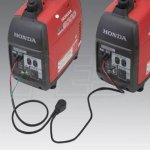
Parallel cables allow the user to obtain the full power of both units, limited by the capacity of an individual outlet. Parallel cables are available for the EU1000i, EU2000i, EU3000 Handi, EU3000i, and EU7000iS.


If you have 2 regular EU2000i or 2 EU7000iS, consider a parallel kit. The parallel kits include a built in 30A outlet (EU2000) or 50A outlet (EU7000iS), which is capable of providing the combined full power from both generators.

If you have a regular EU2000i and the Companion model, you only need a parallel cord. You will be able to use the 30A outlet on the Companion to draw the full combined power of the two units.

From what I read, the EU2000 is still only 120V with the parallel kit. You have to go up to at least a 3800 to get 240V.
 
/ Running generators in parallel #22  
In My Ice storm/ generator lessons there was some discussion of running generators in parallel which I would like to explore further.

I've seen 10KW military gens run in parallel and am familiar with the concept of the Honda gensets that run in parallel. But now there are getting to be a number of inverter generators for relatively low cost that claim to be able to parallel. The DuroMax XP2000iS 2000 Watt Digital Inverter Gas Powered Portable Generator is going for $350 and to me having 2 would be handy.

What is the experience of TBN'ers running gensets in parallel?

How easy is it?
Is Honda that much better to justify $2K versus $700 for the same capability?

That's a good price for an inverter generator.

If you buy two, you've got $700 into it. And then you'll have to find a parallel kit for that specific generator if they make one. So add another $100.

You'll end up with 4000W of 120V power, but no 240V available. So no well pump, air conditioning, heat pump, etc.... if that's important to you. ;)
 
/ Running generators in parallel
  • Thread Starter
#23  
That's a good price for an inverter generator.

If you buy two, you've got $700 into it. And then you'll have to find a parallel kit for that specific generator if they make one. So add another $100.

You'll end up with 4000W of 120V power, but no 240V available. So no well pump, air conditioning, heat pump, etc.... if that's important to you. ;)
Actually Walmart sells the parallel kit for $80 and I don't need 240 for a well pump or heat pump and I have several a/c units that run on 120V. :)
 
/ Running generators in parallel #24  
/ Running generators in parallel
  • Thread Starter
#27  
And remember the Ebay seller of the small generator, factory_authorized_outlet, is the same one that occasionally sells the Duromax Hybrid 10,000 Watt Gasoline Generator dual fuel for $650 or less, when "normal" street price is over $850 according to camelcamelcamel. So the seller might decide to unload a batch a lot cheaper.
 
Last edited:
/ Running generators in parallel #28  
Hold on there, Sparky! :laughing:

That parallel kit is for a different model generator. Will it work on the one you're looking at?
I'm betting "yes", in fact you can make your own, they aren't rocket science...

BTW, Harbor freight sells one for about $45.00...

BTW BTW, those cheapo china small generators are sold in all kinds of brands now-a-days...

SR
 
/ Running generators in parallel #29  
And remember the Ebay seller of the small generator, factory_authorized_outlet, is the same one that occasionally sells the Duromax Hybrid 10,000 Watt Gasoline Generator dual fuel for $650 or less, when "normal" street price is over $850 according to camelcamelcamel. So the seller might decide to unload a batch a lot cheaper.

I'll be watching what you do. Good luck. My generator is a Coleman 4500W 3600RPM gas that is LOUD!!! and uses quite a bit of fuel. I bought it back around 1995. Still works fine, but is heavy and did I mention LOUD!!!?? :)
 
/ Running generators in parallel #30  
I'm betting "yes", in fact you can make your own, they aren't rocket science...

BTW, Harbor freight sells one for about $45.00...

BTW BTW, those cheapo china small generators are sold in all kinds of brands now-a-days...

SR

Here's a video of some guy making his own for about $35.

 
/ Running generators in parallel #31  
Understand. I need to to call my 'well guy' to remind me what exactly is my pump. I know it's on a 230v 30amp breaker but I forget the actual pump numbers.

If considering running a 120 to 240VAC transformer, I'd knock at least 10% off the current output to cover transformer losses. (No more than 13.5A in the example discussed). Transformer loss = fuel burned.

A link cable extends your control circuit over a large area. Before I hooked anything valuable up to dual linked gens, I'd want to know the answer to the question I posed in #5 here..... aka, What happens live if they become unlinked ?

Personally, for home use, I'd just buy one larger 240 capable generator instead of linked duals + transformer. Apples2Apples (ie. staying all Honda), there is a good chance it would be cheaper unless you can get xformers free.

Apologies OP, as I believe 240 is a Don't Care in your case...... just don't want another person to learn about transformer losses the hard way......

Rgds, D.
 
/ Running generators in parallel #33  
A link cable extends your control circuit over a large area. Before I hooked anything valuable up to dual linked gens, I'd want to know the answer to the question I posed in #5 here..... aka, What happens live if they become unlinked ?
Looking at the Reliance Honda parallel cable (Reliance Controls Sidewinder™ Parallel Power RV Cables | Reliance Controls GPK30RV) it appears that they automatically sync:
gpk30rv_honda_500.jpg
See also Honda Parallel Cables Homemade - Outback Modifications - Outback RV Owners Forum for some discussion on the subject.

Aaron Z
 
/ Running generators in parallel #34  
A link cable extends your control circuit over a large area. Before I hooked anything valuable up to dual linked gens, I'd want to know the answer to the question I posed in #5 here..... aka, What happens live if they become unlinked ?
This is just my slightly educated guess, but...
I'd guess that if the generators are inverter type generators and they get unlinked, you'd get some weird waveform instead of a nice 60 hz (+/-) sine wave to your loads. Hard to predict what the exact effect would be, but not good.

If it's a conventional generator and you lose the synch link once running , I'd guess you'd be okay, although you may not get the full dual/equal outputs. But I'd guess everything would still be in synch. Though one generator may generating and the other is motoring (but more likely somewhere in between, the governor, throttle positions, engine output, etc.. come into play). But note, even a generator and a motor are still (relatively) "in synch" with the common sine wave being produced/consumed.

The real problem is you have one generator running, making 60 hz, and then you "switch in" another generator that is also running, making 60 hz, but their sine waves are 180 degrees out of synch. They are now trying to instantaneously spin the others rotor 180 degrees. But then again, this is like starting a motor and going from 0-60hz.
It's likely that on small induction (slip) type, low flywheel mass, with generators of equal size, they'd be little damage as the two fight each other to arrive at synchronicity. Probably same if you start one after the other is running.

It becomes a real problem when you do this at a power plant with a generator where the rotor has tons on mass, and the you hook it into "the grid" with mega-watts of power that attempts to spin tons of generator's rotor 180 degrees instantly. This is when you get a loud bang. Rotors snap, bearings fail and 1500 tons of generator come flying up through the floor.
 
/ Running generators in parallel #35  
AND if you want even more power than two provides, like with the Honda 2000, you can just link more of them together...

Need more power, just add another Honda 2000! lol

I've already mentioned I have a Honda 2000, I've been considering for some time now, to buy a "companion 2000" to go with it.

I use the one that I have quite often, to run power tools, to power a starter/batt. charger ect... I also do use it when the power goes out and have been thinking of adding another to get just a little more power during outages.

Also, I made a trip with the motor home this last winter, my wife didn't want to go and it would have been nice to have one genset with me and the other to stay with the house.

SR
 
/ Running generators in parallel #36  
This is just my slightly educated guess, but...
I'd guess that if the generators are inverter type generators and they get unlinked, you'd get some weird waveform instead of a nice 60 hz (+/-) sine wave to your loads. Hard to predict what the exact effect would be, but not good.

If it's a conventional generator and you lose the synch link once running , I'd guess you'd be okay, although you may not get the full dual/equal outputs. But I'd guess everything would still be in synch. Though one generator may generating and the other is motoring (but more likely somewhere in between, the governor, throttle positions, engine output, etc.. come into play). But note, even a generator and a motor are still (relatively) "in synch" with the common sine wave being produced/consumed.

The real problem is you have one generator running, making 60 hz, and then you "switch in" another generator that is also running, making 60 hz, but their sine waves are 180 degrees out of synch. They are now trying to instantaneously spin the others rotor 180 degrees. But then again, this is like starting a motor and going from 0-60hz.
It's likely that on small induction (slip) type, low flywheel mass, with generators of equal size, they'd be little damage as the two fight each other to arrive at synchronicity. Probably same if you start one after the other is running.

It becomes a real problem when you do this at a power plant with a generator where the rotor has tons on mass, and the you hook it into "the grid" with mega-watts of power that attempts to spin tons of generator's rotor 180 degrees instantly. This is when you get a loud bang. Rotors snap, bearings fail and 1500 tons of generator come flying up through the floor.

Roger that..... you have enough background in power to understand what I was getting at.

Honda, Yamaha and lower tier players are capable of producing units that will sync up. I'm just pointing out that the cable is a weak link that can create an unstable situation, and needs to be protected accordingly.

For someone who is able to totally control their operating environment 100% of the time, should be no issue created running synced duals.

Unfortuately, camping (kids, critters, inebriated guests.... running amok) and emergency use (many random variables and unknowns, by definition.....) tend to be way less than 100% controllable.

I don't have to worry about this in the old travel trailer I use, but many people could stand to lose a lot of expensive electronics in a modern big RV if you had dual gens running synced, and the link cable became compromised. For that matter, the main shore-power DC converter/battery charger units in RVs aren't dirt-cheap by themselves.....

In contrast, an AVR in a large(r) generator is relatively well protected from physical harm.

Don't get me wrong..... well designed compact suitcase gens usually impress me - highly portable and efficient is appealing - just banging on about this so that people understand the significance of keeping that sync cable in good shape, and protected in use - in a typical mobile environment I'd probably cover it with a heavy rubber mat - something like a truck floor mat would do in a pinch.

Rgds, D.
 
/ Running generators in parallel #37  
I still don't see the advantages of parallelng

Capable of being used separately in multiple locations.

Incrementally buy more capacity as needed/as funds allow.

Physically easier to move.

Depending on your needs, none of the above may matter.

Rgds, D.
 
/ Running generators in parallel #38  
Roger that..... you have enough background in power to understand what I was getting at.
Honda, Yamaha and lower tier players are capable of producing units that will sync up. I'm just pointing out that the cable is a weak link that can create an unstable situation, and needs to be protected accordingly.
For someone who is able to totally control their operating environment 100% of the time, should be no issue created running synced duals.
Unfortuately, camping (kids, critters, inebriated guests.... running amok) and emergency use (many random variables and unknowns, by definition.....) tend to be way less than 100% controllable.
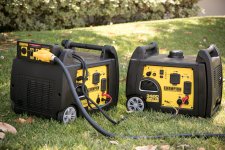
Looking at the Champion kit for their larger (2800+ watt), it only has Hot, Neutral and Ground, so I would suspect that the worst that would happen is that you trip a breaker.
100319-lifestyle-20160708-14.jpg
1333 - Parallel Kit for Linking (2) Inverter Generators 28 Watts and Higher (1) - Champion Power Equipment
On the smaller (2000W) ones, you are correct. For those, they do have some kind of twist lock connector so it should be hard to remove the syncing cable without ripping the cable apart.

Aaron Z
 
/ Running generators in parallel #39  
The parallel kit for the Honda 2000's is just "plug-n-play", nothing else... The twist lock is to get full power out of the pair...

IF, something happens to one gen set or the cable, and there's an over load situation, it just pop's the over load breaker and all is well...

The system looks to be pretty idiot proof to me, kids or no kids...

SR
 
/ Running generators in parallel #40  
This is just my slightly educated guess, but...
I'd guess that if the generators are inverter type generators and they get unlinked, you'd get some weird waveform instead of a nice 60 hz (+/-) sine wave to your loads. Hard to predict what the exact effect would be, but not good.

If it's a conventional generator and you lose the synch link once running , I'd guess you'd be okay, although you may not get the full dual/equal outputs. But I'd guess everything would still be in synch. Though one generator may generating and the other is motoring (but more likely somewhere in between, the governor, throttle positions, engine output, etc.. come into play). But note, even a generator and a motor are still (relatively) "in synch" with the common sine wave being produced/consumed.

The real problem is you have one generator running, making 60 hz, and then you "switch in" another generator that is also running, making 60 hz, but their sine waves are 180 degrees out of synch. They are now trying to instantaneously spin the others rotor 180 degrees. But then again, this is like starting a motor and going from 0-60hz.
It's likely that on small induction (slip) type, low flywheel mass, with generators of equal size, they'd be little damage as the two fight each other to arrive at synchronicity. Probably same if you start one after the other is running.

It becomes a real problem when you do this at a power plant with a generator where the rotor has tons on mass, and the you hook it into "the grid" with mega-watts of power that attempts to spin tons of generator's rotor 180 degrees instantly. This is when you get a loud bang. Rotors snap, bearings fail and 1500 tons of generator come flying up through the floor.
Yea, we manually synced generators in my power lab course in school. A little out of phase and you can make a huge hunk of steel jump. Lol

I have the honda 2000i, nice quiet gen. I bought the companion, now need the other half.
 

Marketplace Items

2005 Chevrolet Silverado Service Truck, VIN # 1GCJK33245F911286 (A65563)
2005 Chevrolet...
John Deere 2 Row Planter (A65640)
John Deere 2 Row...
2022 EZ-GO ELITE ELECTRIC GOLF CART (A63276)
2022 EZ-GO ELITE...
Rotary SPOA9-200 Automotive Lift (A59228)
Rotary SPOA9-200...
2019 ISUZU NPR 4X2 S/A 18FT FLATBED (A59912)
2019 ISUZU NPR 4X2...
3 Brake Drums (A62613)
 
Top