You need balast or you will trash your front axle!!!! really?

/ You need balast or you will trash your front axle!!!! really?
  • Thread Starter
#21  
I am sorry, I thought you did not.

"The reason I began doubting the validity of this is because the amount of rear ballast most people use is not enough to change the weight on the front axle substantially when a heavy load is lifted. I struggle to believe that a 10% difference in weight on the front axle is going to trash it."

Yes, I still stand by this statement. I should clarify that this statement is only true when lifting near max load with the FEL when that max load is well beyond the pins (like with forks). The exact numbers are from my tractor and others will vary.

I should also note that without a heavy load on the FEL, huge percentage differences of weight on the front axle can be achieved by adding weight on the 3pt. Up to and including lifting the front end which would represent a 100% difference.

Sorry for not being more clear.

Given these clarifications, 3pt balast will certainly reduce wear on the front axle as much of the time it will only carry a fraction of the weight without balast and I've never doubted this.

My concern was actual breakage of the axle housing which is most likely to occur with a heavily loaded FEL and some sort of dynamic force (like a bump or ditch while moving).

My observation is that in this max stress senario, the typical 3pt balast used for large frame CUTs (~1000 pounds) is only removing 500 pounds (in static senario) from the front axle when it is loaded to 6000-7000 pounds. That is a small % difference and I'm hoping there is enough to safety factor in the front axle strength to not break if one doesn't have the recommended (by my owners manual) 1000 pound 3pt
weight.
 
/ You need balast or you will trash your front axle!!!! really? #22  
Driving at high speed with max load stresses the front axel, but we don't talk about catastrophic failure. Suspension on the loader helps a lot.
 
/ You need balast or you will trash your front axle!!!! really?
  • Thread Starter
#23  
So what would be really interesting would be to understand how tractors were used (and ballasted or not) that need any type of front axle repair - breakage or wear related.
 
Last edited:
/ You need balast or you will trash your front axle!!!! really? #24  
The front axle will support anything the FEL can lift, but when really digging in and pushing is where more weight on the beefy rears comes in handy. IMO digging in and pushing with a full load of dirt is where the front end gets stressed.

I would rather have the front tires slip than get torqued beyond normal limits.

This proved exactly right in my case. Pushing over trees in the woods two summers ago, I managed (a couple of months apart) to break both bevel gear cases...along with other associated damage. The only way to apply enough force to do this damage was to use the traction of the drive wheels to force excessive weight onto the front ...essentially trying to drive the tractor into the ground. Operator error: some trees are just too big and tough for a 45hp tractor!
 
/ You need balast or you will trash your front axle!!!! really? #25  
If you put enough load in front to lift the rear wheels off the ground (not hard to do) then the front axle is taking all of the weight of the tractor and the load. I can't imagine that is good.
 
/ You need balast or you will trash your front axle!!!! really?
  • Thread Starter
#26  
This proved exactly right in my case. Pushing over trees in the woods two summers ago, I managed (a couple of months apart) to break both bevel gear cases...along with other associated damage. The only way to apply enough force to do this damage was to use the traction of the drive wheels to force excessive weight onto the front ...essentially trying to drive the tractor into the ground. Operator error: some trees are just too big and tough for a 45hp tractor!

That is great to know especially since your tractor is quite similar to mine. It is a different front axle but I suspect not much different. I can easily see how one could break an axle doing what you described.

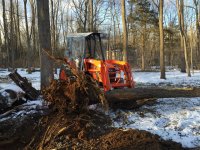
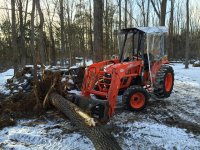
I push trees over in the woods all the time and have been doing this for 10 years with different tractors. I never, ever pressure the front drive train when doing it. What I do is I drive up and place a bucket tooth on the tree. Then I set the brakes and use the hydraulics to lift the front axle off the ground a little. Then I push using the rear only. Doing this obviously keeps stress off the front but also allows the bucket to be high on the tree for more leverage, it allows the loader pivot and bucket pivot to align with the contact patch in the rear to minimize stress on those components as well. The front wheels will gradually come to the ground as the tree goes over the bucket slides down the trunk.

Not saying the way I do it is actually healthy for the tractor, but if you're going to do it, I think the way I do it is the least likely to break something. If a tree doesn't go over right away, I just dig the back out and push again. 60 foot tall 1 foot diameter trees go over fairly quick this way.

Tractor tree 4.jpgTractor tree 5.jpg
 
/ You need balast or you will trash your front axle!!!! really?
  • Thread Starter
#27  
If you put enough load in front to lift the rear wheels off the ground (not hard to do) then the front axle is taking all of the weight of the tractor and the load. I can't imagine that is good.

And what he described could actually cause a load on the FEL that is way beyond it's rated capacity because the FEL can't go down while driving forward into a tree if the bucket is higher than where the loader connects to the tractor.

RD, when you broke your front axle how high was your bucket on the tree. If too high, hydraulic relief wont limit the weight that can be transferred to the font axle.
 
/ You need balast or you will trash your front axle!!!! really? #28  
I'd don't mind admiting that I'm a bit confused by some of the logic being used to support viewpoints.

A tractor is not a teeter-totter. It would seem the discussion of ballast is based on a 2 axle scenario but statements of opinion are too often built based on a single axle scenario imo.

Here is an example. The goal of any tractor is to keep both axles in some form of contact with the ground. If both axles are in contact with the ground . . then leveraged weight outside the tractor's axles (forward of front axle and rearward of rear axle) . . Is still on that axle. That is not true with a teeter totter because the ends can go below axle center . . But on a 2 axle unit like a tractor where both axles are in contact with the groud . . . Leverage can not make the "plane extend lower than axle height".

You can definitely overload either axle or both axles . . . But unless you are allowing an axle to come off ground contact . . You can't alter the other axle's load that I can see.

Maybe my viewpoint is flawed somewhere . . But ballast is designed for one thing and one thing only . . to keep both axles in contact with the ground. A teeter totter or a roller & lever can use ballast to shift weight loads because it is a single fulcrum point. A tractor if being used correctly is a dual fulcrum/axle point.
 
/ You need balast or you will trash your front axle!!!! really? #29  
That is great to know especially since your tractor is quite similar to mine. It is a different front axle but I suspect not much different. I can easily see how one could break an axle doing what you described. I push trees over in the woods all the time and have been doing this for 10 years with different tractors. I never, ever pressure the front drive train when doing it. What I do is I drive up and place a bucket tooth on the tree. Then I set the brakes and use the hydraulics to lift the front axle off the ground a little. Then I push using the rear only. Doing this obviously keeps stress off the front but also allows the bucket to be high on the tree for more leverage, it allows the loader pivot and bucket pivot to align with the contact patch in the rear to minimize stress on those components as well. The front wheels will gradually come to the ground as the tree goes over the bucket slides down the trunk. Not saying the way I do it is actually healthy for the tractor, but if you're going to do it, I think the way I do it is the least likely to break something. If a tree doesn't go over right away, I just dig the back out and push again. 60 foot tall 1 foot diameter trees go over fairly quick this way. <img src="http://www.tractorbynet.com/forums/attachment.php?attachmentid=458046"/><img src="http://www.tractorbynet.com/forums/attachment.php?attachmentid=458047"/>
I busted a power steering hose pushing over trees. It wasn't expensive, but was a real PITA to change.
 
/ You need balast or you will trash your front axle!!!! really? #30  
On my old MF 135 with loader i think a concrete ballast of 800kg would help a lot to ease the load of the quite light design of the front axle, if the front leaves the ground when you shifts hard then you are there ;)
 
/ You need balast or you will trash your front axle!!!! really? #31  
I'd don't mind admiting that I'm a bit confused by some of the logic being used to support viewpoints.

A tractor is not a teeter-totter. It would seem the discussion of ballast is based on a 2 axle scenario but statements of opinion are too often built based on a single axle scenario imo.

Here is an example. The goal of any tractor is to keep both axles in some form of contact with the ground. If both axles are in contact with the ground . . then leveraged weight outside the tractor's axles (forward of front axle and rearward of rear axle) . . Is still on that axle. That is not true with a teeter totter because the ends can go below axle center . . But on a 2 axle unit like a tractor where both axles are in contact with the groud . . . Leverage can not make the "plane extend lower than axle height".

You can definitely overload either axle or both axles . . . But unless you are allowing an axle to come off ground contact . . You can't alter the other axle's load that I can see.

Maybe my viewpoint is flawed somewhere . . But ballast is designed for one thing and one thing only . . to keep both axles in contact with the ground. A teeter totter or a roller & lever can use ballast to shift weight loads because it is a single fulcrum point. A tractor if being used correctly is a dual fulcrum/axle point.

When I load my FEL the front axle becomes the pivot point and as the FEL loads up the down force reduces the load on the rear tires. If continued to load the rear tires will come off the ground and the load of the FEL and the weight of the tractor shifts to the front axle.

The same applies to the 3pth. If the 3pth is overloaded the front tires come off the ground and all the load is on the rear axle.
Adding weight to the 3pth reduces the load on the front axle just not to the point of lifting the wheels off the ground. This makes the load on the front axle less and when you fill the FEL the load is transferred to the front axle but less load is applied to the front axle due to the counter force on the 3pth and rear axle.

The end result is less load on the front axle compared to not having ballast on the rear axle.
 
/ You need balast or you will trash your front axle!!!! really?
  • Thread Starter
#32  
When I load my FEL the front axle becomes the pivot point and as the FEL loads up the down force reduces the load on the rear tires. If continued to load the rear tires will come off the ground and the load of the FEL and the weight of the tractor shifts to the front axle.

The same applies to the 3pth. If the 3pth is overloaded the front tires come off the ground and all the load is on the rear axle.
Adding weight to the 3pth reduces the load on the front axle just not to the point of lifting the wheels off the ground. This makes the load on the front axle less and when you fill the FEL the load is transferred to the front axle but less load is applied to the front axle due to the counter force on the 3pth and rear axle.

The end result is less load on the front axle compared to not having ballast on the rear axle.


Well said.
 
/ You need balast or you will trash your front axle!!!! really? #33  
//The discussion at hand is weather adding wheel weights or filling the rear tires will lighten the load on the front axle. The short answer is that it will not lessen the magnitude of the load on the front axle, but it will change the weight distribution between the front & rear axle. //
Tadah!

I put ballast on my tractor because the rear wheels would come off the ground with a big load, even though the rears are filled.
 
/ You need balast or you will trash your front axle!!!! really? #34  
I'd don't mind admiting that I'm a bit confused by some of the logic being used to support viewpoints.

A tractor is not a teeter-totter. It would seem the discussion of ballast is based on a 2 axle scenario but statements of opinion are too often built based on a single axle scenario imo.

Here is an example. The goal of any tractor is to keep both axles in some form of contact with the ground. If both axles are in contact with the ground . . then leveraged weight outside the tractor's axles (forward of front axle and rearward of rear axle) . . Is still on that axle. That is not true with a teeter totter because the ends can go below axle center . . But on a 2 axle unit like a tractor where both axles are in contact with the groud . . . Leverage can not make the "plane extend lower than axle height".

You can definitely overload either axle or both axles . . . But unless you are allowing an axle to come off ground contact . . You can't alter the other axle's load that I can see.

Maybe my viewpoint is flawed somewhere . . But ballast is designed for one thing and one thing only . . to keep both axles in contact with the ground. A teeter totter or a roller & lever can use ballast to shift weight loads because it is a single fulcrum point. A tractor if being used correctly is a dual fulcrum/axle point.

This discussion come up every year or two. I will assure you that any weight put on the 3pt unloads weight off of the front axle. Even 1 pound. How much it unloads is a function of how much the wieght on the 3 point is and how far back it is from the centerline of the rear axle.

Lets use an absurd example to illustrate my point. hitch a boom pole to your 3 point. Only now this boom pole is 100 foot long. How much weight on the end of this 100 foot boom pole do you think you would need to lift the front axle off of the ground when your loader bucket is full of wet sand? Not much I would wager. In fact in the boom pole was made of steel, I think you front axle and loaded bucket would be off of the ground without any weight on the boom pole. Now shorten the boom pole to 50 foot long. Would the loaded bucket and front axle stay on the ground? Maybe? how about 25 foot long? Now we would likely have to add a little weight to the end of the boom pole to raise the front end right?

How much, I will leave to others to calculate, but my point is any and all weight you add to the 3pt, whether that is 1 pound or 1000 will take weight off of the front axle, as we have built a lever system with the fulcrum point the centerline of the rear axle, and the 3pt is definitely behind the rear axle center line. So the more weight we add, and the further we place it behind the fulcrum, the more weight it will remove from the front axle.

LoaderAndCounterweightForces.png
 
/ You need balast or you will trash your front axle!!!! really? #35  
When I load my FEL the front axle becomes the pivot point and as the FEL loads up the down force reduces the load on the rear tires. If continued to load the rear tires will come off the ground and the load of the FEL and the weight of the tractor shifts to the front axle.

The same applies to the 3pth. If the 3pth is overloaded the front tires come off the ground and all the load is on the rear axle.
Adding weight to the 3pth reduces the load on the front axle just not to the point of lifting the wheels off the ground. This makes the load on the front axle less and when you fill the FEL the load is transferred to the front axle but less load is applied to the front axle due to the counter force on the 3pth and rear axle.

The end result is less load on the front axle compared to not having ballast on the rear axle.

But your statement is talking about one axle not being in contact with the ground and that is not an operational mode of the tractor. Both axles need to contact the ground. Once that is done AND maintained . . . More ballast will not change tbe weight load pressure, on the front axle . More ballast allows you to increase tbe weight and presdure on the front axle . . but still more ballast won't reduce that front weight. Why? Because the tires/wheels/axles of both axles are in ground contact . . There is no place to shift it to. One axle . . . Yes . . . 2 axles . . No.

Jmho
 
/ You need balast or you will trash your front axle!!!! really? #36  
This was proven using scales.
 
/ You need balast or you will trash your front axle!!!! really? #37  
But your statement is talking about one axle not being in contact with the ground and that is not an operational mode of the tractor. Both axles need to contact the ground. Once that is done AND maintained . . . More ballast will not change tbe weight load pressure, on the front axle . More ballast allows you to increase tbe weight and presdure on the front axle . . but still more ballast won't reduce that front weight. Why? Because the tires/wheels/axles of both axles are in ground contact . . There is no place to shift it to. One axle . . . Yes . . . 2 axles . . No.

Jmho

I don't know how to tell you that you are wrong, other than getting your loaded tractor on a set of scales so you will believe it yourself.. BUT you are wrong..
 
/ You need balast or you will trash your front axle!!!! really? #38  
But your statement is talking about one axle not being in contact with the ground and that is not an operational mode of the tractor. Both axles need to contact the ground. Once that is done AND maintained . . . More ballast will not change tbe weight load pressure, on the front axle . More ballast allows you to increase tbe weight and presdure on the front axle . . but still more ballast won't reduce that front weight. Why? Because the tires/wheels/axles of both axles are in ground contact . . There is no place to shift it to. One axle . . . Yes . . . 2 axles . . No.

Jmho

Please read again. Both wheels are on the ground. Just with ballast on the rear leaves less weight on the front axle. Same would be true if the ballast (full FEL) would reduce the weight on the rear axle and shift it to the front axle. All are still in contact but with less ground bearing pressure (less weight).
 
/ You need balast or you will trash your front axle!!!! really? #39  
The simplest way to look at the math/physics is to consider the "additional" load on the front axle as a function of loads on the front loader and loads on the three point. This will be the load above and beyond the basic contribution of the tractor weight. When perfectly ballasted, let's say there will be no more load on the front axle than usual. For that to happen:

F * LF = R * LR

where:

F is the load on the front loader
LF is the length from the front loader's load to the rear axle
R is the load on the three point
LR is the length from the three point's load to the rear axle

That tells us that the rear ballast load must be:

R = (F * LF)/LR

As an example, say I lift 1000# in my L3200. LF is about 7'. LR is about 4'. That means:

R = (1000 * 7)/4 = 1750#

In other words, it would take a heck of a lot of ballast not to add additional load over the front axle. More ballast than the load itself!!!
 
/ You need balast or you will trash your front axle!!!! really? #40  
But your statement is talking about one axle not being in contact with the ground and that is not an operational mode of the tractor. Both axles need to contact the ground. Once that is done AND maintained . . . More ballast will not change tbe weight load pressure, on the front axle . More ballast allows you to increase tbe weight and presdure on the front axle . . but still more ballast won't reduce that front weight. Why? Because the tires/wheels/axles of both axles are in ground contact . . There is no place to shift it to. One axle . . . Yes . . . 2 axles . . No.

Jmho

That is not how the physics work. There are loads on the front and rear of the tractor, plus the tractor's weight, all pressing down. That is counteracted by the combination of the ground pressing back up with a force (or reaction) on the front axle and a force on the rear axle (either of these can be zero if the axle has lifted and the math/physics still works). They all have to add to zero if the tractor is stationary (i.e., not going airborne and not sinking into the ground). Any combination of the front and rear axle reactions that satisfies physics will do that. The exact combination is determined by the distances between the various loads and reactions, which is how leverage comes into play.
 

Marketplace Items

Toro Timecutter Max (A61166)
Toro Timecutter...
2007 50FT T/A 3 CAR HAULER TRAILER (A59906)
2007 50FT T/A 3...
2015 LOAD TRAIL 24+6 GOOSENECK TRAILER (A58214)
2015 LOAD TRAIL...
2017 Western Star 4700 Tri Axle Dump (A62613)
2017 Western Star...
2015 Freightliner M2 106 AWD Altec AT37G Bucket Truck (A60460)
2015 Freightliner...
John Deere 6300 (A60462)
John Deere 6300...
 
Top