LOG SPLITER BUILD

   / LOG SPLITER BUILD
  • Thread Starter
#21  
I'm sure that you have seen them on other builds but I would highly recommend the auto cycle valve so that you just pull the levers and go grab your next piece. When you return the cylinder is already retracted and you put the piece on. Expensive but IMO worth it.

With that engine you will be able to raise the 28GPM side of the pump to its max of 900 PSI. You will be surprised just how much will be split without the pump going into low flow. It will be moving pretty quick and hit the wedge with 10 tons of force to pop it. And then you always have your 41 tons as a backup :thumbsup:

Where is the fuel tank? That engine will be thirsty! Probably a gallon and a half an hour at its rated speed. If you plan on running it at a lower speed you will probably have to cut back on the relief pressures so the engine won't stall. I'd just run it at speed, get it done quicker, and deal with the fuel usage.

Oil temps will likely climb pretty high with that small of a hydraulic tank. Are you planning on splitting year round? If so I would probably suggest an oil with a higher viscosity than the standard AW32.

Nice build!

I am starting to lean toward the auto cycle

heres the fuel tank I am going to get 4.5 GALLON RED FUEL TANK W/FUEL SHUTOFF VALVE

I hope the tank will do most of the store bought splitters have about 1/2 the fluid cap of the pump
 
   / LOG SPLITER BUILD #22  
Concrete crusher. Nice.
 
   / LOG SPLITER BUILD #23  
Don't know anything about a dump valve can you explain

A dump valve diverts fluid from the rod end of cyl back to tank without the fluid having to flow thru the control valve. The reason for using one with high flow pumps is because of volume displacement. While the pump is rated for a certain flow, the actual flow when cyl retracts can actually be as much as twice the amount of oil that the pump is produceing. Just how much is determined by the dia of the rod.The Cyl rod takes up space in the cyl bore. While you might be pumping only 28gpm into the rod end of the cyl, the piston end is having to displace the 28gpm, plus the volume produce by the rod as it re-enters the cyl bore. Because of the rod volume, your 28gpm in to cyl can become 40+gpm coming out of the cyl. Normal splitter valves are usually only rated for 25gpm of flow, but have 40+ gpm trying to come back thru them. This creates a flow restricion that produces heat as well as slows down the travel speed of the cyl. The restriction of the valve can cause a fluid velocity increase that can cause oil foaming in the tank and possible cavitation at the pump when using low capacity hydraulic tanks. A dump valve works by allowing fluid from the control valve to enter the cyl for extend, when the rod retracts, the dump valve contains check. valves that stops flow from going back to the control valve and diverts the fluid straight back to tank. A dump vavle isnt always the answer to speeding up a hydraulic cyl. Actual port size in the cyl also need to be sized to accommodate the extra flow. A cyl with only 1/2in ports will see very little benefit of using a dump valve simply because the 1/2in port isnt large enough to handle the extra oil flow. A 3/4 in port is really only good for flows of around 30gpm. To get the maximum benefit of a dump valve when using a 28gpm pump, you really need to open the base port of the cyl up to at least a 7/8 dia which is not really a common size. The more common size would be 1in. I am not saying you cant push more oil thru a smaller port, but doing so will create un-neccessary heat
 
   / LOG SPLITER BUILD #24  
Here's a link that sells dump valves and shows the plumbing.

Dump Valve

I'm not sure id spend the money on a new one but they show up fairly often on ebay. I paid $25 delivered for one rated at 60gpm with a manifold... Most ebay sellers don't understand sun hydraulics product codes.

ckgb-xcn or ckeb-xcn are I believe what splitez is selling as dump valves. You would then need a compatible manifold. Mine came with a HCN for the ckgb-xcn cartridge.
CKGB | Cartridges サ Directional サ Check | Sun Hydraulics
 
   / LOG SPLITER BUILD
  • Thread Starter
#25  
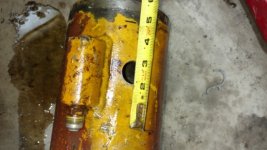
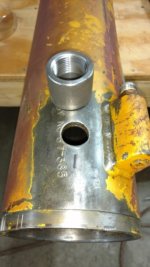
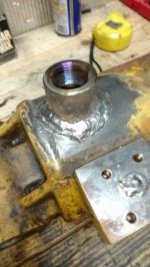
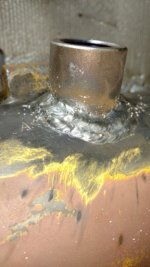
152016171949.jpg152016172016.jpg152016172039.jpg15201617214.jpg
So right or wrong here's what I did 1" ports it should help with the oil flow
 
   / LOG SPLITER BUILD
  • Thread Starter
#26  
A dump valve diverts fluid from the rod end of cyl back to tank without the fluid having to flow thru the control valve. The reason for using one with high flow pumps is because of volume displacement. While the pump is rated for a certain flow, the actual flow when cyl retracts can actually be as much as twice the amount of oil that the pump is produceing. Just how much is determined by the dia of the rod.The Cyl rod takes up space in the cyl bore. While you might be pumping only 28gpm into the rod end of the cyl, the piston end is having to displace the 28gpm, plus the volume produce by the rod as it re-enters the cyl bore. Because of the rod volume, your 28gpm in to cyl can become 40+gpm coming out of the cyl. Normal splitter valves are usually only rated for 25gpm of flow, but have 40+ gpm trying to come back thru them. This creates a flow restricion that produces heat as well as slows down the travel speed of the cyl. The restriction of the valve can cause a fluid velocity increase that can cause oil foaming in the tank and possible cavitation at the pump when using low capacity hydraulic tanks. A dump valve works by allowing fluid from the control valve to enter the cyl for extend, when the rod retracts, the dump valve contains check. valves that stops flow from going back to the control valve and diverts the fluid straight back to tank. A dump vavle isnt always the answer to speeding up a hydraulic cyl. Actual port size in the cyl also need to be sized to accommodate the extra flow. A cyl with only 1/2in ports will see very little benefit of using a dump valve simply because the 1/2in port isnt large enough to handle the extra oil flow. A 3/4 in port is really only good for flows of around 30gpm. To get the maximum benefit of a dump valve when using a 28gpm pump, you really need to open the base port of the cyl up to at least a 7/8 dia which is not really a common size. The more common size would be 1in. I am not saying you cant push more oil thru a smaller port, but doing so will create un-neccessary heat

Thank you that's a very good explanation.
 
   / LOG SPLITER BUILD
  • Thread Starter
#27  
Here's a link that sells dump valves and shows the plumbing.

Dump Valve

I'm not sure id spend the money on a new one but they show up fairly often on ebay. I paid $25 delivered for one rated at 60gpm with a manifold... Most ebay sellers don't understand sun hydraulics product codes.

ckgb-xcn or ckeb-xcn are I believe what splitez is selling as dump valves. You would then need a compatible manifold. Mine came with a HCN for the ckgb-xcn cartridge.
CKGB | Cartridges サ Directional サ Check | Sun Hydraulics

I'm on it will have to get one. One more question I have a truck repair place close by and they have a yard full old dump trucks, garbage trucks, crane trucks would this Pilot Operated Check Valves (dump valves ) be used on anything you can think of
 
Last edited:
   / LOG SPLITER BUILD #28  
What is the green line between the two valves?
 
   / LOG SPLITER BUILD #29  
And how big is the resivoir
 
   / LOG SPLITER BUILD
  • Thread Starter
#30  
What is the green line between the two valves?

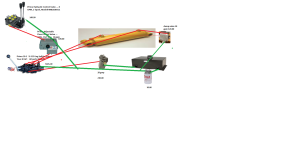
The green lines are return to the tank red are pressure. Out of the main valve the green line is the outlet that returns to the tank the red is the power beyond. The way I understand it in neutral fluid flows through the pb port. And the outlet which is marked green only flows if the relief lets it bypass I'm not 100 % so I wanted to let you all look at what i'm thinking. The tank I already have is 20 gal Got it at junk yard came off a big dump truck.
 
   / LOG SPLITER BUILD #31  
Still not sure I follow you, but whatever the green line between valves is, shouldn't be needed.

Each valve has its own low pressure return.

Main valve feeds your flow control out of the PB port and then supplies second valve. So supply and return are handled for the second valve.

Erase that green line and I think you are all good.

And what kind of flow control are you getting? An inline won't work too well off a PB trying to move 28gpm. If the flow control is more like a flow divider that can dump excess to tank, might be okay.

If it was mine, I'd run a pair of inline flow controls on the lines AFTER the auxillary valve. And would upsize it to 25gpm to handle slow when in neutral
 
   / LOG SPLITER BUILD
  • Thread Starter
#32  
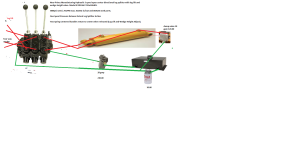
I looked it over again and got rid of the green line between the two valves here's a new sketchlog.png
 
   / LOG SPLITER BUILD
  • Thread Starter
#33  
Still not sure I follow you, but whatever the green line between valves is, shouldn't be needed.

Each valve has its own low pressure return.

Main valve feeds your flow control out of the PB port and then supplies second valve. So supply and return are handled for the second valve.

Erase that green line and I think you are all good.

And what kind of flow control are you getting? An inline won't work too well off a PB trying to move 28gpm. If the flow control is more like a flow divider that can dump excess to tank, might be okay.

If it was mine, I'd run a pair of inline flow controls on the lines AFTER the auxillary valve. And would upsize it to 25gpm to handle slow when in neutral

Prince Adjustable Flow Control Valve — 3/4in. Port Size, Model# RD-175-30 | Adjustable Flow Valves| Northern Tool + Equipment
The link above is what I'm thinking for a flow control valve It says it 30 gmp it was my thinking that I would be able to use lower flow valves for my lift and maybe a four way wedge and be able to reg the speed of them. Its was also in my mind that the flow control valve rated for 30 gpm would be less restrictive than say two 25 gpm valves
 
   / LOG SPLITER BUILD #34  
A flow valve is as restrictive as you make it.

You want a lift and adjustable wedge to be slow. Like say 2 gpm.

If you restrict the PB line feeding the aux. Valve as you show, it will probably make the pump kick into low gear and work hard. Because it's trying like heck to put 28gpm (or 7 gpm in low) through a flow control. If the flow control is dialed below that to control speed, the only place the excess goes is through the relief. And that's what builds heat and cooks hydraulics if done for extended periods.

And doing that, is exactly what will happen anytime the main valve is in neutral. Because when the main is in neutral, oils only exits via the PB. And when pressure is exceeded, then it exits through tank.

It's not good practice to design a system to pump oil through the relief. The only time that should happen by design, is when you stall out a cylinder, and then it's only momentary
 
   / LOG SPLITER BUILD #35  
Edit: I just looked at the flow control you picked. That should work for what you want. That's not an inline flow control in the sense that I think if one.

When I think flow control, I think inline needle valve kind, which is basically just like a ball valve In The sense that it only let's a given amount through and the rest is held back.

What you linked is more like a flow divider that lets a little go to the aux valve and the rest return to tank.
 
   / LOG SPLITER BUILD
  • Thread Starter
#36  
Edit: I just looked at the flow control you picked. That should work for what you want. That's not an inline flow control in the sense that I think if one.

When I think flow control, I think inline needle valve kind, which is basically just like a ball valve In The sense that it only let's a given amount through and the rest is held back.

What you linked is more like a flow divider that lets a little go to the aux valve and the rest return to tank.

You got me thinking though I don't think it will work as I planned because the the inlet on the flow control will build pressure cause the pump to be in low flow all the time
 
   / LOG SPLITER BUILD
  • Thread Starter
#37  
log.png

THis maybe a better option
 
   / LOG SPLITER BUILD #38  
Yea, better.
 
   / LOG SPLITER BUILD #39  
I had never seen that valve, its a pretty good idea.

My only concern would that you'd have a log launcher rather than a lift at 28GPM.
If the valve does not somehow regulate the flow to the other circuits I guess restrictor orifice fittings or small flow control valves would be the best option.
Either that or be very careful when feathering the lever.
 
   / LOG SPLITER BUILD #40  
Small inline flow valves after on the log lift and wedge would be perfect. Anytime things are in neutral that is no blockage or restriction.

Only time you will restrict flow is when operating one of the auxiliary functions, then it is more momentary. But I would try it first without. And no need for more than 1/4" lines. Try to get good at feathering the lift spool.
 

Tractor & Equipment Auctions

Hydraulic Liftgate (A59230)
Hydraulic Liftgate...
2006 Mac Truck CXN613 (A56438)
2006 Mac Truck...
2021 CATERPILLAR D3 LGP CRAWLER DOZER (A60429)
2021 CATERPILLAR...
1999 WEST WIND 30FT PINDLE FLATBED DOVETAIL TRAILER (A58216)
1999 WEST WIND...
2021 FORD F-150 STX CREW CAB TRUCK (A59823)
2021 FORD F-150...
Deere 333G (A53317)
Deere 333G (A53317)
 
Top