sometimes i get interesting jobs.

   / sometimes i get interesting jobs. #1  

pmsmechanic

Elite Member
Joined
Dec 6, 2013
Messages
4,397
Location
Southern Alberta, Canada
Tractor
4410 and F-935 John Deere, MF 245
ForumRunner_20150725_194647.png


ForumRunner_20150725_194719.png

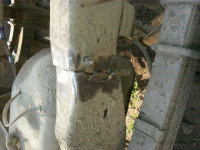
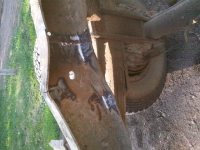
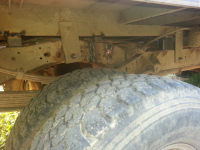
My neighbor brought me his bale truck and asked me to fix it. Both frames are cracked. One is cracked all the way through and the other side had about an inch of frame that isn't cracked. I offered to change the frame but he didn't want to spend the money and I don't blame him. For what the truck is being used for a repair will do an adequate job.

The first picture in the attachments is supposed to go here.

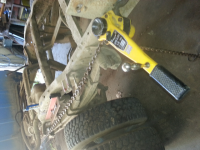
Here I'm starting to get the frame lined up.
ForumRunner_20150725_195643.png


ForumRunner_20150725_195727.png

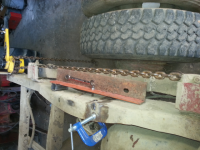
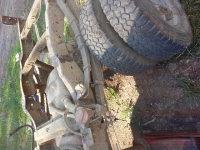
This is what i did to pull everything into place.
 

Attachments
  • ForumRunner_20150725_195406.png
    ForumRunner_20150725_195406.png
    695.4 KB · Views: 321
  • ForumRunner_20150725_195908.png
    ForumRunner_20150725_195908.png
    533.3 KB · Views: 347
Last edited:
   / sometimes i get interesting jobs.
  • Thread Starter
#2  
ForumRunner_20150725_200148.png


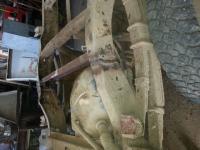
Finished product and i added a cross member as i figured the reason why the frame had cracked was because it was flexing in every time a bale was picked up.

ForumRunner_20150725_200409.png

I also added blocks between the frame and the bake deck to help support the load.

We will see in a few years how this holds. The truck isn't registered and only gets used in the fields and corrals.
 
   / sometimes i get interesting jobs. #3  
If those plates were all that transferred the load to the frame, that would explain why it cracked.
 
   / sometimes i get interesting jobs. #4  
If you still have the truck. How about adding fish plates.
 

Attachments

  • Fish plate diamond.JPG
    Fish plate diamond.JPG
    55.6 KB · Views: 722
   / sometimes i get interesting jobs.
  • Thread Starter
#5  
I never thought of that and I like the idea. There is room if the cross brace was shortened which would be possible. Right now the plan is to keep an eye on it watch for new cracks. The deck would need to be removed again and though that's not fun it's not the worst job either. The truck is only a couple of miles from my place and I'll be seeing it once in a while.

Just curious as to why there are tabs welded in top left and bottom right on the picture of the fish plate?
 
   / sometimes i get interesting jobs. #6  
Just curious as to why there are tabs welded in top left and bottom right on the picture of the fish plate?
I don't know, I stole that picture off a welding forum as a really good example of a fish plate.
 
   / sometimes i get interesting jobs.
  • Thread Starter
#7  
If those plates were all that transferred the load to the frame, that would explain why it cracked.

That is a normal Dewese method of mounting bale decks and there are a lot of decks out there mounted like that. This is not the first one I've seen cracked but there are a lot that never crack.

The decks are mounted by solidly bolting the rear of the deck to the frame and then two of these plates on each side to transfer the load to the frame.

The truck is a first generation 250 Cummins that has been converted to a dually with adapters on the rear axle. I haven't done any measuring but I wouldn't be surprised to find that a Dodge 350 has a deeper frame. I drive a 90 250 Cummins for my work and have a 91 for parts. The frame on the 91 is an inch deeper.
 
   / sometimes i get interesting jobs. #8  
I don't know, I stole that picture off a welding forum as a really good example of a fish plate.

In my opinion the tabs at the ends of the fish plate were added in order to tie in the flanges of the channel to add extra flex resistance.
 
   / sometimes i get interesting jobs. #9  
I was wondering why no fish plates as well. The rounded corner diamond shape is important to prevent future cracking. Something I was taught way back when. A question for Shield Arc. What thickness fish plate in relation to the base metal would be appropriate for the chassis repair? Both sides or one side?
 
   / sometimes i get interesting jobs. #10  
Only time I ever did fish plates was on dirt moving equipment. That was 1/2" and 3/4" thick material. I've read where guys say for truck frames don't go over 1/4" thick. If at all possible, I would fish plate both sides.
 
   / sometimes i get interesting jobs.
  • Thread Starter
#11  
Only time I ever did fish plates was on dirt moving equipment. That was 1/2" and 3/4" thick material. I've read where guys say for truck frames don't go over 1/4" thick. If at all possible, I would fish plate both sides.

Shoot you just wreaked my plan. I had what I thought was a brilliant idea to just fish plate the outside as then the deck could stay on. Back to plan A.

Actually at first I was going to bolt a plate onto the outside of the frame to reinforce the frame but decided not to as then we wouldn't be able to easily see if the frame was cracking again. There is a reason for that. During feeding the deck and frame can get kind of sloppy with manure. I'd just as soon be able to check things without crawling under the truck.
 
   / sometimes i get interesting jobs. #12  
Shoot you just wreaked my plan. I had what I thought was a brilliant idea to just fish plate the outside as then the deck could stay on.
Well that sure beats nothing! You see truck frames with just the fish plate on the outside all the time.
 
   / sometimes i get interesting jobs. #13  
I have seen many fish plates on the outside on single rail chassis when there is hardware, brackets, crossmembers etc on the inside of the rail. I have also seen fish plates with relief holes to go around rivets and mounting bolts as well.
 
   / sometimes i get interesting jobs. #14  
I was wondering too, why no doublers.

In this case the virgin frame material was insufficient. I would not normally trust that a weld could be stronger than what has been proven insufficient (the original frame). Also, a frame that's fatigued enough to crack (there) could have other subsurface cracks 1/4" away from the weld, just waiting for their turn to hit their limit. Doublers extending forward and back would not allow that nearby fatigued metal to experience the high stress levels that cracked it.

It's my opinion that the cracks all started at the flange, and fish plates would contribute less to strength than doublers on the flanges. I think doublers on the flanges are necessary (and I would add a fish plate too).

Those blocks will distribute the load in those conditions when the bed is firmly against the blocks. If the truck is driven with the bed raised then it's all on the rear hinge again. Which might be the condition that broke it (driving while dumping)? Or loaded, driving on uneven ground the bed can lift off the blocks. But the blocks are a good idea.

I don't see the cross member you added but I think the added stability will help to protect the frame flanges. Adding fish plates to the outside because it's accessible sounds like a good idea too.

Thx for posting, (with pics! ) :thumbsup:
 
   / sometimes i get interesting jobs. #15  
Back in the early days of off-road racing, racers would box and strap their lightweight Jeep frames for strength, changing the "C" frame channel to a rectangular tube, and reinforced the flange.

Bruce
 
   / sometimes i get interesting jobs.
  • Thread Starter
#16  
The cross member is in the first picture of my second post.

The bed stays attached to the truck all the time. There are two arms which pivot over the back of the deck, grab the bale and lift the bale onto the deck.

SA i was half joking when I said that you had wreaked my plan. But I must have some real tunnel vision on this one because it didn't even cross my mind then to just do them on the outside.

The cracks do start at the flange and then move to the outside of the frame. That's why I put the extra cross member in. I wanted to prevent that flex. I thought of doublers on the flanges and decided not to do it because if the frame cracks again then there is a real mess to clean up. This is already the second place the frame has broken. A previous owner had the lower flange doubled from half ways down the cab to the front of the springs. I also thought about boxing the frame but was concerned that I would just move the problem to another part of the frame. I stil think the best solution would have been to replace the frame with a heavier one but the customer didn't want to spend the money.

You guys have come up with some great ideas. One of these weeks I'll get the truck back and I will fish plate the frame. Thanks for all the ideas and for not tearing me to pieces. I was a bit worried about that.
 
   / sometimes i get interesting jobs. #17  
Thanks for all the ideas and for not tearing me to pieces. I was a bit worried about that.

I think you're confusing us with Welding Web. :D

Terry
 
   / sometimes i get interesting jobs. #18  
I thought of doublers on the flanges and decided not to do it because if the frame cracks again then there is a real mess to clean up.

Agreed, there are conditions in usage where making a frame too stiff in one area can be the wrong solution. That's difficult to assess over the internet, you're in a better position looking at it in person. Often the cracked parts will tell you what motion caused the crack. For example, was it caused by forces lifting the bale? Or forces transporting the load? Or usage on un-even ground?

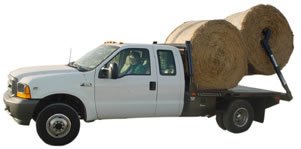
Is this similar to how the bale truck works? (from Google Images "Bale truck")

truck-bed-bale-handler.jpg
 
   / sometimes i get interesting jobs.
  • Thread Starter
#19  
I believe the lifting of the bale caused the frame to flex in as the frame is bent in over the rear springs. That's why I added the extra cross member. That's also why I added the blocks between the frame of the deck and the frame of the truck.

Another part of the problem is that the owner is very rough on equipment. That's why it was decided that only his wife uses this truck to transport bales. The deck has been installed on this truck for about 5-7 years. I don't remember exactly. It took that much time for the frame to break so I don't think it's going to break again quickly but I do expect to see it again for repairs.

That's exactly how a bale deck works. The owner also decided to only transport one bale at a time with this truck. We will see if all these small changes do the trick.
 

Tractor & Equipment Auctions

ALLISON TRANSMISSION (A55745)
ALLISON...
43023 (A59228)
43023 (A59228)
Cat CB24B (A60462)
Cat CB24B (A60462)
2014 Toro Z-Master 6000 Series 60in Zero Turn Commercial Mower (A59228)
2014 Toro Z-Master...
YANMAR VIO35-5 UNIVERSAL EXCAVATOR (A60429)
YANMAR VIO35-5...
78"X16' DOUBLE AXLE TRAILER (A60430)
78"X16' DOUBLE...
 
Top