New wood floor for old barn

/ New wood floor for old barn #1  

quicksandfarmer

Elite Member
Joined
Dec 2, 2006
Messages
2,624
Location
Coastal Rhode Island
Tractor
Jinma 354, purchased 2007
I have an old dairy barn that is roughly 150 years old. It's three levels, with a cellar and a hay loft. The floor on the main level has become dangerously rotten and I've started tearing it out. I'm trying to decide what to replace it with. I'm going to use it as a workshop, so I want a nice smooth floor. I'll probably paint it. The existing floor is 2" rough lumber. I'm mulling a few different options:

I can get rough lumber from a local mill. It would cost me about $1.30/square foot for 2". This would be the historically correct way to proceed (it's possible this is the mill the original lumber for the barn came from). The problem with this is it wouldn't make a very good floor. It's rough surfaced, and even if I sanded it would be hard to sweep. It would expand and contract with the seasons, making cracks for debris to fall in.

I can get tongue and groove modern 2x6's. They're about $2.20 square foot. I think they would make a somewhat better floor than rough lumber.

I could also use sheet goods. The joists are on 21" centers, which means I would probably cut every sheet down to 84 inches, which means a lot of cutting and about 15% waste. An advantage of boards is there would only be 3" waste on a 16' board. I am a little worried that 21" might be a long way for a 3/4" sheet to span.

I could get BC sanded plywood (3/4) for $1.30/ square foot. Tongue and groove plywood ("DryPly" from Home Depot) is $1.32. T&G OSB is $0.54 and plain OSB is $.45.

I'm intrigued by Advantech, which is about the same cost as plywood ($1.32) but I've never used it. Will paint stick to it?

Anybody have any thoughts?

Thanks.
 
/ New wood floor for old barn #2  
If using 3/4" plywood on 21" spacing for a shop floor, I'd probably want to double layer it, with the top layer run across the direction of the first. Not sure how that will work out with waste in the case of oddball spacing, but it's not as critical for the second layer.

I had an exposed 3/4" sanded T&G plywood floor in the small barn at my old house, and it took a lot of abuse over the 12 years I used it. I dragged equipment over it, and drove a tractor in and out regularly.

Advantech's main purpose is to survive getting wet for months while a home is under construction. It does that well. If being installed under an existing dried-in roof, there is no need for it. It will hold paint as well as OSB from what I have seen of overspray when painting baseboard trim in our new home, but no OSB product will be durable as an exposed floor deck, paint or not. As soon as you drag something over it, it will start to flake and tear. As a floor deck, OSB is always generally meant to be covered up.

There might be a cost effective approach to going double layer with OSB on the bottom and 3/4" sanded plywood on top.

Personally, I would go with the 2" rough milled lumber for the rustic look, and just accept that it's going to be a little uneven at times. My dad had a shop with that type of floor, and it wasn't too bad to sweep with a stiff broom (I was the one who swept it most of the time). That floor was T&G, and the worst thing is that it was noisy. Driving a forklift over it was a real creaky experience.
 
/ New wood floor for old barn #3  
if you say it is possible the mill nearby may have supplied the original rough sawn flooring, I would think it was cut with a circular saw. You should be able to tell by looking at the wood and seeing circular imprint. If you had the rough sawn done by someone with a GOOD band saw, chances are there would be more consistency in your sizing. Either way, I would go for roughsawn.

My horse barn floor is 24 by 36 and never regretted it. Periodically I will replace a board. It is all rough saw douglas fir, some done on bandsaw, some on circular saw. I always broom it with the grain, big coarse broom and it does fine. It really isn't the end of the world. If you want it primo, well, then you gotta have a sealed cement floor. A real key to buying the lumber is the mill operator. Some roughsawn stuff is right on, board for board. On the other hand, you could always rent a sander and go over the top a bit to smooth'er out a bit.
 
/ New wood floor for old barn #4  
If the first floor lasted 150 years I would replace it with the same.
 
/ New wood floor for old barn #5  
If it was me I would use the 2" thick boards from the mill.
 
/ New wood floor for old barn #6  
the T&G would feel much more solid, (as the side boards are supporting each other)
and if you want a smooth finish, I would over lay with a sheet product, (plywood) would consider a floor paint or clear finish, to protect the wood, and sweepablity.
and possibly in time even some type of finish floor,
 
/ New wood floor for old barn #7  
As mentioned - I would go with rough cut. I replaced the floor in one of my out-buildings(12 x 18) with rough cut and it has been an excellent choice. Looks good & wears like iron.
 
/ New wood floor for old barn
  • Thread Starter
#8  
if you say it is possible the mill nearby may have supplied the original rough sawn flooring, I would think it was cut with a circular saw. You should be able to tell by looking at the wood and seeing circular imprint. If you had the rough sawn done by someone with a GOOD band saw, chances are there would be more consistency in your sizing. Either way, I would go for roughsawn.

I can see saw marks on the wood where it is exposed. Some pieces have circular marks, some have parallel marks. I've read that mills in my area went from using pit-style saws with a vertical reciprocating blade to circular saw blades around the time of the Civil War, so I figure the barn must have been built about the time of the changeover. Some beams have one type of mark on one face and another on another. There's no indication that the wood was reused or replaced. According to the tax records the house dates from 1850 and the barn is similar construction.

I've purchased a fair bit of wood from the local mill already for various repairs (I feel like I've done nothing but fix this barn since I bought it nine years ago). The wood has been excellent in terms of its uniformity and very pleasant to work with. It's not nearly as hard or dense as the old-growth wood from 150 years ago though.
 
/ New wood floor for old barn
  • Thread Starter
#9  
My horse barn floor is 24 by 36 and never regretted it. Periodically I will replace a board.

This is a factor that has me leaning away from tongue and groove. I've done nothing but fix this barn, I can see myself having to take up the odd board for future repairs.
 
/ New wood floor for old barn
  • Thread Starter
#10  
If the first floor lasted 150 years I would replace it with the same.

I'm aiming for more durability this time. I don't want to burden the great-great-great-great-grandkids!

Sounds like everyone is favoring the rough cut. I thought there'd be some love for the sheet goods but I guess not.
 
/ New wood floor for old barn #11  
Do you have to replace all of the boards? Can you replace just the bad ones and then deal with putting a smooth surface over it? Or sanding it smooth? If you had all the boards in place, you could get away with a nice smooth half inch plywood.


Eddie
 
/ New wood floor for old barn #12  
Hello,
Why don't you use the 2" rough cut lumber but have the mill plane one side of it. If they don't have a machine, take it somewhere that has a planer and get it planed. They would charge you so much by the linear foot to plane it.


MFWD
 
/ New wood floor for old barn
  • Thread Starter
#13  
Do you have to replace all of the boards? Can you replace just the bad ones and then deal with putting a smooth surface over it? Or sanding it smooth? If you had all the boards in place, you could get away with a nice smooth half inch plywood.


Eddie
I don't believe there is a single usable board in the whole floor. At some point in the distant past a former owner poured two inches of concrete on top of about two thirds of the floor. It wasn't in great shape then but the concrete trapped moisture against the floorboards and it's all rotten. A significant portion of the remainder is patches. I think previous owners just grabbed the closest flat object and nailed it in place when someone stepped through -- flattened oil drums, wooden crates, scrap wood. I've already removed all the concrete and about a third of the floor and it was hairy, you never know what's under a patch. I also have to watch for spots that should have been patched but never were! I used several sheets of plywood so I never had to stand on the original floor once a patch was up and worked from the wall toward the door.

The framing seems pretty solid, the previous owner used to park a tractor in there until a rear wheel went through between two joists.
 
/ New wood floor for old barn
  • Thread Starter
#14  
Hello,
Why don't you use the 2" rough cut lumber but have the mill plane one side of it. If they don't have a machine, take it somewhere that has a planer and get it planed. They would charge you so much by the linear foot to plane it.


MFWD

That's a good idea. I'll ask at the mill if they can do that.
 
/ New wood floor for old barn #15  
I can see saw marks on the wood where it is exposed. Some pieces have circular marks, some have parallel marks. I've read that mills in my area went from using pit-style saws with a vertical reciprocating blade to circular saw blades around the time of the Civil War, so I figure the barn must have been built about the time of the changeover. Some beams have one type of mark on one face and another on another. There's no indication that the wood was reused or replaced. According to the tax records the house dates from 1850 and the barn is similar construction. I've purchased a fair bit of wood from the local mill already for various repairs (I feel like I've done nothing but fix this barn since I bought it nine years ago). The wood has been excellent in terms of its uniformity and very pleasant to work with. It's not nearly as hard or dense as the old-growth wood from 150 years ago though.

How are the joists under the floor boards? If the floor is in such bad shape hopefully the joists are usable. I would like to have an old wood barn but the downside is the constant maintenance, unless someone has the money to do a full makeover all at once. I threw my two cents in earlier, good luck with your decision.

If possible do you have any pictures of the barn? I love seeing old barns.
 
/ New wood floor for old barn
  • Thread Starter
#16  
How are the joists under the floor boards? If the floor is in such bad shape hopefully the joists are usable. I would like to have an old wood barn but the downside is the constant maintenance, unless someone has the money to do a full makeover all at once. I threw my two cents in earlier, good luck with your decision.

If possible do you have any pictures of the barn? I love seeing old barns.
P1050605.jpg

Always happy to oblige!

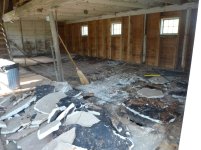
Here's a picture of the work in progress. I'll try to orient you. The barn runs with the long direction east-west. This picture is taken from the south door looking north, the white line on the far right of the picture is the door frame. We're looking at the east bay, which was the milking parlor, there used to be nine stalls there. On the back wall and ceiling you can see where it was painted white for sanitary reasons. The wall on the right of the picture was replaced four years ago, it was almost completely rotten, out of the whole wall I was only able to save a few studs, which you can see by their white paint.

In the underside of the beam running across the upper left corner you can see mortises where the stanchions for the stalls were set in. Those stanchions also held up the hay loft and when a previous owner removed them the beam sagged. There were two 4x4's holding up the beam, you can see one in the picture waiting to have the wiring taken off. I've got three eyebolts in that beam with chains going to a beam above and those chains are holding the beam up right now. What I'd like to do is replace the stanchions and restore the historic look. To the left of the picture is the stairs going up to the hayloft.

This barn is of a type called a suspension barn, I've not been able to learn much about it, a Google search turns up only the fact that they are rare. You can see in the picture two vertical iron rods coming down from the hayloft and through the floor. There is a beam under the floor parallel to the beam you see which holds up the floor. That beam is supported by the iron rods. So the basement is completely open, a clear span of 28 feet. The other end of the rods is in the beam above the loft at eave height, that's the one I attached the chains to. That beam basically holds up the whole building, carrying the weight of the main floor and the hayloft below, and the roof above. In the far left corner of the picture you can see a beam that comes down at a 45 degree angle from that main beam to the post. There are two of these main beams, one on each side of the door.

Three of the four iron rods have rusted through in the basement and failed, so the floor beams have sagged and one was quite badly damaged. I've decided to forego the clear span in the basement and put columns where the metal rods came out. I will leave the rods in place because they are historic but they no longer support anything. So far I have repaired the damaged beam and placed two of the four columns. The other beam is on screw jacks right now, I'm trying to see how straight I can get it by slowly jacking it.

This picture was taken after I had broken up the concrete floor and was in the process of removing the pieces. You can see the holes in the floor, and the sheets of plywood I'm using to provide a working area. I broke up the concrete by hand, mostly by hammering a prybar underneath it and cracking it. For the most part I was afraid to pound directly lest I go through the floor. I carried it all out by hand, I estimate it was about four cubic yards. I think the concrete was done by someone who had never done concrete but had read that it should metal reinforcing in it, every manner of metal scrap was embedded in the floor: field fence, a grill from an oven, wood stove parts, paint can lids, random pieces of pipe. A lot of it had been nailed to the floor which was a real pain to get out.

I can talk about my barn all day. Usually by the time I get to this point in my tour people remember they have a train to catch or something.
 
/ New wood floor for old barn #17  
Wow, that sounds like a cool building! I think I'd want to strangle the guy who put in the concrete with all that scrap embedded.
 
/ New wood floor for old barn #18  
Thanks for the picture. Removing that concrete doesn't look like fun but once the new floor is in it will be worth it. I haven't seen a suspension barn, but that is a very neat/functional concept with having the whole basement area open. It must be an impressive bean that supports the hay loft and first floor, just think of the weight that could potentially be in there. Any chance of replacing the metal support rods? You are doing a nice job keeping up a piece of history. An old barn (about 100 years old) was just torn down about a 1/4 mile from me. The property sold and the new owners didn't want the barn. I was disappointed coming home from work that day and seeing it being ripped down, fewer and fewer of these old barns exist and especially one like yours. Well done.
 
/ New wood floor for old barn #19  
Hello,
Why don't you use the 2" rough cut lumber but have the mill plane one side of it. If they don't have a machine, take it somewhere that has a planer and get it planed. They would charge you so much by the linear foot to plane it.


MFWD

Good suggestion. If the mill can't do it I'm sure someone else can, or depending on cost of the planing, buy a planer for your shop. With that joist spacing, I would suggest reinforcing as necessary with the 2" boards my first choice followed by the t&g. Last choice would be sheet goods for your situation. While you have it opened up, if there is none, adding some full cross bracing to the joists would really help to stiffen the floor.

If you needed a smooth surface for a small area out of the total floor, you could tac down some thinner sheet good over your board floor. In any event, great job working to preserve an old bar. I have seen dozens lost around here either to housing allotments, which I hate to see, and many due to failure to repair or replace a roof.
 
/ New wood floor for old barn
  • Thread Starter
#20  
Wow, that sounds like a cool building! I think I'd want to strangle the guy who put in the concrete with all that scrap embedded.

Last summer, most evenings after the kids went to bed I would go out to the barn, put on the Red Sox game on the radio, and spend a few hours breaking up concrete (usually while the Sox lost.) As I took up that floor I developed a real feeling of kinship for the man who put it in. I pictured him toiling away by himself -- friends don't let friends do projects that way. Probably in the semi-darkness from the look of the work. With only the vaguest idea of a plan. Not quite right in the head either if I had to judge. I think we'd have a lot to talk about.
 

Marketplace Items

Sdlanch SDLGM1220F (A60463)
Sdlanch SDLGM1220F...
2015 FREIGHTLINER M2 26' BOX TRUCK (A59906)
2015 FREIGHTLINER...
2012 HEIL TRAILER INTERNATIONAL CRUDE TRAILER (A60736)
2012 HEIL TRAILER...
2015 Freightliner Coronado 122SD T/A Day Cab Truck Tractor (A60352)
2015 Freightliner...
2015 John Deere 3038E (A60462)
2015 John Deere...
Sakai SV505 (A60462)
 
Top