Kent
Bronze Member
Not having bought a mid-life sports car, I decided with little practical sense to upgrade the engine of my PT-425 to the Robin EH72-FI (fuel injected) only after 219 hours on the original 25 hp engine. The promise of better gas mileage, better winter starting (there is no manual choke control with the FI version), and more horsepower, made it irresistible to better handle my hilly Vermont property year round.
I first want to thank these two other members for their very helpful instructions on how to swap out the PT-422/25 engine:
KMA's post at http://www.tractorbynet.com/forums/...ngine-swap-completed-pics.html?highlight=100#
SnowRidge's post at http://www.tractorbynet.com/forums/...tml?highlight=PT-425+engine+removal+procedure
I also took KMA's advice to split the shroud across the top of the engine flywheel fan (http://www.tractorbynet.com/forums/power-trac/309111-engine-heat-shields.html#post3740605) and taped it back together with Gorilla Tape.
All went well with the engine swap, but the first sign of any trouble was during the engine break-in period when the tire under the muffler started smoking and the rubber became quite soft. I quickly moved the tractor a little to prevent a fire.
The FI engine runs at 4000 RPM so after the break in I dialed down the maximum speed screw on the throttle body to be under 3600 RPM to match the max speed of the hydraulic pumps. Keep in mind that the two EH-72 engines are basically identical except for the FI throttle body and electric fuel pump.
With the engine broken in, I tried a little mowing, but things quickly went fatally wrong. The engine cut out and dead stopped after only about 20 minutes. It would not restart.
I went through everything I had done during the swap, but everything seemed tightly and correctly connected. I did notice lots of bubbling in the fuel filter. Vapor lock?
You should be aware that the fuel pump on the FI uses an electric motor, and that motor is mounted on the engine on the left side of the metal cylinder shroud. I used my IR temperature meter and found the PT-crafted muffler to be 672 degrees and the tub under the muffler behind which sat the fuel pump to be 235 degrees. Pretty hot!
Figuring vapor lock, I re-routed both the gas lines (the FI fuel pump requires a gas line from the throttle body back to the top of the fuel tank) to run on the opposite side of the engine. This shows the two gas lines coming out of the side opposite the muffler:
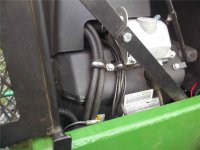
This shows the new location of the fuel pump under the right bottom the fuel tank (there is also a shutoff valve under there).
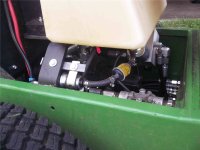
While I was at it, I sprang for high-pressure fuel line made for fuel injection. Not that the pressure is that great but the hose is really beefy and in my mind less prone to vapor lock.
Confident I would not suffer from vapor lock again I attempted another mow. But once again, the engine cut out and dead stopped. Rather discouraged I actually read the engine manual and discovered that there is a temperature sensor wire on the FI version of the engine. It goes up to the FI throttle body/computer and if the engine is too hot, the power to the fuel pump is immediately cut off. This certainly explains the problem! The sensor wire connects to the bottom of the crankcase with a little screw down below where the crankshaft joins the hydraulic pumps. By the time I made it back to the tractor with my IR temperature meter, that screw was still at 212 degrees. I don't know what temp triggers the overheat condition. The top of the crankcase where the PT muffler is about an inch away, was at 298 degrees.
I had never had reason before this to study the PT muffler, and not being an engineer or mechanic of any kind, could only rely on simple observation. First, the round exhaust pipes are perpendicular to the square header pipe (doesn't seem to encourage any velocity) and the square header pipe is smack in the middle of where the air is flowing past the cylinder heads from the flywheel fan, blocking the flow. Then the whole thing is encased by the heat shield, with not much place for the air from the flywheel fan to go, and even worse, that airflow is further blocked by the heat shield. The hydraulic cooling fan on top doesn't pick up any of the exhaust heat due to the heat shield. So the exhaust heats up, which in turn heats up the crankcase, which quickly trips the temperature sensor. This whole exhaust set up wasn't problematic for the 25 hp engine only because it doesn't have a temperature sensor! This doesn't mean the engine isn't overheating, just it isn't smart enough to shut itself down when it does.
Naturally at this point I was rather bummed out with this new engine, but at least I had a clue as to what the problem is, mainly exhaust heat build up. I decided after reading various posts that I had really only two solutions: 1) install a side fan (CFR Performance Electric Radiator Cooling Fan - Flat Blade, HZ-1001-8); and, 2) install the Robin exhaust header/muffler (Robin Subaru Muffler Kit Side Mount Oil Filter Side #92630004). Though probably not necessary or effective, I also covered the entire length of the thermostat wire with Heatshield Products Hot Rod Sleeve thermal sleeving to shield it from ambient engine/exhaust heat.
Cooling Fan
I am grateful for these posts:
Phils's post at http://www.tractorbynet.com/forums/power-trac/99371-pt422-aux-cooling.html?highlight=fan
Kludge's post at http://www.tractorbynet.com/forums/power-trac/65543-added-extra-cooling-fan.html?highlight=fan
I went with the CFR fan because it is only 3 amp and the 8" size seemed perfect. I made up a harness to run off the battery (connected at the starter motor), a 7.5 amp inline fuse, and then through a Therm-O-Disk sensor (identical to the one used by the hydraulic fan) attached to the heat shield. I attached the sensor, based on temperatures I took with my IR temperature meter, to the heat shield.
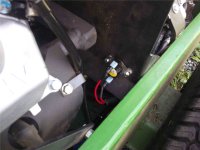
I connected to the ground screw for the fan to an existing ground bolt inside the right rear of the tub.
It takes about 5 minutes or so for the engine to heat up enough such that the heat shield and contact thermostat reach 110 degrees (the closing temp of the thermostat). When I turn off the tractor, the fan keeps running for a few minutes until the temp goes down below 90 degrees. That way the engine when turned off doesn't cook and overheat itself with residual/trapped heat. To test the fan I just zip tied it to the side of the engine compartment and at full operation the temperature sensor screw dropped to 204 degrees, down from 212 (or higher)! And better yet, the stalling problem had been fixed.
For a permanent installation I built a frame out of 1-1/2" c-channel steel and asked my neighbor to weld it onto the tractor. This shows the frame.
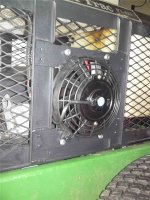
I cut out the diamond screen behind the fan to improve airflow.
FYI, I bought a new battery and the engine has a 30-amp charge coil, so I don't think the fan running after shutdown for at most 15 minutes will be a problem.
Robin Muffler
I am thankful for Gravy's post at http://www.tractorbynet.com/forums/power-trac/100127-robin-exhaust.html?highlight= for ideas on how to use the Robin muffler.
If figured a new, better flowing muffler should reduce heat under the heat shield and a better header let the engine fan push air past the cylinders more efficiently. And moreover the horizontal header pipe is now above the crankcase, hopefully cutting down on radiant heat to the crankcase where the temperature sensor wire is attached. I cut the new header pipe right before the bend and rotated the flange 180 degrees before bolting it on to the muffler. I also bent the stock attachment plate 90 degrees and ran two bolts into the tub. This shows the bracket this along with a little brace I added to strengthen the attachment.
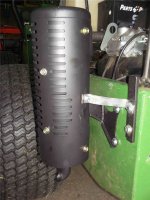
The OD of the Robin exhaust header is 1-1/4" and I found Walker Flex Exhaust Tubing with an ID of 1-1/4". Add 1-1/4" muffler clamps from JEGS and it all bolted together nicely, as shown here without any welding required.
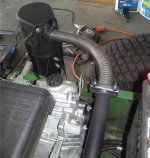
The flex pipe has a nice smooth curve, and it just so happened that the minimum bend radius was perfect, lining up the two ends of the cut header pipe. This shows the smooth bends of the Robin exhaust manifold and how they go away and up from the exhaust ports and higher over the top of the crankcase in comparison to the PT muffler.
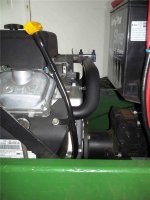
With the Robin exhaust and the side fan running, the temperature sensor screw dropped to 172 degrees! There just isn't as much heat to move out from under the heat shield. While the PowerTrac muffler is I suspect OK with regard to minimizing backpressure, it does poorly with respect to velocity. The Robin header and muffler more speedily remove gas and heat. The temperature at the top of the muffler is only 220 degrees, the bottom a mere 128 degrees. The middle of the flexpipe is only 130 degrees. Compare that with the 672 degree PowerTrac muffler in the same location! The tub under the muffler (which is also further away from the tire but high enough so the tip is above the bottom of the tub) is 160 degrees, down from the original 235.
To make the ideal installation possible I cut out the double plated arch in the engine housing and made a new support structure with a higher/wider opening, as shown here:
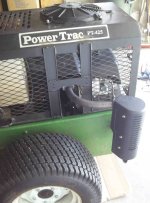
The Robin muffler has a slightly mellower tone such that I can now hear the finish mower whirring and more hydraulic whine, and it has a spark arrestor at the tip as a bonus. But the point of the Robin muffler was heat reduction, so any reduction in volume/tone is a bonus.
With these two changes, the side fan and the Robin muffler, I have had no further overheating, and am enjoying the couple extra horsepower as I mow up the hills. The engine doesn't bog down like the 25 hp engine did, and I don't have to slow down to keep the finish mower blade tip speed up. I also find that with the additional horsepower I can run the throttle at maybe 3200 when finish mowing and have more power than before (check out the power curve on the FI version at http://www.subarupower.com/pspecsheet.aspx?pid=223), which also reduces the volume. When bush hogging 3 grass I go up to full throttle (3600), which seems to work better.
Overall I am feeling pretty darn lucky that the changes enabled the engine to work in the PT-425. There really wasn't anything else I could try, short of putting the old engine back in and eating the cost of the new engine.
I first want to thank these two other members for their very helpful instructions on how to swap out the PT-422/25 engine:
KMA's post at http://www.tractorbynet.com/forums/...ngine-swap-completed-pics.html?highlight=100#
SnowRidge's post at http://www.tractorbynet.com/forums/...tml?highlight=PT-425+engine+removal+procedure
I also took KMA's advice to split the shroud across the top of the engine flywheel fan (http://www.tractorbynet.com/forums/power-trac/309111-engine-heat-shields.html#post3740605) and taped it back together with Gorilla Tape.
All went well with the engine swap, but the first sign of any trouble was during the engine break-in period when the tire under the muffler started smoking and the rubber became quite soft. I quickly moved the tractor a little to prevent a fire.
The FI engine runs at 4000 RPM so after the break in I dialed down the maximum speed screw on the throttle body to be under 3600 RPM to match the max speed of the hydraulic pumps. Keep in mind that the two EH-72 engines are basically identical except for the FI throttle body and electric fuel pump.
With the engine broken in, I tried a little mowing, but things quickly went fatally wrong. The engine cut out and dead stopped after only about 20 minutes. It would not restart.
I went through everything I had done during the swap, but everything seemed tightly and correctly connected. I did notice lots of bubbling in the fuel filter. Vapor lock?
You should be aware that the fuel pump on the FI uses an electric motor, and that motor is mounted on the engine on the left side of the metal cylinder shroud. I used my IR temperature meter and found the PT-crafted muffler to be 672 degrees and the tub under the muffler behind which sat the fuel pump to be 235 degrees. Pretty hot!
Figuring vapor lock, I re-routed both the gas lines (the FI fuel pump requires a gas line from the throttle body back to the top of the fuel tank) to run on the opposite side of the engine. This shows the two gas lines coming out of the side opposite the muffler:
This shows the new location of the fuel pump under the right bottom the fuel tank (there is also a shutoff valve under there).
While I was at it, I sprang for high-pressure fuel line made for fuel injection. Not that the pressure is that great but the hose is really beefy and in my mind less prone to vapor lock.
Confident I would not suffer from vapor lock again I attempted another mow. But once again, the engine cut out and dead stopped. Rather discouraged I actually read the engine manual and discovered that there is a temperature sensor wire on the FI version of the engine. It goes up to the FI throttle body/computer and if the engine is too hot, the power to the fuel pump is immediately cut off. This certainly explains the problem! The sensor wire connects to the bottom of the crankcase with a little screw down below where the crankshaft joins the hydraulic pumps. By the time I made it back to the tractor with my IR temperature meter, that screw was still at 212 degrees. I don't know what temp triggers the overheat condition. The top of the crankcase where the PT muffler is about an inch away, was at 298 degrees.
I had never had reason before this to study the PT muffler, and not being an engineer or mechanic of any kind, could only rely on simple observation. First, the round exhaust pipes are perpendicular to the square header pipe (doesn't seem to encourage any velocity) and the square header pipe is smack in the middle of where the air is flowing past the cylinder heads from the flywheel fan, blocking the flow. Then the whole thing is encased by the heat shield, with not much place for the air from the flywheel fan to go, and even worse, that airflow is further blocked by the heat shield. The hydraulic cooling fan on top doesn't pick up any of the exhaust heat due to the heat shield. So the exhaust heats up, which in turn heats up the crankcase, which quickly trips the temperature sensor. This whole exhaust set up wasn't problematic for the 25 hp engine only because it doesn't have a temperature sensor! This doesn't mean the engine isn't overheating, just it isn't smart enough to shut itself down when it does.
Naturally at this point I was rather bummed out with this new engine, but at least I had a clue as to what the problem is, mainly exhaust heat build up. I decided after reading various posts that I had really only two solutions: 1) install a side fan (CFR Performance Electric Radiator Cooling Fan - Flat Blade, HZ-1001-8); and, 2) install the Robin exhaust header/muffler (Robin Subaru Muffler Kit Side Mount Oil Filter Side #92630004). Though probably not necessary or effective, I also covered the entire length of the thermostat wire with Heatshield Products Hot Rod Sleeve thermal sleeving to shield it from ambient engine/exhaust heat.
Cooling Fan
I am grateful for these posts:
Phils's post at http://www.tractorbynet.com/forums/power-trac/99371-pt422-aux-cooling.html?highlight=fan
Kludge's post at http://www.tractorbynet.com/forums/power-trac/65543-added-extra-cooling-fan.html?highlight=fan
I went with the CFR fan because it is only 3 amp and the 8" size seemed perfect. I made up a harness to run off the battery (connected at the starter motor), a 7.5 amp inline fuse, and then through a Therm-O-Disk sensor (identical to the one used by the hydraulic fan) attached to the heat shield. I attached the sensor, based on temperatures I took with my IR temperature meter, to the heat shield.
I connected to the ground screw for the fan to an existing ground bolt inside the right rear of the tub.
It takes about 5 minutes or so for the engine to heat up enough such that the heat shield and contact thermostat reach 110 degrees (the closing temp of the thermostat). When I turn off the tractor, the fan keeps running for a few minutes until the temp goes down below 90 degrees. That way the engine when turned off doesn't cook and overheat itself with residual/trapped heat. To test the fan I just zip tied it to the side of the engine compartment and at full operation the temperature sensor screw dropped to 204 degrees, down from 212 (or higher)! And better yet, the stalling problem had been fixed.
For a permanent installation I built a frame out of 1-1/2" c-channel steel and asked my neighbor to weld it onto the tractor. This shows the frame.
I cut out the diamond screen behind the fan to improve airflow.
FYI, I bought a new battery and the engine has a 30-amp charge coil, so I don't think the fan running after shutdown for at most 15 minutes will be a problem.
Robin Muffler
I am thankful for Gravy's post at http://www.tractorbynet.com/forums/power-trac/100127-robin-exhaust.html?highlight= for ideas on how to use the Robin muffler.
If figured a new, better flowing muffler should reduce heat under the heat shield and a better header let the engine fan push air past the cylinders more efficiently. And moreover the horizontal header pipe is now above the crankcase, hopefully cutting down on radiant heat to the crankcase where the temperature sensor wire is attached. I cut the new header pipe right before the bend and rotated the flange 180 degrees before bolting it on to the muffler. I also bent the stock attachment plate 90 degrees and ran two bolts into the tub. This shows the bracket this along with a little brace I added to strengthen the attachment.
The OD of the Robin exhaust header is 1-1/4" and I found Walker Flex Exhaust Tubing with an ID of 1-1/4". Add 1-1/4" muffler clamps from JEGS and it all bolted together nicely, as shown here without any welding required.
The flex pipe has a nice smooth curve, and it just so happened that the minimum bend radius was perfect, lining up the two ends of the cut header pipe. This shows the smooth bends of the Robin exhaust manifold and how they go away and up from the exhaust ports and higher over the top of the crankcase in comparison to the PT muffler.
With the Robin exhaust and the side fan running, the temperature sensor screw dropped to 172 degrees! There just isn't as much heat to move out from under the heat shield. While the PowerTrac muffler is I suspect OK with regard to minimizing backpressure, it does poorly with respect to velocity. The Robin header and muffler more speedily remove gas and heat. The temperature at the top of the muffler is only 220 degrees, the bottom a mere 128 degrees. The middle of the flexpipe is only 130 degrees. Compare that with the 672 degree PowerTrac muffler in the same location! The tub under the muffler (which is also further away from the tire but high enough so the tip is above the bottom of the tub) is 160 degrees, down from the original 235.
To make the ideal installation possible I cut out the double plated arch in the engine housing and made a new support structure with a higher/wider opening, as shown here:
The Robin muffler has a slightly mellower tone such that I can now hear the finish mower whirring and more hydraulic whine, and it has a spark arrestor at the tip as a bonus. But the point of the Robin muffler was heat reduction, so any reduction in volume/tone is a bonus.
With these two changes, the side fan and the Robin muffler, I have had no further overheating, and am enjoying the couple extra horsepower as I mow up the hills. The engine doesn't bog down like the 25 hp engine did, and I don't have to slow down to keep the finish mower blade tip speed up. I also find that with the additional horsepower I can run the throttle at maybe 3200 when finish mowing and have more power than before (check out the power curve on the FI version at http://www.subarupower.com/pspecsheet.aspx?pid=223), which also reduces the volume. When bush hogging 3 grass I go up to full throttle (3600), which seems to work better.
Overall I am feeling pretty darn lucky that the changes enabled the engine to work in the PT-425. There really wasn't anything else I could try, short of putting the old engine back in and eating the cost of the new engine.
Last edited:


