Winmac
Gold Member
- Joined
- Dec 31, 2011
- Messages
- 367
- Tractor
- Landini 6860
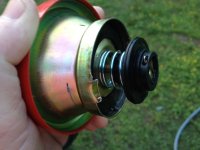
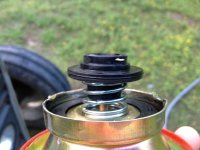
I may be able to explain a couple of the new issues you created, let's see a picture of the underside of the new cap.

I may be able to explain a couple of the new issues you created, let's see a picture of the underside of the new cap.
What dose this mean if you had the cap off with hot coolant then reinstalled it and allowed the system to cool. You now have a negative pressure in the system, this will collapse the rad hoses.

Now here is a new problem that I KNOW isn't right.
I took the bottom hose off the radiator (cold engine).. Took radiator cap off and filled radiator up with garden hose through the bottom of radiator. When the water came out the top of the radiator I put the cap back on and sealed the bottom of the radiator opening with my hand.
Well guess what?! No water came out the radiator UNTIL I removed the cap!! Then all the water came out!
.
And another important thing...
When I first start the engine, and have the radiator cap off, water tends to "push out" the top of the radiator neck as the engine warms up.
It never did this with the old cap. Not sure if it's supposed to do this or not.
Travis, have you ever been served a soda and inserted a straw to the bottom of the glass, then capped the top with your thumb while pulling the straw out of the soda? The soda stays in the straw, doesn't it? The air is not able to make it up the straw to allow the soda to drain back out. The radiator tubes are like straws. The air can not make it up the small tubes To allow the coolant to drain.
Maybe it has to do with the different thermostats, I'm not sure. But is it normal for water to be pushed out the top of the radiator as the engine warms up? I don't remember it doing this with the old thermostat.The cap is off, how can it have anything to do with the coolant level?
water tends to "push out" the top of the radiator neck as the engine warms up.
And I thought it was the pump the whole time.What creates the pressure in the cooling system? Is it the pump,nope..... When heat is applied to a liquid it's volume expands, simple physics.
Maybe it has to do with the different thermostats, I'm not sure. But is it normal for water to be pushed out the top of the radiator as the engine warms up? I don't remember it doing this with the old thermostat.
Sometimes I tend to confuse myself. (As if u didn't already know LOL)
Now I understand how this works. ThanksThis is not a concern. Your new thermostat is opening earlier and apparently faster than the old one. Once the coolant is pushed to the top of the radiator it has to drain down to the bottom without the cap being on the radiator to "push it". Potentially your lower hose may be partially collapsing at the same time and not "drawing" the coolant down the radiator. In addition, as has bee mentioned the coolant pushed into the top of the radiator is now warm, taking up more volume.

So now the question is why the high temp reading on the gage.
.
Please elaborate.OMG. Is this post a joke??
Would it be a correct reading to shoot the infrared thermometer on the outside of the sending unit?? .
Just performed another test..
With the radiator cap on, tractor high idling around 1800 RPMs for about 10-15 minutes, the temp. in the upper radiator fins was around 155F.... The bottom fins read around 85F.... The thermostat housing was reading right at 180F.
I took the wire off on the sending unit and put the infrared light on the brass part of the sending unit. Removing the wire disables the temp gauge completely.
The reading I got was around 143F-147F.... When the wire was plugged back in, the temp gauge needle was still almost to the red (white) just like the previous posted picture.
Again, this is telling me either the sending unit, temp gauge, or both is bad.
Based on the info I posted, does anyone disagree with this?