scrapyard box blade...first fabrication project

/ scrapyard box blade...first fabrication project #1  

stormpetrel

Gold Member
Joined
Oct 16, 2010
Messages
353
Location
Block Island R.I.
Tractor
ym2210D
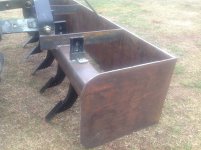
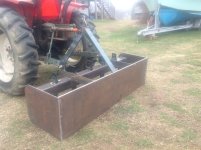
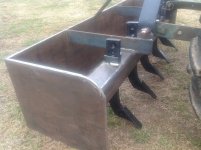
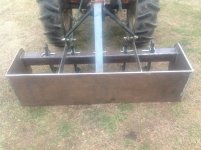
I finally did it!:cool2: It still needs: a second 1/4" plate on one side (the back and other side are made up of two 1/4" plates welded together) and the front and rear cutting blades.

I lucked out the day I went to the scrap yard, they had a 60" 4"x4" square tube and a piece of 1/4" plate steel that was about 59 & 3/4". I got the scarifier shanks and teeth from Agri-supply, as well as the A-frame support.

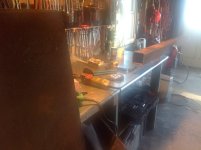
In order to start I had to get the old beat up Cutmaster 38 I got off of ebay working. I finally got the right torch, and inline filter, the correct consumables, and a cutting guide. There was a learning curve just to get the thing cutting right.....too much air, not enough air, no pilot arc (wrong amperage tip) power turned up too much, bad ground. My garage only has 110v, so the machine wasn't operating at full power. It was plenty for cutting 1/4" material though.

I didn't have any plans. What I did was to google "Box blade images" and to carefully study all the photos of box blades for dimensions, ratios, and other features/techniques.

The blade is on the tractor so I could weld with it in the air, and not hunched over the floor. I thought I was building it heavy, but it doesn't even come close to the weight of the 30 gal. barrel counterweight I made. Any guesses what this thing might weigh?

The steel didn't cost all that much, the scarifiers and other stuff I bought new was relatively cheap. It sure is a good thing I didn't have to pay anyone to do this...it would have cost a ton!! Even though it's not quite done, it sure is a nice feeling building your own (sort of large and heavy) tractor attachment. I learned a lot.

I wanted help with: (a)how to cut the forward (inside) cutting edge. Since it's a little less than 60", and the blade will be 60", I'll need to cut it. Can you plasma-cut hardened steel without it losing it's temper? (b) is it better to hinge the rear cutting blade, or not? (c) method of obtaining the 30 degree angle required for the cutting edges; can I weld some steel angle on to do that?

Oh. And yes, the welds are a little rough. AND....made with a little Lincoln 125 (gasp!) flux core welder. Interestingly enough, it was a **** getting the welds apart the couple of times I had to re-weld. It was NOT easy......them welds were *strong*. Now that I have used my tractor grapple to move big-*** stones for a few weeks without the welds I made attaching a new 1/4" top to the bucket cracking I have confidence in them.
 

Attachments

  • image.jpg
    image.jpg
    538.7 KB · Views: 1,966
  • image.jpg
    image.jpg
    529.9 KB · Views: 2,419
  • image.jpg
    image.jpg
    542.2 KB · Views: 1,043
  • image.jpg
    image.jpg
    562.7 KB · Views: 1,181
  • image.jpg
    image.jpg
    308.1 KB · Views: 889
/ scrapyard box blade...first fabrication project #2  
Don't worry about cutting the edge. I'm assuming you'd be cutting off one end. you aren't going to weaken it at all. I'd cut with Plasma if you got it.

I prefer a hinged rear blade that can be bolted/pinned if needed.

Most blades have an angle iron welded into the frame that the cutter edge bolts to. I've saw some where the front and rear cutters were bolted to the same angle iron.

Looks real nice. I love it when a guy invents his own equipment without plans!!!

Keep in mind that when the scarifiers are down the box wants to dump real bad!!!! In other words it will put a lot of compression force on the piece of flat iron you have welded to the back wall of the box and the top of the hitch triangle. If it fails or buckles, it will also twist and distort the flat irons that create the triangle.

As it appears now your box assembly is a LOT stronger than your hitch triangle. May be fine, I'm not familiar with your tractor so don't know it's weight. HP is secondary. Tractor weight is what will test your box blade.

Again, nice job!!! :thumbsup:
 
/ scrapyard box blade...first fabrication project #3  
The blade is on the tractor so I could weld with it in the air, and not hunched over the floor. I thought I was building it heavy, but it doesn't even come close to the weight of the 30 gal. barrel counterweight I made. Any guesses what this thing might weigh?

It looks like you have done a very good job. As far as the weight, 1" plate weighs 40lbs. a square foot, 1/2" plate weighs 20lbs. and so on, so your 1/4" weighs 10lbs. a square foot. All you have to do is measure each piece and do a little math.
 
/ scrapyard box blade...first fabrication project #4  
looks like a very good job on the fabrication...my only thought is if I had the basic materials and the need of a (different) box blade...I would make one with hydraulic scarifiers...or at least start with a design than would allow an adaptation...

again, very nice work...don't know how powerful your tractor is but if you use that bb enough you will find out which is tougher...good luck...
 
/ scrapyard box blade...first fabrication project #5  
Looks great! Good job.

Personally, I prefer that the rear blade be fixed, not hinged. I don't think it really makes a lot of difference though.
 
/ scrapyard box blade...first fabrication project #6  
Looks great! Good job.

Personally, I prefer that the rear blade be fixed, not hinged. I don't think it really makes a lot of difference though.


Why do you prefer a fixed??


With a smaller tractor/box blade it might not matter much. Where a hinged blade comes in handy is if trying to dig. With the rear blade floating, the box blade will have to be carried by the 3pt to keep it from digging until it stalls the tractor.

If you have TnT you can overcome a fixed blade by shortening the top link to get the front blade to cut deeper. If not, you're kinda stuck with a 1/4" cut at a time.

I rarely fasten my hinged rear blade. Just let it swing. I've gotten used to it and can control the cut very well.
 
/ scrapyard box blade...first fabrication project #7  
Box blade which have 2 blades in back, one facing forwards which is fixed, & the rear one which floats while going forward but is pushed against stops when pushing against the back of the blade while driving the tractor backwards are very handy & practical. As one poster mentioned if the second blade did not hinge out of the way, it would work as a gauge & prevent the first blade from digging in.

Stormpetrel's box blade only has the one fixed blade in back which it looks like his cutting edge will be fastened to. I would recommend he weld a strong back across the back of the blade to keep it from bowing.
 
/ scrapyard box blade...first fabrication project #8  
Looks pretty good, few things the top edge (back edge without some bracing will bend.)

Here is a close up pick of mine which is BENT at the top 90 degrees to reinforce the top AND a 2x2x1/4" angle welded across the top back INSIDE the box area.
(NOTE: this was taken because I added the Receiver tube to my Box Blade. I USED to have a plate welded to that 90 degree bend and had a ball bolted in but had to un-bolt ball every time I wanted to switch from one ball size to the other (I have all 3 sizes of balls on different trailers.)


and INSIDE of the box back plate w Receiver tube welded in. note this reinforces the box blade a lot too the tube was A HF 18" one paid 12 bucks for it.


The BOTTOM of my box blade is a 3x3x3/8" angle welded on point to the 1/4" back plate. there is no cutting edge that is removable. SOME use the 3x3 and then drill and bolt hardened plate to the base. the angle is upside down between the side plates. On your's you would have to cut out the back plate some to install it.

Mark
 
/ scrapyard box blade...first fabrication project
  • Thread Starter
#9  
Thanks for the comments, folks! I LOVE the receiver tube/reinforcement trick...nice.

My box blade walls are 1/2" thick (except for the left side, 'cause I ran out)...I welded two 1/4" sheets together to make the right side and rear panels. I have considered: (a) beefing up the top with a 3/8" thick x 2" wide strip welded along the entire thing and (b) "boxing in" the support that goes from the top of the back of the box blade to the hitch a-frame support top with a 1/4" x 2" strip on both the left and the right sides, running the full length.

Can anyone post a photo (or drawing/diagram) of how the angle iron would be mounted, and how the cutting blade would be bolted? I can't quite wrap my head around how this'll work. I was thinking I would weld angle iron on at the bottom of the back side and the front (inside) of the back of the BB to create the 30 degree angle necessary, and hang the cutting edge an inch or so below the bottom. Is that not right?

THe Yanmar 2210D weighs around 3500-3600 w/ loader, grapple and tooth bar. In 4wd and in low gear it's quite a powerful little 26 hp machine.

Thanks again for the kind words and suggestions. I have a lot of time, thought and work into this project, and want it to come out right........
 
/ scrapyard box blade...first fabrication project #10  
some thing like this, the BACK is actually shorter than the sides, BUT the ANGLE or welded in plates make up the rest of the height of the BACK part of the box blade.


I simulated bolted on cutting edge in that angle on back. & added the simulated box tubing & cutters 3 pt hookup... just quick sketch.

Mark
 
/ scrapyard box blade...first fabrication project #11  
Yep, like Spiker's drawing. The angle iron is in place like this ^
 
/ scrapyard box blade...first fabrication project
  • Thread Starter
#12  
Ok....I get it. That should be an interesting welding situation! I'll have to grind the upward-facing point of the angle flat to mate that surface to the bottom edge of the BB.....?

It'll also be fun cutting away the bottom edge, 1/2". On 110 V house current. :/
 
/ scrapyard box blade...first fabrication project #13  
No actually the angle usually goes inside the box. But then, the rear panel of a box is usually rolled a bit and mates to the top of the angle ^. Let's see,,,,, how you gonna do this?? Maybe use flat iron to bolt the cutter to? Weld in a piece of flat at a 30 degrees angle tipping forward to bolt the front blade to? Then add a similar piece on the back side to bolt the rear blade to??? You could then weld in some braces between your existing back panel and those flats to give it more strength? The bottoms of the flats would be flush with the bottom of the box. Then your cutters would bolt on with them hanging down 1/2" or so??
 
/ scrapyard box blade...first fabrication project #14  
Looks good. Definitely add the angle on the bottom. It provides a lot of stiffness to the bottom edge, and also is perfect for bolting a cutting edge onto. I'd replace the flatbar rear support on your 3pt with square tube, or at a minimum, weld another piece of flat on it to make it a "T" shape. The flat will bend in compression. Also consider stiffening the top edge of the back of the box by welding a piece of angle (or flat) to it, too, like this:
_
|
|
^

You don't need to grind the "point" off the angle... after you cut the rear plate off up higher (have fun!), butt the angle to it and fill the gap with weld fillet. When butt welding, you always want a notch to fill so you get good penetration into each piece rather than just on the surface.

It's surprising how heavy these things get after adding all the bit together, isn't it!
 
/ scrapyard box blade...first fabrication project
  • Thread Starter
#15  
I'm liking the idea of welding flat steel at the bottom of the BB front and back. And NOT cutting the 1/2" steel. I could weld little triangles into the empty space and get a very strong bottom edge. I could also weld a 1/4" flat strip onto the bottom edge, then weld my 30 degree flat steel (that the blade would get bolted to) to that, then hang the blade 3/4" or so below that? Thoughts?

I was gonna get the cutting blades from Agri-supply. I don't see thickness and width dimensions on their site. Is there a standard thickness & width for a 60" cutting edge?
 
/ scrapyard box blade...first fabrication project #16  
I'm liking the idea of welding flat steel at the bottom of the BB front and back. And NOT cutting the 1/2" steel. I could weld little triangles into the empty space and get a very strong bottom edge. I could also weld a 1/4" flat strip onto the bottom edge, then weld my 30 degree flat steel (that the blade would get bolted to) to that, then hang the blade 3/4" or so below that? Thoughts?

I was gonna get the cutting blades from Agri-supply. I don't see thickness and width dimensions on their site. Is there a standard thickness & width for a 60" cutting edge?

The triangles is what I was thinking. You can't run the 1/4" Flat Strip all the way across the bottom edge of the box back panel because then you wouldn't be able to get in there to bolt on the cutters. Just use the triangle idea maybe every foot or so. Also for the rear you can cut and weld in a triangle on each end to close that gap and add strength. As for the triangles, don't weld them in until you've drilled your blade holes. Otherwise, if your luck is like mine, you'd weld one exactly where a cutter bolt goes!!!!

I'm not sure about the cutter dimensions. I'd want cutters with the bolt holes in the middle so they can be reversed. I think you should purchase the cutters before you build the brackets we are talking about to mount them to. That way you can make up and down adjustments to those brackets to place your cutters where you want them before you weld the brackets on. If you don't have the cutters you won't know for sure where the best placement is.
 
/ scrapyard box blade...first fabrication project #17  
Hey Guys:

It can be fixed with the small triangle cut out hunks and 1/4" flat bar with holes drilled and some Nuts welded into that so you can bolt the cutter edges onto it.

I modified the drawing from page one and showed end and back view w colors to show different parts welded/bolted together.

CLICK PIC FOR FULL SIZE LOOK


BLACK is 1/2" existing back plate
Orange is the 1/4" flat bar
Red is the Cutter Edge
Pink Bolts
Grey is the 1/4" cut triangles to fit and support the 1/2" to the two 1/4" & Cutting edges so all of it ties together supporting itself all as one part.

I would add some 2x2 or 3x3 angle to the TOP Edge too, and that down drag can be replaced with channel OR modify with some 1x1/4 bar welded in to keep it from collapsing when pushing and the thing wants to roll/twist up on ya.

I pushed my factory built box back into my tire almost it bent so bad when I hit a stump backing up... :eek:

Like someone mentioned bolt that cutter edge to the 1/4" and weld the nuts on back then tack weld the 1/4" to the box blade so that the cutter edge is 1/4" below the side plates, (set it on floor on some 1/4 shims then set the edge and 1/4" against the back 1/2" & tack it good same goes for inside, you MAY have to cut down the hardened cutting edge for the inside cutter (forward pulling cut).


Mark
 
/ scrapyard box blade...first fabrication project
  • Thread Starter
#18  
Hey Guys:

It can be fixed with the small triangle cut out hunks and 1/4" flat bar with holes drilled and some Nuts welded into that so you can bolt the cutter edges onto it.

I modified the drawing from page one and showed end and back view w colors to show different parts welded/bolted together.

CLICK PIC FOR FULL SIZE LOOK


BLACK is 1/2" existing back plate
Orange is the 1/4" flat bar
Red is the Cutter Edge
Pink Bolts
Grey is the 1/4" cut triangles to fit and support the 1/2" to the two 1/4" & Cutting edges so all of it ties together supporting itself all as one part.

I would add some 2x2 or 3x3 angle to the TOP Edge too, and that down drag can be replaced with channel OR modify with some 1x1/4 bar welded in to keep it from collapsing when pushing and the thing wants to roll/twist up on ya.

I pushed my factory built box back into my tire almost it bent so bad when I hit a stump backing up... :eek:

Like someone mentioned bolt that cutter edge to the 1/4" and weld the nuts on back then tack weld the 1/4" to the box blade so that the cutter edge is 1/4" below the side plates, (set it on floor on some 1/4 shims then set the edge and 1/4" against the back 1/2" & tack it good same goes for inside, you MAY have to cut down the hardened cutting edge for the inside cutter (forward pulling cut).


Mark

Oh yeah, that'll do it! Should add a bunch of weight to the whole thing too! Thanks!
 
/ scrapyard box blade...first fabrication project #19  
I'm with Mark on everything except welding the nuts. I don't recommend that for long term use.

It will take you quite a while to wear out your cutters. So when, not if, when the day comes that they need flipped or replaced the bolts/nuts may be rusted to the point that the bolts twist off or eat the threads out of the nuts on the way out. Usually caused by a couple threads of the bolts sticking thru the nuts and exposed. If you've welded the nuts, this will be a disaster to fix and will probably require cutting your flats loose so you can get at the welded nuts.

Additionally cutters usually have square holes in them for the bolts. Designed to use carriage or plow shear type bolts which require the nuts be turned to remove them.

I suggest using triangle braces between the cutter bolts and leaving the bottom open so you can access the nuts. Then when it's time to change the cutters, if needed, you can cut the nuts off with a torch and replace them without having to disassemble the cutter holder assembly.
 
/ scrapyard box blade...first fabrication project #20  
I wish the scrap yards around me would let me pick, but they won't!
 
 
Top