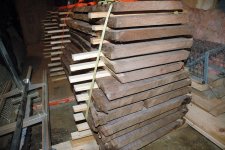
Harvesting Black Walnut with an Alaskan Saw Mill

/ Harvesting Black Walnut with an Alaskan Saw Mill #1  

LogChain

Member
Joined
Oct 11, 2006
Messages
41
Location
Oak Ridge, Tennessee
Tractor
None
Well, it finally happened. A gust of wind on the leading edge of a thunder storm took down one of my black walnut trees--one that had been ailing for several years. The tree had stood ~70 feet tall, was ~18" in diameter at its base, and was located ~100 yards from the house in a wooded area difficult to reach except by foot. Because of its size and location, it was not a good candidate for the local portable saw mill operator, but was of great interest to me as a hobbyist woodworker. Sadly, I am way overdue in making my youngest daughter her dresser :eek:. So with a nudge from Mother Nature, let the fun begin :licking:!

I've been following MotorSeven's "The Log house Project begins ........" thread http://www.tractorbynet.com/forums/projects/156451-log-house-project-begins-32.html for several years and have especially enjoyed seeing what he has done with his portable saw mill (e.g, ~ Post 315). I thought I might share with interested TBN members a smaller scale project using a smaller scale saw mill--the Granberg 36" Alaskan Saw Mill. I hope to show the steps to harvest successfully black walnut lumber from a single isolated tree.

The Alaskan Saw Mill is a rectangular frame that clamps to the bar of a chain saw. I use a Husqvarna 3120 XP power head with a 32" bar and a rip chain. The saw has plenty of power (8.4 hp) and a trigger lock--two features which are important for portable saw mill use.
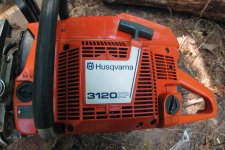
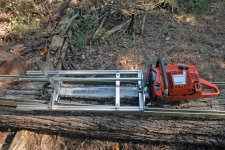
3120XP Power Head.jpgAlaskan Saw Mill.jpg

I also use the Alaskan Saw Mill G 850 slabbing rail brackets for the first cut of a log. Instead of using 2 x 4's for rails as suggested in the instructions, I use a pair of 10' perforated steel UniStrut channels. They seem to be straighter and stiffer than 2 x 4's and don't tend to get cut up for other purposes and be unavailable when needed for slabbing.
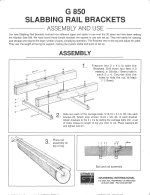
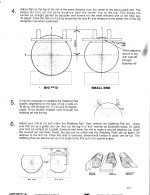
Alaskan Saw Mill Brackets_Page_1.jpgAlaskan Saw Mill Brackets_Page_2.jpg

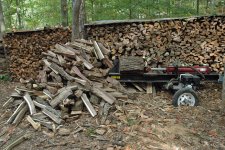
Before slab cutting (or live sawing) the logs, I limbed the tree and cut the top and branches in 22" lengths for firewood. Other trees that were in the fall line of the walnut were also cut into fire wood. My "orange tractor" (the 5.5 hp DR Power Wagon--it's all I've got :eek:) was convenient to bring the fire wood up the hill to the house for splitting. I may be one of only a few TBN members whose chain saw can out power his/her tractor.
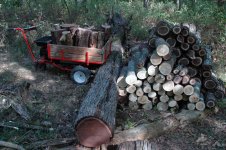
Firewood At Stump.jpgFirewood at Splitter.jpgFirewood Split.jpg

Next, two logs 9' 6" long were cut from the trunk, and the lower log was pulled into a convenient position for slabbing with my log winch/skidder (human powered at about 0.25 hp :sweatdrop:). Although this setup lacks a LogChain (my moniker), it's light and effective.
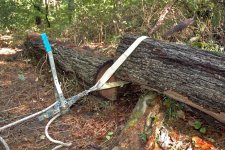
Log Winch-Skidder.jpg

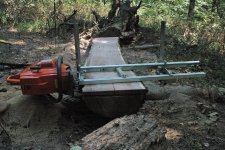
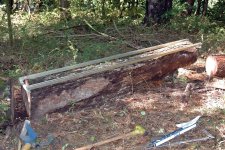
Then the two rail brackets were leveled and attached at opposite ends of the log equidistant from the log center (in this case ~6.5") with four duplex-head 20p nails. The two 10' UniStrut rails were finally placed on the brackets roughly parallel to each other and secured with nuts.
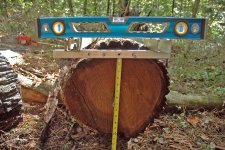
Rail Bracket Attachment.jpgRail Brackets Installed.jpg

After setting the rails, the day was getting late, and I was getting tired so I decided to delay slabbing until this coming weekend. Yes, I've got a job. Please stay tuned :rolleyes:.

-- LogChain
 
Last edited:
/ Harvesting Black Walnut with an Alaskan Saw Mill #2  
Subscribed! Watching with interest, as I have a big stand of black walnut trees and a house to help build over the next few years. I'd love to mill some slabs for counters, cabinets, trim, furniture, etc. A full-on sawmill is out of my price range for the foreseeable future, but an alaskan mill might be doable. hate to put that kind of hurt on the chainsaw, but maybe it's not so bad...?
 
/ Harvesting Black Walnut with an Alaskan Saw Mill #3  
Interesting. I always wanted to try one of those things.
 
/ Harvesting Black Walnut with an Alaskan Saw Mill #4  
Cool! I look forward to seeing the rest. I have two walnut logs I want to get sawed up at some point. Have been thinking about getting an Alaskan sawmill rig.

deezler, if you have a big enough saw (at least 70cc) and the proper bar/chain, it's not bad at all. For sawing boards, you can get a narrow kerf rip chain with cutters designed specially for this task. When cutting along the grain, the ripping chain will not slow down or heat up like a regular chain would, plus it clears chips better and makes a much smoother cut. Just don't free-hand or cross-cut with it -- it's definitely intended to be used in a jig.
 
/ Harvesting Black Walnut with an Alaskan Saw Mill
  • Thread Starter
#5  
Thanks for expressing your interests. I find two websites particularly useful for information on the Alaskan Saw Mill and lumber harvesting in general:

Welcome To Madsen's Online

and

Husqvarna Chainsaws, Outdoor Power Equipment and Tree Care Supplies from Bailey's

They have some good tips, pictures, and what I consider sales videos on using the Alaskan Saw Mill. They also discuss (and sell) several types of rip chains.

I now use the Oregon #72RD rip chain I got from Madsen's. It looks (and costs) similar to a standard saw chain but the top plate has a little blunter angle which makes it a little more aggressive. I have, by mistake (or perhaps by laziness), used the Oregon rip chain for cross cutting. It crosscuts noticeably faster than the standard saw chain but should probably be used only for ripping for safety (kickback) reasons.

I have used other rip chains with a skip-tooth type designs that work well also. See for example:

Granberg Ripping Chain | Granberg International

As I recall, however, these chains were a little harder to sharpen than the Oregon rip chain. Whatever kind you use, be sure that the pitch is right for your sprocket and the gauge is right for your bar. I have a few mismatched chains in my closet.:duh:

My chain is sharp, my powerhead is fueled and oiled, and I'm ready to RIP (Saturday)! :thumbsup:


-- LogChain
 
/ Harvesting Black Walnut with an Alaskan Saw Mill #6  
I love the internet. I'm just biding time til I retire and can start doing stuff!
 
/ Harvesting Black Walnut with an Alaskan Saw Mill #7  
Using a sawmill is a lot of work. I use mine every now and then. Here are some slabs I made benches out of. That is some nice looking black walnut he is sawing...
 

Attachments

  • husky sawmill.jpg
    husky sawmill.jpg
    1,007.3 KB · Views: 1,758
/ Harvesting Black Walnut with an Alaskan Saw Mill
  • Thread Starter
#8  
I love the internet. I'm just biding time til I retire and can start doing stuff!

Stick,

My view on this is, "Do as much 'stuff' as you can now before you retire so when you retire you're in good enough shape to do 'stuff' full time." :) What you do now is training for retirement.


-- LogChain
 
/ Harvesting Black Walnut with an Alaskan Saw Mill #9  
Have you considered using screws instead of nails to hold the rails.:D

Just for information I've made my own chainsaw mill. There are pictures of it on TBN.
 
Last edited:
/ Harvesting Black Walnut with an Alaskan Saw Mill #10  
A beautiful tree. Looking forward to more pics of your project.
 
/ Harvesting Black Walnut with an Alaskan Saw Mill
  • Thread Starter
#11  
Using a sawmill is a lot of work. I use mine every now and then. Here are some slabs I made benches out of. That is some nice looking black walnut he is sawing...

Johnk,

Nice setup. I agree with you that using the Alaskan Saw Mill requires a lot of effort. I liken it to the sustained effort required to hold yourself in a raised "push-up" position for the duration of the cut--perhaps 20 minutes. The milling is NOT a passive exercise but I believe a healthy one--not too dangerous and not too nasty. I suppose a logger's physique is the worst that is likely to result from milling ;).

Like you, I use my mill every now and then--actually no more than once every two to three years and only for what I consider special trees such as those that are used in projects that might be passed down to future generations. Imagine "Your great grandpappy made this beautiful desk with wood he cut from his homestead in the Tennessee mountains." And the response, "Uhh, what's wood?" I can dream, can't I? :D

Enjoy your mill, if only occasionally

--LogChain
 
Last edited:
/ Harvesting Black Walnut with an Alaskan Saw Mill
  • Thread Starter
#12  
Have you considered using screws instead of nails to hold the rails.:D

Just for information I've made my own chainsaw mill. There are pictures of it on TBN.


http://www.tractorbynet.com/forums/projects/159689-chainsaw-mill.html


Egon,

Wow, your chainsaw mill makes mine look a little wimpy. But mine IS more portable. :)

Yes, screws would be fine for the rail brackets. I got the brackets about fifteen years ago before lithium batteries and cordless tools were so readily available. Then, duplex head nails were maybe considered the removable fastener of choice (?).

-- LogChain
 
/ Harvesting Black Walnut with an Alaskan Saw Mill #13  
LC, looks like fun...I love the smell of 2 stroke fumes in the morning.....or any other time:D

I've never tried a slabber, but someday I hope to have one. I have read a few threads on them and some of the guys place the log on an incline, which makes sawing it a bit easier going down hill.

Looking forward to the results.......!
 
/ Harvesting Black Walnut with an Alaskan Saw Mill
  • Thread Starter
#14  
LC, looks like fun...I love the smell of 2 stroke fumes in the morning.....or any other time:D

I've never tried a slabber, but someday I hope to have one. I have read a few threads on them and some of the guys place the log on an incline, which makes sawing it a bit easier going down hill.

Looking forward to the results.......!

Rick,

For me this weekend it'll be 2 stroke fumes in the morning while slabbing, 4 stroke fumes in the afternoon while slitting firewood, and diesel fumes at night while dreaming about the tractor I don't have :) .

I really like the idea about slabbing on an incline. Although the walnut nut tree happens to be in one of the few flat areas in my property, I'll try to take advantage of all the incline I can manage. Thanks.

BTW, I just saw that I graduated from a TBN New Member to a TBN Member! It shouldn't be more than a few centuries before my next graduation!

-- LogChain
 
/ Harvesting Black Walnut with an Alaskan Saw Mill #15  
Your not kidding..."flat" land in our area is pretty rare.....but that's why I like it so much:)
 
/ Harvesting Black Walnut with an Alaskan Saw Mill
  • Thread Starter
#16  
Summary: The weekend lumber harvest was successful. The saw was run at full throttle for a total of five hours (15 rip cuts at about 20 minutes per cut). Nearly three gallons of 2-cycle fuel mix and 1.5 gallons of bar chain oil were consumed. The harvest yielded thirteen 1" thick boards, 9.5' long and ~1' wide. Am I tired? I can barely move. Was it fun? You bet! Now the details ...


Early (well actually closer to 10 AM) Saturday morning, I met six curious guests at the base of the walnut tree. One lingered long enough for me to take a picture (Find Freddie).

Curious Guest.jpg

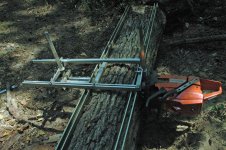
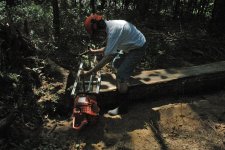
The depth of cut of the Alaskan Saw Mill was first adjusted to just BELOW the rail bracket (~3") that I had attached a week earlier and a cut was made with the Saw Mill sliding on top of the UniStrut rails. The rate at which the first cut was made was about one foot of linear travel per minute. The log had been intentionally inclined so that the direction of the cut was slightly downhill, as suggested by MotorSeven, in order to take advantage of gravity; this inclination seemed to help reduce the operator effort required to cut. I stopped in the middle of the cut to take a picture.

First Cut.jpg

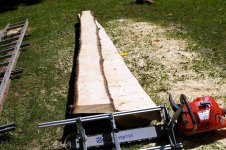
After completing the cut, I lifted the waste slab and the attached rails from the log thereby exposing for the first time a view of the rough cut lumber--a nice mixture of heart wood and sap wood. :thumbsup:

First Look at Lumber.jpg

Notice how close to the tree stump the cutting actually occurs (~6"). This capability of the Alaskan Saw Mill reduces the need for heavy equipment to position and lift the heavy log--perhaps not such a good thing for someone trying to justify a tractor purchase. :duh:

Quick calculation: The density of green hardwood is nearly (and sometimes greater than) that of water (~62.4 lbs. / cu. ft.). The volume of this roughly cylindrical log is its length (9.5 ft.) times Pi (~3.1416) times half its average diameter (~8 in. or 0.67 ft.) squared (0.444 sq. ft.) or ~13.26 cu. ft. The weight of this log is its density (62.4) times its volume (13.26) or ~827 lbs.

The brackets and rails at this point were no longer needed and were put aside for the next log.

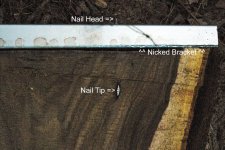
Because I was trying to maximize my lumber yield from the tree (walnut is usually considered "black gold" by furniture makers, and they can never have too much of it :) ), I adjusted the Saw Mill a little too high and nicked one of the aluminum brackets and one duplex steel bracket attachment nail when exiting the log. I guess I got a little too greedy. I examined the chain after this mishap, and it seemed ok. So after topping up the fuel and oil, I continued without re-sharpening.

Bracket and Nail Labelled.jpg

The Saw Mill was now adjusted to the desired rough thickness of the boards (in this case 1"), and boards were ripped with the Saw Mill sliding on top of the flat surface of the log made by the previous cut. The picture shows the center cut midway down into the log, after taking off three boards. As you can see, saw dust accumulation can be significant when slab cutting with a chain saw.

The Center Cut.jpgSaw Dust A Plenty.jpg

At the midway point, I was visited by another guest--my mother (no, NOT Freddie again!). She had heard the chainsaw running nearly continuously for more than an hour and decided to venture down the foot trail to investigate. I let her have some fun and cut a part of one slab, but only because it was her 86[SUP]th[/SUP] birthday. I guess you can always count on your mom for help when the going gets tough!

Mom Finishing The Log.jpg

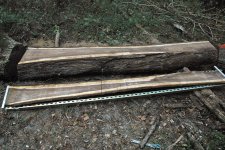
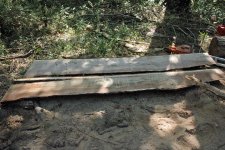
The remaining portion of the log was cut into 1" thick rough boards. The total yield for the log was seven 1" thick boards that were ~12" wide and 9' 6" long or ~66 board-feet. Waste consisted of the two end boards (pictured) and the saw dust from eight chainsaw cuts (chain kerf/ width ~3/8") or the equivalent of ~28 board-feet of lumber dust! In the foreground of the picture, the light brown is not dirt but is saw dust 4 to 8" deep.

Waste Wood.jpg

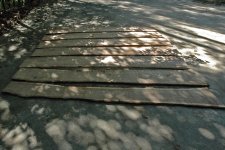
The total cutting time per cut was ~20 minutes which included fueling, oiling, and resting. About 1.5 gallons of gasoline were burned, and ~3 quarts of bar oil were consumed for this log. The boards were individually hand/leg carried up the hill to the house (remember my lack of a real tractor?) and displayed on the driveway while the second (slightly smaller) log was slab cut.

Seven Boards.jpg

The second log yielded six 1" thick boards (~47 board-feet). Pictures of the second log cutting were unfortunately lost due to operator error by the camera man (me).

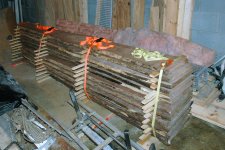
All the boards were then stacked and stickered in the garage. I used 24" grade stakes from Home Depot for the stickers and 1" nylon ratchet straps for binders.

The Big Stack.jpgBig End View.jpg

I intend to air dry the boards for about a year (depending on moisture content) before trimming and planing to 0.75" thick for furniture work. This plan has worked well for me in the past with a larger 28" diameter red oak log. During the initial drying, I will be on the lookout for mold. This was a problem earlier with the red oak, but not a problem with red cedar--perhaps not so surprising. I have box fans on standby in case mold becomes a problem.

Things I've learned from this project include the following:

a) Freshly cut walnut when drying smells really good (so do oak and cedar for that matter); imagine the bouquet of something similar to a mixture of pipe tobacco, leather, and horses;

b) Black walnut lumber is not dark in color when freshly cut but is rather a paler yellow/brown; the rich chocolate color takes hours/days/years (?) to fully develop. Maybe this should not be a surprise. [ Aside: As an experiment for the adventurous, try removing the green hulls of several dozen black walnuts with your bare hands (no rubber gloves allowed). The walnuts nuts here in Tennessee are just about perfect for this experiment right now. If needed, you can first stomp on the nuts with your feet to loosen the hulls, as long as you are either barefoot (as most of us folks in Tennessee are :us-tennessee: ) or wearing your good shoes. Then observe and record the color of your hands over the next several hours. At the end of this experiment, rinse off your hands/feet (cold water will probably be sufficient) and head off to Hancock County, Tennessee to MotorSeven's cabin with your results--I hear he needs someone to hold a bag for some kind of snipe hunt. :D ]

and c) The yield when slab cutting lumber from a log using a saw mill with a chain saw is low--only ~47% of the walnut logs was converted to rough lumber and after trimming and planing the boards, the yield will likely be less than one third.

Regardless of the yield, I did have fun (although I am rather sore) and have enough drying walnut for my daugther's dresser :) . Expect a follow-up on the outcome of the drying lumber in about year.

-- LogChain
 
Last edited:
/ Harvesting Black Walnut with an Alaskan Saw Mill #18  
Thanks for the Explanation and pictures.:thumbsup:

Did yo use wedges in the saw kerf?
 
/ Harvesting Black Walnut with an Alaskan Saw Mill #19  
Wow excellent job! I have some observations. Your very meticulous and very organized and that makes this kind of a job easier. Excellent use of ratchet straps to keep the stickered slabs from warping. 1" is a good all around size for wood working. Math is not my strongest subject, your weight calculations made my head hurt:no::D.

You sawdust is way too "fine", you should be throwing much larger chips which is slowing you down some...although on the plus side it produces a smoother cut. What degree are you filing and how often are you sharpening?? Most go between zero and 10 degrees, re-sharpen after a few slabs. I need to find my Woodbug video on rip chain sharpening for you. He does things a little different(25 degree top angle and 15 degree down angle) and files into the cutter...not away like most of us were taught. The hard chrome coating on the cutting tooth is what does the cutting. Filing away makes little jagged edges of the coating hang off the cutter which soon get broken off leaving a tiny divit on the cutting edge(dull). Filing into the cutter smooths that hard chrome and blends it into the steel of the tooth so there is nothing to break off and the edge stays sharper longer. Filing both ways the chain is equally sharp to begin with, but I found that filing "in" made the my chains go much longer between sharpening's. Give it a try...I only file "in" now on all my saws, besides how did Dad teach us to sharpen a knife....."in" right?

Anyway, outstanding job, beautiful wood. Years from now you will pull out a slab for a project and smile:)
 
/ Harvesting Black Walnut with an Alaskan Saw Mill
  • Thread Starter
#20  
Thanks for the Explanation and pictures.:thumbsup:

Did yo use wedges in the saw kerf?

Egon,

Good point. Yes. When I remembered, I did use plastic wedges in the kerf between the board being cut and the log to reduce binding and re-cutting of the board. I didn't, however, notice much difference with and without the wedges :confused3:

-- LogChain
 

Marketplace Items

Hercules Pesticide Applicator with Nozzle (A61568)
Hercules Pesticide...
2014 FVCG TRAILER (A61567)
2014 FVCG TRAILER...
New/Unused ATS-ME18 Mini Excavator (A61166)
New/Unused...
2007 Bobcat T300 High Flow Compact Track Loader Skid Steer (A60352)
2007 Bobcat T300...
2016 CATERPILLAR 305E2 CR EXCAVATOR (A62129)
2016 CATERPILLAR...
2014 Kubota RTV X900 4x4 Diesel Utility Cart (A61567)
2014 Kubota RTV...
 
Top