Barn Restoration

/ Barn Restoration #1  

Raider43

Bronze Member
Joined
Feb 8, 2012
Messages
91
Location
Newtown, Ct
Tractor
Kubota L35 "1998",Kubota RTV900 "2010", Samsung SE210LC-2"1998" AM General M817 dump truck "1972" John Deere 450B "1998"
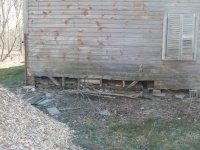
I have started on a project never attempted before (by me). I have a late 1800's two story hay barn which has settled a good 6" on some of the sides. The main sill beam is completely gone. The ridge is good and straight and has not sagged too much at all if any. I stopped the continuing sagging by jacking up an inch or so and placing some rock and wood to prevent it. Next step is to form up some jacking points and pour some concrete mix. I was told that you have to do this very slowly and take some time or the slate roof will get damaged (I am heading that). It would help if I could get some pointers from the group. I have read a bit, but this forum is great.
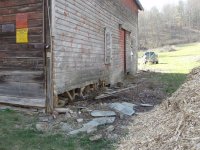
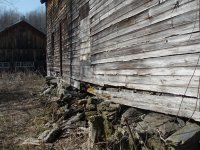
P4130011.JPGP4130009.JPGP4130003.JPGP4130001.JPG
 
/ Barn Restoration #2  
I can't give you any advice but will follow your progress. It is great project and it will look great when finished. I love old barns how they were put together with wooden pins instead of bolts and nails. I think old barns should be saved.
 
/ Barn Restoration #3  
Glad to see someone restoring an old barn. To many people ruin perfectly good barns by not keeping a good roof on them and ignoring painting them. In the late '70s and mid '80s I helped my dad rejuvenate barns on a couple of pieces of property he purchased (unfortunatly the 1890's house on one was beyond salvage).

We used several (10-12) screw type house jacks and large (8"x8" posts I believe), and over a period of several days raised one of them over 12" to dig new footings, pour concrete, and make new sill plates. The key is to not get in a hurry. As I remember start to finish on each took between 45-60 days.

Good luck on your project, and as always, work safely.

Ken
 
/ Barn Restoration #4  
I am looking forward to this thread. Some day (year) I am going to rehab our old barn. The foundation walls are crumbling in some places and the 1st story walls are bowing out. The previous home owner had someone come in and install a couple of support posts and beams on the inside to stabilize it. Hopefully I can learn from your experiences.
 
/ Barn Restoration
  • Thread Starter
#5  
I am in no rush and do have a good roof (had it patched last fall) new ridge cap left at the property. I actually have 4 barns, one was re-constructed by previous owner and one is really in need of help. I may just use for parts on barn #1 which I am rehabbing. It will be slow, the ground level floor is shot, but the second floor seems pretty good. This may be a long thread (time wise). Just stay posted and maybe you all can keep me motivated. This week coming is the jack points to be created.
 
/ Barn Restoration #6  
I worked at a farm park that had a big barn built in the 1880's that had rotting sills and a foundation wall that collapsed and posts that were rotting out. We got it all repaired and repainted in 2006 so it should be good for another 100 years.
Sorry I messed up in attaching these in any kind of order. The first picture is the new white oak sill installed. The siding was removed because most of it needed to be replaced also. 2) The barn when everything was completed and painted. 3) New siding put on. 4) Some of the old wide board siding was reused. 5) Battens were replace on much of the barn. 6) another view of the new sill. 7-9) Several of the posts were also rotten at the bottom, these photos show how they spliced in new wood to the old. Long lab screws were used to attached it to the sill.

You have quite a project in front of you. The craftsmanship in these old barn is really worth saving. I marvel at the hand hewn beams in this barn that were perfectly square. The joints they made are amazing. Good luck with your project.
Rick
 

Attachments

  • IMG_0897 (Small).JPG
    IMG_0897 (Small).JPG
    52 KB · Views: 556
  • IMG_0898 (Small).JPG
    IMG_0898 (Small).JPG
    31.1 KB · Views: 456
  • IMG_0899 (Small).JPG
    IMG_0899 (Small).JPG
    36.4 KB · Views: 471
  • IMG_0910 (Small).JPG
    IMG_0910 (Small).JPG
    64.4 KB · Views: 461
  • IMG_0418 (Small).JPG
    IMG_0418 (Small).JPG
    39.3 KB · Views: 375
  • IMG_1200 (Small).JPG
    IMG_1200 (Small).JPG
    54.9 KB · Views: 419
  • IMG_1202 (Small).JPG
    IMG_1202 (Small).JPG
    55.1 KB · Views: 386
  • IMG_1204 (Small).JPG
    IMG_1204 (Small).JPG
    53.3 KB · Views: 522
  • IMG_1677 (Small).jpg
    IMG_1677 (Small).jpg
    38.3 KB · Views: 475
  • IMG_0909 (Small).JPG
    IMG_0909 (Small).JPG
    61.4 KB · Views: 548
/ Barn Restoration #7  
We bought a piece of property largely for the big gambrel roof barn several years ago. It was straight along the peak and we thought we could take our time getting to the roof.... Wrong! I started working the property around the barn to improve drainage, along with working on other buildings (mainly the house)... Long story short, the barn is gone and the bad roof is the reason why. Had I slapped some metal on there in 2003 when we bought it, it would be full of animals and hay today. Instead, its pieces have been used in other projects, including a neighbors tree-fort.
 
/ Barn Restoration
  • Thread Starter
#8  
Ranger Rich, that is exactly what I have to do to the sill on the grade side. Why white oak, did you have that on site? I have the old house on site, but too close to the road for my liking to fix up. I can scavenge from it. Barn look great now.
 
/ Barn Restoration #9  
Ranger Rich, that is exactly what I have to do to the sill on the grade side. Why white oak, did you have that on site? I have the old house on site, but too close to the road for my liking to fix up. I can scavenge from it. Barn look great now.

From what I was told White Oak is naturally resistant to rot. I looked it up apparently White Oak has structures in the wood called tyloses in the pores of the wood that prevent moisture from getting into the wood. Since the sill is sitting on the ground or close to it you do not want it to rot away in your lifetime. I have gotten White oak from a local saw mill in our area. They do not have it all of the time and I had to order weeks ahead to get the size cut that I needed.
Rick
 
/ Barn Restoration #10  
I am in the middle of a long term project of replacing the foundation, sills, etc in an 1800s barn (30 x 60). The sills on much of the barn were replaced already with dimensional lumber that has rotted away. I'm replacing these with 8x12" beams on top of a new poured concrete wall at least 8" above grade.

Besides my BX24 the most useful tool I've had is Nick Engler's book "Renovating Old Barns". It covers everything from foundation to roof. Very hands on, clear and well illustrated. Good advice on options for jacking and shoring.

Dave
 
/ Barn Restoration #11  
Ranger Rich, that is exactly what I have to do to the sill on the grade side. Why white oak, did you have that on site? I have the old house on site, but too close to the road for my liking to fix up. I can scavenge from it. Barn look great now.

From what I was told White Oak is naturally resistant to rot. I looked it up apparently White Oak has structures in the wood called tyloses in the pores of the wood that prevent moisture from getting into the wood. Since the sill is sitting on the ground or close to it you do not want it to rot away in your lifetime. I have gotten White oak from a local saw mill in our area. They do not have it all of the time and I had to order weeks ahead to get the size cut that I needed. Of course you could always look into using pressure treated wood but you may have a problem finding the size that you need for the sill and the posts to sit on. Ask at a full service lumber yard they might be able to get large treated timbers for you. Compare costs.
Rick
 
/ Barn Restoration #13  
We had to take down our Upstate NY mid 1800's 30' x 50' three bay English barn a while back after the big old Maple near it decided to drop a large branch on a corner. It was already in bad shape due to neglect over the years, despite friends and my efforts to get a hat back on it. So we salvaged what we could and purchased a second, slightly larger barn of the same vintage from nearby and have it stacked on our property.

The plan now is to put it up as a house for us in our old age, all sealed up with SIP's and all the mod cons. Since most of the sills on the purchased barn were bad, we will likely dispense with them, securing the frame on a modern foundation.

I have a restacking project due to be done soon (the beams are all well up off the ground on stacked pallets, separated by slats for ventilation and covered with tarps). Part of the project is to get accurate measurements of everything and treat all the wood with BoraCare, which makes it inedible to bugs (powder post beetles are the main issue I undertsand). But you still can't allow it contact with the ground for any extended period.

Thanks for posting, I'll be following any updtaes with great interest!
 
/ Barn Restoration #14  
Glad to see someone restoring an old barn. To many people ruin perfectly good barns by not keeping a good roof on them and ignoring painting them. In the late '70s and mid '80s I helped my dad rejuvenate barns on a couple of pieces of property he purchased (unfortunatly the 1890's house on one was beyond salvage).

We used several (10-12) screw type house jacks and large (8"x8" posts I believe), and over a period of several days raised one of them over 12" to dig new footings, pour concrete, and make new sill plates. The key is to not get in a hurry. As I remember start to finish on each took between 45-60 days.

Good luck on your project, and as always, work safely.

Ken

you see a lot of barns that could have been saved but just left till its to late in Wisconsin.
 
/ Barn Restoration #15  
Why not jack it up where it is straight and level and then just cut a few inches of rot off the posts,studs, and braces? Then dig and pour a new foundation under it and set the barn on a standard 2x treated plate with some modern connectors.
 
/ Barn Restoration
  • Thread Starter
#16  
Why not jack it up where it is straight and level and then just cut a few inches of rot off the posts,studs, and braces? Then dig and pour a new foundation under it and set the barn on a standard 2x treated plate with some modern connectors.

there in lies the question. I have had that discussion and have heard that the Oak or another type of wood (can't remember what it is) is better than the pressure treated. Also depends on the finished look. I am planning on raising the structure anough to work, then fix the foundation (one side is at grade and the other as seen in the photo is about 3-4 feet up). I then have the choice of the 8"x8" beem or pressure treated sill plate 2x with conventional (newer) fasteners of some sort. I am not a builder, but it does not seem to complicated. Hardest part is getting it lifted and level without any further damage to the structure.

thanks,
 
/ Barn Restoration #17  
It really depends on the type of foundation you wind up putting in. The timbers used in old post and beam were intended to cary most of the weight at the point where a post landed, and the studs are really mostly there to nail the siding to on the outside (and lath inside if you're plastering). In such a barn you'll find a BIG rock under the sill where the posts are (especially at the corners) and then smaller stone piled between. A piece of pressure treated 2x12 will have less ability to bridge the unevenness of that point load. With a continuous (poured concrete or block) foundation the sill is supported all along its length.

Dave
 
/ Barn Restoration #18  
cotterd said:
I am in the middle of a long term project of replacing the foundation, sills, etc in an 1800s barn (30 x 60). The sills on much of the barn were replaced already with dimensional lumber that has rotted away. I'm replacing these with 8x12" beams on top of a new poured concrete wall at least 8" above grade.

Besides my BX24 the most useful tool I've had is Nick Engler's book "Renovating Old Barns". It covers everything from foundation to roof. Very hands on, clear and well illustrated. Good advice on options for jacking and shoring.

Dave

Thanks for the tip on the book. I got it from Amazon.com the other day and am almost finished reading it. It has some good info in it.
 
/ Barn Restoration
  • Thread Starter
#19  
I am back, last week my hydraulic jack failed to work. I am now looking at some screw jacks to continue with raising the barn. I kind of like the Ellis jacks that you put either a 4" or 6" post in to lift. Anyone have experience with how much weight I might be lifting? I have a two story barn, slate roof. Is 5 ton enough?

Raider
 
/ Barn Restoration
  • Thread Starter
#20  
Hello all,
just reviving this thread. I finally have cleaned out the barn from debri of the last 100 years. News papers from "1936" era (kind of cool). The floor has to be taken out and I need to set some new support posts.

Raider,

Photo's to follow.
 

Marketplace Items

2000 CATERPILLAR 988F WHEEL LOADER (A62129)
2000 CATERPILLAR...
2016 CHEVROLET SILVERADO CREW CAB TRUCK (A59823)
2016 CHEVROLET...
2011 HEIL TRAILER INTERNATIONAL CRUDE TRAILER (A60736)
2011 HEIL TRAILER...
2015 FORD F-150 LARIAT CREW CAB TRUCK (A59823)
2015 FORD F-150...
Pace American MW8516TA2 T/A Enclosed Concession Trailer (A56857)
Pace American...
CAT930K (A58214)
CAT930K (A58214)
 
Top