Making a Tractor Road - I've got questions

/ Making a Tractor Road - I've got questions #1  

MossflowerWoods

Super Member
Joined
Aug 12, 2011
Messages
6,024
Location
Fredericksburg, VA
Tractor
Kioti DK50SE HST w/FEL, Gravely 60" ZTR Mower. Stihl MS290 (selling), CS261, & FS190 + Echo CS400 & 2010 F-350 6.4 PSD snowplow truck
Guys,

I am trying to rebuild an old and overgrown tractor road. Clearly I have a bigger tractor than the other guy had and I'm having issues.

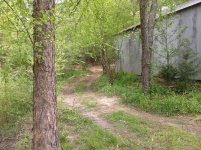
My biggest problem is that I have wet spots. The ground slopes and the road runs alongside a pond. when it is dry and has been for a while the road is awesome. if it has rained, Oh Golly! it turns to serious mud and the tractor tears it up, digs ruts and makes a mess. To top it off, the part in the picture, right by the "barn" is not level, it slopes towards the pond.

I really would like this to work. It is the only way to get access to park the tractor in the barn where my hay etc is stored without tearing up part of the "yard" with a tractor road.

I have added some fill to the low spots, and I though maybe it was dry again, and I tried to backdrag it smooth and all I got was deep muddy ruts.

Do I need to add gravel? I can add tons of pine straw and or leaes or other organic material to soak up water, but I suspect that will be worse.

I do not have a "stream" I can cut a culvert for to divert the water, this is more like seepage and I have 3 distinct "wet spots".

Thanks in advance,
David
 

Attachments

  • 2012-04-21 14.27.10.jpg
    2012-04-21 14.27.10.jpg
    867 KB · Views: 529
/ Making a Tractor Road - I've got questions #2  
I'd put down a couple pieces of 4" plastic pipe across the road, cover it with filter cloth and then a foot of slag, crushed limestone or crushed rock... something with jagged edges to keep it in place. Any seepage should travel throught the pipes from the high side to the low side. The filter cloth will help keep the crushed rock from getting pushed into the mud by the tractor. A foot is more than enough to cover the pipes.
 
/ Making a Tractor Road - I've got questions #3  
Dave,

That does not look like seepage (per se). That is the point that all of the water from the surrounding area flows through. In my area it would also be wet even days after rains because the top soil is on a clay base.

Not an expert, but that spot appears to need what Mosswood noted.
 
/ Making a Tractor Road - I've got questions #4  
You can fix it as outlined by MossRoad. We have several miles of such roads and just use crushed rock. Depending on the amount of water going over, we use 1" to 2". It has worked well for us the 20+ years we have had the roads. We do have a fairly high clay content, so the rock doesn't work down. On some soils this won't work.
 
/ Making a Tractor Road - I've got questions
  • Thread Starter
#5  
Dave,

That does not look like seepage (per se). That is the point that all of the water from the surrounding area flows through. In my area it would also be wet even days after rains because the top soil is on a clay base.

Not an expert, but that spot appears to need what Mosswood noted.

Jim,

I believe your diagnosis is correct... I have heavy clay with a little topsoil. when totally dry it is awesome, but after rain... mudbog for days...

I will try to take some new pics and get the other two areas also. One is a corner boggy spot and I just swing wide around it and I'm fine...

Thanks,
David
 
/ Making a Tractor Road - I've got questions
  • Thread Starter
#6  
You can fix it as outlined by MossRoad. We have several miles of such roads and just use crushed rock. Depending on the amount of water going over, we use 1" to 2". It has worked well for us the 20+ years we have had the roads. We do have a fairly high clay content, so the rock doesn't work down. On some soils this won't work.

RRR,

You do NOT use the pipe, just dig out a channel and lay down crushed rock?

Did you use the fabric barrier?

Thanks,

David
 
/ Making a Tractor Road - I've got questions
  • Thread Starter
#7  
I'd put down a couple pieces of 4" plastic pipe across the road, cover it with filter cloth and then a foot of slag, crushed limestone or crushed rock... something with jagged edges to keep it in place. Any seepage should travel throught the pipes from the high side to the low side. The filter cloth will help keep the crushed rock from getting pushed into the mud by the tractor. A foot is more than enough to cover the pipes.

David,

So lets see if I understand...

If I go cut a 1 foot deep channel in the wettest section across the road. Then I lay down filter cloth (Is this like weed barrier cloth?). Then I lay down some sections of 4" plastic pipe (PVC?) fold the filter cloth over the pipe ends and cover the whole thing with jagged gravel (Crush & Run, etc.).

This in effect makes a culvert in the wet spot. seepage flows through the pipe and gravel and the gravel keeps the pipe from crushing under the tractor.

How much wider than the "road" do the pipe sections need to be? do I need a clear flow path from the exit of the pipes (like a channel to the pond, or ???)?

I just want to make sure I understand.

I will have more questions when I have more pics to show you...

Thanks. This is exactly what I was hoping for, clear advice.

Be well,

David
 
/ Making a Tractor Road - I've got questions #8  
RRR,

You do NOT use the pipe, just dig out a channel and lay down crushed rock?

Did you use the fabric barrier?

Thanks,

David

No, we just put down rock; no pipes or cloth barriers. Not that doing so won't work well as it will, we just would spend a fortune due to the amount of roads we have.

We don't have any problems with mud and excess water just flows over the roads. We did have some washouts one spring, but pipes wouldn't have helped as the waters went over our county road with 6' culverts.

We have culverts to allow some drainage ditches into our ponds or in really bad areas, but they are up to 36".

We tried some 4" pipe in a couple of places when we first put our roads in, but they were always clogging up with leaves, sticks and such.
 
/ Making a Tractor Road - I've got questions #9  
Hard to tell the depth of the hole from the photos but a small black drain pipe might be large enough. Depends on how much area is being drained.

All of our driveway, maybe 750 linear feet 12.5 wide, uses geotextile fabric on grade followed by ABC gravel. ABC is road base in NC. It is fines aka dust up to maybe two inch long gravel. This stuff locks up tight. The fabric helps distribute the weight of the vehicle and keeps the gravel from being pushed into the clay.

We should have 4-6 inches of gravel over the fabric but in most places we have 2-4 inches. The areas with 2 inches of ABC needs more gravel but whenever we budget adding more we spend the money elsewhere because the driveway is just fine. The driveway held up with seven cement trucks that poured our slab plus trucks for the foundation pour, bricks, dump trucks and misc construction traffic. Without that fabric the driveway would have been torn up.

Drainage pipe needs X number of inches to support a given weight. I look up my culvert years ago and it was supposed to have 12 inches. I might have 6 inches. You will want enough gravel over whatever pipe you use to keep from crushing the culvert.

Geotextile fabric is like to landscaping fabric but different. For what you are doing I might use the landscape fabric if that was all I could get. I have a local supplier that sells geotextile. He has fabric that is 3', 6' and 12.5 feet wide. A roll was 360 feet if I remember right and roughly $1 a linear foot for the 12.5 inch wide material. He would sell by the linear foot.

He has two types, a woven and mesh fabric. The woven stuff is kinda like a how a tarp looks. The mesh is sponging and I think allows more water to pass through. I used mesh. It smelled of asphalt and was made by Amoco if I remember right. I could cut it with a utility knife but the stuff would dull the blade ASAP. It is pretty tough stuff.

Our "soil," I use that work loosely, will rut up in a heart beat in the winter wet. I will not drive the tractor off gravel in certain areas during winter. Once the trees leaf out and start drinking ground water the ground dries out and the tractor will not cause ruts. There are ruts on our place, some quite bad, from tractor used to log the place 70-80 years ago.

Later,
Dan
 
/ Making a Tractor Road - I've got questions #10  
All great suggestions here.

I have dealt with a similar issue in a wet spot on a tractor trail by dumping a few buckets of #57 gravel over the top (had a pile of it on hand for another project). Solved the problem instantly. You could definitely improve on this by putting fabric down first, but I was in a pinch and didn't have time to run out and get some. Fabric will prevent the stone from possibly sinking down into the mud. That may or may not be a problem. It hasn't been an issue for me so far in this one spot -- the mud and rock locked together down below, and there is still a few inches of loose stone on top.

I had another wet spot near the bottom end of a hill, where runoff and groundwater naturally flowed. For that, I cut a shallow drainage ditch on the uphill side of the trail and ran it farther down the hill to carry the water away from the trail. I filled the ditch with #57 to level it off, with weed fabric underneath to prevent silt from clogging up the stone. White septic cloth would also work fine for that sort of thing.
 
/ Making a Tractor Road - I've got questions #12  
Your driving a tractor over it correct?
A few bumps shouldn't matter.

How many feet, meters or whatever do you have problems with?

From the size of your log pile if you could get a local portable sawyer to mill up some of the logs you could lay down sections of a "corduroy road" made by the slabs left over. Of course you would have to find something to do with all that lumber also.

After all the slabs are just waste for firewood or mulch.

You probably should put in some drainage channels.

It wouldn't be my solution if I was going to roller blade on it, but I think a DK50 could handle it easily.

/edit - As I was composing Larry beat me to it.
 
/ Making a Tractor Road - I've got questions
  • Thread Starter
#13  
Your driving a tractor over it correct?
A few bumps shouldn't matter.

How many feet, meters or whatever do you have problems with?

The spot you can see (except that it is dry in the pic) is 7-10 feet I think. The issue I have is not so much the bumps, but the tire rut nearest the pond (and it is only 12-18 inches from steep drop into the pond) is like 6 inches lower that the other tire rut, and in 2wd (which is my default state) the tractor goes sideways slightly in the muck and clay. I would HATE to drop the tractor into the pond...

I also need the tractor road to be passable for my riding mowers.

I will try to take some pix of what I did yesterday, after 5 dry days all I tried to do was backdrag the extra 6-7 wheelbarrows of dirt/clay I dumped trying to raise the level of the rut nearest the pond. I have GIANT ruts now and the tractor is bobtailed (nothing on PTO) and only bucket on the FEL.

If I get home tonight before dark I will snap pix tonight.

Thanks all,
David
 
/ Making a Tractor Road - I've got questions
  • Thread Starter
#14  
/ Making a Tractor Road - I've got questions #15  
David,

So lets see if I understand...

If I go cut a 1 foot deep channel in the wettest section across the road. Then I lay down filter cloth (Is this like weed barrier cloth?). Then I lay down some sections of 4" plastic pipe (PVC?) fold the filter cloth over the pipe ends and cover the whole thing with jagged gravel (Crush & Run, etc.).

This in effect makes a culvert in the wet spot. seepage flows through the pipe and gravel and the gravel keeps the pipe from crushing under the tractor.

How much wider than the "road" do the pipe sections need to be? do I need a clear flow path from the exit of the pipes (like a channel to the pond, or ???)?

I just want to make sure I understand.

I will have more questions when I have more pics to show you...

Thanks. This is exactly what I was hoping for, clear advice.

Be well,

David

I think you got it. :thumbsup:

Find the lowest point (the dip) in the road and put the pipe there. You should make the pipe to meet the lowest part of the water on the high side, so that the water goes into the pipe. If you make it higher, it will dam up on the right side. That could cause water to pool on the high side and cause problems in frost or freeze times. You want the water flowing into the pipe on the high side and exiting on the low side. From your picture, that looks to be from right to left. It doesn't have to slope much at all.

You may have to dig down a bit to meet the height requirements on the high side. Just make sure it slopes.

Someone mentioned geotextile cloth. That is what I was talking about. It is heavier than landscape fabric and lasts a lot longer. I would put it over the entire area that you want to dry out. So, you need a piece a few feet wider than your road and as long as the area you are patching. You can overlap it if you can't find it wide enough.

The pipe length depends on the width of your road. An 8' wide road I would use a 12' pipe for two feet extra on each side.

You can put a piece of fabric over the ends of the pipe and then cap it with a grated cap. They are cheap. The grate keeps animals out and the fabric keeps mud and sticks out and still allows water to seep through. I would leave the ends exposed for maintenance just in case. Or, you could put just a couple larger rocks around the ends to protect them, yet allow access. Just make sure they aren't tight, so water can run through.

Then cover the whole thing with several inches of crushed rock to do two things.

One, it protects the pipe. Even a few inches of rock will be enough for tractor traffic from crushing the pipe.
Two, the rock on top of the fabric on top of the dirt keeps the dirt from coming up into your rocks and keeps your rocks from getting pushed into the dirt.

How many times have we read here about people having to add rocks to their roads? Well, where did the rocks go? They went down into the soil and the soil came up into the rocks. The fabric prevents this from happening.
 
/ Making a Tractor Road - I've got questions
  • Thread Starter
#16  
Pictures!

I cannot seem to add pictures because of the white space problem.

I have some great pics I took last evening.

David
 
/ Making a Tractor Road - I've got questions #17  
I certainly would NOT use 4" pipe, it will clog up (as already noted) and be useless. I would go with at least 8" or 12" if you are going to use pipe. It has to be big enough to let debris through. Dead grass, leaves, sticks, etc. will block up small pipe or any type of filter.

We had a 1000' driveway across flat clay land ("crayfish land" as one contractor put it) that held water like a bowl. I put in a heavy layer of bigger rock (#2, 3-4"), then a layer of 304 (crusher run + 1 rock). It held up very well, even with concrete trucks during construction of the house.

At our current place, when we widened the driveway coming up the hill, the contractor recommended smaller rock (1-2"). It quickly disappeared when wet, sinking in. When I did it my way, putting in the bigger #2 rock, it locked in and made a solid road.

Ken
 
/ Making a Tractor Road - I've got questions #18  
I like TripleR's method of just putting crushed rock down. Maybe get a bigger load than you need for this job and have them dump it in a central location and then you'll have extra for other wet spots.
Around here pit run is alot cheaper but its also full of 3-4" and some bigger rocks and once packed its not easy to work with. I don't know what's available in your area.
 
/ Making a Tractor Road - I've got questions #19  
The spot you can see (except that it is dry in the pic) is 7-10 feet I think. The issue I have is not so much the bumps, but the tire rut nearest the pond (and it is only 12-18 inches from steep drop into the pond) is like 6 inches lower that the other tire rut, and in 2wd (which is my default state) the tractor goes sideways slightly in the muck and clay. I would HATE to drop the tractor into the pond...

For 7-10 feet I was going to say just drop some gravel and be done with it. :D But then you mentioned the short difference to the drop off to the pond and what sounds like a slope.

You might want to stack some rocks on down slope side of this hole to act as a retaining wall for the gravel. I used rip rap which is the larger rock used to stabilize steep embankments along roads and ditches. ABC will lock up pretty tightly and not move much but with rocks/rip rap acting as a retaining wall the gravel will not move.

Given the margin for error with the pond I would be looking to at least level out that spot.

Instead of the pipe to drain the water you could use a PT wood trough built into the gravel. The top would be open for easy clean out. Check out the figures on page three in the following document. The doc has other ideas that might help as well.

http://www.stream.fs.fed.us/water-road/w-r-pdf/crossdrains.pdf

When looking for a document with the right images, I hit on something else. They were using rubber conveyor belts buried in the road to divert water from the road. Pretty nifty idea. The belts stick up enough to divert water but you just drive right over them. I don't think this helps your problem but it was a nifty idea. :D

Later,
Dan
 
/ Making a Tractor Road - I've got questions #20  
They were using rubber conveyor belts buried in the road to divert water from the road. Pretty nifty idea. The belts stick up enough to divert water but you just drive right over them. I don't think this helps your problem but it was a nifty idea. :D

Later,
Dan

I've seen that used on bridal trails going down a hill, usually between a couple of buried boards. I agree it wouldn't work here on flat terrain.

Actually for roads or trails doing down a hill, the current generally recommended design is for built in dips draining to the side. They are supposed to hold up better than above trail diversions. I try to use that on my trails.

Ken
 
 
Top