"Trail" driveway: How do I improve it?

/ "Trail" driveway: How do I improve it? #1  

beppington

Elite Member
Joined
May 25, 2010
Messages
3,795
Location
of my
Tractor
Here
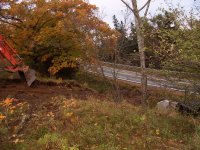
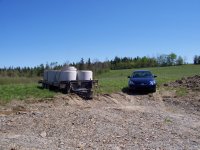
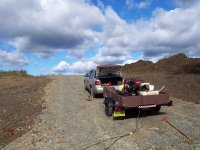
Below is a pic of the old ~600' "trail" driveway on the property I plan to build a house on.

Much of the lot is just below the flood plain, & this trail is just a whisper above it (~1 ft), so there are 2 spots that become muddy during even a light rain. My limited experience so far is that the 2 mud areas aren't extreme, meaning I don't think a car would drop a foot down into it, but then I don't know that for sure either. (sorry no pics of the muddy areas, but right now they're dry as a bone anyway)

When it's dry, it's perfectly fine to drive on as-is. But it'll need to be able to reliably allow concrete trucks (& others) to get in & out, even when wet.

My question: Should I dig out the existing material ... either the muddy/ clay part, or the entire length of the trail ... in order to fill it back in with driveway material, or should I just spread the new driveway material right on top of the existing trail, so that it's raised as much as possible above the flood plain?

BTW, I was planning on using a driveway material the distributor calls "scrap rock": It's a mixture of the leftover scrap amounts of all their different normal materials that they combine & sell. It's got big stuff, medium stuff & fines, & has limerock, granite, gravel, etc. My friend used it on his driveway, & man it locks together almost as well as pavement. And he didn't even roll/ compact it; just box bladed it smooth & started driving on it.

I'll love to hear any other suggestions, too ... Thanks!

191467d1292517612-pics-my-new-kubota-l3940-img_6295b.jpg
 
/ "Trail" driveway: How do I improve it? #2  
I know for our road (just over a mile of it) I mix the riff raff and gravel in with the dirt. Low spots will collect water so I'm trying to keep it above grade a bit
 
/ "Trail" driveway: How do I improve it? #3  
With that rock type your considering, do you think a small drain pipe or 2 at the lowest problem areas would help with heavier moisture?? That's what I'd be looking at as my 1st "shot over the bow" may be the simplest thing, maybe it would allow some type of "control" where the water and low spots are. just thinking out load.
 
/ "Trail" driveway: How do I improve it?
  • Thread Starter
#4  
Nobody else? Dan, I was hoping for opinions since the material will be delivered soon.
 
/ "Trail" driveway: How do I improve it? #5  
The mistake I made when building our driveway was trying to smooth it down. Kinda hard to make something smooth with root and rocks all through the soil. I quickly figure out that smoothing was a loosing proposition but I still had box bladed a shallow trench.

I used geotextile fabric which was one reason I was trying to smooth out the driveway "path." We ended up only putting down 3-4 inches of ABC gravel. We had planned to add another 3-4 inches but the fabric worked so well the gravel money got spent else where. We need to put down more gravel to get the driveway above grade. As it is heavy rain will put water on the driveway for a short distance which does move some gravel. Not bad but a few more inches of ABC would solve the problem.

The problem is not too bad because it has been like this for a good eight or so years. :D

I would put down fabric and build up from grade.

Later,
Dan
 
/ "Trail" driveway: How do I improve it? #6  
Another vote for the fabric, you use a lot less gravel and I even tried it on some swampy areas and although the ground still wiggles a bit it holds my tractor.
Rick
 
/ "Trail" driveway: How do I improve it?
  • Thread Starter
#7  
Do you have a source for the geotextile fabric? Should I be able to find it locally?
 
/ "Trail" driveway: How do I improve it? #8  
I even tried it on some swampy areas and although the ground still wiggles a bit it holds my tractor.

Those are the types of conditions the fabric is meant for.:)
 
/ "Trail" driveway: How do I improve it? #9  
What type of soil do you have now? Clay or sand are non organic and do not need to be removed. In fact, removing clay will cause water to settle in the road and create a nightmare of a mess. The only reason you dig out and remove any soil to build a road is that it is organic topsoil that will decay over time. When anything decays, it settles and you end up with low spots and pot holes.

The first thing that isn't clear is how wide the trail is. Adding material to build up the road might sufficate some of the roots. I don't know our trees, but you might kill them anyway, even if you want to keep them. It's always easier and cheaper to take them out before adding any sort of material next to them.

you need a minimum of ten feet of width for your road. Anything less and the edges become soft. 12 is better, but it's also 20% more money!!!!!

What way does the water flow when it rains? What about when it rains REALLY HARD? By building up the road and creating a crown, you are also building a dam that will stop the water and change where it might have been going. If the slope is fine on either side and it will just go away on it's own, then you are golden. If it wants to cross your road, you need to figure out how big of a culvert that you need. The easiest and best way to do this is to go see what others have and if they can handle your rains. The only rains that matter are the big ones that do all the damage. You don't same any money by putting in a 12 inch culvert if it can't handle the water and your entire road washes out.

Rule of thumb for culverts is that you need half as much material above the culvert as the thickness of the culvert. If the land is totaly flat, and you only need a 12 inch culvert, then you will need 18 inches of material before and after that culvert. Plust enough material to get to that point and back down again. Cement trucks are heavy, and if you cut corners, you will be liable for the damage to the truck, the lost load of concrete and the tow to get it out. Plus your road will be destroyed.

I'm not a huge fan of fabric for roads. It's used when other things are not done properly. If there is a wet area, then the drainage needs to be fixed. Relying on fabric doesn't solve the drainage issue. If you have a wet area, dig it out, replace it with dry material, compact it, and build it up so that water goes AWAY from that wet area. It's very simple, but it takes a lot of material and time to make it right.

Eddie
 
/ "Trail" driveway: How do I improve it? #10  
Do you have a source for the geotextile fabric? Should I be able to find it locally?

A company selling culverts should have it.

I am a big fan of fabric. It saved us a fortune in gravel. Not to mention the time it would take to put down more gravel. I do need more gravel to get the driveway slightly above grade. Since I get water on one section of the driveway I have to touch it up with the box blade every 3-4 years. The rest of the driveway is just fine and will never have to be maintained. If I would spend the $2,000 to add gravel I would not have to use the box blade. $2,000 vs a few minutes with the box blade.... :D

Our soil is heavy clay which is why there are quite a few brick and pottery companies in my area. My neighbors did not use fabric so they have to constantly regrade their driveways. I finally had time on Saturday to move some trees I got up months ago. Unfortunately we had 2 inches of rain on Thursday and Friday. When I had to move off the gravel I just made a mess in the mud. Our soil is weird when wet. Drive on it once and it is ok. Drive on it a second time it turns to jello. The third time you sink the tires. Imagine what that would be like as your driveway.

Without fabric I would have had to redo the driveway multiple times. We had multiple dump, logging, brick, and cement trucks on our driveway. The driveway only had 2-4 inches of ABC over fabric but it held up perfectly.

The only problem I have with fabric is that you want it installed as smoothly as possible. You do not want it stick up on a rock, twig, or root which is easier said that done. If you do have to grade the driveway you have to make sure you do not catch the fabric that is sticking up. Flip side is you should never have to grade again. I only have that one stretch that needs to be graded because the top of the driveway is at grade level.

My supplier had two fabric types both 12 feet wide an in rolls 360 feet long. At the time it was priced a bit under a dollar a linear foot. There was a mesh and woven type. I used mesh but I cannot remember why. I could cut it with a utility knife but it would quickly dull the blades.

Later,
Dan
 
/ "Trail" driveway: How do I improve it? #11  
Dan,

Why not bring in more of that heavy clay to build up the road bed? Gravel is expensive and dirt is usualy quite a bit cheaper. Dig out the wet areas and set that muddy stuff aside somewhere for it to dry out, then bring in clay or other suituable fill material and build up the road bed just like you would a house pad. Get the dirt part of it up to grade and compact it. Then the water will naturaly run away from the road and where you want it. Then add gravel to the top of the dirt that has been built up above grade.

Eddie
 
/ "Trail" driveway: How do I improve it?
  • Thread Starter
#12  
Just learned: $437 for 21 yards of the scrap rock.

Yikes: So, I'm kinda wanting to make sure I have a good plan before proceeding.

I can operate the tractor for a looong time for that amount of money, so I think I'm going to try some tractor work as the first step: Box blade & grading scraper on the entire trail to 1) remove all grassy material, & 2) create ditches on both sides the entire length of the driveway. I'm hoping that will dry out (& keep dry) the 2 muddy areas.

One thing I'm not clear on: My 2 muddy areas seem to be clay, whereas the rest of the trail that isn't muddy is more sand-based. So, it would "seem" wise to dig the clay out of there & re-fill the hole with say builder's sand (what all builders here use for house foundations). But this goes against Eddie's mention of actually using clay, even bringing it in ... ?
 
Last edited:
/ "Trail" driveway: How do I improve it? #13  
Clay makes great roads if it is shaped properly and compacted while it is dry. You need to get it dry and keep it dry and it will provide a great foundation for gravel.

Once wet, it turns to pumpy snot that will eat rock and tires like a monster.

If you were trying to do this work in the wet season and the muddy area were already wet then I would recommend removal of the clay and replacement with either dry clay or some other import. Since it is already dry, you can shape it now.

I like using fabric when the underlying soil is something that might possibly squirt up and contaminate the gravel. At that point you would have a gravelly clay snot mix that will get ruts and get wetter which means it will turn to the pumpy snot monster. Your goal is to shape the clay and keep it shaped so that it will shed water.
 
/ "Trail" driveway: How do I improve it? #14  
Dan,

Why not bring in more of that heavy clay to build up the road bed? Gravel is expensive and dirt is usualy quite a bit cheaper. Dig out the wet areas and set that muddy stuff aside somewhere for it to dry out, then bring in clay or other suituable fill material and build up the road bed just like you would a house pad. Get the dirt part of it up to grade and compact it. Then the water will naturaly run away from the road and where you want it. Then add gravel to the top of the dirt that has been built up above grade.

Eddie

Clay is the problem. Taking out my clay and putting in more clay that cost money, does nothing but cost me money and time. We just need to add a couple inches of gravel. :)

I had clay brought it to spread in the yard and it was not much cheaper than ABC. The quarry is near us and the trucking cost for gravel is lower than clay. But why do I want clay? I have got enough of that crap.

When our soil gets wet it gets messy. The areas I am talking about are NOT low areas. In fact one of them is almost at the top of a hill and is the highest point for a mile or so. If the soil gets wet it gets messy.

The huge advantage of fabric is that it keeps the gravel from being mixed with soil. Our road is gravel on clay. Every couple of years I have to regrade the road because the gravel is pushed into the clay and pot holes form. I do NOT have this problem on our driveway built with fabric. We should have 4-6 inches of gravel on our driveway. Instead we have 2-4 inches. If we had 4-6 inches the water the water would not be getting on a section of driveway and causing nitty little issues.

Our driveway is 500-600 feet from the road with a turning circle. From the circle the driveway goes back another 100-150 feet with one area being about 36'x100'. All of it has fabric under the gravel. The neighbors with just gravel are constantly dropping more gravel and regrading. I just have to touch up the 100-200 foot section that gets water on the gravel. The vast majority of our driveway requires no work at all to maintain. Well, that is not quite true. I have to spray Roundup to kill the weeds. :D

None of the driveway is flat, it all runs down hill.

The driveway/road contractors around here do not want to use fabric because it would keep them from making more money dropping more gravel and regrading. I see people on our local mailing list/BBS needing their driveway redone. If they did it right with fabric the first time, they would be done.

I will not put down gravel for a driveway or even a walk way without using fabric. I have used fabric under our gravel walkways. Fabric comes in 3 foot widths. :D

Later,
Dan
 
/ "Trail" driveway: How do I improve it? #15  
Remove 8-12 inches of the clay in those muddy areas and fill it with a large process road base material, that's 2 inch stone mixed with smaller stone and fine chips (dust).
You shouldn't even need fabric for light to medium vehicle traffic.

But if you do use the heavy woven (mesh) fabric, you wouldn't have to remove as much of the clay, and you would use less stone. Just takes a fraction more skill level.

Around here clay is nasty unstable stuff, I've heard of some clays that are workable but not ours. Just today I went by some utility upgrade work sites in the city and everywhere they had to excavate, they just stock piled the clay in huge piles and brought in a better quality material for all the back fills.
I understand why, even though the clay was fairly dry and didn't look to bad. They just couldn't take the chance using it under the road on these very extensive and expensive infrastructure projects.

I've made the mistake of trying to reuse the clay on projects, ended up with jello yards :mad:

JB.
 
/ "Trail" driveway: How do I improve it? #16  
One thing I'm not clear on: My 2 muddy areas seem to be clay, whereas the rest of the trail that isn't muddy is more sand-based. So, it would "seem" wise to dig the clay out of there & re-fill the hole with say builder's sand (what all builders here use for house foundations). But this goes against Eddie's mention of actually using clay, even bringing it in ... ?

Maybe check out the drainage situation on those troublesome clay areas!:thumbsup:

It might explain the mud!:D

Building roads is pretty simple. Establish drainage, get rid of organics and bring in materials that can be compacted and top with a waterproof coating of some sort that will protect the base from getting wet.:thumbsup:

Eddie can build a road for me anytime.:thumbsup::thumbsup:
 
/ "Trail" driveway: How do I improve it? #17  
Remove 8-12 inches of the clay in those muddy areas and fill it with a large process road base material, that's 2 inch stone mixed with smaller stone and fine chips (dust).

+1

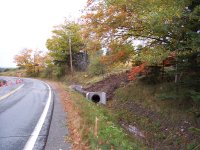
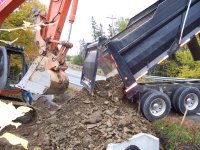
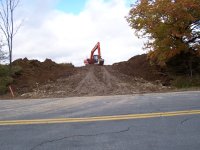
We put in a driveway a few years ago, the excavator operator dug out at least a foot or two of topsoil and clay, then built it back up with what we call pit-run rock, which is a mix of rock up to 6 inch, fines, smaller shards of rock, etc.

Hauling locally, it wasn't expensive. Including excavator time and culverts with concrete ends the whole driveway (250 feet) cost about $3500. More than I really wanted to spend at the time, but you can drive a concrete truck over it any day of the year you like without worrying about damage. We've since top dressed it with class A gravel, 3/4" rock plus fines

Ours is 30 feet wide at the road and narrows toward the top.

Sean
 

Attachments

  • 04.jpg
    04.jpg
    971.5 KB · Views: 213
  • 06.jpg
    06.jpg
    857.3 KB · Views: 208
  • 08.jpg
    08.jpg
    790.5 KB · Views: 227
  • 10.jpg
    10.jpg
    570.4 KB · Views: 218
  • 25.jpg
    25.jpg
    679.4 KB · Views: 223
  • 17.jpg
    17.jpg
    585.9 KB · Views: 225
/ "Trail" driveway: How do I improve it? #18  
The cheapeast and by far best way to fix areas with rotten clay is lime. And if you have a tiller for your tractor it will do the trick. Just scratch up the clay with scarifiers and spread out bag lime to the soil. Clay weighs about 100 lbs/cf, so do the math to add 4-6% lime by weight. Then mix in the lime with the scarifiers or tiller. Let it cook for 48hrs and mix again with water. Then roll it with your loaded tractor and problem solved. If you have sand then use portland cement, not sackcrete, but straight cement and mix it in with water. No remixing with cement. This is the same scaled back way we build highways on high PI soils. It is cheap and only takes a little time for a permanent fix. Filter fabric is too expensive and doesn't stabilize the soil.
 
/ "Trail" driveway: How do I improve it? #19  
I have to say that road is absolutely beautiful. I wouldn't want to do anything to it if it's been working for years. It's hard to get something that pretty by working at it.
 
/ "Trail" driveway: How do I improve it? #20  
I just had about 300 feet or so of mine done. It was as you describe, muddy water pooling in spots when it rains and as well during spring when the snow is melting. This is a low spot in the drive but no flood plain involved. Passing over it when wet would create ruts, nothing to get stuck in but would get the vehicles muddy.

The guy I use hauled in several dump loads of larger stone, maybe hardball size, for a 6-8 inch base over what was there and then put a topping of smaller stone over that.

The material he uses isn't quarry process but rather something he calls bank run. The stone is smooth. It's a little cheaper than the quarry stuff but most of the cost of stone up this way is in the trucking anyway.
 

Marketplace Items

2020 CASE TV450B SKID STEER (A64279)
2020 CASE TV450B...
UNUSED SDLANCH SDLC2533FT 25'X33' METAL SHED (A64281)
UNUSED SDLANCH...
2022 Ram ProMaster 2500 Cargo Van (A61573)
2022 Ram ProMaster...
2015 Ford Explorer SUV (A61574)
2015 Ford Explorer...
2011 Ford E-350 Passenger Van (A61573)
2011 Ford E-350...
EZ Trail 3400 (A63688)
 
Top