Weight, Hills and Balance

/ Weight, Hills and Balance #1  

TNTractor1

Silver Member
Joined
Feb 11, 2011
Messages
113
Location
Jackson, TN
Tractor
2011 JD2520
I just ordered my new 2520 with FEL and 62D MMM today. I have been searching and reading this forum all day to learn more about my tractor and I have found lots of good info so far. I need some advice on how to best equip my tractor to best handle the layout of my land. My land has some hilly areas with trees. I know that I need to use the ballast box with weight for loader work, but I am unsure about some weight issues... here are a few questions I have:
1. When mowing, is it best to detach the bucket, keep the bucket on and low, detach the whole loader and bucket, or does it matter?
2. Should I get the tires loaded since I have some hills? Is there a disadvantage to loading the tires?
3. Would weight in the ballast box help when mowing the hills?

Basically, I am trying to understand if loaded tires are right for me. Thanks in advance.
 
/ Weight, Hills and Balance #2  
I always take the FEL completely off my 2520 when I mow. It's just easier to maneuver and get close to things without it.

I don't have a ballast box, but the rear tires are filled. I've never had a problem with not having enough weight, although I often also have the 60" rear blade on when using the loader.

I'm sure the extra weight in the tires lowers the center of gravity and makes it more stable. I thought it may also cause the tractor to tear up the lawn more, or leave R4 tracks in the lawn, but that's never been a problem. I've not regretted having them filled.
 
/ Weight, Hills and Balance #3  
I feel your pain X2.

I have a 2520 and mow 20 degree side hills. I have both the 62D and a 72 inch rear finish mower, but primarily use the RFM because I feel it delivers a better cut and it's easier to trim under trees, etc.

My property is so hilly that I have to mow in 4WD all the time. The RFM is heavy and tries to pull the rear of the machine sideways on the hills. I'm not complaining, just giving you some background as to my situation.

Anyway, although I knew I'd need ballast weight, I chose not to load the tires and went with wheel weights (the maximum 3 per side). I also keep the loader on (without the bucket) and feel that the extra weight helps.

The upshot of it is, it works, but just barely. The machine still slides sideways on the hills and will still break traction fairly easily if I'm not real careful. I haven't run my 62D in awhile, but didn't notice a lot of difference, other than less of a tendency to pull sideways.

On the plus side, I can report that the machine has always felt stable in this environment, however, I never let my guard down. On the steepest areas, I take it very slowly and am always ready to take corrective action if it acts like it's going to tip.

I have never tried carrying the weight box when using the belly mower, but it would probably help traction. However, I wouldn't want to carry a lot of weight behind the rear axle and nothing on the front. If/when I try it, I would probably have my loader frame on or suitcase weights on the front rack to keep the front end from getting light.

Generally speaking, I'm kind of leery about using the ballast box as weight for traction on hills because I think a good portion of the weight may wind up above the axle line, which isn't the best for stability.

I can't answer your questions except to say what I would do and there are many people on here who are more knowledgeable than me.

1. I have tried mowing with/without the loader and (at least with the RFM) I prefer to keep the loader on and drop the bucket off (for maneuverability).
2. Loading the tires is probably a good idea, however, I personally chose not to do so because I did not want to deal with the issue of losing the liquid when/if I got tire punctures.
3. As mentioned, I haven't tried the ballast box when mowing, but have given it some thought and would probably try it, but not with full weight. The way I have mine set up, I can vary the weight from 400 to 800 or so lbs and I would probably try running with the minimum amount in the box at first.

I dont' know if any of this helps, but the message is that you may need to experiment a little to see what works for you.

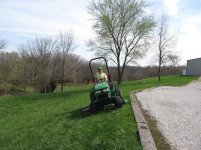
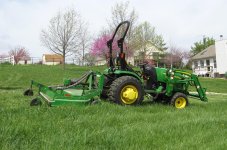
Incidentally, the picture on the left is on the 20 degree side slope, although it doesn't look that steep.

Wishing you the best of luck.
 

Attachments

  • 100_0279.jpg
    100_0279.jpg
    899.8 KB · Views: 488
  • 100_0703 B.JPG
    100_0703 B.JPG
    785 KB · Views: 450
/ Weight, Hills and Balance
  • Thread Starter
#4  
When tires are "loaded", how much are they filled with fluid? Half full? Less, more? Seems like once you go over half full it wouldn't be as effective.
 
/ Weight, Hills and Balance #5  
When tires are "loaded", how much are they filled with fluid? Half full? Less, more? Seems like once you go over half full it wouldn't be as effective.

Usually 75% to allow air flex, or at least enough to cover the rim to help protect against corrosion.
 
/ Weight, Hills and Balance #6  
When tires are "loaded", how much are they filled with fluid? Half full? Less, more? Seems like once you go over half full it wouldn't be as effective.

I'm with you on this one. When I get my tires filled I am probably only going to fill them 50%. Hadn't thought about the over the rim to prevent corrosion, but I plan on using rimguard so maybe it won't make a diff. I think using the MMM would be better for your center of gravity. The MMM being suspended under the tractor would make a good low ballast on the tractor.
 
/ Weight, Hills and Balance #7  
Ever thought of a ballast box and a bucket of dirt on the loader?? why spend more money than you have too?

Wooden
 
/ Weight, Hills and Balance #8  
I always mow steep hills by backing straight up them, then drive down and repeat. Mowing on the side of a steep hill is risky at best, at worse your tractor will slide down the hill sideways. R1s are better than R4s for this, but backing up is ideal.
 
/ Weight, Hills and Balance #9  
Another reason 75% fill is recommended is to keep the slosh down and minimize the drag of the fluid in the tire. I have driven tractors with 50% fill and it can get sporting as the fluid sloshes back and forth.:)
 
/ Weight, Hills and Balance #10  
I have some hills that still scare me , only going up & down I have lost traction and have slid a few times . Using 4 wd is is must on these hills and have had to use the FEL to stop!!! Wet grass over clay not good! Also have a stream running down the back side of the hill running in to the pond.
 
/ Weight, Hills and Balance #11  
Ever thought of a ballast box and a bucket of dirt on the loader?? why spend more money than you have too?

Wooden
The bucket or anything in it has the effect of unweighting the rears. Not good. All your stability comes from the rear.
larry
 
/ Weight, Hills and Balance #12  
Another reason 75% fill is recommended is to keep the slosh down and minimize the drag of the fluid in the tire. I have driven tractors with 50% fill and it can get sporting as the fluid sloshes back and forth.:)

Good point. Thanks. I guess I could try 50% and if it is too sloshy I could have more put in.
 
/ Weight, Hills and Balance #13  
Good point. Thanks. I guess I could try 50% and if it is too sloshy I could have more put in.

The point about corrosion is valid. If you are using calcium chloride I would strongly recommend either a 75% fill or tubing the tire.:thumbsup::D
 
/ Weight, Hills and Balance #14  
Be careful on the hills. When the tractor starts sliding down a hill the rear has a tendency to want to go down the hill first. Gravity is an unforgiving teacher. Sliding down a hill backwards is very unpleasant. The transition of the tractor switching from forwards to backwards during this sliding process is an even more unpleasant experience.
 
/ Weight, Hills and Balance #15  
Be careful on the hills. When the tractor starts sliding down a hill the rear has a tendency to want to go down the hill first. Gravity is an unforgiving teacher. Sliding down a hill backwards is very unpleasant. The transition of the tractor switching from forwards to backwards during this sliding process is an even more unpleasant experience.

:laughing: :thumbsup:
 
/ Weight, Hills and Balance #16  
I feel your pain X2.

I have a 2520 and mow 20 degree side hills. I have both the 62D and a 72 inch rear finish mower, but primarily use the RFM because I feel it delivers a better cut and it's easier to trim under trees, etc.

My property is so hilly that I have to mow in 4WD all the time. The RFM is heavy and tries to pull the rear of the machine sideways on the hills. I'm not complaining, just giving you some background as to my situation.

Anyway, although I knew I'd need ballast weight, I chose not to load the tires and went with wheel weights (the maximum 3 per side). I also keep the loader on (without the bucket) and feel that the extra weight helps.

The upshot of it is, it works, but just barely. The machine still slides sideways on the hills and will still break traction fairly easily if I'm not real careful. I haven't run my 62D in awhile, but didn't notice a lot of difference, other than less of a tendency to pull sideways.

On the plus side, I can report that the machine has always felt stable in this environment, however, I never let my guard down. On the steepest areas, I take it very slowly and am always ready to take corrective action if it acts like it's going to tip.

I have never tried carrying the weight box when using the belly mower, but it would probably help traction. However, I wouldn't want to carry a lot of weight behind the rear axle and nothing on the front. If/when I try it, I would probably have my loader frame on or suitcase weights on the front rack to keep the front end from getting light.

Generally speaking, I'm kind of leery about using the ballast box as weight for traction on hills because I think a good portion of the weight may wind up above the axle line, which isn't the best for stability.

I can't answer your questions except to say what I would do and there are many people on here who are more knowledgeable than me.

1. I have tried mowing with/without the loader and (at least with the RFM) I prefer to keep the loader on and drop the bucket off (for maneuverability).
2. Loading the tires is probably a good idea, however, I personally chose not to do so because I did not want to deal with the issue of losing the liquid when/if I got tire punctures.
3. As mentioned, I haven't tried the ballast box when mowing, but have given it some thought and would probably try it, but not with full weight. The way I have mine set up, I can vary the weight from 400 to 800 or so lbs and I would probably try running with the minimum amount in the box at first.

I dont' know if any of this helps, but the message is that you may need to experiment a little to see what works for you.

Incidentally, the picture on the left is on the 20 degree side slope, although it doesn't look that steep.

Wishing you the best of luck.

I would say having a 72 inch rear mount mower on a 2520 would be challenging on hills or ditches.
 
/ Weight, Hills and Balance #17  
This tractor was headed down a hill with clay soil that had just thawed and was slippery as snot. The tractor was carrying no load. The tires were not loaded. Once the back end started to slide around and the FEL clipped a small tree, the tractor got sideways and went over.

Nobody was hurt. The tractor was fine once it was righted. This is just one of those examples of how quickly things can go wrong.
 

Attachments

  • image-2670321097.png
    image-2670321097.png
    735.7 KB · Views: 239
  • image-2595780967.png
    image-2595780967.png
    744.2 KB · Views: 275
/ Weight, Hills and Balance #18  
This tractor was headed down a hill with clay soil that had just thawed and was slippery as snot. The tractor was carrying no load. The tires were not loaded. Once the back end started to slide around and the FEL clipped a small tree, the tractor got sideways and went over.

Nobody was hurt. The tractor was fine once it was righted. This is just one of those examples of how quickly things can go wrong.
Yes, they sure can. I hear about a lot of that kind of directional issue, esp with turfs and R4s. Was 4wd engaged?
larry
 
/ Weight, Hills and Balance #19  
The bucket or anything in it has the effect of unweighting the rears. Not good. All your stability comes from the rear.
larry

I would think if you have about 400 lbs in the ballast box and a bucket of dirt , you would be well balanced, don't you?? the load will be behind the back wheels and in front of the front wheels, would it not? and the ballast box does not have to be lifted too high off the ground.

Wooden
 
/ Weight, Hills and Balance #20  
Ever thought of a ballast box and a bucket of dirt on the loader?? why spend more money than you have too?

Wooden

That would most likely put weight where you don't want it (too high up) and make the situation worse.

I normally run most of the mowing season with the loader off the tractor. If the loader is installed, I'll drop the bucket off.
 

Marketplace Items

John Deere S350 (A60462)
John Deere S350...
2019 Merlo TF 42.7 (A60462)
2019 Merlo TF 42.7...
Informational Lot - Financing (A63688)
Informational Lot...
2015 FREIGHTLINER CASCADIA 6x4 T/A DAY CAB TRUCK TRACTOR (A59906)
2015 FREIGHTLINER...
2013 Ford Taurus Sedan (A61574)
2013 Ford Taurus...
NEW HOLLAND LB75 BACKHOE (A63291)
NEW HOLLAND LB75...
 
Top