Loader pin root grapple

   / Loader pin root grapple #1  

JustGary

Silver Member
Joined
Oct 24, 2005
Messages
182
Location
NW Florida, USA
Tractor
Kubota L2800 HST
All -

With all of this talk lately of grapples (and just getting 40 acres clear cut), I'm interested in one too. I'd like to just buy one, but I don't have (or want) a QA plate, and it seems that most of the available ones don't use pins.

After talking with Melissa at Markham Welding, I'm strongly considering getting them to cut and weld my design. I'm not opposed to doing it myself, but I'd rather save the time (and get much better welding).

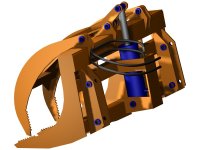
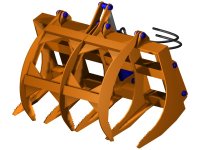
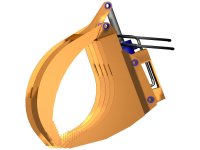
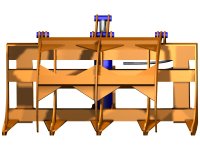
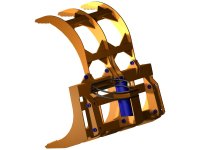
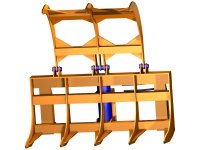
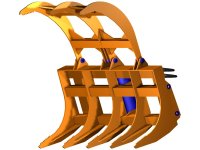
Anyway, one of the photos posted by a TBNer got me thinking about what I want, so I dusted off the ol' CAD program. Please feel free to comment on the design. Keep in mind that it is a 48" grapple for a 28 HP Kubota with the LA463 loader. Some key points:

- 48 3/4" wide
- 3/8" plate construction except for tubing
- Rake uses 3" square tube, 1/4" wall
- Grapple uses 2 1/2" square tube, 1/4" wall
- 1" pins throughout
- 8" stroke DA cylinder from Surplus Center
- Cylinder mounted behind rake for more protection, a distinct advantage over QA plate
- 100 degree jaw movement, opens to 46+" at tips
- Weight not calculated yet (I'm working on that next)

Questions for you to answer (I know I'm asking for it now...):

- Is it strong enough? I suspect yes, but you be the judge.
- Is it too strong? The loader is rated at about 1000 pounds lift, but curl (and ramming) forces are probably much greater.
- Should the grapple overlap the rake when closed (and loose opening distance)?
- What have I missed? Cupholders?

Regards,

- Just Gary
 

Attachments

  • Root_Grapple_1a.jpg
    Root_Grapple_1a.jpg
    70.2 KB · Views: 604
  • Root_Grapple_1b.jpg
    Root_Grapple_1b.jpg
    78.8 KB · Views: 456
  • Root_Grapple_1c.jpg
    Root_Grapple_1c.jpg
    51.6 KB · Views: 402
  • Root_Grapple_1d.jpg
    Root_Grapple_1d.jpg
    69.4 KB · Views: 341
  • Root_Grapple_1h.jpg
    Root_Grapple_1h.jpg
    56.1 KB · Views: 375
  • Root_Grapple_1g.jpg
    Root_Grapple_1g.jpg
    66.8 KB · Views: 399
  • Root_Grapple_1f.jpg
    Root_Grapple_1f.jpg
    72 KB · Views: 387
  • Root_Grapple_1e.jpg
    Root_Grapple_1e.jpg
    31.5 KB · Views: 382
   / Loader pin root grapple #3  
I really like the hydraulic cylinder behind the grapple, but do you think it will have enough clamping force with the cylinder attached so close to the pivot point of the grapple? If you think it will work, it looks great.
 
   / Loader pin root grapple
  • Thread Starter
#4  
mjncad: I used TurboCAD V15.1. I'm not in love with it (mainly because they break things as they add new features, then make the users prove that it doesn't work any more), but it works for what I need most of the time.

L4400: At the risk of doing math in public, I'll try to answer the clamping force question. I'm sure someone will correct me if I do it wrong (and please do).

Cylinder diameter = 3"
System pressure ~= 2300 PSI or so on a good day
Fulcrum to cylinder pin = 5.17"
Fulcrum to grapple tip = 30.15"

Piston area = 1.5" x 1.5" x pi = 7.07 sq. in.
Total force on piston pin = 7.07 sq. in. x 2300 PSI = 16,257.74 pounds
Force at tip of grapple = 16,257.74 pounds * 5.17" / 30.15" = 2787.81 pounds

Dang. That's more than I would have guessed, and I wouldn't want my parts near it when it closes. Thanks for making me do the math. I'm still working on the weight.

Regards,

- Just Gary
 
   / Loader pin root grapple #5  
That looks great! My only comment is to make sure the cage around the cylinder will clear the torque tube on your loader...I am pretty sure it would NOT on mine.
 
   / Loader pin root grapple #6  
Yeah, it does look great. Your CAD drawings are awesome.
I was going to make the exact same comment that Kenny made about clearing the torque tube.
Other than that, it's fantastic looking!
 
   / Loader pin root grapple #7  
Just Gary,

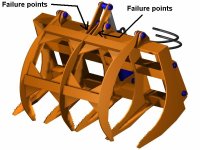
Your 3D drawing is superb! I'm having a hard enough time drawing 2D let alone something as eloquent as your grapple creation. Two concerns I would have are the tremendous forces present so close to the pivot point. See doctored drawing attached, the other is weight, without having all the surface areas to calculate weight, just looking at it my guess would be near 400 - 500 pounds? give or take. Does your CAD program have the "area" command ? I could be all wrong on my predicted stress failure points but it might be something worth looking at, maybe beef up the fulcrum arms past the pivot point?


Larry
 

Attachments

  • Just Gary Grapple.jpg
    Just Gary Grapple.jpg
    63.7 KB · Views: 673
   / Loader pin root grapple #8  
mjncad: I used TurboCAD V15.1. I'm not in love with it (mainly because they break things as they add new features, then make the users prove that it doesn't work any more), but it works for what I need most of the time.

Regards,

- Just Gary

All the software companies do that, just some more than others. I just loaded AutoCAD 2008 on my machine and it sucks compared to AutoCAD 2008. At least 2009 is not as bad as Release 11 & 13...so far.
 
   / Loader pin root grapple
  • Thread Starter
#9  
Just Gary,

Your 3D drawing is superb! I'm having a hard enough time drawing 2D let alone something as eloquent as your grapple creation. Two concerns I would have are the tremendous forces present so close to the pivot point. See doctored drawing attached, the other is weight, without having all the surface areas to calculate weight, just looking at it my guess would be near 400 - 500 pounds? give or take. Does your CAD program have the "area" command ? I could be all wrong on my predicted stress failure points but it might be something worth looking at, maybe beef up the fulcrum arms past the pivot point?


Larry

Larry -

Thanks for the compliment. 3D is not hard once you figure out that the program wants to work with 2D at a time. You just have to remember to tell it which 2D you want to work with at the time (the workplane). Figuring out how to make a particular part is a trick too, but the 3D extrude and 3D subtract are my friends most of the time. Plates and pipes are pretty easy, since you just enter the thickness you want.

On the pivot forces, I have nearly 20 inches of weldable joint when you look at both the butt into the square pipe plus the two gussets. At 1000 pounds per inch of weld, that's about 20,000 pounds. Granted, the force is high nearest the fulcrum, but at some point the 1" pin will shear and I won't have to worry about the welds any more.

The weight with 3/8" plate construction is around 350 pounds plus pins, cylinder, and the cylinder guard (I forgot it when calculating). The guard could easily be lighter material, though, so I'm not too concerned about it. I'm considering changing the larger gussets to 1/4", especially on the grapple. I would like the weight as low as possible, but I don't want to turn it into a pretzel just because I abuse it (which I will, I'm sure). The factory bucket is 1/4 material, yet seems incredibly strong. I have not been able to bend it, despite years of trying.

Regards,

- Just Gary
 
   / Loader pin root grapple #10  
Gary,
I was going to say what you said.
Granted, the force is high nearest the fulcrum, but at some point the 1" pin will shear and I won't have to worry about the welds any more.
The pivot point (pin an hole) is the focus of all the stress. I'm of the opinion (instead of the pin shearing), the 3/8" thick brackets would tear through the pivot hole or bend first. But i really don't think it's a problem. I'd build it today.
I'm with Larry, I'm a 2D hack too. I'd sure like to learn how to use the 3D and solid modeling features of the CAD system I have.
CAdKey 99
CadKey Workshop 21.5 ( I think)
Maybe you can't teach an old dog new tricks, or I'm just too lazy?:)
 
   / Loader pin root grapple
  • Thread Starter
#11  
Rob -

All of the pivots will have 1/2" long x 1" I.D. 1/4" wall tubing (shown in blue) welded to the brackets to help keep the pins from ripping through. That is how my loader bucket is built (except on 1/4" plate), and it shows no signs of stress at the pins.

If you guys want to play with 3D, your programs should allow you to create a shape (like a circle or rectangle) and specify a depth for that shape. You may need to enable 3D first, but when you do you should be able to change the view to top, front, side, isometric, etc. and see the 3D part. Once you can do that, making more complicated parts just takes practice (and a little thought). Learning how to place parts next to each other by changing the origin point and using snaps comes next. Just work with it, and you'll get better. Ask questions, too.

I decided to model the cylinder and hoses when I thought about posting the design for you guys to review. I figured I needed to learn how to do a hose anyway, and the cylinder was pretty easy (it *is* made of simple cylinders) except for the fillet welds at both ends. I kind of just filled the space since it doesn't really show anyway. Besides, the more detail I add, the more you can review. The only problem is that it is not really Kubota orange...

Regards,

- Just Gary
 
   / Loader pin root grapple #12  
Thanks Gary,
I couldn't tell if those blue objects in the pivot were pins only or pins and bushings. I was going to suggest using a bushing but you already thought of that.
Someday I'll start practicing with the 3D and solid modeling features. You all are posting some excellent drawings and mine look stone age.
 
   / Loader pin root grapple #13  
The biggest trick to doing any 3D work is first learning to navigate the program's 3D space. After that, one then becomes proficient at modeling. when I was teaching myself 3D, I had a pretty structural connection detail in plan view. Then I switched to an isometric view and I had parts everwhere in the Z-axis. That's when I said to myself, "Slow down, learn to navigate, then learn to model."

I use a lot of 2D shapes that are extruded into 3D, followed by the Boolean operations of Add, Subtract and on occassion Intersection.

The composite picture shows a 1970's vintage Kenworth 953S tractor and the Clark BD100000 (100,000 pound rated) axles. I did the axles in 3DS MAX, which makes AutoCAD look easy. I keep hoping to get back to this modeling project.
 

Attachments

  • COMPOSITE.jpg
    COMPOSITE.jpg
    778.4 KB · Views: 443
  • axle_middle_closeup.jpg
    axle_middle_closeup.jpg
    55.4 KB · Views: 358
   / Loader pin root grapple
  • Thread Starter
#14  
3RRL: I knew at the time that the blue bushings would confuse someone, but left them blue for clarity. They do make a lot of sense though, because they distribute all of that point stress out to the flat part (plus provide a much larger wear surface for the pin).

mjncad: I agree completely about mastering 3D views and workplanes. I did the same thing at first. As I got better I learned how to cut parts to fit each other instead of just letting them overlap. I would say that the most frustrating thing is learning the little gotchas inherent to your chosen program (usually relating to that third plane that you don't see). That's great work, by the way.

I've saved up my lunch money for a while and intend to buy a 3-axis CNC mill this year. I have cobbled all of my milling work for years (on a 1958 Shopsmith model ER), and I'm ready for a real mill. I decided to jump straight to CNC, and will probably get the 4th axis drive along with it. I'm leaning strongly toward the PCNC-1100 from Tormach.

I can't think of a better reason to master 3D CAD than to work up to 3D CAM, at which point a fella could build just about anything that would fit on the table...

Regards,

- Just Gary
 
   / Loader pin root grapple
  • Thread Starter
#15  
mjncad: Oh, and I especially like the 3D models in front of the tire in the lower right photo...

- Just Gary
 
   / Loader pin root grapple #16  
Keep in mind that it is a 48" grapple for a 28 HP Kubota with the LA463 loader.

I agree, very nice 3D renderings, JUST.

I use a cheapo program called DeltaCAD, but only for 2D. I never tried
the 3D capability. I am only using it to communicate with a CNC plasma
cutter anyway.

As for your design, you can increase the curl forces by using the larger
loader arm pivot spacings that your drawing shows, but you will have to
eliminate the links your FEL uses betw the curl cyl and the loader arm.
Make sure you allow for that or your grapple will not curl enough. I had this
same issue with my fork frame.

Your FEL bkt is 1/4" thick? You must have an HD bucket and they can be
very heavy.
 
   / Loader pin root grapple
  • Thread Starter
#18  
dfkrug: I should learn to measure before I type. The vertical leading edges of the bucket are 1/4", but now that I have actually measured it, I see that the rest of the bucket is 3/16". I had always just glanced at the sides and assumed that the other parts looked a bit thinner because they were made on a metric roll...

That means that the pin brackets on my bucket are 3/16" also. I can see where I can lighten this design considerably by using thinner plate for most of the gussets. What I don't know is what grade steel Kubota used for the bucket. I'm assuming mild steel will do, except for the pin bushings.

I used the same curl cylinder spacing and angles as my loader bucket, so I expect the same amount of curl from the rake. I did bias the bottom tines downward just a little, because I'm OK with loosing a little rollback in favor of more "dump" so the grapple will have plenty of opportunity to pick up logs and other things on the ground. I'll check that again before I cut metal.

And if I had your CNC plasma cutter, I probably would have cut metal by now...

Regards,

- Just Gary
 
   / Loader pin root grapple #19  
dfkrug: I should learn to measure before I type. The vertical leading edges of the bucket are 1/4", but now that I have actually measured it, I see that the rest of the bucket is 3/16". I had always just glanced at the sides and assumed that the other parts looked a bit thinner because they were made on a metric roll...

That means that the pin brackets on my bucket are 3/16" also. I can see where I can lighten this design considerably by using thinner plate for most of the gussets. What I don't know is what grade steel Kubota used for the bucket. I'm assuming mild steel will do, except for the pin bushings.

I used the same curl cylinder spacing and angles as my loader bucket, so I expect the same amount of curl from the rake. I did bias the bottom tines downward just a little, because I'm OK with loosing a little rollback in favor of more "dump" so the grapple will have plenty of opportunity to pick up logs and other things on the ground. I'll check that again before I cut metal.

And if I had your CNC plasma cutter, I probably would have cut metal by now...

A CNC milling machine will make my plasma cutter look cheap. My PC is
manual only...I send out DXF files to a shop in LA for repetitive cuts.

When my previous Kubotas had an OEM bkt, they were the standard duty
ones with only 1/8" carcases and 1/2" plow steel cutting edge. Kub has a
HD bkt option for other L tractors and they have reinforced top lips and
sides. Maybe thicker carcasses. Sometimes QA attachment.

Mild steel is fine for everything but the cutting edges, which should be
plow steel. As for the bushings, my guess is the 1" ID, 1.5 OD DOM tubing
used here is also mild steel. I use .75-1" bushing lengths and weld them
into 1.5" holes in the brackets. Since you are doing a grapple, you might
consider using plow steel or replaceable teeth on your tines. Rocks wear
out A36 mild steel pretty fast.
 
   / Loader pin root grapple
  • Thread Starter
#20  
dfkrug: This is the only bucket I was offered by the dealer, and it does have a 1/2" carbon steel edge, but is 3/16" for the main construction instead of 1/8". I'm impressed with its ability to take a deliberate beating (ramming trees, for example) and only get the paint scuffed off.

I may try to fit the bushing in a 1 1/2" hole, but that's a lot harder to drill than 1" is. If I can get the mill first, the holes won't be a problem at all. Neither will accuracy. The problem is that I would really like to have the rake and grapple now (well, OK, I'd like the mill now, too).

I'm leaning toward A36 steel for the tines because I'm in Florida and the only rocks I ever see had to be purchased or I have to drive somewhere else to see them. If I need hard faces I figured I'd just zap them with hardened rod and let them go. I do have sand, though, and trees. I rinse my loader every time I use it, and grease the heck out of it also. The pins are already getting a little loose fitting. Did I mention the sand?

Regards,

- Just Gary
 

Tractor & Equipment Auctions

2012 JOHN DEERE 13-INCH REAR WHEEL SPACER FOR 10 BOLT HUB (A55315)
2012 JOHN DEERE...
17102 (A56859)
17102 (A56859)
JOHN DEERE 772GP MOTOR GRADER (A58214)
JOHN DEERE 772GP...
UNVERFERTH 330 - 22-INCH EXTENTSION TUBE FOR BASE AND WING ASSEMBLY FOR RIPPER (A55315)
UNVERFERTH 330 -...
206320 (A57192)
206320 (A57192)
2012 VOLVO VNL (A55745)
2012 VOLVO VNL...
 
Top