3-Point Hitch Which Top Link Hole to Use - an illustrative model

   / Which Top Link Hole to Use - an illustrative model #1  

pmbutter

New member
Joined
Mar 11, 2019
Messages
11
Location
Ontario, NY
Tractor
LS R4047
There is a lot of contradictory information about which hole to use for the tractor end of the top link. It's confounded by the issue of hydraulic draft control, which some tractors have, as the effect of that draft control is more pronounced at certain holes.

I know the best advice is to RTFM, but my manual (LS R4047) didn't have any info on the subject.

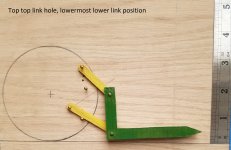
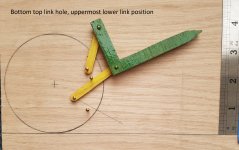
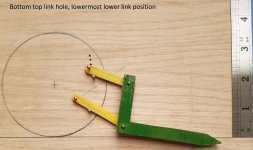
Because I found the geometries hard to visualize, I built myself a little model. It was an amusing diversion, and was fun thinking about Harry Furguson's groundbreaking invention... which originally had two links on the top and one on the bottom. Who knew?! 3 point linkage.* 3 point tractor linkage

There will be some variation from tractor to tractor about where the connection points are relative to each other, but you may find looking at these pictures helps you think about your tractor.

The bottom hole provides the greatest elevation change of the "tail wheel" of my "implement", but it also the greatest angular change relative to the plane of the ground.

The top hole gives the least elevation change of the tail wheel, but better maintains parallelism with the ground.

Hence, I'm thinking the bottom hole is best for something like a landscape rake where you might want to lift it up and out of the way, perhaps with a little more angle so trash drops off the tines.
And a plow ought to be in one of the upper holes, so it's still at a proper working angle, regardless of its depth.

Happy Spring, everyone!
:D

20190318_110244.jpg20190318_110359.jpg20190318_110439.jpg20190318_110554.jpg
 
Last edited:
   / Which Top Link Hole to Use - an illustrative model #2  
There is a lot of contradictory information about which hole to use for the tractor end of the top link. It's confounded by the issue of hydraulic draft control, which some tractors have, as the effect of that draft control is more pronounced at certain holes.

I know the best advice is to RTFM, but my manual (LS R4047) didn't have any info on the subject.

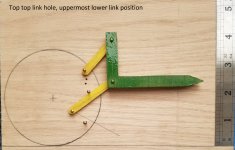
Because I found the geometries hard to visualize, I built myself a little model. It was an amusing diversion, and was fun thinking about Harry Furguson's groundbreaking invention... which originally had two links on the top and one on the bottom. Who knew?! 3 point linkage.* 3 point tractor linkage

There will be some variation from tractor to tractor about where the connection points are relative to each other, but you may find looking at these pictures helps you think about your tractor.

The bottom hole provides the greatest elevation change of the "tail wheel" of my "implement", but it also the greatest angular change relative to the plane of the ground.

The top hole gives the least elevation change of the tail wheel, but better maintains parallelism with the ground.

Hence, I'm thinking the top hole is best for something like a landscape rake where you might want to lift it up and out of the way, perhaps with a little more angle so trash drops off the tines.
And a plow ought to be in one of the lower holes, so it's still at a proper working angle, regardless of its depth.


Happy Spring, everyone!
:D

View attachment 596427View attachment 596428View attachment 596429View attachment 596430
Doesn't that contradict what your test revealed?
 
   / Which Top Link Hole to Use - an illustrative model #3  
Interesting demonstration.

I don't use any implements that require draft control so I don't know much about how it works. When mounting my snowblower and mower I just make sure the top and bottom links are as close to parallel to each other as the existing holes in the tractor and implement allow.
 
   / Which Top Link Hole to Use - an illustrative model
  • Thread Starter
#4  
Yep. Had a senior moment there. Editing to correct. Thanks, Ford850.
 
   / Which Top Link Hole to Use - an illustrative model #5  
My tractor has three top link holes. #1 being on top - #3 being on the bottom. This is the page out of my Op Manual that details which hole to use. I currently have my hydraulic top link in the middle( #2 ) hole.

View attachment 596448
 
   / Which Top Link Hole to Use - an illustrative model #7  
Thank you! I have been trying to picture that in my head for years. Now it makes sense!
 
   / Which Top Link Hole to Use - an illustrative model #8  
Thanks for the post. I just bought a drum mower and the non-mowing "stow" position is directly behind the tractor. Since total length out behind where the rear tires contact the ground is like 9', having adequate ground clearance is important. I had thought about doing a diagram such as yours to determine which hole is best....you saved me the effort.....on setting the implement down using the lowest hole, the height of the 3 pt when mower is on the ground makes for a straight line....other things like a tandem disc could be as shown in the 4th picture.

On Draft control, my 3910 manual specifies that the lower hole is for the fastest response....didn't explain what you did.
 
   / Which Top Link Hole to Use - an illustrative model #9  
Thanks for the post. I consider myself having 1/2 a brain, and it would always hurt when trying to work through what your model easily shows.

Couple of question/notes:

Don't these models really show what adjustments can be made if you've reached the limits of adjusting your top link and want a "little more"?

I believe the primary reason for having the three holes is to adjust sensitivity of draft control as Texasmark and Oosik refer to. However, I believe the 3 holes are usually on a bracket that is a "lever arm" itself, as part of the draft control sensing. So whether the top hole or bottom hole is more sensitive and has most draft control response, depends on whether the "fulcrum" (and the attachment of this bracket to the draft control "sensor") is at the top or bottom of this bracket (if that makes sense). Other may know better than me, but which hole is most sensitive may differ from tractor to tractor based on how the draft control input linkage is oriented.
:2cents:
 
Last edited:
   / Which Top Link Hole to Use - an illustrative model #10  
I'll be honest. That page I posted out of my Op Manual makes no logical sense to me. The really sad part - there is little to no verbal explanation to go along with that page. pmbutter's posts make a lot more sense. I think the page I posted has more to do with draft control. Not really so much - what hole to use for the top link.
 
   / Which Top Link Hole to Use - an illustrative model #11  
I'll be honest. That page I posted out of my Op Manual makes no logical sense to me. The really sad part - there is little to no verbal explanation to go along with that page. pmbutter's posts make a lot more sense. I think the page I posted has more to do with draft control. Not really so much - what hole to use for the top link.

It looks like draft control is only used with middle and bottom holes #2 & #3; and #1 hole, because its at the top, its geometry probably doesn't allow it to 'input" into/lever the draft control with any accuracy.
It looks like the farther you get away from the top, the more leverage /"sensitivity to force" the top link applies to the draft control input. I assume this is why on light soil you run in a more sensitive hole.
 
   / Which Top Link Hole to Use - an illustrative model #13  
If you are lifting something at or near the Max capacity of the hydraulics....the top hole gives the most lifting force (because it is moving the implement the least distance)
 
   / Which Top Link Hole to Use - an illustrative model #14  
Nicely illustrated. I saved your pics in a folder labeled Top Link Positions.

As LD1 pointed out the greater distance will decrease your lifting capacity.

I moved the pins on my backhoe bucket one time to see what the result would be. It had greater travel but greatly reduced the power to tear out roots. The explanation in my manual was reversed as I read it.
 
   / Which Top Link Hole to Use - an illustrative model #15  
Yep, its as simple as you cant have something for nothing.

Greater articulation (tail wheel lift) comes with the price of reduced power.

Greater power comes with the price of reduced articulation
 
   / Which Top Link Hole to Use - an illustrative model #16  
If you are lifting something at or near the Max capacity of the hydraulics....the top hole gives the most lifting force (because it is moving the implement the least distance)

Maybe I am missing something. When you say "top hole" I assume you mean the top hole for the upper link arm. The upper link arm doesn't lift the implement, the lower arms lift the implement.

My limited understanding of the draft control is it's purpose isn't to lift the implement, it is to hold or adjust the angle of ground engaging equipment such as a plow.
 
   / Which Top Link Hole to Use - an illustrative model #17  
Maybe I am missing something. When you say "top hole" I assume you mean the top hole for the upper link arm. The upper link arm doesn't lift the implement, the lower arms lift the implement.

My limited understanding of the draft control is it's purpose isn't to lift the implement, it is to hold or adjust the angle of ground engaging equipment such as a plow.

Yes, the holes at the tractor that the upper link arm connects to.
Yes, the lower link arms do all the lifting, but as OP model shows, the lower top link hole results in the implement being higher. So moving the lift arms to their maximum height required more work than if top link used lower holes. There's no free lunch. You can think of it like a simple lever where you have only so much force on one side (from the lift arms), but you're shortening the position of the fulcrum to get greater travel on the other (implement) side. Thus you can see that implement's travel distance would be increased, and the lift capacity would be decreased.

Bonus question: Which top link position is the front of tractor the lightest? And how does that effect lift capacity (without additional front end weights and avoiding wheelies)?
 
   / Which Top Link Hole to Use - an illustrative model #18  
Maybe I am missing something. When you say "top hole" I assume you mean the top hole for the upper link arm. The upper link arm doesn't lift the implement, the lower arms lift the implement.

My limited understanding of the draft control is it's purpose isn't to lift the implement, it is to hold or adjust the angle of ground engaging equipment such as a plow.

Dont feel bad. MANY people fail to understand. When I said upper hole...YES I am talking about toplink. the HIGHER it is mounted on the tractor side.....the MORE you can lift.

Look at the illustration the OP posted in the first post. Do you agree that it is accurate and that is indeed what happens in the real world. Where the top hole causes the tips of the forks (or tailwheel of a bushhog) to remain more level?

Now I am just gonna throw out some random numbers.....cause Im not near a tractor at the moment. But lets say that through out its WHOLE range of travel....the 3PH lower ball ends move 20". And lets say they are capable of lifting 1000#

Now lets attach pallet forks back there and put the toplink in the top hole. And through out its WHOLE range, the fork tips move 30". Well, something capable of lifting something no more than 1000# and only 20" certainly isnt gonna lift the same 1000# 30" now is it. Nope.....it will now be able to lift 667# at them fork tips. More lift height = less it can lift.

Now lets put that toplink in the bottom hole. Whola....Fork tips NOW move 40" in the same range of travel of the 3PH.
Again, cant get something for nothing. Getting that extra 10" of lift height cost us more capacity. Now it can only lift 500# at them fork tips.

Aint geometry wonderful:D
 
   / Which Top Link Hole to Use - an illustrative model #19  
I doubt a person will see a measurable difference in the amount of weight the lower link arms will lift regardless of which position the upper link is pinned in. But to me it is a mute point anyway due to my implements all have drivelines so I want the implement as flat as possible thru the entire lift/lowering range.

If a mower or snowblower were setup like OP's last two examples, the driveline u-joints would have a shortened life span due to the tractor out put shaft and implement input shaft not being kept somewhat parallel to each other.
 
   / Which Top Link Hole to Use - an illustrative model #20  
Over the years, the geometry between the lift arm pivots and where the top link attaches have been all over the place. Also, the geometry between the 3pt attachment points on the equipment we use are all different. Some of the old tractors with draft control had 5 holes for the upper link.
 

Tractor & Equipment Auctions

2017 CATERPILLAR 120M2 MOTORGRADER (A52709)
2017 CATERPILLAR...
UNUSED X-STAR ACS LOADER BOOM LIFT (A52706)
UNUSED X-STAR ACS...
2016 Toro Groundsmaster 4500-D 4WD Commercial Rotary Mower (A59228)
2016 Toro...
12ft x 8ft Military Flat Bed (A57454)
12ft x 8ft...
2017 CATERPILLAR 305E2 CR EXCAVATOR (A60429)
2017 CATERPILLAR...
2015 CATERPILLAR 308E2 CR EXCAVATOR (A60429)
2015 CATERPILLAR...
 
Top