what makes a good "arc?"

/ what makes a good "arc?" #1  

mikehaugen

Elite Member
Joined
Mar 9, 2009
Messages
3,407
Location
Lee, IL
Tractor
John Deere 1070
I hear a lot of experienced welders speak highly of certain machines stating that they have a nice "arc." Why is this? I guess this is really 2 questions. What characteristic is it that one weldor may prefer about a certain welder, where someone else may prefer a different welder. Also, what actually causes this? Particularly with dc, where does the difference come from? In my mind, I think of a dc current traveling through the leads at a particular amount of amps and the only difference I could think of would be ocv that might make a difference. I know some welders have "dig" control (or something like that) but what does that mean? Some prefer red, and some blue. Our recently departed friend here I know had made some references here and there.

I have welded with about a half dozen or so different welders, and have done enough to consider myself "ok." I can lay a decent bead with 6010 and 7018 that won't break, but certainly would not call myself a pro. Any difference between welders I have probably chalked up to my inexperience and figured I wasn't consistent.

So come on you pro's (or hobbiests, or whatever), tell us your thoughts. What should I be paying attention to when using defferent welders.
 
/ what makes a good "arc?" #2  
I have wondered about this too. Some welders "weld" a lot easier than others. It's just easier to strike and hold an arc. Just like some rods weld a lot nicer than others. So I'm just in to learn something again.
 
/ what makes a good "arc?" #3  
I copied this from a welding thread on the Hobart forum.


TRG-42
02-14-2007, 07:26 PM
Since there has been recent discussion regarding arc force / dig / etc on engine drives here is the theory in a long and potentially boring nutshell

The term Arc Force actually means different things depending on the particular machine

In generally Arc Force ( traditional ) / Dig ( Miller Trade Name )when stick welding is the following

- as voltage decreases, current spikes ( think of it as a tail on the volt amp curve ) . Please see diagram of Miller VA curve below.

- the key point is as the electrodes arc voltage approaches zero ( starts to short ) the current increases ( to a varying degree determined by Dig / arc force setting - the 0% to 100% )


http://i30.photobucket.com/albums/c347/TRG42/MillerDig.png

Why would you want Arc Force / Dig ?

If you have trouble with, for example, E7018 sticking you can turn up arc force. As you short out the electrode because you got too close the current shoots up, burning back. You can take an electrode and push it straight through a 1/2" plate with arc force turned all the way up !

If you are pipe welding, and the gap is tighter, by pushing in ( shortening arc length, therefore arc voltage ) the current goes up ( see bottom of VA curve shown above ) to ensure adequate penetration

As arc force goes up the arc generally gets harsher, especially if you start to shorten arc length

What Machines have this
- almost all stick machines now, and Miller engine drives

Key Point - all these machines have a TRADITIONAL textbook CC curve ( dropper ) Again, refer to VA curve above

Conclusion - Arc Force ( traditional ) / Dig are pretty rudimentary soloutions to increase current depending on arc length

Lincolns Arc Control ( their version of arc force ) on Chopper Machines

This is kinda the same as Arc Force ( traditional ) and Dig except the VA curve ( when you set it in CC downhill pipe mode ) has slope

http://i30.photobucket.com/albums/c347/TRG42/ArcControl.png

Again, if you turn up the Arc Control, essentially the software will cause the VA curve to provide more amps as voltage approaches zero ( electrode starts to get closer )

Advantage over Traditional Arc Force /Dig

Although traditional arc force will cause the current to vary , it only starts to vary as electrode starts to drop well below 20 arc volts ( once again, refer to miller VA curve above ). Slope only starts at the "tail end"

As a result, the current does not vary that much unless you get real close. Most people actually want this, because this is true constant current


However, if you are a pipeline welder, they prefer the more slopy VA curve, which is what ALL Lincoln generators will do and all Lincoln Chopper machines on "Downhill Pipe CC setting " ( Lincoln choppers on standard CC behave like all Miller VA curve

This is why guys who want a generator arc but dont want a generator use Lincoln Ranger 305s / Vantages because you can emulate ( not perfectly as you will see ) the VA characteristic of a true generator

Key Point - Chopper machines on Downhill Pipe ( even they are on constant current ) have not so constant current because of the sloping VA curve ( see VA curve of chopper above )

This is far more refined way to vary amps as voltage changes. It will vary it continously, not only radically as voltage approaches zero ( electrode starts to short ). in additon traditional CC curves with arc force can only INCREASE current as electrode starts to short

A sloping VA curve indicates that current can also decrease as arc length increases


Example, you can swing a 125 amp arc from 140 to 100 if you wanted to.

Conclusion - Lincolns arc control on chopper machines not only incorporates traditional arc force, but also can play with the VA curve yielding ( depending if you are on CC or Downhill Pipe setting ) far more current control ( yeah i know its suppose to be constant current ) than you can ever hope to get with a traditional CC machine

King of Variable Arc - The generator !

The mainstay of the pipewelding industry is the generator machine. how does the arcs VA curve vary

- VA curve has slope . As in "Downhill Pipe " on chopper machines, sloping VA curves yields far greater control on the arc ( IF the operator knows what he is doing )

- VA cuve is variable . This is the main reason that generator machines rule when it comes to pleasing stick welding connisors

Please see VA curve of a Classic 300D below showing the numerous VA curves the machine is capable of

As you can see below ( its not as confusing as it looks ! ) the VA curve is unlike a true CC curve because it has slope . Again, this means that as voltage changes current also changes

ALL other CC machines have basically one volt amp curve. If you don't like it too bad because thats the curve. On a generator machine, as you can see, there are numerous VA curves

More importantly you can , hit a desired current on two or three taps

Key Point - this is NOT like a range switch on other engine drives ( it does chang the range ) but you can hit a given current on numerous ranges ( way more overlapp )

The purpose of this is you can hit a given current with a more sloped or less sloped tap .

Advantage is you can have a 160 amp arc , for example, that has lots of variation as arc length changes, or a 160 amp arc with less variation as arc length changes

http://i30.photobucket.com/albums/c347/TRG42/VACurveClassic.jpg

Here is a more clear picture of the choice of two VA curves for a given current ( load point - where machine has been set for - is where the two graphs intersect ). Depending on which VA curve, the current will vary differently as V changes

http://i30.photobucket.com/albums/c347/TRG42/GeneratorControl.png


Also notice that not only the slope is different, but the current as voltage approaches zero ( starts to short ) is noticably higher on the bottom curve. This means there would be more current as electrode starts to short. This is very similar to more arc force


Last, you can play with the engine RPM to vary the OCV ( open circuit voltage )

This is different from variable slope on VA curve because the slope does not change but rather it moves up or down ( varys OCV )

Variation is about 100 to 150 rpm btw


http://i30.photobucket.com/albums/c347/TRG42/CustomArc1.jpg


http://i30.photobucket.com/albums/c347/TRG42/CustomArc2.jpg

Conclusion - Generator Machines

Not only do you have a better VA curve for Pipe Welding, you can choose from different VA slopes

You can also vary the OCV to change the arc characteristic

You can also roll the rack ( I think I am starting to get too long winded so i quite while Im ahead )

Are these arc force ( in the traditional sense ) , NO . Do they vary the arc characteristics ( far more variation and control compared to conventional arc force ) YES .

This way there is way more control over the arc with a generator machine than you can hope to get with even a chopper machine, or a traditional rectified alternator
 
/ what makes a good "arc?" #4  
Where in "heck" is Shield Arc when you need him.
 
/ what makes a good "arc?" #5  
Not all DC current is created the same. Lincoln generators produce true DC current. Miller uses a rectifier to change AC into DC. Open circuit voltage and the slope (volt/amp curve) make a difference as well. Sometimes certain machines just work better with certain rods.
 
/ what makes a good "arc?" #6  
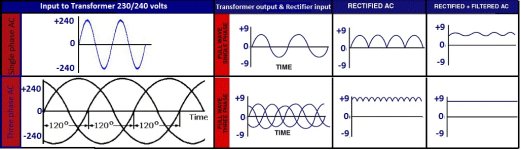
As far as DC, until a person uses a pure DC generator like an SA-200 or similar, I don't think the difference is as clear.

A three phase rectified DC signal is about as close as a person would get.

Standard single phase rectified is the bottom.

But, my 900 lb Airco has a very smooth DC arc that does not stick, is not harsh or spattery, and runs 7018 better than any plug in welder I've used. I can push on the electrode if I want and the arc does not snuff out and stick.

My inverter machine, Invertec v250-s, is almost identical.

My little AC/DC homeowner machine does not fare as well, the arc is kind of noisy and feels different, almost like it has a pulse.

The SA-200 has a pure DC signal that feels like it just melts a rod like spreading butter.

Check out this pic of single phase (top) and three phase (bottom).
image.jpg
 
/ what makes a good "arc?" #7  
Not all DC current is created the same. Lincoln generators produce true DC current. Miller uses a rectifier to change AC into DC. Open circuit voltage and the slope (volt/amp curve) make a difference as well. Sometimes certain machines just work better with certain rods.

Interesting. I didn't realize there was a fundamental difference between Red and Blue. Learn something every day.

Lots of good info in this thread already.
 
/ what makes a good "arc?"
  • Thread Starter
#8  
Ok, so I think I understand better now. According to what James posted, the current does in fact change based on voltage, which is the result of arc length... makes sense. I guess "constant current" is not exactly constant current.

What Dave posted also makes a lot of sense. We used to have a big, old lincoln 3 phase welder where I work. It was a big cylinder about 2 feet around and maybe 5 feet long. It was very noisy, and by the sound of it, I always presumed it was a 3 phase motor coupled to a dc generator. Never understood the logic and I guess I just figured because it was old that it was the only technology they had back then. Looking back now, I guess it was pretty smooth, but like I said, I just assumed it was my welding technique causing differences.

I would have to wonder if the newer inverter welders would replicate this smooth arc?

Not all DC current is created the same. Lincoln generators produce true DC current. Miller uses a rectifier to change AC into DC. Open circuit voltage and the slope (volt/amp curve) make a difference as well. Sometimes certain machines just work better with certain rods.

Is this true of all Lincolns/Millers? I know I've heard a lot of praise for the lincoln engine drives over the millers and this probably explains it. Why would miller do this? Is there an advantage of using rectified ac over dc? I could only assume cost, but even that doesn't make sense.
 
/ what makes a good "arc?"
  • Thread Starter
#9  
Is this true of all Lincolns/Millers? I know I've heard a lot of praise for the lincoln engine drives over the millers and this probably explains it. Why would miller do this? Is there an advantage of using rectified ac over dc? I could only assume cost, but even that doesn't make sense.

Thinking more about it, I may have answered my own question. It would be much easier to convert ac to dc with rectifiers, than to try to make ac out of generated dc. So I guess the new question is how does Lincoln overcome this and make ac output on an engine drive?
 
/ what makes a good "arc?" #10  
Shield Arc, used to say that the Everlast PA200 had as smooth of an arc when running 7018 as any of his many engine drives. I don't have a clue.
 
/ what makes a good "arc?" #11  
As far as DC, until a person uses a pure DC generator like an SA-200 or similar, I don't think the difference is as clear.
For sure, they are the best stick machine IMHO, mind you saying that, arc blow with them is a b&&ch, that and burning the switches out of grinders....Mike
 
/ what makes a good "arc?" #12  
Shield Arc, used to say that the Everlast PA200 had as smooth of an arc when running 7018 as any of his many engine drives. I don't have a clue.

I find this machine to run 7018 smooth.
 
/ what makes a good "arc?"
  • Thread Starter
#15  
Where in "heck" is Shield Arc when you need him.

Over on welding web... he is still active there and I do quite a bit of lurking there (still haven't signed up).

Can't remember his screen name but I recognize his avatar everytime :D
 
/ what makes a good "arc?" #16  
Interesting. I didn't realize there was a fundamental difference between Red and Blue. Learn something every day.

Lots of good info in this thread already.

It's not that simple, both red and blue use various size capacitors to re-shape the DC waveform and make it more steady. There are subtle differences, but not stark differences in the ones I have seen on a scope.
 
/ what makes a good "arc?" #18  
Maybe I can add to this complexity. First, red and blue both make good machines as do others. It's a design issue. For example, There are large capacitors that can dump high current at startup so a rod doesn't stick when first struck. And Inductors maintain the current flow when the arc length increases instead of arc blowing out. Each of these can then be controlled to various degrees to a desired result. Also, motor/ generators tend to have more inductance than AC powered resulting generally in smoother arc. But money can equalize inherent differences. So more expensive machines have more control over the arc / current / voltage characteristics. Most designs are different therefore the results will be different. I built my first DC stick machine and learned some of the relationships. It was crude by today's standards but effective at the time.
. Now I use a red and a blue mig.
Thomas h beat me to it and is more distinct. Good job T
 
/ what makes a good "arc?" #19  
Maybe I can add to this complexity. First, red and blue both make good machines as do others. It's a design issue. For example, There are large capacitors that can dump high current at startup so a rod doesn't stick when first struck. And Inductors maintain the current flow when the arc length increases instead of arc blowing out. Each of these can then be controlled to various degrees to a desired result. Also, motor/ generators tend to have more inductance than AC powered resulting generally in smoother arc. But money can equalize inherent differences. So more expensive machines have more control over the arc / current / voltage characteristics. Most designs are different therefore the results will be different. I built my first DC stick machine and learned some of the relationships. It was crude by today's standards but effective at the time. My Elec Eng background helped. Now I use a red and a blue mig.

Well put, and let me add that when striking the arc, the more sophisticated machines will attempt to provide a lot of power to keep the rod from sticking (for about 1/4 of a second); which gets you started. And they can control the inductance, which tends to either concentrate the arc or spread it out.

Some of the less expensive welders have some of these features, and typically the latest inverter machines have more of them than the similarly priced transformer machines.
 
/ what makes a good "arc?" #20  
Burn some rod with different machines and you can tell. I have used engine drives, inverters, and transformers. All can be good but there are some that shine above the rest. There are a few transformer machines that have a very smooth arc and are able to run a very tight arc. The ability to run a short arc length when running 7018 is important. The ability to keep the arc length short decreases the chance for arc blow and allows you to run higher current. When is was competing I used to train on as many machines as possible. The worst stick machines were the first generation inverters. I remember going into my welding booth at VICA nationals and seeing the red inverter and knowing it would be a challenge. For most general welding a name brand newer machines will run well. How you route your ground cable and stinger cable when welding can also help with this. For most general repair or hobby welding this should not be much of a concern. And it is not as much of a problem with rods like 6010 or 6011.
 

Marketplace Items

2015 John Deere 210 GLC Excavator (A60352)
2015 John Deere...
2015 C.GALLEGOS PNEUMATIC TRAILER (A60736)
2015 C.GALLEGOS...
2000 ITASCA SUNCRUISER 37G CLASS A RV (A60736)
2000 ITASCA...
Midwestern Industries MEV Screen Model MEV 5X10⁻² (A61307)
Midwestern...
2023 VOLVO VNL760 6X4 T/A  SLEEPER TRUCK TRACTOR (A59908)
2023 VOLVO VNL760...
1999 John Deere 7810 (A60462)
1999 John Deere...
 
Top