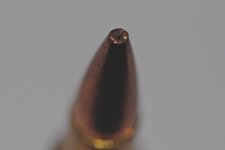
What kind of bullet is this?

   / What kind of bullet is this? #1  

N80

Super Member
Joined
Aug 2, 2005
Messages
6,940
Location
SC
Tractor
Kubota L4400 4wd w/LA 703 FEL
This is a 7mm-08, Remington case. Bullet type is unmarked and unknown. I do not think it is a reload so probably something standard from Remington but it is different in appearance from all the other Soft Point Cor-Lokt bullets I have. The main thing I want to know is if it is a big game bullet suitable for deer. Any assistance appreciated.

_DSC6040.jpg

P.S.: I have tried using Remington's web site but it is, and has always been, almost unusably slow. I have no idea why......probably big brother....;)
 
   / What kind of bullet is this? #2  
Remington factory hollow point bullet.I have a similar bullet in 25/06 from the factory.Didn't like them for deer;too much destruction.
 
   / What kind of bullet is this? #3  
Without pulling the bullet I cant be sure, but I think it is a type of Full Metal Jacket but it may be have a copper base instead of being open on the base ans showing the lead core. Basically I believe this bullet is built the other way, in that the nose was the open end of the bullet cup and has a lead core but the base is solid copper. So that makes it still a FMJ bullet type and as such is more or less no expanding, so should not be used for Hunting. Plinking/target round only.

James K0UA
 
   / What kind of bullet is this? #4  
Sure looks like one of Remmington's hollow points. I could never get them to shoot well for me
 
   / What kind of bullet is this?
  • Thread Starter
#5  
Thanks guys. I don't think it is an FMJ. These were mixed in with some of my Dad's stuff and I don't know why he'd have owned FMJ bullets. Plus, at the tip the copper has cut grooves (which don't show up well in the photo) for expansion.

nybirdman, when you say too much destruction do you mean the bullets were coming apart or too much damage to the deer?
 
   / What kind of bullet is this?
  • Thread Starter
#6  
Sure looks like one of Remmington's hollow points. I could never get them to shoot well for me

Well, I pulled this gun out to make sure it was sighted in (it was my Dad's) and I just grabbed these bullets without paying too much attention to what they were, but they shot a super tight group at 100 yards with a 4x scope.

I will run a few of the soft point Core-lokt bullets through it too to make sure they hit close to these since they (the soft points) are in the box (so I know exactly what they are) and I have plenty of them.
 
   / What kind of bullet is this? #7  
That's not a FMJ, it's a varmit round or a match round. Have to pull it to tell for sure. It has been sitting in a magazine while the rifle was shot stored incorrectly, that's why the nose is deformed.
 
   / What kind of bullet is this?
  • Thread Starter
#8  
No, its been sitting in the factory plastic bullet holder (minus the box) for years. And Dad rarely hunted with this gun, but it may have been in and out of the gun a few times....or bouncing around in a pocket.

But, the bottom line is that it doesn't sound like there is any way for me to be completely sure what type of bullet it is and I would not want to shoot it at a deer unless I knew for sure. So I better mark them 'not for hunting' and just shoot them up for general sighting in and/or plinking. Or coyotes.
 
   / What kind of bullet is this? #9  
Ok, I stand corrected, perhaps it is what Rem. Catalogs as an OTM or open tip match bullet.?
 
   / What kind of bullet is this? #10  
Ok, I stand corrected, perhaps it is what Rem. Catalogs as an OTM or open tip match bullet.?
That is what it looks like. OTM describes the result of drawing the copper jacket from the base up, versus from the tip down. The result is a FMJ with a small aperture at the tip. The prime advantage of OTM is accuracy; this is a result of better base uniformity. As the bullet egresses the muzzle, the more uniform the base of the bullet and the more uniform the barrel crown, the more uniform the gas pressure will be around the periphery of the bullet/crown interface. The resultant homogeneous pressure distribution results in less initial upset of the tail of the bullet, which in turn reduces epicyclic swerve. See this link for a detailed explanation and a video.

Note that OTM is *not* classed as a hollow-point projectile. The aperture left by the bottom-up copper jacket drawing process is generally not large enough to induce "flower petaling" as would occur in a true JHP projectile. Therefore, the wounding mechanism for OTM is very much like any high velocity FMJ projectile: transient yawing followed by fragmentation typically initiated at the cannelure.

Also note that OTM projectiles are currently in widespread use by US military snipers; JAG has ruled OTM usage is in accordance with the Hague Convention.

Wrooster
 
   / What kind of bullet is this? #11  
Thanks guys. I don't think it is an FMJ. These were mixed in with some of my Dad's stuff and I don't know why he'd have owned FMJ bullets. Plus, at the tip the copper has cut grooves (which don't show up well in the photo) for expansion.

nybirdman, when you say too much destruction do you mean the bullets were coming apart or too much damage to the deer?
My experience with that load on deer,of course dead deer but tremendous loss of meat on a shoulder shot.I handload Nosler partition 120/115 gr.for the 25/06 with excellent results .
 
   / What kind of bullet is this?
  • Thread Starter
#12  
Note that OTM is *not* classed as a hollow-point projectile. The aperture left by the bottom-up copper jacket drawing process is generally not large enough to induce "flower petaling" as would occur in a true JHP projectile. Therefore, the wounding mechanism for OTM is very much like any high velocity FMJ projectile: transient yawing followed by fragmentation typically initiated at the cannelure.

Wrooster

Okay, so maybe just right for coyotes.
 
   / What kind of bullet is this? #13  
No, its been sitting in the factory plastic bullet holder (minus the box) for years.
That would be plenty to do that damage to that round.

Yes it would be great yot medicine or any thin animals up to the 100ish pound range. I've taken a few caribu with the .308 162 federal match ammo and they did great, all about placement.
 
   / What kind of bullet is this? #14  
Okay, so maybe just right for coyotes.
As noted prior, bullet yaw followed by fragmentation is the primary wounding mechanism for most all high velocity FMJ projectiles -- including the 5.56mm NATO type 62gr M855 used in .mil M16's and M4's. So, it works on more than just coyotes...

Wrooster
 
   / What kind of bullet is this? #15  
It could be a match round or a hunting round, but I can't tell from the photo. The Match King bullets I used in competition are not that much different weight wise or visually with the Game King bullets I have used. I know both shoot the same with my loads.

A visit to a gun store with a good supply of reloading components and/or commercial rounds might help ID the round.

Later,
Dan
 
   / What kind of bullet is this? #16  
From what I read years ago, match bullets have thinner jackets and don not hold up/expand like hunting bullets. They tend to fragment and wound, partly from uncontrolled expansion and then fragmentation. So you wind up with a bad wound instead of a clean kill.

Trying to remember, I think it was discussed in my first Speer book, and in Ken Waters "Pet Loads".

nybirdman, when you say too much destruction do you mean the bullets were coming apart or too much damage to the deer?
 
   / What kind of bullet is this? #17  
From what I read years ago, match bullets have thinner jackets and don not hold up/expand like hunting bullets. They tend to fragment and wound, partly from uncontrolled expansion and then fragmentation. So you wind up with a bad wound instead of a clean kill.
I'm having trouble differentiating between a "bad wound" and a "clean kill".

Assuming the same shot placement, there are two mechanisms which lead to death: 1) hypovolemia link leading to exsanguination link leading to cerebral anoxia link of the brain, and 2) disruption or termination of central nervous system (CNS) function such that autonomous functions (breathing, etc) cease.

In layman's terms, #1 above is "bleeding out", typically from a COM (center of mass) strike, and #2 is a "head shot".

A COM hit generally does not produce "instant death" as -- depending on an individual's physiology and many other factors -- semi-normal functioning is possible for anywhere from 15 seconds to 5 minutes even with traumatic injury within the thoracic triangle (draw a triangle between your nipples and the top of your breast plate at the base of your neck -- if you take a round in that area you got yourself a major problem which is typically not solvable "in the field"). Outside of the thoracic triangle, the outcome varies widely.

A proper head shot, assuming the medulla link is stuck and/or significantly damaged by overpressure, is "lights out". All motor function ceases and death is, from a physiological perspective, instantaneous. Of course not all head shots result in death; the number of people (and animals) struck in the head but still walking around today is a fair percentage.

Back on topic, in terms of hunting -- head shots on game such as deer could be considered "risky" and even inhumane. The target is small and constantly swiveling around. A poor shot could result in significant damage to the animal's jaw, for example. Unless successfully tracked and put down, the animal will slowly starve to death over the course of a few weeks. For this reason, "COM" on game animals is advised -- through front shoulder and into vital organs for example.

Accordingly, there is no "lights out" with this approach. Taking the animal rapidly and without extensive tracking depends on maximizing the damage withing the equivalent of the thoracic triangle -- meaning heart and lungs, primarily. Whatever projectile maximizes damage in this area will minimize the time until cessation of effective cardiovascular function.

Wrooster
 
   / What kind of bullet is this?
  • Thread Starter
#18  
There can be several differences between a bad wound and a clean kill. In terms of warfare a bad wound is more effective than a clean kill since it can occupy ancillary troops and resources. A less 'bad' wound can accomplish the same thing. So, in efforts to keep warfare less barbaric there are 'rules' that try to minimize bad wounds while still attempting to minimize loss of life at the same time. That's why hunting bullets and designed fragmentation bullets are generally not kosher.

From a hunting perspective a bad wound can mean a lethal wound but one that damages too much meat.

There is a third mechanism of death that technically does not occur due to hypovolemia or exsanguination but still results in immediate cerebral anoxia and that is 'pump failure' which is essentially a direct heart shot. Yes, hypovolemia and exsanguination occur, but when the heart does not beat, the brain stops functioning fast, even before hypovolemia occurs. In other words, the volume of blood within the vascular system is not severely depleted, it just isn't going anywhere because the heart is either gone or immediately stops beating due to shock wave trauma. This is splitting hairs but I think it accounts for a lot of the "COM" shots that result in an animal falling in its tracks with hardly even a kick, effectively a lights out shot. The type of shot we all prefer but, as mentioned, "COM" do not always result in.

I do not take head or neck shots for the very reasons cited above. Sure, they preserve more meat but I'm not starving or hungry enough to risk jaw, esophagus or trachea shots that are not immediately lethal. It is inhumane and unnecessary in my book.
 
   / What kind of bullet is this? #19  
Looks to me as a FMJ with the tip filed back and an X made in the tip.
I know that some poorer hunters in my area did that to create their own 'soft nose' ammo.
That was back in the '50's when surplus ammo was real cheap compared to hunting ammo.
 
   / What kind of bullet is this?
  • Thread Starter
#20  
After accessing Remington's web site, which as mentioned is just awfully slow and clunky, I do believe this is their 'varmint' hollow point round.
 

Tractor & Equipment Auctions

2017 John Deere 5090GN (A53317)
2017 John Deere...
2011 INTERNATIONAL WORKSTAR 7400 SBA 6X4 DUMP TRK (A52706)
2011 INTERNATIONAL...
2012 KINZE FLAT FOLD ROW MARKERS SET FOR 12 ROW 36/38 STACK FOLD TOOL BAR (A55315)
2012 KINZE FLAT...
2018 Dodge Journey SUV (A59231)
2018 Dodge Journey...
2006 JAYCO JAYFLIGHT 30' TYPE CAMPER (A58375)
2006 JAYCO...
2024 DEVELON DL250-7 WHEEL LOADER (A59823)
2024 DEVELON...
 
Top