well drilling / puunding

/ well drilling / puunding #1  

tommu56

Elite Member
Joined
Oct 4, 2004
Messages
2,939
Location
Lycoming county pa
Tractor
kubota bx23
I was talking to well driller yesterday he has a "pounder" type rigg the other person I have talked to have "rotary" type the pounder said the pounder is more costly per foot than the rotary and the pounder said he dosent have to go as deep because he fractuers the rock. The other cabin on the ridge had theirs rotary drilled and went 440ft to get water. did any one else ever have a well pounded in the mountins elevation about 2100' valley is just over 700'.

tom
 
/ well drilling / puunding #2  
Each will naturally argue for their own respective method. Any indication what one will cost vs. the other to get a finished well that produces a reasonable flow of water? Do you have to take all the risk?

I used to live next door to a 'pounder' and there were more horror stories from that method than the 'drillers' have. You don't have an easy decision to make.

Myself, I wouldn't consider a pounder but that may just be me. /forums/images/graemlins/tongue.gif
 
/ well drilling / puunding #3  
I am not a well driller - my mountain well was drilled through almost solid rock 160 feet. - done in 4 hours (29 years ago). A Pounder would have been there 3 weeks or more, if not still pounding away to this very day.
Eventhough it's Rotary, there is still considerable rock fracturing. The "rotary" works very similar to a Hammer Drill in that there is high impact along with rotation. Additionally with rotary the material chips are ejected out of the bore hole with high pressure air and a slurry solution to carry the material up and out the top.
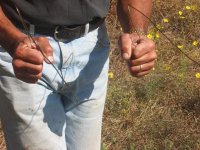
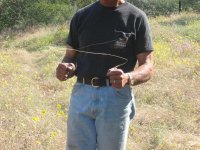
With pounders all the dislodged material is packed against the sides of the well hole. So you decide. Weather you believe in it or not I would consider "witching" the well site - you can do this very easy - no experience required. Get two 3 foot 1/8" diameter copper coated Oxy, Acetelene welding rods from Home Depot or welding supply. Bend one end of each rod @ 90* so that there is about 6" to hold onto. Then one rod in each hand hold them parallel to the ground, parallel to each other and straight out away from you, can tilt them down slightly for better stability and fewer false readings. Walk around all over the place You WILL know when you walk over something, you can even find underground pipes and electrical conduit. It's no guarntee you will find water but what the hay. I use this method to find my underground pipes all the time.

Either way good luck to you.
 
/ well drilling / puunding #4  
The rotary driller will go a lot deeper than the " pounder " you are talking about and a lot faster. My well is 509' deep water was found at 435' It took 24 hours drilling time to reach 509' I was told the water is usally in a layer of sand,which is where my water is,in a 70' thick layer of sand.
 
/ well drilling / puunding #5  
Mornin Tom,
A good friend of mine who lives just down the street from me is in the water pump business and a few years ago expanded his business with a rotary well digging truck. An exoensive piece of appartus for sure. As others have said, a rotary is much faster, and usually on site no more than a few hours or no longer than a day. Depending upon soil conditions, and amount of rock that you are drilling through can determine how water flows into the well. In our area in the northeast, quite often to get sufficient gpm for a useable well a fracing sp? rig is brought in to systematically flush the walls of the well and allow better water flow to occur. Years ago when pounding a well with the conventional rigs of that time, that procedure was not used. There are very few pounders left in this area now, simply because it takes much longer, not cost effective, and everyone these days has some kind of a schedule to meet! There are a few old timers that still provide this service, but not many.

When I drilled my well at my Ct in 82, I had a pounder do it. They dug 165 ft and I had about 5 gpm at the time. As more and more homes were built in the area, and the aquafer was effectively lowered, we began to run out of water! Then in 2000 I had a rotary rig come in and deepen the existing well to 450. After they completed there work I still wasnt getting much water, so I had to pay to have the well fracked, which is a way to cleanse the veins in the rock in 20 ft intervals I believe. After that I had plenty of water, my static water level is abou 40 ft below grade at present, giving me a pretty huge reserve. This method was expensive, but it worked. For the redrilling and fracking I paid about $6000. When the well was originally drilled with the pounder in 82 it was $7 per ft so the total was about $1200 plus the price of a pump and hookup.

Hope this helps.

scotty
ps If you have the time to get the well pounded and the cost savings are there it could work for you.
 
/ well drilling / puunding #6  
In most cases, there is local government office that issues well permits. The people there should have their ears to the ground on this sort of thing. I would make some discreet and polite inquiries and see if you can't get a heads up on the drillers that are held in high regard by the locals, and those that aren't.

It costs nothing, and could save you a bundle.
 
/ well drilling / puunding #7  
You should have a water resource board somewhere in state government.

The interesting thing in my state is all wells are reported, so you can find out how deep your neighbors wells are, how much they produce, & who drilled them.

I have 2 wells on my property.

One that was pounded 68ft deep 20 years ago that gives 20 gpm -Except for 2 weeks in July when it dries up to 3 gal min /forums/images/graemlins/frown.gif
The other is a drilled well that is 600 ft deep & we get 15 gal min all year. /forums/images/graemlins/confused.gif

The pounded well came with the property, I've got $10,300 into the drilled well /forums/images/graemlins/shocked.gif
 
/ well drilling / puunding #8  
tommu56,

We had our well rotary drilled and the experience was very interesting to watch. It is done exactly as GuglioLS described above. Our well was washed out and purged and we got clean water after a couple of hours of letting it run. I don't know about pounding but would think it might take more purging to clear out the "shrapnel".

We were fortunate in that we hit 15gals/min water at 220'. We continued deeper an got 100+ gals/min at 442' deep. Interesting about water witching as that we used coat hangers and found this spot ourselves. We found several places in the area but this one particular spot just yanked the coat hangers together. I called my wife over without telling her and she found the same thing at the same place. Then had our son do it too without telling him so they did not "expect" the reaction at that spot. We all tried it and were blown away!
Here's a pic of the start.
 

Attachments

  • 839521-WATER WITCH.JPG
    839521-WATER WITCH.JPG
    84.7 KB · Views: 779
/ well drilling / puunding #10  
I've only been around witching for one well- it is amazing how the wires crossed at the same point for everyone. A buddy had some experience and got us started. We drove a sand point almost 100" and got great water.
 
/ well drilling / puunding #11  
My 3 closest neighbors on my right side have pounded wells. The 2 on my side of the road are less than a 100 feet deep with plenty of water. My well is drilled at 465 feet and we need to have it fracked now for lack of water. The neighbors down the street across the road from these two houses have a pounded well also. It is 150 feet with lots of water.
 
/ well drilling / puunding #12  
I'm interested in the comments being made about a well producing so many gallons of water per minute. Anyone know how that rate is determined?
Seems it would take some special technique to do that over time.
My well was drilled in '68 and is down 320'. No water until the last 20' of drill pipe was added at 300' and when hitting water it came up into the well 75' so there is 95' of water depth (at least that is what it was when the well was drilled). At that time, the well was pumped and pumped 30 gal/min with no drop in water level for 2 hours. Seems that would be the only way of knowing if the well would support that draw for any length of time.
Now that the pump is in place (at 260' down, or 35' below the initial water line or 60' from the bottom of the well hole), I've no way of knowing how the rate it is capable of producing can be measured.
Maybe some of you know who are keeping track of it in your wells?
 
/ well drilling / puunding #13  
Beenthere,
The well drillers that I know all used some type of a bail pipe, but I understand what your saying also. If the water is entering the well at such a fast rate, it would make their estimate difficult at best. I really dont have an answer to that question but I can find out. Im thinking that if they are getting water as fast as they can bail it, they rate the well with a real high GPM number. I will look into it.

Another thought, if you know how much your pump is capable of pumping per minute, you can use the ice cube trick. Take the well cap off and drop an ice cube down the well, I think its about 20 ft every second. When you hear the splash you can estimate your static level. I think your getting my drift /forums/images/graemlins/grin.gif

scotty
 
/ well drilling / puunding #14  
</font><font color="blue" class="small">( My 3 closest neighbors on my right side have pounded wells. The 2 on my side of the road are less than a 100 feet deep with plenty of water. My well is drilled at 465 feet and we need to have it fracked now for lack of water. The neighbors down the street across the road from these two houses have a pounded well also. It is 150 feet with lots of water. )</font>

Hey Jim,
You could unplug those drain pipes and have all the water you want /forums/images/graemlins/grin.gif

I couldnt resist /forums/images/graemlins/grin.gif

scotty

ps Tryin to keep your sense of humor /forums/images/graemlins/grin.gif
 
/ well drilling / puunding #15  
beenthere,

This is not very technical but it is what my well driller used. He then sends out an official report on the flow and is recorded so when you sell the property you can claim by his numbers. He's been doing it in my area (with his dad and brother) since the late 50's!

This is what he does. He digs a trench where the water is flowing out and installs a 6" pipe in it. Then builds a dam around the trench with the end of the pipe sticking through it. He then digs a 3' hole for the water to spill into and a trench for it to exit...keep flowing away.

Now this part cracks me up....
Then he gets a 1 gallon bucket and a stop watch. He holds the bucket under the stream of water coming out of the pipe and his brother times how fast the bucket fills up. They do this several times and get an average.

For example: if it takes 5 seconds for the bucket to fill, you've got 12 gals/min. In my case, the bucket filled so fast he was hardly able to start and stop the watch before it was filled....less than ½ second!

I asked him how he does extremely large flow rates and does it with a 5 or even 10 gallon bucket and uses the same principal.
 
/ well drilling / puunding #16  
Hey Jim,
You could unplug those drain pipes and have all the water you want /forums/images/graemlins/grin.gif

I couldnt resist /forums/images/graemlins/grin.gif

scotty

ps Tryin to keep your sense of humor /forums/images/graemlins/grin.gif


Hi Scott,

I'd have to run a pipe another couple hundred yards to get that water into my well. That source is going to run dry pretty soon.
 
/ well drilling / puunding #17  
Rob,

Seems to me that the only information you would get that way is how fast your pump is pumping.

Around here they actually measure the static water level and then suck water until the drawdown stays constant. They suck it down to almost dry and then suck less hard until they get a stable water level while sucking. Then measure the flow rate coming out of the pipe. The stable water level must stay stable for the entire two hours of the pump test. An orifice is then added to the pump discharge line to limit the flow rate and prevent sucking the well dry.

It's no big deal to measure the water level in a well. You drop an open ended tube down to a known depth, usually tie it to the pump when you set it, then cap the little tube with a pressure gauge at the top and pump air into the tube until the pressure stops rising. That pressure can be converted into a water depth. That water depth is the amount of water above the end of the little tube. You can leave the little tube there forever and check the water level at will by pumping a little air in. The tube can be all coiled and ugly so long as its opening is at a known depth.

There is also an electronic device that you lower into the well and when it hits water it beeps. That's for sissies though.
 
/ well drilling / puunding #18  
I'm sorry Highbeam, I did not even mention that....
Yes, he does this with a water level measuring device as you've described while doing his flow test. Although he did not do it for 2 hours constant. The final test he did only lasted an hour or a little more.

I also forgot to mention that the water level rose on it's own pressure to within 150' of the surface after he hit that major fisher. I'm not sure but I think he's placed the pump in there about 250' to 275' deep or so.

The other thing is that he uses 2 gals/minute of water in his drilling rig to flood the hole and purge the ground up granite and quartzite. When the flow starts to exceed the 2 gals/min. he's putting into the drilled hole is how he determines the initial amount of flow. He does this the entire time he's drilling so when the flow of water comes out more and more, he's able to get a reading on how much it is.
I'm no well expert so I'm describing as best I can from what he told me and from what I saw him do...

One thing I do know, we've got LOTS of water /forums/images/graemlins/grin.gif. I know you've visited our website and there are photos and even a video of him drilling the well and finally hitting the large fisher.
 
/ well drilling / puunding #19  
One more thing to clear it up. He put the pump in about 2 after he was complete with the drilling and cleaning of the well. There was no pump in it during the drilling (of course) only his 2 gals/min. All his testing was done during that time, not with the pump in it.
Hope that clears it up a bit???
 
/ well drilling / puunding #20  
Interesting. If you have a 450' deep well with the static water level at 150' down, then you have a good 750 gallon reservoir above the bottom. I would set that pump near the bottom to take advantage of that. But with the super duper flow rate your man determined, you have mucho water.

The time you run the pump once the level stabilizes surely varies and experience matters here. Our well reports have a flow rate and time box so you have to report how long you pump tested. He could probably tell by the drill slag what kind of aquifer was there and could say with confidence after an hour that it would last.

Many folks would love to have your well Rob.
 

Marketplace Items

2020 CATERPILLAR D5 LGP HIGH TRACK CRAWLER DOZER (A60429)
2020 CATERPILLAR...
2018 Chevy Silverado 1500 4X4 (A61306)
2018 Chevy...
2007 Ingersoll Rand G240 240kVA 3-Phase Towable Diesel Generator (A59228)
2007 Ingersoll...
500 BBL FRAC TANK (A58214)
500 BBL FRAC TANK...
2015 FONTAINE 53 DROP DECK (A55745)
2015 FONTAINE 53...
ALLMAND NIGHT-LIGHT PRO 4 BULB LIGHT PLANT (A52706)
ALLMAND...
 
Top