Welding Bucket Hooks!

/ Welding Bucket Hooks! #61  
A little trick I learned while while welding with 7018 is to flick the tip of the rod as you complete a pass. This clears the tip of the rod of that "glass over" and enables you to restart lots easier. If you stop your pass this way, you will just have a cup of flux at the tip which is easy to crush with your gloved finger tip before striking for your next pass. But, be aware of your surroundings, when you flick the tip of the rod, that little ball of molten flux can end up where you don't want it. :eek:
 
/ Welding Bucket Hooks!
  • Thread Starter
#62  
HOT tip! I'll have to try that.

Hopefully I don't put another slagball where I don't want it :eek: :p.
 
/ Welding Bucket Hooks! #63  
xlr82v2,

As far as my MM180, I like it a lot!! So far, it has done what I have asked of it within the constraints of its capabilities. You do have to pay attention to joint prep and cleanliness, but if you do, it can weld just about anything made of mild steel. I've been using a 75-25 gas mix, but will most likely switch to CO2 with the next cylinder change out. But I do need a stick welder again and this time its going to be an AC/DC machine!!!.

You have an interesting background, and with the exception of flying Lear jets now, is very similar to mine!! I got an engineering degree and left the farm. The degree has allowed me to be involved with some pretty cool stuff over the years. But now, I'm in management :(.

Growing up on a family farm I was constantly around and on tractors. I still thoroughly enjoy them and just about anything else mechanical (its the reason I became an engineer). Growing up I got more and more involved with the maintenance/repairs on the equipment on the farm to the point where I was doing most of it by the time I graduated from HS. And that is where I also learned how much I enjoyed welding too!!

I still live adjacent to the original farm but its a small beef farm now and do most of the repairs on the equipment when my hectic work schedule allows. I live on about five acres and enjoy my little Kubota B7610. Its also very useful on the beef farm too, believe it or not!!!

The tractors and equipment, welding and repairs, and my small shop keep me grounded also. I can't imagine not having it as an outlet!

Isn't it interesting how our backgrounds are so similar!

Dave
 
/ Welding Bucket Hooks! #64  
Dascro said:
The Hobart at TSC is the least expensive with the Lincoln next (at the local weld shop) followed by the Miller. The performance specifications of all three appear to be very similar.

Is there any reason to be hesitant to buy the Hobart?

Thanks,
Dave

Dave, All are good but before you buy anything at your local weld shop visit a Home Depot or Lowe's. Lowe's carries the Lincoln AC/DC which has been a standard for decades. Most welding shops tend to have higher prices for their smaller machines than the mass merchandisers and you will save $ yu can spend on accessories or ...

These machines are commodities. They are robust and can be abused for decades without needing a repair. Service after sales is basically not an issue so shop price. I'd be searching the internet and discount houses for the best price.

I have an AC/DC Lincoln I bought at a big box store. I have used the heck out of it, mercilessly with no problems for over 10 years, and it is in as good as new condition EXCEPT the electrode holder is showing the effects of high heat but it should last several more years.

The little wheels in the wheel kit are not sufficient for such a heavy machine. It rolls well on concrete. I got an el cheapo hand cart/dolly and retrofitted it with much larger diameter wheels and lashed the welder on it. Way better mobility and can roll on grass and gravel.

I am not familiar with other than Lincoln welders you are looking at but I can attest to the Lincoln being an excellent choice. The others are well respected brands and likely to be as or nearly as good so... buy on price in this instance.

Pat
 
/ Welding Bucket Hooks!
  • Thread Starter
#65  
Yep! Pretty cool knowing that there's others out there somewhat like me. I'll have to tell my wife that!;)

Back to the MIG, if you can work it out, it's pretty handy at times having both CO2 and C25 available... you might want to consider keeping your C25 and just obtaining a CO2 cylinder, especially if you own your bottles. CO2 comes in a different type of cylinder than C25 (lower pressure, with a different valve outlet style) which you may have already known (but others reading this may not have;)), so they may not give you an even swap. One thing too, about switching to CO2... the little regulators that come with the MIG machines usually aren't designed to be used with CO2... and if you do enough welding with them to where they start to get cold (doesn't take much with CO2) they can freeze internally and actually allow full bottle pressure to make it's way to the welder... not really a good thing to have happen. It's a very good idea to get a regulator/flowmeter that's designed to be used with CO2 to prevent this from happening.

If you keep your eyes open, you may be able to find a CO2 bottle very cheap, or even FREE... that's how I got mine. They tore down the restaurant next door to where I work... and I happened to see my bottle laying in the big construction dumpster. I went over to the foreman, asked if he minded if I took that bottle, he said "No, you just don't know where it came from", and I had myself a FREE CO2 bottle! They're actually pretty common, and not that hard to find.

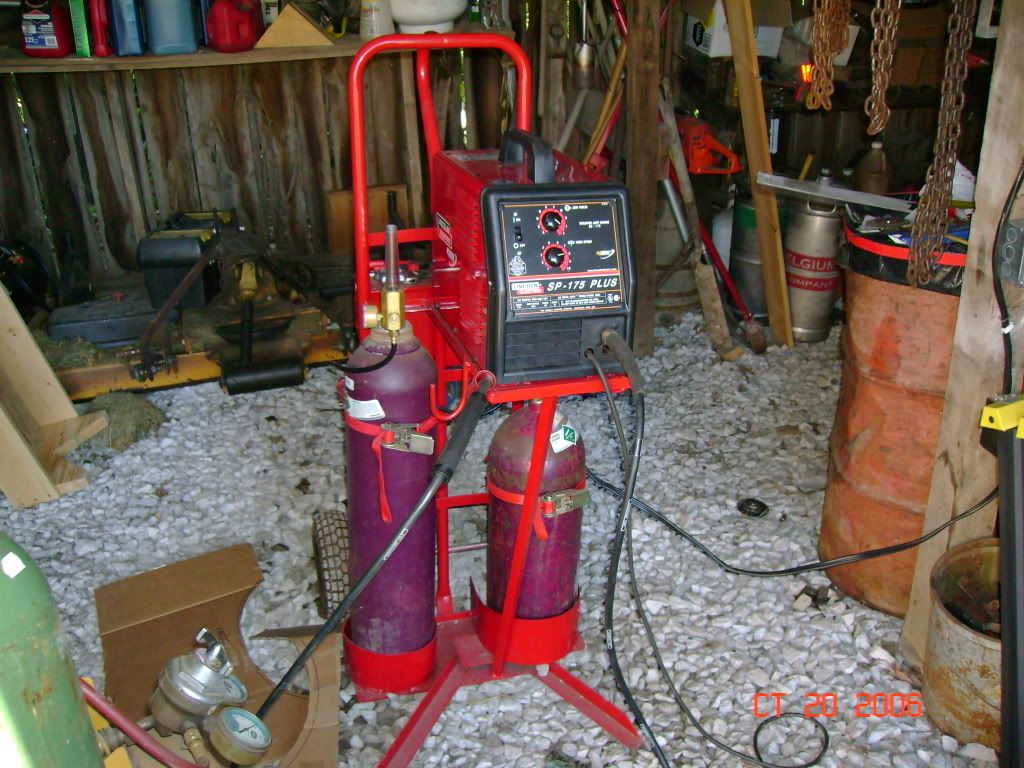
Here's a pic of my MIG machine on the cart I made from a hand truck...

 
/ Welding Bucket Hooks! #66  
Brian,

You know... It never occurred to me to keep the C25 and simply add CO2. But I like the idea! And the more I think about it, no need to have the regulator for the C25 just laying around not being used. And I like the versatility. Yep, I think that's what I'll do. Thanks for the idea!!

Pat,

The Lincoln "tombstone" welders have been around a long time. Its what we used on the farm growing up and it never failed to make quality welds on some crappy stuff!! It was an AC only machine though. This time I want an AC/DC machine. I just want the DC welding characteristics. Right now, the Hobart is probably the welder I am going to get. New or used.

Thanks for all the great, informative discussions. I'm enjoying this thread!

Dave
 
/ Welding Bucket Hooks! #67  
Right on Dave, I'm only suggesting that all the top brands that you are considering are good choices. The Lincoln "Tombstone" I have is AC/DC and has proved totally bulletproof and cheaper to buy at a Big Box store.

Of all those good brands you mention, you can't go wrong for a simple AC/DC machine which is why I advise just shopping price within those brands and go with the most for the least wherever you can find it as it is highly unlikely you will have a warranty issue.

Pat
 
/ Welding Bucket Hooks! #68  
Hi i used a lincoln a/c 225 for a long time found out that A blue flux covered stick wire called 80 T A/C plus works great and is 80,000 ts its A flat wire. I have purchased a miller XMT 304 c/c c/v inverter and a miller 12vs wire feeder thats a great combo.sleepy:D
 
/ Welding Bucket Hooks! #69  
I am a complete amature. But, since nobody else has stated it yet (or, if they did, I missed it), watch out for "duty cycle" on the cheaper welders. I happened to glance at the welders at Harbor Freight the last time I walked through. They all had what I consider horrible duty cycles for anything except for sheet-metal ranges.

*** Edit *** I'd better say that I'm sure they have 1 or 2 good welders. Just be sure to look close before buying.
 
/ Welding Bucket Hooks! #70  
In response about duty cycle, my old lincoln welder 225 AC was purchased in 1976 and the duty cycle on this welder was 20%. I can not count how many 50 pound boxes of welding wire I used in all of my welding with this particular welder. I have made many projects that I can not count how many, but the only thing that went wrong was the fan about 8 years ago. The welder still works but I need to replace the fan. I was told that this welder had a copper core and I did not weld 2 minutes out of 10 minutes, welded steady for hours, did not seem to hurt this welder a bit. I am not sure if they have switched to any other material for the core now on the new ones. I don't know if Lincoln under rated this machine. My advice is stick to the brands that you see in the fields that the professionals use and you can't go wrong.
Sleepy owl.:)
 
/ Welding Bucket Hooks! #71  
Interesting post as I am waiting for a lull in the Nor'Easter storm presently snowing/sleeting in CT.

As a side bar to using hooks on your bucket, remember that hooking up a chain to the bucket hook loads only one side of the hook. This could twist your loader frame/arms with a heavy load on the outside bucket hooks. It takes more chain, but the more stable method is to attach your chain to both outside hooks to distribute the load/stress on the bucket/loader arms. The further away from the centerline of the bucket, the more leverage/force generated on your bucket & loader. I have the same hook set up on my L-39 & BX 2200.

I also suggest this idea. After asking a rigger for his opinion concerning lifting loads, and the stresses generated, he suggested that I add a swinging D-ring to the top center inside of my buckets. As it swings, both sides/welds of the ring take a equal load, minimizing the chance of torsional loading ( I think ?) AKA twisting. Also when lifting with the loader, keep the load as low to the ground as possible when moving, with your hand on the loader control to bring it down to the ground quickly if the load becomes unstable.

I attached a couple of pictures to give you a visual idea on the D-ring location.

I took the welding plunge 3 years ago, after having to borrow a welder frequently, and bought a Miller MIG 251at a Miller trailer load sale for $1700.00.
I may not use it daily, but it is a great tool to have in the shop. Tractor projects & add on's can be done when you have the time, rather than when you have access to a welder.
As a long time woodworker, a welder is that proverbial " board stretcher" not available in the wood shop when pieces come up a little short. Just add on another piece to your metal project if needed and grind down the rough spots..........

Happy Tractoring:

WALT
 

Attachments

  • L-39 TOOTHBAR #3.JPG
    L-39 TOOTHBAR #3.JPG
    71.9 KB · Views: 742
  • 100_0330a.JPG
    100_0330a.JPG
    50.2 KB · Views: 715
/ Welding Bucket Hooks! #72  
Right on, Sleepy. My Lincoln AC/DC machine is rated 20% but for my use to be under 20% you'd have to include time when it wasn't even plugged in sometimes. I have abused the devil out of it for 15 years and except for the electrode holder showing wear (but working perfectly) it is like new.

Some of the lesser machines need to be treated differently, as if the 20% was a REAL ISSSUE.

Stick welding typically involves grinding, chipping, clamping etc. so it is not unusual at all to find yourself actually burning rod way less than 100% of the time and 20% is not really unusual. Still, I have often gone through 15-20 rods at full power on DC as fast as I can eject the butt of the expended rod and insert a fresh one.

When the welder was new I used to worry about abusing it on DC, having thoughts of the rectifiers failing. Well, they didn't yet and I have had it over 10years. It is still probably NOT good practice and your mileage may vary but my Lincoln has taken lots of abuse and just keeps on keeping on. It is one solid box. Similarly rated cheap imports may meet their specs but I'd be careful about using then the way Sleepy and I do. I suspect the other major USA made units to be similarly robust. El Cheapo Harbor Freight units realy are not so solid.

I didn't understand the coper core comment because copper is not ferromagnetic and will not act as an electromagnetic core. There are some seriously heavy duty copper conductors in these welders. You can't push power through a transformer unless you have enough core which is heavy. Adequate copper windings are heavy also. The combination of generous core material and HD windings is that the welder is HEAVY.

If you are comparing 60Hz welders, be suspicious of one that has the same ratings but is a lot lighter in weight. High Freq welders (Inverter type) convert the welding current to a much higher freq than 60Hz and that allows for lighter weight inductive elements, such as transformers. It also increases the electronic complexity by quite a margin which is OK when well done and you have self protective limiting circuitry otherwise you may make some expensive smoke and then own a boat anchor instead of a welder.

There is just not enough difference in price in a once in a lifetime purchase to justify buying a cheapy AC/DC welder if you intend it to do much for you. The lesser machines will not take the abuse and even when used properly the arc characteristics, especially striking the arc, are harder to live with on a "skimped on" machine than a REAL WELDER like a Lincoln, Hobart, or Miller. If you wait to learn this through personal experience you will have wasted time and money on the "junk" welder and still need a real one.

I'm sure there are folks here who weld well with "junk" welders but poll the guys who need to get it right first time every time and whose welding is not just a hobby but a requirement to be successful and I doubt you will find many with a cheap import AC-DC buzz boxes. I'd bet the overwhelming majority have top US brands.

Pat
 
/ Welding Bucket Hooks! #73  
Walt, I admire the floor drain your picture shows in front of the bucket proudly displaying the tooth bar. I relied on slope and a a sall step going from inside to outside the garage but a drain like that would be just peachy keen and fine when there is much slush and ice melting off of vehicles!

Oh, and by the way, nice teeth.

Pat
 
/ Welding Bucket Hooks! #74  
Hi I thought I'de mention a little tid bit of advise. When welding on vehicles, machinery, etc. that has a battery it's a good habit to disconnect the battery before you weld. Current sometimes flows to the wrong places and can damage computers big time. Had a friend that had his atv welded on without disconnecting the battery, $800 later in computer and electrical parts.:eek: If the area where the welding ground clamp is cleaned good some people say that nothing will happen. I don't like to take the chance. Sleepy owl
 
/ Welding Bucket Hooks! #75  
patrick_g said:
Walt, I admire the floor drain your picture shows in front of the bucket proudly displaying the tooth bar. I relied on slope and a a sall step going from inside to outside the garage but a drain like that would be just peachy keen and fine when there is much slush and ice melting off of vehicles! Pat
The reason most garages don't have floor drains is they not to code. My contractor told me when he was going to pour the garage floor and if I installed a drain he would look the other way. There was a sheet of sheeting over the drain until the OC was signed. :D

Reason I was told is that drains in garage allow pooling of flammable's and can lead to contamination or worse. :eek:
 
/ Welding Bucket Hooks! #76  
I just got a welder for Christmas. it's a Lincoln 3200HD Wire Feed. I've never welded before so I know I'll need lots of practice. How good are the wire fed welders? Will it be up to the task for welding things like hooks on the bucket? I've been wanting to put hooks on the bucket since I bought the tractor. I'm always using the loader to pull posts out of the ground, lifting heaving objects and pulling my post digger out of the ground when the shear bolt snaps.
 
/ Welding Bucket Hooks! #77  
Etch said:
I just got a welder for Christmas. it's a Lincoln 3200HD Wire Feed. I've never welded before so I know I'll need lots of practice. How good are the wire fed welders? Will it be up to the task for welding things like hooks on the bucket? I've been wanting to put hooks on the bucket since I bought the tractor. I'm always using the loader to pull posts out of the ground, lifting heaving objects and pulling my post digger out of the ground when the shear bolt snaps.

Wire feed (MIG) are fine. I have a Lincoln "Lunchbox" 120VAC MIG unit(Weld Pak 100) as well as a Lincoln AC/DC stick welder (Tombstone) When the MIG hasn't got the punch I use the stick. I Have had mine for at least 10 years and abuse the heck out of it. It takes a licking and keeps on ticking. I push the duty cycle unmercifully and the unit will go into self protection and shut off welding current till the fan cools it down... B U T... it has never faied to come back on and work perfectly. Mine came with the ability to control shielding gas flow but I just use flux cored wire in the 11 pound (I think) rolls.

It will handle up to about 1/4 inch material with multi-pass techniques. I find that its power is right at the margin between OK and too puny. It has done a lot of good welding for me, I like it, it works fine B U T if I had it to do over again I'd go with a 240VAC machine so I coiulid bet more power and or better duty cycle and it wouldn't have cost all that much more.

When you start welding heavy chunks of metal like good solid hooks you might be hard pressed to get the penetration you need for a good weld. I assure you that a single pass would NOT be enough with my wire feed.

I recommend you read and or watch videos about welding technique and also practice safety. Safety is important. Arc rays are dangerous. You can do permanent eye damage, get a bad "sun burn", start fires, blind children, pets, and stock which don't know to not look and may actually be attracted to look at the arc. Breathing the fumes is not a good idea no matter how many of the members of the peanut gallery will claim they have done it for decades with no ill effect.

Best of luck to you with your welding. It is a bit like playing a musical instrument. Nearly everyone can learn to play a little tune on some instrument or the other and there is no limit to the challenge in improving your performance under varying conditions.

Pat
 
/ Welding Bucket Hooks!
  • Thread Starter
#78  
Etch,

I think that your welder will be able to weld your bucket hooks, although you will be right on the ragged edge of your 120V machine's capability.

Since you haven't welded before, I certainly wouldn't make the bucket hooks one of your first projects. If you need them attached soon, I'd highly recommend that you get an experienced weldor to do the job for you. You don't want a hook to come off and possibly hurt someone or something because of an inadequate weld... which, is one of the MIG's little "gotcha"'s... It's very easy (until you get some experience and know what to look for while welding) to make a very nice, pretty weld on something like a bucket hook that won't even hold a potted plant. And, the larger the material that you're welding (like your bucket hooks), the easier it is to have this happen. The best thing you could do is to take a welding class at the local community college or at least get some instruction from a knowledgeable weldor. That is the biggest favor that you could do for yourself with your welder. And, practice. Get some good instruction, and practice what you're taught.

And don't let the fumes scare you, it isn't necessary to dress up in astronaut suits or to have a hood with forced air respirators and all that stuff like some members here believe ;). Just use your common sense. Don't weld in an enclosed area. Be sure there is good ventilation. The one exception is when welding galvanized steel. Zinc fume poisioning is very real. I haven't ever heard of anyone dying from it, but if you ever get the "fever" from welding galvanized, you will wish you were dead. Avoid welding galvanized if you can. If you do ever have to weld it, set up fans to blow the fumes away from your work area, and do it completely outdoors if possible, not in the shop.

Try to clean any paint off of the material you're welding before you strike an arc. With your MIG, that is a REQUIREMENT... CLEAN CLEAN CLEAN is the name of the game with MIG... they do not like dirty metal at all. They are not like a Stick machine, where you can weld right through rust and paint and whatnot and get a good weld... with MIG, it has to be clean before you start.

Good luck with your little Lincoln, and welcome to the welding world.
 
/ Welding Bucket Hooks! #79  
Thanks for the tips and suggestions guys. I'm thrilled to have a welder and I was thinking of taking a class to get the basics down. I know it will take practice. I do play musical instruments, so I can relate to what you all are saying. I know I won't be making great welds in the beginning.

Too bad you guys aren't in San Antonio. I'd hire you to weld my hooks on.
 
/ Welding Bucket Hooks! #80  
MUDONTHETIRES said:
Brian,

Let me start by saying those are mighty fine welds!:) Your video is great too!
As a beginner welder (purchased 1st welder 2 weeks ago) I have a silly question. Why did you elect to use 7018's over 6011's? After I learn how to strike an arc without having it stick to the metal,:mad:

Thanks for reading,
Mud
thats why they call it stick welding silly:p
 

Marketplace Items

KJ K2512 25'x12' Metal Shed (A60463)
KJ K2512 25'x12'...
2024 CATERPILLAR 930 AG HANDLER WHEEL LOADER (A52709)
2024 CATERPILLAR...
500 BBL FRAC TANK (A58214)
500 BBL FRAC TANK...
2017 Ford F-150 Ext. Cab Pickup Truck (A60352)
2017 Ford F-150...
2020 VOLVO 760 TANDEM AXLE SLEEPER (A59906)
2020 VOLVO 760...
2019 FREIGHTLINER CASCADIA  T/A  SLEEPER TUCK TRACTOR (A59906)
2019 FREIGHTLINER...
 
Top