Water line leaking - how to find it

   / Water line leaking - how to find it #1  
Joined
Apr 26, 2020
Messages
31
Location
Booneville, AR
Tractor
busted NH TC48DA
All,

I reside on 160 acres in western Arkansas. My driveway (and water supply line) is about 1/2 mile long. The water line is leaking somewhere between the gate and the house but I have not found where. The water line is about 20 years old and so the seals around the PVC may be leaking. I forget the name of this type of piping, but the piping is not glued to each other. Instead a 20' section of pipe is made with a male end and a female end. There is a gasket (O-ring) in the female end that seals the male end of the next pipe. These pips are laid out and then covered over, They work great as long as the ground is not disturbed and the seals don't fail (which apparently starts to happen around 20 years).

My problem is that I don't know exactly where the water line is buried. I know where the line is about 1/4 of the way from the house, as it leaked there and was repaired back in 2020 (that was an adventure but a story for another time). The water meter is located at the gate, so that is the other end. But where the line is in between is a mystery. I see no signs of leakage in the pastures, but the water line crosses a small creek at an unknown place, so it may be leaking there. We had a really dry summer and there was no sign of water entering the creek, as it was completely dry, but maybe the trees there are absorbing the water that is leaking.

So what do you folks recommend: (1) find the leak and repair it, (2) replace the entire water line with a water line that won't use gaskets/seals that will deteriorate, (3) something else?

All recommendations are welcome. Thanks in advance.

Senile Texas Aggie
 
   / Water line leaking - how to find it #2  
There are companies out there that can locate water leaks underground. Our water district uses a few when we have issues.

youll have to do internet searches in your area. Not cheap, but better than digging 50 exploratory holes.
 
   / Water line leaking - how to find it #3  
How deep is the line buried?
I have had good luck locating within 8 inch either way using a couple pieces of wire. 2 lenghts (about 16 inches each) of wire. Bend both 90° at 4 inch. Hold one in each hand. And hold short ends loosely in fists with the end balanced on little finger. Hold long ends level, pointing away from you. As you walk over the area of the pipe they will cross each other.
 
   / Water line leaking - how to find it #4  
Dowsing as JPRambo does.
Hire someone with listening equipment to do leak detection.
Isolate the line at 50% intervals and narrow the search.
Replace it all, sounds like that is in your future anyway.
 
   / Water line leaking - how to find it #5  
All,

I reside on 160 acres in western Arkansas. My driveway (and water supply line) is about 1/2 mile long. The water line is leaking somewhere between the gate and the house but I have not found where. The water line is about 20 years old and so the seals around the PVC may be leaking. I forget the name of this type of piping, but the piping is not glued to each other. Instead a 20' section of pipe is made with a male end and a female end. There is a gasket (O-ring) in the female end that seals the male end of the next pipe. These pips are laid out and then covered over, They work great as long as the ground is not disturbed and the seals don't fail (which apparently starts to happen around 20 years).

My problem is that I don't know exactly where the water line is buried. I know where the line is about 1/4 of the way from the house, as it leaked there and was repaired back in 2020 (that was an adventure but a story for another time). The water meter is located at the gate, so that is the other end. But where the line is in between is a mystery. I see no signs of leakage in the pastures, but the water line crosses a small creek at an unknown place, so it may be leaking there. We had a really dry summer and there was no sign of water entering the creek, as it was completely dry, but maybe the trees there are absorbing the water that is leaking.

So what do you folks recommend: (1) find the leak and repair it, (2) replace the entire water line with a water line that won't use gaskets/seals that will deteriorate, (3) something else?

All recommendations are welcome. Thanks in advance.

Senile Texas Aggie
Searching for a leak in water line of that length can be time consuming and therefore expensive, even if you knew its location. I would suggest no. 2, replace the entire water line with a water line that won't use gaskets/seals that will deteriorate.

We had a leaking water line somewhere between the meter and our two structures. We replaced the entire line over 25 years ago, right at 1,000 feet of 1” pvc. Cost including, trenching, was less than $1,000. Probably at least twice that now. We’ve had no problems since.then.
 
Last edited:
   / Water line leaking - how to find it #7  
I have read about how water leaks can be found by the sound they make. I wonder ifyou could use a stethoscope type setup to listen for the leak. Maybe shut the water off at the meter and pressurize the pipe with air so you can listen for the hiss.
Eric
 
   / Water line leaking - how to find it #8  
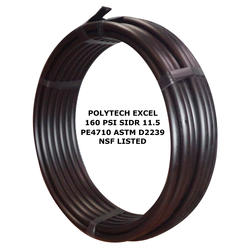
I would replace with the black poly pipe like Iman stated above. Do it once and forget it.
 
   / Water line leaking - how to find it #9  
All the previous responses make good sense to me. I would only add that if one O ring is leaking now, how many will fail sooner or later? That suggests replacing the entire pipe may be a very good option.
 
   / Water line leaking - how to find it #10  
Q- how do you know it is leaking? Pressure loss?

Dowsing for it is an option which may or may not work.

If you have access to either end of the pipe, or could gain access, you could map out the entire route with an underground locator device. I believe you can rent those. Some models have a transmitter that you push along through the underground pipe while the detector at ground level follows it.

Just fyi, when I drained my irrigation lines this year I discovered something quite interesting. Way up the hill, I heard hissing in two places. Air was rushing into the pipe to compensate for drainage below. It alerted me to two areas I need to repair. Now I am thinking of pressurizing the entire set of pipes as a way to check for additional leaks after I fix those. I suspected a water leak in one of the areas that started hissing, but it was always a guess. But the hiss was unmistakable.

If you use air, be sure to keep the pressure at or lower than your water PSI.
 
   / Water line leaking - how to find it #11  
I would replace the entire line. Finding one leak and fixing that will last what ? a year, then you are back to the same problem.

Also when you replace the line, if you use a non-metallic line, bury a copper wire with the pipe and make sure both ends of the wire a above the ground lever at each end. This is what the local water an gas companies do so that if necessary, they can use a metal detector to find the pipe and it's path.

Good Luck

Richard
 
   / Water line leaking - how to find it #12  
I sent you a PM on the subject. You can click the envelope on the right end of the Tractorbynet bar to read it.
Best of luck,
Stuck
 
   / Water line leaking - how to find it #13  
There are locate companies that have the technology to locate the pipe but then you still have to find the leak. You fix the leak and then does it leak again somewhere else? I’d probably run a new line but it’s easy for me to spend your money.
 
   / Water line leaking - how to find it #14  
What diameter is the water line? Is it practical to insert a smaller one inside it? I've had described to me a device that will crawl through the old pipe, expanding it as it goes and drawing a line behind it. Don't know anything about it but might be worth researching.
 
   / Water line leaking - how to find it #15  
I have found every pipe, wire, and more, that I needed to find (and quite a few that I didn't) using a simple pipe finder. Basically a telescoping antenna with a very low friction handle, costing about $15

Downsides; it doesn't work well if it's windy, and you won't know what you found until after digging it up. But with both ends known it'd be hard to go wrong.

I'd use it to find the existing path, then replace the entire pipe.
 
   / Water line leaking - how to find it #16  
Why not just have a well drilled right near the house and quit using the leaking system ? Not worth the time or cost if you have trouble locating a leak.

When one of my hydrant lines starts to leak somewhere, I drill some 24" holes approximately where the line is. Pretty soon water will spring up in 1 or more of them. That's close enough for me. On recent occasion, a 1-1/2" black plastic pipe cracked somewhere under the concrete barn foundation & floor. I shoved 1" plastic thru it and hooked everything back up. You can NOT tell if there is a flow reduction.
 
   / Water line leaking - how to find it #17  
When one of my hydrant lines starts to leak somewhere, I drill some 24" holes approximately where the line is. Pretty soon water will spring up in 1 or more of them.
Had a valve freeze (and crack) right by a hydrant. Supposedly 80,000 gallons leaked out.
Pulled the hydrant and it was barely moist down there.
 
   / Water line leaking - how to find it #18  
I've had described to me a device that will crawl through the old pipe, expanding it as it goes and drawing a line behind it.
That's call pipe bursting. An aircraft grade cable and very powerful winch pulls a ram through the old pipe, breaking it out as the new pipe is pulled in. I had it done on a prior residence to break out the old and failing sewer line and install a new one. It avoids having to dig up the landscaping as only a hole (somewhat large) on each end is needed. I had extensive, beautiful landscaping so this was the only way to go.

Total cost was about $9,000. I am glad I had a fixed price contract and not time and materials. Because about half way through pulling, the high strength cable snapped, stranding the whole mess about halfway inside the pipe. The hardpan in my area and the old pipe were too much for the winch and cable being used. Before it was over they had to bring in a super-duty winch from another state to finish the job. It was quoted as a 2-3 day job, but it took nearly 4 weeks.
 
   / Water line leaking - how to find it #19  
If this was my pipe I would be in a bit of a quandary. The main pipe seems to be OK, it is just the o-ring seals that seem to fail. So, do I dig up and replace 1/2 mile of pipe or do I dig up a connection every 20 feet and replace the o-ring connection with a glued connection. Since I have never been faced with this problem before I don't know the answer. But just because of the way I am and the amount of dirt that would be disturbed I would be inclined to use my post hole auger to drill holes close to the connections and use glued joints. I understand this process would require much larger holes than the initial auger holes AND there would be a lot of holes, approximately 132 of them, so maybe this solution is not the best if every joint will need to be replaced. I like the solution where a pipe is dragged through the existing pipe. It might be the least expensive. If it is more cost effective to just dig a new trench and lay new pipe I would consider laying larger diameter pipe, just in case you may need more water flow in the future.
Eric
 
   / Water line leaking - how to find it #20  
So, first, this type of pipe is absolutely normal, for anything 4" and above, and I've seen it used in 2" before. It lasts just fine, but, I'm assuming near a change in direction, or an improperly homed joint, it has separated, and either wasn't homed, or needed a bell joint restraint or thrust block.

Me personally, I'd get a trench shovel and post hole diggers and just start spotting it every 250 ft. Maybe install a valve every 500 ft or so. Then you can come up with a general area, instead of 2500 lf between A and Z; maybe a 200 ft section between G and H.

I doubt it's deeper than 30-36" and it's really not that bad to dig a small locating trench across the general running line to locate it.

Now, you've got valves installed every 500 lf, with a 4" "riser" to the valve, preferably a few inches above the ground, and in the future, you have a fixed locate every 500 lf.

For everyone saying replace; looks like $2.31/lf x 2500 lf=$6000 just in pipe. Well worth a few hours with a shovel to find and repair the leak....

Any chance they ran locate wire or tonable tape on the line when installed (imo tonable tape is pure trash from a locating prespective, and warning tape typically just tells you what type of line you just cut...)
 

Tractor & Equipment Auctions

2014 Club Car Carryall 295 4x4 Utility Cart (A59228)
2014 Club Car...
2023 FORD F750 CAB & CHASSIS (A57880)
2023 FORD F750 CAB...
2017 CAT 315F LCR EXCAVATOR (A58214)
2017 CAT 315F LCR...
2017 John Deere 5090GN (A53317)
2017 John Deere...
Rooster Weathervane (A55853)
Rooster...
DEUTZ MARATHON 60KW GENERATOR (A58214)
DEUTZ MARATHON...
 
Top