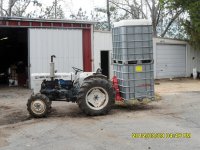
Using Totes for irrigation supply--Questions:

/ Using Totes for irrigation supply--Questions: #1  

ocaj11

Silver Member
Joined
Jun 17, 2004
Messages
190
Location
Northeast Texas
Tractor
John Deere 5325 4wd, Kubota B7500 HST
Hi All,

I had a 4" well drilled on my property last week. I'm getting around 10 GPM steady at 40ish psi. This would be OK if I only wanted to hook up a couple of impact sprinklers, but I would like to get more GPM so I can run more impact heads at a time. I just ran 1000' of 1.5 inch pvc from the well to my house and 500' of wire from my shop (power source) to the well. The well pump is 1/2 HP and gives me a pretty good stream of water out of the hose 1000' away.

Today, I purchased 4 330 gallon totes. I want to plumb those four totes together and locate them next to the well. The totes can't be pressurized, so I can't use a pressure switch to cut the pump off when the totes get full, I'm thinking a float switch at the top of one of the totes would be my best option. The float switch would engage the pump when the water level drops and disengage when the water level returns.

I'm planning to install a 1.5 - 2.0 HP irrigation pump about 500' away (at my shop) that will pull water from the totes. I would like to get around 20 - 25 GPM at 50 psi to the end of my pipe which will be another 500' away. The totes will hold 1,340 gallons of water. The 1/2 HP well pump will fill the totes at around 10 GPM. I should be able to comfortably run the irrigation pump for an hour before I have to let the totes fill again.

Here are my questions:

1. Has anyone tried this successfully?
2. Does anyone have an idea what kind of float switch I would need to use?
3. Will there be any issue installing the irrigation pump 1/2 way between the well and house? The land is practically flat for the entire length of run.
4. Assuming I use a pressure switch on the output side of the irrigation pump. Will I need a pressure tank installed there? I think this should work running the sprinkler heads, but what about using a single water hose at the house?
5. How many GPM would the irrigation pump deliver through the single water hose? I assume it's going to deliver much less than the 25 GPM it would deliver running multiple impact sprinklers?
5. Are there any issues with this plan that I need to address?

Thanks for all the advice. :thumbsup:

Keith
 
/ Using Totes for irrigation supply--Questions: #2  
Before we can get energized to reply we need PICS!!

I'm interested because I just gave my cousin-in-law, Dr. Johnson, one of the totes given to me by Taylortractornut.

8x6SAM_0422.jpg

He just puts it in the back of his truck and after filling it drives it up to his watermelon patch.

I'm sure for next year he will want a more "automated" approach.
 
/ Using Totes for irrigation supply--Questions: #4  
First off I am wondering if you are planning to use both sprinkler heads and filling totes same time? If not, why not tee in a pipe from well pump to your shop since its only 500 ft away to the totes instead of 1000 ft like to your house. You could use the toilet fill valves in each one of those totes instead of messing with tying them together so its one big sharing unit. This way, it you need to move one of them, it can still work in any configuration with a shutoff valve before toilet fill valve. If you need pressurized water, just use a shallow well pump/tank combo that pulls water from all tanks.
 
/ Using Totes for irrigation supply--Questions: #5  
ya doing what many folks do with "rain barrels" other words they run there gutter down spouts to barrels or to some sort of collection container. and then use a pump, to water things from there.

some things you will have issues with. the totes should be covered up. so no sun light hits them. or you will end up having issues with algae that could cause clogs with the irritation pump.

if the pump for the well is down inside the well itself, if you can tee/ wye right into the pipe near the well. for filling the totes. you will more likely have more GPM filling the totes vs trying to fill totes if placed near house or shed.

the totes would need an "auto fill valve" you can normally find auto fill valves at pond stores, pool stores, and agriculture stores for horse/cattle/live stock water tanks.

you will have issue of gunk and stuff settling into the bottom of these tanks, so make sure you figure out a way to easily wash them out and remove gunk in the bottom. 2" shower drains, been used many times as "bulkheads" Koiphen.com see the pond and construction forum. and look for DIY male / female adapters as being used as bulkheads as well.

you will most likely want a "low water shut off" switch. if you hooking all 4 totes together. for the irrigation pump. so pump shuts off when not enough water.

you will want some sort of "dome" or slit or holed pipe in bottom of each tote on the outlets. so a whirl pool does not form and cause air to be sucked into the pump.

hint: come out the bottom of each tote with a 2" shower drain. then run them into a common 2" pipe. with tees or wye fittings. wye off to irritation pump. and then put a valve or clean out plug. so you can easily drain the totes and wash them out. a dome could be a flower pot with some concrete placed into it, and turned up side down, and placed over the 2" shower drain inside the tote.

==============
problem is "short cycling" and could cause pump to rapidly turn on/off when water level gets low, and might look into some sort of extend timer to keep irrigation pump off. or get a shut off switch that you can adjust for a few inches, to reduce "short cycling" for the irrigation pump.

i would suggest a well tank / pressure tank, with pressure switch on irritation pump. it is extra cost and you do not have to have a well tank / pressure tank, if no tank, you will always need to have a something on, sprinkler, garden hose, or something, to let water flow through the pump, or you could burn the pump up.

with a pressure tank and pressure switch for irrigation pump. you could open garden hose faucet and have water right there when you needed it, vs making sure something is on, sprinkler is already setup, garden hose with no nozzle already hooked up and valve is fully open, and then going back and turning on the irrigation pump.

============

there will be issue of causing a possible "siphon" between well and totes. so you will most likely want to cut a hole in the tops of totes. were auto fill valve is located. and you will want to place a peacock (double check valve) between well and auto fill valve. so if for what ever reason check valves fail, you do not siphon water out of totes back down into well or into the house. and possibly contaminating your water supply.

if water in the totes may be setting for some time between uses, you may want to setup a small submersible fountain pump. or setup a small air lift using an aquarium air pump. to circulate water between all totes. so water does not become stagnate and breading ground for bugs.

you can normally pickup a fair cheap "leaf basket" for say a pool pump. or pond pump. and use an adapter to hook it up right before the irrigation pump. to act like a small size screen, in case any sort of snakes, bugs, frogs, etc... get into the totes and make it to the pump. the leaf basket should catch most stuff, and keep the sprinkler heads from clogging up on you. and keep the irrigation pump from getting clogged up and burning up.

===============
WARNING it is assumed as soon as water enters the 4 totes, it is "gray water" or backrish water. meaning it is no longer "drinkable water / suited for human consumption" as long as you just use the water for irrigation and like you should be fine, but as soon as think about hooking the water up coming from totes to a sink, or like, you get in a whole mess of regulations and codes. that can get very expensive, and can require extra filters and like, and on top of that fines if not properly setup for human consumption.
 
/ Using Totes for irrigation supply--Questions:
  • Thread Starter
#6  
Fantastic information guys. That gives me a lot to think about. I will take some pictures of the setup once I figure out exactly how to set it up. :laughing:

I am planning to fill the totes at the same time I'm pulling water with the irrigation pump (will only be used for irrigation. No household use). I think that gives me the most amount of water and that's the reason I want to plumb them all together. Each tote has a 2" npt outlet on the bottom and a lid on the top. I'm planning to use a 2" pvc pipe and 2" pvc fittings to make a manifold at the bottom so water is constantly pulled off the bottom. My plan is to fill one tote from the well and let the water flow through the bottom manifold to fill the remaining three totes. I'll have to watch things closely to see if that actually works. I will add a screened vent pipe to the top of each tote to prevent pressure build up inside the totes and to keep bugs and debris out. I will cover the totes or paint them silver to keep sunlight out. I do want to place the totes by the well for a couple of reasons. First, the well location is out of the way so I won't have to look at 4 ugly totes while driving in and out. Second, I will get the most GPM this way.

1. One thing I'm not clear on that boggen mentioned: How does the "dome" or "holed pipe" stop a whirlpool from forming inside the totes? This seems like a valid concern and I want to make sure I understand what needs to be done to prevent the air from being sucked into the pipe.

2. I like the "auto fill valve" idea and will see what I can find. Are these valves reliable? If they fail, will they fail open or fail closed?

3. Can I use a pressure switch on the pressure side of the irrigation pump without using a tank? Would the 500' of 1.5 inch supply line sort of act like a pressure tank to turn the pump on when I'm watering and turn it off once there is no flow and the pipe pressurizes?

Thanks for all the help.
 
/ Using Totes for irrigation supply--Questions: #7  
when you go do a dishes in the kitchen sink. and pull the bottom drain plug out of the sink. as the sink gets near empty, a whirl pool will normally form. and you can hear the sucking noise as air goes down the drain. the same thing can and will happen with the totes. and you can a piece of pipe and drill a bunch of holes in it. or take a piece of pipe and run it through a table saw, only cutting almost half way through pipe for a slotted pipe. (see previous reply for dome) to stop the whirl pool from forming above the bottom outlet / bottom drain on each tote. if you used a holed pipe or slotted pipe it needs to be laying down on the bottom or near bottom of the tank. a dome just sets on bottom of the tank.

if you come through the side of the tote (very low on tote itself) for an outlet to the pump, it might be easier to install a sloted or holed pipe. that lays horizontally across the bottom of the tote. there just to many ways go about the anti vortex / anti whirl pool thing. some things work better than others. but for most part all generic ideas work for keeping the whirl pool from forming and sucking air.

with auto fill valve inside a protected area you should be ok, if auto fill valve was in a water tank for live stock, or in a pond. then you would have issues with leaves, and animals nocking into the auto fill valve. beyond that, you have to deal with water supply from well. hard water, can and will cause things to clog up eventually. and that is just part of life. or less you go through expense to setup a big water softener and for irrigation i doubt that would ever pay off or ever be needed.

as far as pressure switch and no tank, that is a no go. and will cause pump to "rapidly" short cycle on/off. air will compress into a smaller area, water does not compress. all pressure tanks either rely on a rubber bladder with air, or a non blader tank with air in it. so as the water pressure builds up, the air compresses inside the tank. you most likely do not need a large pressure tank. just something big enough to reduce short cycling of the pump. with you running irrigation and multi sprinklers, my assumption will be, within the first 2 to 5 minutes any pressure tank you get will empty, and then all water going to sprinklers will come straight from the irrigation pump.

on other hand if you do not run enough sprinklers at one time. and say only run a single sprinkler or garden hose, you could have pump short cycling. due to smaller size pressure tank emptying quickly enough, but not using enough water, to keep the pump from continually running.

when using PVC pipe, make sure you also paint it as well. pvc pipe and sunlight do not mix long term and pipe will become brittle and easly crack. if ya spray paint the pvc pipe that is exposed to sunlight you should be ok.

if you are going through all this expense and trouble, i would advise, putting some rock with a good rubber liner say roofing liner below rock, or pouring a concrete pad for the totes. weed-eating around them, and checking things to make sure all is ok, can be a pain, when they are just setting there in the grass / dirt.

being in texas, i might advise some sort of actual roof placed over the totes, to keep the sun off the toes themselves, to help reduce evaporation. and also help reduce direct heat that would build up on tote sides and right at the ground.

one last thing to think about, when tying into the well line that runs to house. besides a line for auto fill valve, think about a regular garden faucet valve, so you have a quick easy way to clean things right there were the totes are.
 
/ Using Totes for irrigation supply--Questions: #8  
errr thought i answered question #1 but i did not give clear answer to it.

a dome or holed or slotted pipe. causes the water being sucked out. to be "spread out" kinda like going from a little nozzle on a vacumm cleaner, to a large wide nozzle for cleaning off stairs or couchs. the dome or holed or slotted pipe is just that changing a nozzle from a little narrow nozzle to a wide nozzle. the difference in nozzle sizes, reduce how fast water moves right at the inlet of the nozzle. less speed, less pull on air above the water to be pulled down and out of the container.

a dome or hole or slotted pipe, goes a bit further. by putting something in the water, that also helps reduce chance of water begin to swirl around, and cause a whirl pool to form.

about all i can say is have fun playing in the kitchen with the kitchen sink, and using your hand or small plastic bowl, or small saucer plate. as you fill and empty the kitchen sink a few times.
 
/ Using Totes for irrigation supply--Questions: #9  
Nifty thread, and lots of good info from Boggen.

The setup described shares a couple similarities with our well to cistern to housepump to pressure tank setup, for delivering water into our house.

Just a couple more quick hints for you:
- If you're doing any more automated wiring, or want to look at some interesting stuff, check out a few of the PDFs on this page: Pump Wiring | Valve Wiring It might give you some good ideas you hadn't thought of yet too.

- For filling our 500-gallon cistern, there are two "float switches" inside it. Similar to what you see near the bottom of this page: Pumps, DC One of them turns the well pump on when the level in the cistern gets low. The other turns the well pump off when it gets almost full. I think they make these valves in two styles: certified safe for drinking water, and not. The latter is probably less expensive. They also have a single switch that turns both on and off... google "well cistern float switch" and you'll see a number of varieties. You can use these switches to both protect your pumps (turn off irrigation pump when level gets too low) and to refill your tanks (turn on well pump when level falls below the refill threshold, then turn off well pump when full level reached).

- Here is another link to a float valve I ran across, but have never used or have any experience with these. MECHANICAL FLOAT SWITCH FOR FILLING OPEN TANKS SUCH AS CISTERNS OR STOCK TANKS.

Best of luck! :thumbsup:
-Mitch
 
/ Using Totes for irrigation supply--Questions:
  • Thread Starter
#10  
Thanks all for the awesome information. Especially Boggen for taking the time to post the detailed responses.

I think I have the information I need to get started. I'll post some pics of the setup when I get it running so others can see what I've done.
 
/ Using Totes for irrigation supply--Questions: #11  
Keep in mind that above ground jet pumps are not designed to "pull" water for any distance ... they do, however, "push" water quite well. I would place the pump as near the tanks as you can.

Also, since you can measure the amount of water in the tank(s) and know how many gallons are there and you can determine the GPM that the system is delivering, finding the time that it takes for the pump to empty the tank(s) is doable.

If you use an irrigation clock (controller) you could eliminate the pressure switch and tank completely. The irrigation clock will turn the system on and off for the specified time you program it and when you program it. They also have a "pump start" feature built into them.

This means that you can install a "pump start switch" to power the pump and the pump will only run when the clock turns it on and will turn off when the clock turns it off. As long as you use all the GPM that the system is delivering, pressure is not a problem. We have put in many such systems.

The length of the pipe runs after the pump are not that great of a concern. Any decent pump will be able to deliver enough water to run irrigation as long as the pipe size is correct for the system. If you are going to be delivering 20-25 GPM from your pump you will want 1 1/4" minimum coming from the pump. Feeding the pump with 1 1/2" or 2" is a good idea.

I would also recommend installing some sort of "back-flow prevention device" in the line that supplies the totes. You don't want anything to contaminate your drinking water.
 
/ Using Totes for irrigation supply--Questions: #12  
Also, since you can measure the amount of water in the tank(s) and know how many gallons are there and you can determine the GPM that the system is delivering, finding the time that it takes for the pump to empty the tank(s) is doable.

If you use an irrigation clock (controller) you could eliminate the pressure switch and tank completely. The irrigation clock will turn the system on and off for the specified time you program it and when you program it. They also have a "pump start" feature built into them.

[...snip...]

I would also recommend installing some sort of "back-flow prevention device" in the line that supplies the totes. You don't want anything to contaminate your drinking water.

I like the idea of the irrigation clocks to automate the start and stop of irrigation. However, I would not rely on them as the sole controller for either filling or emptying the totes. If there is ever a case where the flow rate changes or the amount that a tank is filled is not what is expected, you will either run a pump dry, deadhead it, or overflow your totes. (Any obstruction in flow or a lower supply of water in the well or lower head pressure could all cause these.) A system that reacts based on the level of water in the tote is a safe backup (e.g. float switch).

One of the simplest and most reliable ways to prevent backflow (and well contamination) is via a siphon break built into the system between the well and the first tote. A simple implementation of this would be to have the well supply going into the top of the first tote. Then, there should be a tote overflow below the level of the inflow, but above the level of water you desire in the tote. There are also some nifty & simple ways to make sure that end of the well-supply pipe remains underwater (even when suspended above the level of your tote water) using a water trap (a partitioned box, or other plumbing-based trap that keeps water blocking the end of the supply pipe). The siphon break cannot fail the way a mechanical backflow preventer might. I like it because it is simple and reliable. :thumbsup:

Best to you. I'll be interested to see what you finally implement.
-Mitch
 
/ Using Totes for irrigation supply--Questions: #13  
It is true that an air gap is the most effective back-flow prevention. However, you will still need some device to turn the water on before the air gap.

Also, keep in mind that a single check valve is not sufficient for safe back-flow prevention. They do make a "double-check" back-flow device. Since you are not trying to use the 10gpm flow to directly irrigate, the RPZ (reduced pressure zone) back-flow would work quite well. They are approved for use with potable water.

I do wonder why you don't have a larger pump down that 4" well. Does the well itself only produce 10gpm or is it because you have a 1/2 hp pump that has a low flow rate.

I recently installed a 1 1/2 HP @ 20gpm flow that only cost $425. With 20gpm you would not really need to go through all the expense and work of converting the totes, plus you still need to buy another pump to use the totes.

I also installed another pump that was 2 HP @35 gpm. It will deliver the 35gpm at 50 PSI with no problems.

Also, have you thought of using a rotor (Hunter/Rainbird/K-Rain) instead of impact style. Impact heads tend to use more gpm then the smooth operating rotors made by the mentioned brands. They also have changeable nozzles so you can adjust the amount of water each head is using.
 
/ Using Totes for irrigation supply--Questions: #14  
Funny I stumbled in this evening and this was up. Similar to what I have been padiddling with lately trying to make work on several levels.

Thoughts in Random order.

500' is an awful long way to pull, much better to push.

Irrigation pumps that I am familiar with at the nursereys etc. we work with seldom have pressure tanks. But they are also "ON" and valves open.

I am working on an engine driven pumping unit, will probably end up much like a "turbo turf" unit (google is your friend)

I am using the totes as "rain Barrels" and then need to pump up to the trailer with more totes.

As was stated there is a simple float valve available at TSC etc. for about $10 that does watering troughs that should work for your auto shutoff. You could also do the float valve switch like is used in a septic pump, basically just a float that is hooked to a male female plug that your pump is hooked into.

Consider staging your tanks progressively higher, it would give some advantages (and some disadvantages such as loosing capacity)

State of Texas has some great water management stuff out there available for free.

The video "food production systems for a backyard small farm" has some neat stuff on rain collection and tanks (but many principals will apply)

Qapla, it is funny that you spoke of doing the rotors, we just did that last week, I built some conduit 3 legged stands with a vertical 3/4" pipe nipple at the apex, hose adapter on the bottom, irrigation rotor on the top. Easy to move, light weight, cheap, darn near infinitely adjustable and does not leave us the 6' diameter soaked ring that the impacts tend to give us. It works really nicely for us.

Good luck, would like to see what you are doing and will try and get up some pics of what we have going on, time is just so short though.
 
/ Using Totes for irrigation supply--Questions:
  • Thread Starter
#15  
There are some great points being made. I appreciate all the info.

My well will only produce 10 GPM. I would LOVE to have a well producing 20-25 GPM. I would buy the necessary pump in a heartbeat.

We're eventually going to setup a container tree farm which is the real reason I dug the well. Watering my lawn is a bonus. I currently have two 5.5 HP trash pumps pumping water to my lawn from my 9-10 acre lake. That has allowed me to get about 3 acres of grass established this year. We seem to be in a drought every summer now, so my lake doesn't get replinished during the hot months. The well/tote idea should allow me to stop pumping water out of the lake and I can use the temporary pvc/water hose/impact sprinkler setup I have now to make sure the lawn survives through the summer. I will remove all of that when it starts raining again in the fall. I'll probably convert over to the rotor sprinklers for use next summer.

I could put the irrigation pump at the well/tote location, but I don't want to run another 500 feet of electric wire that far. If I locate the irrigation pump at the shop, I can run less than 100 feet of wire that I already have. Since the pump and water in the totes will be about level with each other, shouldn't the pump be able to pull the water through 1.5 inch pvc?

Another novice question: I have a 33 gallon air compressor tank sitting around. Can I convert this into a pressure tank for the irrigation pump? I'll purchase another pressure tank if needed, but that free tank is calling my name. :)
 
/ Using Totes for irrigation supply--Questions: #16  
problem with air compressor tanks = metal. that can and will rust out. beyond that. you could use the air tank as a pressure tank. put tire nipple or (valve and air tool nipple and pressure gauge) on top of the tank, so you can adjust amount of air pressure in the tank. (if use use a tire nipple, you can use a regular air tire pressure gauge to find amount of air pressure in the tank.

i honestly do not remember the rule of thumb for setting amount of air pressure, for non bladder pressure tanks for water.
 
/ Using Totes for irrigation supply--Questions: #17  
You could use one of the trash pumps to send it the 500 feet to the tanks if needed.
You can always try it, then add something additional if needed.

I have been buying star water pumps from Rural King and they have excellent tech support, might ne worth a call to them and ask their reccomendations.

Basic rule of thumb I use is that it is always better to push then suck.

Personally I am also looking at a windmill to pump up to elevated storage then gravity back down to fields.
 
/ Using Totes for irrigation supply--Questions: #18  
My well will only produce 10 GPM. I would LOVE to have a well producing 20-25 GPM. I would buy the necessary pump in a heartbeat.
Thus, the reason for the totes. But I agree with those who have said that you really don't need a pressure tank nor pressure switches for this setup. Just the well pump to get water into totes, some switches (float or other) to turn water on and off (discussed already in depth above), and another pump between the totes and the place you're irrigating to push the water through.


I could put the irrigation pump at the well/tote location, but I don't want to run another 500 feet of electric wire that far. If I locate the irrigation pump at the shop, I can run less than 100 feet of wire that I already have. Since the pump and water in the totes will be about level with each other, shouldn't the pump be able to pull the water through 1.5 inch pvc?
Best to heed the advice above about not trying to pull the water too far, but rather push it. A little more independent search on the internet confirms this. All that air in the very long pipe is very "elastic", and besides that, your pump will have to pull all that air through before it gets water... possible priming problems, and those pumps aren't really meant to pull air (I know, you could assume that once the pipe is filled, it will remain filled, or primed. Not the most reliable... sitting a day or two with 100's of feet of pipe, air is trying to be pulled in, and well... could work, but I think it'll give you headaches at some point when air gets in at the pump connection or elsewhere). Quapla's info on jet pumps is well taken too. I know you're tempted to only use the wiring you have, but your layout distances makes it look like a case of penny-wise, pound-foolish.
Another novice question: I have a 33 gallon air compressor tank sitting around. Can I convert this into a pressure tank for the irrigation pump? I'll purchase another pressure tank if needed, but that free tank is calling my name. :)
Reiterate: Make the system as simple/low maintenance as possible, with each pump starting and stopping as little as possible (makes pumps last a lot longer). A very small tank like that will have your pump cycling several times per minute (just an approximation here, but that 33 gal tank will only hold a part of that in water, since it also needs a significant volume of pressurized air, and if you're trying to irrigate the water at a rate of 10-20 GPM you'll need higher pressure to push it any distance through the heads, I'd say you're going to get no more than 5 gallons at the required pressure before the pump has to cycle on again... pressure tank really becomes worthless, and pump is constantly going on and off). You can find exact measures for this online, but I have one real data point with a small tank (I believe similar in size to what you are talking, maybe slightly smaller) we use to deliver around 4-6 GPM at 35-50 lbs pressure... jet pump cycles about every 30 seconds.

Summary: Put the pump out near the source (totes) from which it will be pumping water, and no need (nor benefit) to having the pressure tank.

Keep us updated on your progress/experience! :)
-Mitch
 
/ Using Totes for irrigation supply--Questions: #19  
P.S. Another option is to rethink your location for the totes. You could put them within reach of your 100' of wire (and thus locate them with the pump that will use them as a source for irrigation). This way, your well pump is pushing the water up to the totes, and your irrigation pump is pushing the water out to the sprinkler heads. Just a thought.
 
/ Using Totes for irrigation supply--Questions: #20  
Re: pressure tanks: Here is a quick data point for you: 32 Gallon Well Pressure Tank, 21" x 27.75"

Summary: 32-gal tank. Deliver 10.9 gallons water at 30-50lbs pressure. You'll need higher pressure to power more than one or two heads. I'm not sure on this, but I'm guessing that to maintain higher pressure in the tank, you will get less delivered at that pressure (?) - I haven't done the math. ;) Anyone more knowledgeable, feel free to chime in.

:2cents: -Mitch
 
 
Top