universal joint question

/ universal joint question #1  

Cord

Veteran Member
Joined
Mar 21, 2005
Messages
1,720
Location
Richfield, Wi
Tractor
Resident Architect
I'm working on a drive line to power a snowblower. I just realized that I'm facing some severe drive shaft angles. The angles are definetly beyond the capacity of a single U joint. I've seen some double U joints used but have little experience with them. Can I have a double U joint at BOTH ends of a driveshaft? All the applications that I can think of only have the double U joint at one end and then a single cross at the other.
 
/ universal joint question #2  
If you are building it yourself can you use the CV joint from a vehicle.

Egon /forums/images/graemlins/grin.gif
 
/ universal joint question #3  
Maybe some belt or chain transfer to get the offset you need.

What angle are you trying to get to transfer the drive power?
 
/ universal joint question #4  
You might need a carrier bearing in the middle with a double joint on both ends. Not sure, I have never done that though. But it seems that the middle might have too much wobble.

Ben
 
/ universal joint question
  • Thread Starter
#5  
Yes, I'm toying with the idea of using a automotive CV joint. The problem is trying to adapt one to a ag drive line. Most of these CV joints have funky ends specific to the vehicle.

The chain would be the perfect solution, but the attachment swings in an arc so the pulleys would never be aligned. Otherwise it would be the perfect solution. I'm going to ballpark some angles tonight.

My research shows that you would need a center bearing if you used a double universal joint. There is a "Carden" constant velocity joint that is capable of locating the knuckle so the shaft doesn't need to be supported. I'm still trying to get some pricing on the unit, but they sound pretty expensive. Several hundred for each assembly and I need two of them.

Somehow I may need to adapt those auto CV joints...
 
/ universal joint question #6  
Cord Ive adapted a few cv joints to pto shfting before its not too hard, theres several ways most of the time adpters can be found at ag shops. If you want a heavyduty one get one off an old Eldorado Ive got a few on hay bailers and pull type combines Ive fixed for neighbors.
 
/ universal joint question #7  
</font><font color="blue" class="small">( funky ends specific to the vehicle )</font>

Might have to do some welding to the proper ends.

Egon /forums/images/graemlins/grin.gif
 
/ universal joint question #8  
</font><font color="blue" class="small">( The chain would be the perfect solution, but the attachment swings in an arc so the pulleys would never be aligned. )</font>

The 'arc' you speak of is the raising and lowering of the snowblower? There isn't a need to also angle the blower is there?
Seems a telescoping drive shaft is what is needed with simple u-joints on each end. But I don't know exactly what limitations you are faced with, I admit. /forums/images/graemlins/tongue.gif
 
/ universal joint question #9  
Here's an idea, just for the sake of brainstorming.

How about a hydraulic drive system. A pump on the PTO and motor on the snowblower. The hoses in between are about the most flexible driveline you are likely to ever get. /forums/images/graemlins/tongue.gif

I don't know what the availability of surplus hydraulics is like in your area, but if you can find a source, you might be able to find a suitable pump and motor as cheap or cheaper than those fancy driveshafts you mentioned. You'd need to choose pump and motor displacements appropriately to get the blower going the right speed, and of course choose parts rated for the power you'll be transferring through them.

Good luck whatever method you use ...
/forums/images/graemlins/cool.gif
 
/ universal joint question
  • Thread Starter
#10  
Well, I measured the angles tonight. 20 degrees on both ends. That's well beyond the capability of a regular U-joint.

Hydraulics would be the perfect solution. Unfortinatly they are horribly inefficent. The best pumps are 80% efficent. The best motors are 80% efficent. That's a bunch of hp lost and I don't have any to spare. Great suggestion though!
 
/ universal joint question #11  
I thought I once heard/read that a U-joint is OK up to nearly 45 degrees at slower speeds (although I don't know what "slower" really means). If that's true, and roughly judging by the angle of my tiller PTO shaft when in use, I would have thought 20 degrees at each end would be OK ...
 
/ universal joint question #12  
Gday people, Im probably a bit late with this post but the maximum constant velocity angle for a single universal joint is 27 degrees.

Cheers
Roscoe
 
/ universal joint question #13  
</font><font color="blue" class="small">( Gday people, Im probably a bit late with this post but the maximum constant velocity angle for a single universal joint is 27 degrees.

Cheers
Roscoe )</font>

I think I feel pretty confident that the 27 degrees is not a constant and is highly dependant on the physical design of any given U-Joint.

Dave
 
/ universal joint question
  • Thread Starter
#14  
Well, as mentioned above it all has to do with how many RPM's are being turned. Some constant velocity joints can handle 70-80 degrees-but that's at 100rpms. My shaft is turning at 1200rpms so there is a significant angle reduction. A mfr told me that at 20 degrees with a double knuckle joint that it'll start to chatter. As I understand it the chatter comes from the diameter of the knuckle changing as it rotates causing a speed change. Guess it's a problem that really shows up at the higher speeds.
 
/ universal joint question #15  
like they said, a cv joint from the front axle of a FWD car wll do the most angles.
doing a carrier bearing in the middle is another choice. have the carrier bearing will double the u-joints, allowing each to have half the angles, if you do it right.
the old style cv joint, in and of itself, doesn't add much angle, especially at slower speeds.
hydraulic pumps are closer to 90 percent efficient i believe.
 
/ universal joint question
  • Thread Starter
#16  
Ok so lets try describing this layout...

on the left I have a jack shaft which is bearing supported. This is connected to a long shaft with no bearing support with a single cross universal joint. On the right I have another jackshaft which is also supported by bearings. This second jackshaft is connected to the long shaft with a double H style constant velocity joint. This is not a cardan style joint. Does the long shaft need a bearing to support it on the right side?


---B---B--- u joint ------------ u joint H u joint ---B----B---
 
/ universal joint question #17  
You need a bearing in there somewhere. The problem is the center U-joint. Visualize it this way: If you hold this two-piece shaft by the ends, it will tend to bend at the center joint. If the shaft is spinning, it will wobble. Putting a bearing support on the long shaft, this will effectively lock it in place and make the CV joint the only part free to wobble. Since it is supported at both ends by a U-joint connected to a stationary shaft, it can't wobble.

Of course, this won't work if the long shaft needs to change angle at any time.

Maybe take a look under a large truck or bus for ideas, they usually (or, at least often...) have a 2 shaft setup. The first shaft is fixed at part of the needed angle and the second shaft is allowed to move.
 
/ universal joint question #18  
I put up a reply saying that the max constant angle was 27 degrees, this was for automotive use and since then I have looked at varios websites concerning UJ angles and they all quote differant maximum angles so It dousnt make it easy.

If you look at the drive shaft angle between the drive axles on a truck/tractor unit (Called the "Jack shaft" here), the angles are quite severe, more so when the axles are oscillating over uneven ground.

One thing that has not been mentioned here is that the UJ Yokes must be in line on the same shaft, eg, if the shaft is splined in the middle and can come apart, when assembled, the yokes that hold the universal joint MUST be lined up or "In Phase". All Agricultural shafts that I have seen can only be assembled one way to ensure this happens.

I accidently assembled the rear shaft on my 4WD once, one spline out and when I tried to drive away there was this terrible banging from underneath and the rear of the vehicle was trying to twist on the springs so that alignment is very important.

I think if you are having continuing issiues with shaft angles then a hydraulic motor may be a worthwhile option.
This has the advantage that the motor speed is infinitly variable irrispective of what the tractor engine rpm is.

Cheers
Roscoe
 
/ universal joint question #19  
I use U-joint couplings for a variety of power transmission applications. The rule of thumb is a 20 degree max. operating angle for the max. recommended operating RPM.

As you increase the operating angle under power the velocity or RPM of the shaft changes as the bearing ends of the joint rotate. This velocity change leads to vibration in the drive shaft which increases as load and RPM increase.

Greater operating angles can be tolerated up to a point as long as load is lighter and RPM's are lower. A constant velocity automotive joint would work well as long as dirt does not get into the joint, a good boot on the joint is necessary.

Randy
 
/ universal joint question #20  
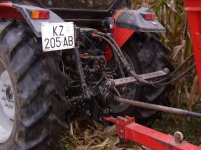
I had very good luck with both of my PTO shafts, with wide angle CV joints on one side, used on corn pickers. They were not stopped even at full angle (80-85 degrees), and they survived several hundered hours without any problems, run at 540rpm.
 

Attachments

  • 750474-mP9130043.JPG
    750474-mP9130043.JPG
    93 KB · Views: 192

Marketplace Items

2021 MULTIQUIP 25 WHISPERWATT AC GENERATOR (A59823)
2021 MULTIQUIP 25...
2011 Ford Explorer Limited AWD SUV (A59231)
2011 Ford Explorer...
2019 Toyota Mirai Sedan (A59231)
2019 Toyota Mirai...
2009 JACK COUNTY KILL TRAILER (A58214)
2009 JACK COUNTY...
2016 Chevrolet Silverado 1500 4x4 Crew Cab Pickup Truck (A59230)
2016 Chevrolet...
Caterpillar D5G LGP (A53317)
Caterpillar D5G...
 
Top