Boy you found the button for flushing out expert opinions ! Appreciate your candor in the OP saying you don't know how to load a trailer. You now have north of 30 posts telling you how to do things, acting like safety experts, etc. In there somewhere are several very good pieces of advice and worthwhile assistance. I'll stick my nose in and summarize (which is OF COURSE my opinion.)
[Note: I wager this trailer was pulled behind a dump truck in the past, hauling some sort of heavy gear by people who would never notice if it were fishtailing, could not see back there, would get the load about right just by eye ball in less time than reading this & couldn't care less...]
1) Yes,
too little tongue load is why you were fishtailing whether loaded or empty.
2) At legal highway speeds aerodynamics was never a part of your problem and won't be.
3) There are too many rabbits mentioned to be chased. One at a time. The faults in the trailer, the light loafered truck, the which-end-goes-on-first, etc. All rabbits to be chased or in some cases discarded as irrelevant.
Easy one first: It flat does not matter which end goes on front or back. Any way is OK as long as you have adequate tongue weight. As another suggested, yank those hefty looking ramps off, tie them on the front of the trailer and it better tow empty without fishtailing. If not, stop until you find out why.
Two: Trailer fault is unlikely -- tire wear may be abuse or they may be the worst tires pulled off 3 other trailers before the thing was sold to you. Worry about that last.
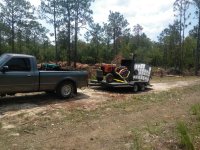
Three: That poor little maligned Ford Ranger. As described so far, your task is non-commercial, occasional, hauling an
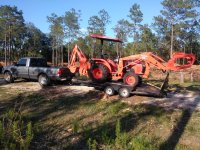
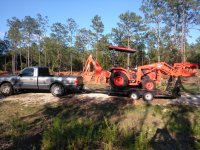
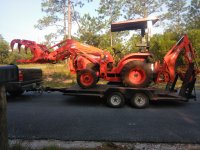
L2501 which weighs around 2500lbs. No, the loader is not adding 1000 lbs. No, that trailer probably does not weigh 3000lbs. Go weigh it if it seems important. Assuming you tow the empty trailer OK now, I say you can also tow the
L2501 with loader on it provided you get the CG far enough forward.You might have to back on to the trailer in order to get decent tongue weight. I suggest use a yardstick and measure the hitchball to ground distance first with empty trailer and then with the "initial try load position." Aim for a drop of around 5 or 6 inches at your hitch. Whatever leaves the rear axle of the truck at least an inch or so (as another guy suggested) from the rubber stops. Play with that a little moving the load fore and aft until it is lowering the hitch to the level just described. You will then be just fine towing with the Ranger in "easier terrain," staying out of the bigger mountains, etc. Either have good brakes on the trailer and a well-adjusted brake controller on the Ranger or else leave 15 extra car lengths between you and where ever you plan to stop.
Fourth: If all this "let's try it" fails for some reason (I don't think it will...) then you said you have bigger trucks. Use them. End result may be using the Ranger for short hauls and lighter cases and switching to the heavier trucks when you have extra load, longer hauls, steeper hills to pull, etc. You'll figure that out.