Tractor stability going uphill vs. down

/ Tractor stability going uphill vs. down #1  

rfc143

Silver Member
Joined
Mar 1, 2017
Messages
196
Location
Vermont
Tractor
kubota 5240
I know there are a huge number of variables involved with answering the question, but is it generally true that a tractor like mine (Kubota L5240), with only a FEL and nothing on the 3Pt Hitch, with loaded tires and wheel weights, (both of which tend to move the C of G rearward, would be more stable going down a hill than up a hill?

I've got a steep skidder trail on my property that I've come down with a 800 lb grapple claw on the front; 600 lb winch on the back. I believe once or twice I've been able to back up the same trail (but if it's too wet, can not). How would I know if it's safe to try driving up it?
 
/ Tractor stability going uphill vs. down #2  
Stability

vs traction, two different concepts.

But, a tractor's stability is located AT THE REAR AXLE! The front end is on a pivot. The nearer one can get the center of mass to the rear axle, the more "stability" you will have. That is, only tire deflection can shift the lateral CG at the rear axle beyond the lay of the land.

Running that grapple out front must pull a lot of weight off the rear wheels. If you get in a situation where the rear end leaves the ground, a tractor offers NO lateral stability. Zero, nadda, zilch!
 
/ Tractor stability going uphill vs. down #3  
many tractors if you swap the rear wheels side for side so as to keep direction of treads on tires. you can either gain a couple inches or loose a couple inches of width on the rear end.

no brakes on front tires. only brakes on rear tires.

check your operators manual to find out what it suggests for counter balancing weight between front and rear of tractor.

always try to keep the FEL low to the ground to keep COG (center of gravity) low to the ground while moving.

i have backed up a hill in reverse a few times on rather ugly nasty slope of a hill/s with the TLB (tractor loader backhoe). so i could keep weight on the front tires. (backhoe weight and at that angle *ughs*)

if you have 4x4 / MFWD engage it, and shift to a lower range / lowest range gear option. and just take it slow. if need be the engine can help perform some braking possibly. by dropping the engine RPM's.

tire pressure lower pressure within tires can allow the tires to defalt / bulge per say on the ground allowing for more ground contact and in that more traction.

chains on tires can also allow for more traction.

if it is to wet it is to wet. no if's and's or but's. if you are putting ruts on level ground, the hill most likely just going to be the same. spring/fall around here are wet seasons and you just wait, and wait. till things dry up.

make sure your ROPS (roll over protection system) is in good working order (without finding out the hard way). were a hard hat. and make sure safety seat belt is properly adjusted. do not think you will push over a tractor or hold it up with your body, if it rolls, keep your hands, feet, head in side the ROPS/tractor.

=================
with above said.
How would I know if it's safe to try driving up it?
no one is gong to be able to answer that specific question. it is a judgment call at least for me if i was driver. if you do not fill you can do it, do not do it. if you do, do it, nice and slow. so if something happens you might be able to correct issue and keep on going. or slowly come to a stop and slowly get it back down the hill without rolling it.
 
/ Tractor stability going uphill vs. down #4  
I know there are a huge number of variables involved with answering the question, but is it generally true that a tractor like mine (Kubota L5240), with only a FEL and nothing on the 3Pt Hitch, with loaded tires and wheel weights, (both of which tend to move the C of G rearward, would be more stable going down a hill than up a hill?

I've got a steep skidder trail on my property that I've come down with a 800 lb grapple claw on the front; 600 lb winch on the back. I believe once or twice I've been able to back up the same trail (but if it's too wet, can not). How would I know if it's safe to try driving up it?

For me, it depends on what is at the bottom of the hill. If I am going down hill and go into a slide, I want to be able to skid/slide into a safe area at the bottom of the hill. I have a hill on the farm that I can navigate safley going down, and would not ever attempt it going up. Ken Sweet
 
/ Tractor stability going uphill vs. down #5  
When the going gets steep:

Back up. Drive down. Same tractor orientation. Keep bucket low.

Otherwise you you may test out the ROP's:D!
 
/ Tractor stability going uphill vs. down #6  
When the going gets steep:

Back up. Drive down. Same tractor orientation. Keep bucket low.

Otherwise you you may test out the ROP's:D!
I agree. If you don't have the traction to back up a hill, stay away from it. With FEL or other type of attachment on the front, while driving down hill(or backing uphill) with front of tractor facing downhill, if you loose traction and go into a slide, just drop the FEL to the ground to stop your slide or at least slow it way down. This reduction of weight to the rear wheels will also allow them to regain some traction.
 
/ Tractor stability going uphill vs. down #8  
When the going gets steep:

Back up. Drive down. Same tractor orientation. Keep bucket low.

Otherwise you you may test out the ROP's:D!

Yes, ...

But also make sure you have more weight in back than in front. On a slope, the weight of the tractor shifts to the downhill end of the tractor. If most of the weight is already on the front, when you back up, even more weight goes to the front axle. If it's too much, the rears will get light and not only lose traction, but the tractor could be laterally unstable due to the front axle pivot. Having more weight on the uphill end of the tractor keeps the back end planted to maintain both traction and side-to-side balance.
 
/ Tractor stability going uphill vs. down #9  
Yes, ...

But also make sure you have more weight in back than in front. On a slope, the weight of the tractor shifts to the downhill end of the tractor. If most of the weight is already on the front, when you back up, even more weight goes to the front axle. If it's too much, the rears will get light and not only lose traction, but the tractor could be laterally unstable due to the front axle pivot. Having more weight on the uphill end of the tractor keeps the back end planted to maintain both traction and side-to-side balance.

That's when you drop the bucket and use the curl traction assist option.
 
/ Tractor stability going uphill vs. down #10  
Yup test by backing up than go w/your gut feelings.
Have you consider good traction tire chains?
 
/ Tractor stability going uphill vs. down
  • Thread Starter
#11  
Yup test by backing up than go w/your gut feelings.
Have you consider good traction tire chains?
I have them, but take them off in the summer because they tear up the drive way. If I had some decent gravel on the property, I could fill in several of the dips and probably make it, but will live for now with backing up the trail. I appreciate all the good advice here.
 
/ Tractor stability going uphill vs. down #12  
I'll attempt to climb any hill as long as I have an implement on the back.
 
/ Tractor stability going uphill vs. down #13  
That's when you drop the bucket and use the curl traction assist option.

Yep. Keep your hand on the joystick and the bucket low and be ready to drop it into the dirt if you have to.
 
/ Tractor stability going uphill vs. down #14  
I'm thinking that a good box blade with scarifiers lowered can become an excellent anchor going down hill. My property is fairly flat, so no real experience.
 
/ Tractor stability going uphill vs. down #15  
A couple things I learned early on - that fear buries into your brain:

1. If you are on a hill of any kind - 4wd must be engaged or you have no front axle braking. This is how things can break away and go gravity speed (yikes).

2. The idea of dropping your bucket to help you stop. Sounds good - but you want to have bucket curled up so the front edge does NOT cut into the ground - if it does cut into the ground - it doesn't slow you down - it makes the bucket stop dead and you and tractor keep going forward or to the side - scary is momentum going down and a bucket edge digging into the ground very suddenly.

3. damp or wet grass/rocks/leaves/or slippery clay - are not your friend

4. I learned that SOMETIMES backing downhill while not comfortable - is a whole lot safer than driving down.

And lastly 5. If you'd feel uncomfortable trying to walk or hike down a hill - why would you think driving a tractor down it would be smart LOL That's what ATVs are for.
 
/ Tractor stability going uphill vs. down #16  
We have a steep dam that I occasionally mow when it is vey dry. I always back up the hill going straight up and down always in low gear and never with my wife around. I would never attempt to drive up it but backing up it seems a lot safer. I am not sure the degree of slope but I can't take my ATV up it straight or back it up. I have never attemped the very back of the dam where the slope is crazy i just take the weed eater to it.
 
/ Tractor stability going uphill vs. down #17  
1. If you are on a hill of any kind - 4wd must be engaged or you have no front axle braking.

:thumbsup:
This needs to be repeated. You only have front wheel "braking" when in 4WD.
When going downhill forward, angle causes rear axle to lighten (especially with a load in FEL) you need front wheel braking.
Using 4wd should be Plan A. Dropping bucket (and implement) into dirt or wet grass to stop should be Plan B. Right before Plan C(hit)!
 
/ Tractor stability going uphill vs. down #18  
I live on a hill, but since I'm retired, for the most part I get to decide when and where I go up or down.

Some things I've done to improve my tractor's ability to go up and down:

- Filled both rear and front tires. Rear wheels have concrete, steel and lead wheel weights (500 lbs total). Loaded front tires worked better then 2 30 gallon water filled barrels in the FEL).
- Added front weights to the weight bar.
- Added 910 lbs to my 675 lb BB, which is my usual 3ph counter weight; if I'm bushhogging, I use my BH286 ~1k lb bushhog.
- Lowered the rear and front tire pressure for full tire width contact.
- Had the rear tires and wheels widened to their widest setting (Grand L's have about 5 settings, IRC). The downside: too wide for most implements like my 6' wide BH and BB.

Some advice for going up and down hills:

- Never go down a hill without 4wd engaged. You'll do it once, take the 2" ride*, then never do it again.
- Never go down a hill without significant weight on the 3ph.
- Try to never go down a hill when it's wet, either from rain (slippery mud/ground) or dew (slippery grass).
- Except to bypass an obstacle, I never back up a hill. I want the rear tires doing most of the work, not the front. Plus it's far easier to see where you're going. Personally, I think backing up a long hill like I have is retarded. No offense.

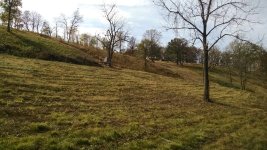
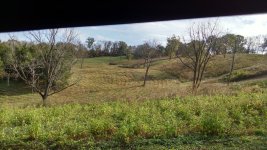
Some pics showing the hill I have to work on:

IMG_20161107_123145267 (Large).jpgIMG_20161107_123336653_HDR (Large).jpg

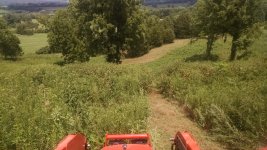
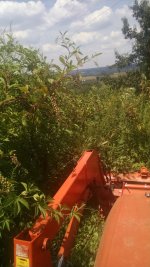
Pics while bushhogging it:

IMG_20160723_140517494 (Large).jpgIMG_20140815_135717364 (Large).jpgIMG_20140815_135720274 (Large).jpgIMG_20140815_135730780 (Large).jpg

I hope this helps!


*2" Ride: Uncontrolled ride down a hill, whereupon you suck up 2" of seat cushion before you get it back under control. Also known as "I just crapped my pants" ride in some circles.
 
/ Tractor stability going uphill vs. down #19  
Correct me if I'm wrong but the 3pt can be pushed up- the tractor does not lock the 3pt or push down on it. So an implement on the 3pt won't prevent the tractor from flipping over backwards. But the loader can push down so the bucket would help prevent flipping over the front axle.

I have a steep road with stuff at the top that needs chipping. I've been waiting for the road to dry but my plan is to back up it in 4wd with the loader bucket near the ground. The 1000lb chipper on the back should help too.
 
/ Tractor stability going uphill vs. down #20  
I live on a hill, but since I'm retired, for the most part I get to decide when and where I go up or down.

Some things I've done to improve my tractor's ability to go up and down:

- Filled both rear and front tires. Rear wheels have concrete, steel and lead wheel weights (500 lbs total). Loaded front tires worked better then 2 30 gallon water filled barrels in the FEL).
- Added front weights to the weight bar.
- Added 910 lbs to my 675 lb BB, which is my usual 3ph counter weight; if I'm bushhogging, I use my BH286 ~1k lb bushhog.
- Lowered the rear and front tire pressure for full tire width contact.
- Had the rear tires and wheels widened to their widest setting (Grand L's have about 5 settings, IRC). The downside: too wide for most implements like my 6' wide BH and BB.

Some advice for going up and down hills:

- Never go down a hill without 4wd engaged. You'll do it once, take the 2" ride*, then never do it again.
- Never go down a hill without significant weight on the 3ph.
- Try to never go down a hill when it's wet, either from rain (slippery mud/ground) or dew (slippery grass).
- Except to bypass an obstacle, I never back up a hill. I want the rear tires doing most of the work, not the front. Plus it's far easier to see where you're going. Personally, I think backing up a long hill like I have is retarded. No offense.

Some pics showing the hill I have to work on:

View attachment 508089View attachment 508090

Pics while bushhogging it:

View attachment 508091View attachment 508092View attachment 508093View attachment 508094

I hope this helps!


*2" Ride: Uncontrolled ride down a hill, whereupon you suck up 2" of seat cushion before you get it back under control. Also known as "I just crapped my pants" ride in some circles.

What he said ^. His slopes look like the slopes around here.
 

Marketplace Items

2015 Sealine F380 Flybridge Motor Yacht Boat (A59231)
2015 Sealine F380...
CASE INTERNATIONAL 3900 DISC HARROW (A63291)
CASE INTERNATIONAL...
Case 580K Backhoe (A64047)
Case 580K Backhoe...
John Deere 2750 Tractor (A64047)
John Deere 2750...
2005 JLG BOOM LIFT (A59228)
2005 JLG BOOM LIFT...
YALE FORKLIFT (A63291)
 
Top