Snow Tires for chains

/ Tires for chains #1  

DrDirt

New member
Joined
Jan 18, 2011
Messages
1
Location
Newport, Virginia
Tractor
1952 Ford 8n, 1942 AC Model C, 1944 Farmall A, John Deere 3038E
I just bought a pair of mounted turf tires (rear) to permanently mount my chains on my BX25. I normally use the industrial treads year round. The dealer told me that Kubota frowned on mixing tires from front to back, and it could void any warranties. The reason was that the circumference was different on the turfs vs the industrials, and it wasn't healthy for the 4WD. My viewpoint is that using chains will effectively change the circumference of the rear tires regardless of the treads, and since Kubota isn't keen on using chains on the front, I cant see how this argument is valid.

Do I have anyone who agrees with me, or should I buy turfs for the front for snow use with my chains?
 
Last edited:
/ Tires for chains #2  
I've never seen mixed tires on 4-wheel street vehicles. Even dualies rears match the fronts. Can't be that expensive to pick up a front set with turfs. Could even come in handy, if you get a flat in the front. I'm a big believer in chains.
 

Attachments

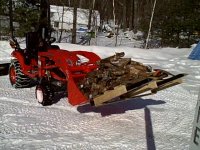
  • Kubota BX25 Meets Rube Goldberg.jpg
    Kubota BX25 Meets Rube Goldberg.jpg
    95 KB · Views: 327
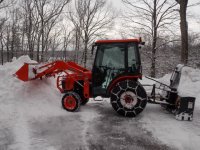
  • Kubota B3030 Snow Pile EM.JPG
    Kubota B3030 Snow Pile EM.JPG
    131.2 KB · Views: 211
/ Tires for chains #3  
Well it depends! If you only run the chained tires on snow covered roads there is enough slippage for the fronts to relieve any mismatch in tire circumference and nothing to be concerned about. If you need to do a lot of close turns on dry pavement you will be either pushing or dragging the front tires and adding extra stress and wear to the front axle parts. I'd run the chains on rear with the fronts you have and pop it into 2WD anytime I had to drive on dry pavement. Do run a compatible front to rear set in the summer or you will suffer rapid front tire wear plus axle bearing wear on the front.
 
/ Tires for chains #4  
If you switch to turf tires all around you will likely find that you will never need chains.
Good Snow tires are designed closer to turf tires...
I put the Largest Turf tire & wheel That would fit in the rear wheel opening on my L4200... Then had the tire guys find a Ratio matching wheel & turf tire for the front... Have Never had traction problems on any surface.
If you are only going to do the rear, simply measure the actual rolling circumference of the old rear tire and compare it to the New rear tire... If you are not changing the front that New rear tire Must have the Same rolling circumference ... KennyV
 
/ Tires for chains #5  
If you switch to turf tires all around you will likely find that you will never need chains.
Really? That is a bold statement but seeing that you are from Kansas, it explains your comment a bit. Up here in Washington state we have little hills that you might call mountains. Turfs won't cut it. My driveway isn't passable sometimes without chains whether a 4WD truck or tractor regardless of tread.
 
/ Tires for chains #6  
Really? That is a bold statement but seeing that you are from Kansas, it explains your comment a bit. Up here in Washington state we have little hills that you might call mountains. Turfs won't cut it. My driveway isn't passable sometimes without chains whether a 4WD truck or tractor regardless of tread.

on snow You will get Great traction using turf s....
If you are talking ice, then chains are the only thing that will help.
Chain will have best contact over turf tires, if you end up with ice. Over size tallest and widest... you will need different Wheels & Tires but keep the front to rear ratio the same as stock.
And Yes we enjoy the Flat land here in Kansas... but I am familiar with mountains and snow... Colorado and Utah.
Your Best all around traction tire will be Turf... largest that you can fit... then add weight to make it all work.
 
/ Tires for chains #7  
With these on it doesn't matter what tread pattern you have under them. Ice surface with rain on top and no tire is worth a darn without chains.
 
/ Tires for chains #8  
I've had filled turf's(21") on my L2550, no chains and had no issues in snow or hill's.
I now have filled R1's,(28" that could use replacement) and again have had no issue's
in the same condition's. I do have chains but never needed them.
I suppose what I'm trying to say is, WEIGHT is the key for good traction.
It's always good to have a set of chains handy, though.
 
/ Tires for chains #9  
vtsnowedin, do you have ballast in your rear tires.
Nice chains, by the way.
 
/ Tires for chains #11  
I just bought a pair of mounted turf tires (rear) to permanently mount my chains on my BX25. I normally use the industrial treads year round. The dealer told me that Kubota frowned on mixing tires from front to back, and it could void any warranties. The reason was that the circumference was different on the turfs vs the industrials, and it wasn't healthy for the 4WD. My viewpoint is that using chains will effectively change the circumference of the rear tires regardless of the treads, and since Kubota isn't keen on using chains on the front, I cant see how this argument is valid.

Do I have anyone who agrees with me, or should I buy turfs for the front for snow use with my chains?

I can't comment on the traction part of your question. Traction would seem to depend too much on local conditions. Anyway it seems like you are mostly concerned about the front/rear differential ratio and how tire affects that ratio. I live in a deep snow area and ran chains on 4wd tractors for the past 30 years. Learned a lot.

First of all, I think you are on the right track. I'm assuming that you did some research before starting all this and already know that your mounted turfs with the chains on are about the same diameter as the industrials that you took off. In tractors, knowing the diameter doesn't get you wheel circumference directly like it does in HS math...but at least it gets you close.

What you really want to know is the actual rolling circumference of the tire. The rolling circumference is the measure of how the tire is "geared" to the ground. Unfortunately, rolling circumference varies with the type of surface as well as the inflation, but we can get very close.
You can do this with the original industrial tires in several ways. The easiest way I know is to mark the tread and measure between the marks it makes on the ground. An easy way with industrial tires is by putting a spot of paint on the tire tread and driving down the road. Do that for the fronts and the rears and measure the distance between the dots. This will give you your actual front to rear tire size ratio. In a perfect world, this would also be the ratio of the mechanical front versus rear axle gearing inside the tractor. But it isn't.

And now you need to find the factory front-to-rear internal gear ratio by taking the tractor apart and counting all the various teeth and gear diameters between the front wheel and the rear. UGH! Or you can do it more simply directly by jacking up one side of the tractor, put it into 4WD, mark both tires and then slowly (key is slowly) rotate the front wheel and count the number of rotations of the front wheel until the back tire makes one complete revolution.

If you compare that internal gear ratio to the actual rolling circumference you will find that they are not th same. Reason for this is that the original tires are always sized by the designers at the factory so that the front end of the tractor is slightly higher geared than the internal gearing would suggest. Somewhere between 5 and lightly under 10% is typical.... This provides for the very necessary positive steering control, but it also puts a torsional stress on axles and drive shafts when in 4wd mode. Thjx deliberate mismatch is the accepted but unfortunate compromise in any inexpensive 4Wd machine. The more expensive solution is to have another degree of variable coupling between the front and rear drive shafts. Most Ag and Homeowner tractors I know of do not have that more expensive sophistication - although you will see it on most industrial machines and full time 4wd cars. However, in any tractor having this deliberate mismatch you don't want to ever use 4wd in any high traction situation......Not on dry pavement and also not on snow with all 4 wheels chained. The torsional wind-up stress is additive as you drive and will eventually either cause a tire to slip on the surface or else something will break. BTW, you can often feel this wind-up stress as a reluctance of tractor to shift out of 4wd mode. It can feel like the 4wd shifter is bound up. What you are actually feeling is normal wind-up stress due to the front tires being higher geared relative to the rears.

After a bit of experience, the amount of reluctance to shift out of 4wd mode makes for a pretty good "cheap and dirty" way to measure just how close to right you have gotten the tire diameters. The harder it is to shift out of 4wd, the more attention you need to place on effects of varying traction.

I've played with this front/rear ratio thing a fair amount over the years on several machines.. If you have questions we can work on them.
enjoy! rScotty
 
/ Tires for chains #12  
When I got my BX which came with turfs I thought for sure I'd need chains for the New England snow. I was pleasantly surprised at how well turfs do in the white stuff. Can't see myself needing them.
 
/ Tires for chains #13  
When I got my BX which came with turfs I thought for sure I'd need chains for the New England snow. I was pleasantly surprised at how well turfs do in the white stuff. Can't see myself needing them.

I found the same thing. I actually bought the chains with my first BX but in 11 winters I've never needed them.

Sent from my iPad using TractorByNet
 

Marketplace Items

2016 JCB 3CX 4x4 Loader Backhoe (A64194)
2016 JCB 3CX 4x4...
HEIN-WERNER 57 SERIES 2 BUMPER JACK (A65643)
HEIN-WERNER 57...
2018 DRAGON  130BBL VACUUM TRAILER (A65643)
2018 DRAGON...
2011 Ford F-350 Crew Cab Service Truck 4x4 (A62613)
2011 Ford F-350...
2017 Freightliner M2 106 Auto Crane HC10 5 Ton Crane Service Truck (A61573)
2017 Freightliner...
Concrete Cut Off Saw (A66408)
Concrete Cut Off...
 
Top