Tandem Disc Harrows and Pi

/ Tandem Disc Harrows and Pi #1  

jeff9366

Super Star Member
Joined
Jan 14, 2011
Messages
12,787
Location
Alachua County, North-Central Florida
Tractor
Kubota Tractor Loader L3560 HST+ ~~~~~~~~~~~~~ 3,700 pounds bare tractor, 5,400 pounds operating weight, 37 horsepower
Tandem Disc Harrows and Pi​


Disc Harrow effectiveness is closely related to weight bearing on each disc or pan. The heaviest components, in total, are the Disc Harrow pans.

The weight of each pan is related to its area, its thickness and to its concavity.

The formula for the area of a circle is: A = Pi x R[SUP]2[/SUP]

Here are the approximate areas, in square inches, of common Disc Harrow pans:

Pan Pi R[SUP]2[/SUP] Area
14" 3.14 49 154

16" 3.14 64 201

18" 3.14 81 254

20" 3.14 100 314

22" 3.14 121 380

24" 3.14 144 452

Greater concentricity/dish requires more material so will increase differences above.

Thickness differences would increase differences above, but change would be linear. Larger diameter pans are usually thicker than smaller diameter pans.

Notched pans will be slightly lighter than un-notched pans of the same diameter, thickness, and concavity.

The point of this exercise is to show how rapidly pan weight and therefore pan penetration, increases with diameter.

Tandem Disc Harrows commonly have 16, 20 or 24 pans, so the effect on total Disc Harrow weight increase rapidly with pan diameter.

We should de-emphasize Disc Harrow frame width and introduce the importance pan diameter when making Disc Harrow recommendations, especially when the question involves cutting/penetration.


***COMMENTS PLEASE***​


(Will someone explain the method to construct or introduce a data table to T-B-N?)
 
Last edited:
/ Tandem Disc Harrows and Pi #2  
It depends on tractor size, disc type, and weight you can apply. any variable changes the outcome.
 
/ Tandem Disc Harrows and Pi #3  
More to the point is pan thickness which also increases with size of the disk pan therefore more weight. Also in the equation is the spacer spools which can be a big factor in weight of the disc along with frame materials. All together, larger/heavier frame, larger/heavier disc pans, larger/heavier spacer spools make the disc cut more or less along with the diameter. Diameter of the pan limits the depth of cut the most. The disc can only cut 1/2 the disc diameter, minus the spacer spool diameter. So if you have a 18" pan with 4" spools, it can only cut 9"-4" for total of 5" whereas a 24" pan minus the 4" would be able to cut 8" deep. Per design requirements because of induced load, the frame on a disc with 24" blades would need to be stronger, thus heavier, than the frame of a disc with 18" blades.

Everything about the disc is relevant to how well it cuts, not just the pan diameters.
 
/ Tandem Disc Harrows and Pi #4  
"We should de-emphasize Disc Harrow frame width and introduce the importance pan diameter when making Disc Harrow recommendations, especially when the question involves cutting/penetration."


I agree with this and while I may recommend a width for a disk it is only one of many parameters to consider.


Gary makes some very good points in his post above, it is all relavent.
 
/ Tandem Disc Harrows and Pi #5  
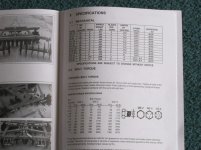
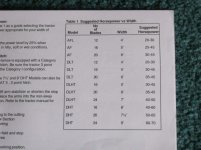
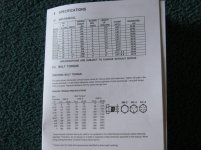
Heres some info that's on my Howes owners manual.
 

Attachments

  • 002.jpg
    002.jpg
    712.4 KB · Views: 186
  • 001.jpg
    001.jpg
    640.3 KB · Views: 135
  • 004.jpg
    004.jpg
    657.7 KB · Views: 141
  • 002.jpg
    002.jpg
    786.8 KB · Views: 141
  • 001.jpg
    001.jpg
    727.2 KB · Views: 130
/ Tandem Disc Harrows and Pi
  • Thread Starter
#6  
If someone educates me on how to place a table in T-B-N posts I will add a column with actual pan weights from Agri-Supply's offerings, choosing a weight from the middle range of thicknesses and concavity and using notched discs. Pan thickness varies.

Replacement 18 inch discs are available in 3mm, 3.5mm, and 4mm thickness. Replacement 20 inch discs are available in 3.5mm, 4mm, 4.5mm, 4.76mm, 5mm and 6.35mm thickness. As you see, diameters and thickness overlap.

(Agri-Supply offers ***516*** replacement disc types on its web site. (What a great country!)

I may also add columns to show weight of (x)16 pans and (x) 20 pans to express total pan weight.

Gary Fowler: I have never taken a Disc Harrow apart. How much does a spacer spool for an 18" or 20" Disc Harrow weigh, just 'ballpark' ? I find 1" and 1-1/8" axles to be surprisingly light.
 
Last edited:
/ Tandem Disc Harrows and Pi
  • Thread Starter
#7  
Everything about the disc is relevant to how well it cuts, not just the pan diameters.

I agree; however…..

For cutting the two most important Disc Harrow factors are weight bearing on the ground through each pan and gang angle adjustment. Weight bearing per pan will be mostly influenced by pan diameter, then thickness.

Concavity is a third factor. As pan concavity increases, 'float' increases, resisting penetration but throwing dirt wider.

Top Link length is important too, but Top Link is not a part of the Disc Harrow, per se.
 
Last edited:
/ Tandem Disc Harrows and Pi #8  
jeff9366, interesting thread. I have been looking for a tandem for a while now. Choosing the right size has been a real pain. I want to use a tandem to plant food plots so I don't need a great big one. Maybe 8'-10'. I need to penetrate the ground as deep as I can and chop weeds. That said, weight is important. I have even thought about cutting down a 12' heavy duty drag type tandem to 8' (easier to get into tight plots and through smaller gates). I appreciate your point that the higher total weight per disk, the better ground penetration you will have and also that most of the weight of the plow is in the disks themselves. I also appreciate your explanation on the effects of concavity. Since I am putting in new food plots where penetration and ability to chop weeds is paramount, less concavity will be better that more. (my new food plots will first be chiseled then disked, seeded and culti-packed).

I was looking at Agri-Supply's offerings, (good prices on disks by the way) and I couldn't find the weights of the disks that they were offering. I am leaning towards (as I said) an 8' tandem with 20-20"X6mm blades with a 2.5" concavity (I still could use some guidance on the correct concavity for what I am trying to do).

I for one, would appreciate your posting a table. I wonder if you could create a table in Excel (or any spreadsheet) then convert it to a .jpg file. It could then be easily imported into a tractorbynet post using the "manage attachments" utility in the Advanced posting section.

Again, thank you for starting this thread. Hopefully it will degenerate into a discussion on how to choose a tandem disk.

Tim
 
/ Tandem Disc Harrows and Pi
  • Thread Starter
#9  
I want to use a tandem to plant food plots so I don't need a great big one. Maybe 8'-10'. I need to penetrate the ground as deep as I can (my new food plots will first be chiseled then disked, seeded and culti-packed).

I was looking at Agri-Supply's offerings, (good prices on discs by the way) and I couldn't find the weights of the disks that they were offering. I am leaning towards (as I said) an 8' tandem with 20-20"X6mm blades with a 2.5" concavity (I still could use some guidance on the correct concavity for what I am trying to do).

I for one, would appreciate your posting a table. I wonder if you could create a table in Excel (or any spreadsheet) then convert it to a .jpg file. It could then be easily imported into a tractorbynet post using the "manage attachments" utility in the Advanced posting section.

In my experience in Florida, food plots do not require deep preparation or fine tilling, although it might be nice to do both. Deer and Turkey plot seed mixes are strong germinators and the seed is cheap. I refer to "scratching in" food plots with a Disc Harrow, then seeding. As I generally plant both Spring/Summer and Fall/Winter plots the ground is disced twice per year. So, with cheap seed, I disc, then sow. However, I do have a Cultipacker and I run it over the planted seed without fail.

I have ordered parts from Agri Supply in the past. When the freight is calculated, the product weight appears. I may call in to double check weights on the few discs I want for examples, or I may find weights somewhere else.

"I was looking at Agri-Supply's offerings, good prices on disks by the way, I am leaning towards an 8' tandem with 20-20"X6mm blades with a 2.5" concavity (I still could use some guidance on the correct concavity for what I am trying to do)".

I think you are "right on" with what you are considering. Just keep the Disc Harrow width a bit narrower than your tractor tires if you have to maneuver your tractor and DH between trees, boulders or other obstructions. I have never seen pan thicknesses nor concavity listed in the marketing materials for any Disc Harrow for compact tractors but that does not mean the information is not available from the manufacturer via telephone. I am sure you are planning to order notched pans front and rear.

How do I convert an Excel spreadsheet into a .jpg file?

You may have seen the thread I created on choosing Disc Harrows, link following.

http://www.tractorbynet.com/forums/attachments/308251-disc-harrow-selection-18-45-a.html?highlight=
 
Last edited:
/ Tandem Disc Harrows and Pi #10  
I saved this Excel spreadsheet as a .pdf file and them from Preview (I am using a Mac) I exported it to a .jpg file. The .jpg file can be uploaded to tractorbynet posts. Kind of a convoluted way to do it, but it works. I tried it with Adobe and it wouldn't let me save it or export it to anything but a .pdf. If you can't find an easy way to make the conversion, send me the .xls file and I will make the conversion for you. I think you can send the file by PM. If not, let me know and I will send you my email address.

I am planning to put notched disks on the front for sure, and maybe on the back too. Makes sense that it would do a better job of chopping up the vegetation with notched disks on both the front and back. Hadn't thought about that.
 

Attachments

  • table test.jpg
    table test.jpg
    39.2 KB · Views: 114
/ Tandem Disc Harrows and Pi
  • Thread Starter
#11  
Since acquisition I have adjusted my Howse Disc Harrow so that front gangs are set at an angle and the rear gangs are set two adjustment holes "straighter", then experimented with adjustments off this relationship. From my observations most north Florida Disc Harrows are set in this relationship.

Earlier this week I was guest conductor on a Deere 5103 / 50-hp / 5,000 pounds pulling a Deere/Frontier 20" Disc Harrow with lever adjustment. The owner, who has farmed part-time in my area for thirty years, has his front gang "straight" and his rear gang angled, a recent change I was told. It tilled really well but he has been amending his soil with manure for years and it is exceptionally friable. When I next see Andrew, who is suffering from Shingles, I will discuss his DH settings with him and may experiment with his basic setting, which is the reverse of my basic setting. Before I bought my DH I thought Andrew's adjustments, straight front (cutting) and angled rear (mixing) made sense in theory.

I love to experiment, seeking implement/soil nirvana for each implement.
 
Last edited:
/ Tandem Disc Harrows and Pi #12  
jeff9366 said:
The point of this exercise is to show how rapidly pan weight and therefore pan penetration, increases with diameter.

But the disc is larger in diameter, so there is more of the disc edge in contact with the soil per inch of soil penatration. I think that cancels out the increase of weight from the increase in diameter.
 
/ Tandem Disc Harrows and Pi #13  
Hey jeff,

You seem to have developed a good bit of information and expertise regarding tandem disks so maybe you can answer a question for me. What is the optimum speed that a tandem should be pulled and why

Thanks,

Tim
 
/ Tandem Disc Harrows and Pi
  • Thread Starter
#14  
A Tandem Disc Harrow is a tiller, which mixes the soil. In the process it also levels the soil. One gang, usually the one nearest the tractor, throws soil out. The other gang, usually set wider and usually the rear gang, throws soil in. In the process soil is mixed and soil profile is leveled as soil is moving in the air as the pans traverse furrows.

The Disc Harrow should be pulled fast enough so soil thrown out, then in, is equal. Usually that is a "brisk" pace. For my tractor/Disc Harrow combination, that is HST medium range, plus some hand throttle.

Cannot give an exact speed. Optimum speed is dependent on user selected Three Point Hitch depth setting, user selected Top Link length, user selected gang angles, pan concavity, pan spacing, pan penetration, depth of plow furrows being crossed, if any; crop residue, soil type, and soil moisture.

Good?
 
Last edited:
/ Tandem Disc Harrows and Pi
  • Thread Starter
#15  
But the disc is larger in diameter, so there is more of the disc edge in contact with the soil per inch of soil penatration. I think that cancels out the increase of weight from the increase in diameter.

Pans have an edge like a knife. (serrated knife?)

When you carve a roast, what works best? A large, heavy, carving knife or a small, light, paring knife?
 
/ Tandem Disc Harrows and Pi #16  
jeff9366 said:
Pans have an edge like a knife. (serrated knife?)

When you carve a roast, what works best? A large, heavy, carving knife or a small, light, paring knife?

Just being pressed into the roast, the smaller knife would have a smaller length of cut, so more pressure. But I don't think thats a good analogy for a disc harrows action.

If you wanted to penatrate something tough , would you use the tip of a knife, or the edge?

The tip of the knife would concentrate the force on a very small area. The edge, though sharp, would apply the force over a larger area. This is with the same overall force for both situations mind you.

Note also that with a harrows disc rotating as it goes allong the soil, you don't get the slicing/sawing action that would be used with a knife. More like a pressing/rolling motion.
But then there is the angle of the disc axle to to the direction of pull. Combined with the amount of dish the disc has creates a plow like action.

I'm not sure what would be a good analogy to a disc harrows cutting action.

But I just wanted to point out that your calculations weren't taking account of the larger edge contact a larger disc would have.

But I do think the larger/ thicker/ heavyer discs will work better.
 
/ Tandem Disc Harrows and Pi
  • Thread Starter
#17  
The long carving knife has more edge in contact with the roast. Carving knife cuts better because of weight.

There is no down pressure from the 3-Pt.; gravity is the only down force, which is why pan weight is key.

The leading edge of a larger diameter pan (50% of ground contact) will present some increase of resistance to penetration with increasing diameter but it is a small increment relative to the increase in pan weight with diameter. The trailing edge of the pan (50% of ground contact) is being lifted and presents NO resistance.

Pans are all edge; no point. Notched pans are pretty good slicers, that is why they are used to cut in crop residue in preference to smooth pans. "Slicing action" occurs as the Disc Harrow makes second and succeeding passes over the ground; just an interval between slicing strokes.

Debates are good here, provided they yield more light than heat.

The readership will select from information presented.
 
Last edited:
/ Tandem Disc Harrows and Pi
  • Thread Starter
#18  
Since acquisition I have adjusted my Howse Disc Harrow so that front gangs are set at an angle and the rear gangs are set two adjustment holes "straighter", then experimented with adjustments off this relationship. From my observations most north Florida Disc Harrows are set in this relationship.

How are "y'all" in other parts of the country setting your Tandem Disc Harrows? What are your objectives when setting them? What is your soil? Do you Fall plow? What other settings have you experimented with? (Let's stay on Tandem Disc Harrows, please.)
 
/ Tandem Disc Harrows and Pi #19  
A Tandem Disc Harrow is a tiller, which mixes the soil. In the process it also levels the soil. One gang, usually the one nearest the tractor, throws soil out. The other gang, usually set wider and usually the rear gang, throws soil in. In the process soil is mixed and soil profile is leveled as soil is moving in the air as the pans traverse furrows.

The Disc Harrow should be pulled fast enough so soil thrown out, then in, is equal. Usually that is a "brisk" pace. For my tractor/Disc Harrow combination, that is HST medium range, plus some hand throttle.

Cannot give an exact speed. Optimum speed is dependent on user selected Three Point Hitch depth setting, user selected Top Link length, user selected gang angles, pan concavity, pan spacing, pan penetration, depth of plow furrows being crossed, if any; crop residue, soil type, and soil moisture.

Good?

Well... I was sort of hoping I could get a little more definitive answer from you, kind of like 4.56278mph or thereabouts:). But, I get what you are saying. I have pulled several sizes of tandems with my tractor over the last several years. Ranging from 14' down to 6'. With the 6' I can go as fast as I can stay in the seat. With the 14' I can get about 3mph at full power. I pulled a 12' plow (tandem disk) last year and was able to get 4.5 mph out of it. I realize there can be a lot of variables when measuring the effectiveness of the plow but for all intents and purposes each of the plots I was working was very similar. Clearly the 14' is too much. Originally my intent was to find the largest tandem that I could pull at about 5 or 6 mph. I think I can do that with a 10' plow. I have kind of settled on a 8' plow for other reasons (such as transporting, getting through gates etc.).

I also run a tandem as flat as I can so that the front and rear gangs engage the ground about the same. It never occurred to me the bury the front gangs. I would think that you risk damaging the plow if you go overboard with that. Could be wrong:).

Tim


Top