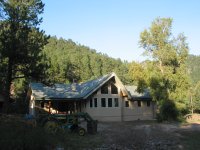
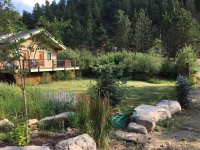
Shouse Build

   / Shouse Build #41  
No such thing as tornado proof. The house I live in currently was built in 1880 and it's still here. We will be placing a metal shelter inside the garage portion in case we need it but that's about it. The building itself is engineered to handle the weather here.

I'm 48 my wife is 43, our kids are 18 and 16. They'll hopefully be moving on with their own lives. :laughing:

I ordered a Branson 2510H, just needed something small to do bush hogging and mowing and drag the driveway every now and then. I could have went bigger but didn't see the need once the property was established and it's really not the right tool for earth moving anyways. I know it's a weird brand but the people that own them seem to like them a lot, and I liked the dealer a lot more than others I visited. If it's crap I will live and learn I guess.

Yeah fun, I'll make sure to take plenty of pics and video of me doing stupid things and nearly killing myself. I'm sure those will get a laugh. Nothing like city folks moving to the sticks and doing stuff they probably shouldn't be doing themselves. That's hours of entertainment. :D

Maybe not tornado proof, but Morton buildings will replace your building if a tornado takes it away within the first 5 years. That痴 pretty solid.
 
   / Shouse Build
  • Thread Starter
#43  
Maybe not tornado proof, but Morton buildings will replace your building if a tornado takes it away within the first 5 years. Thatç—´ pretty solid.

That's what insurance is for.
 
   / Shouse Build #44  
That's what insurance is for.

Yep.

Great sales point for Morton though. It would be interesting to know how many times they have had to do that? What's the odds? :)
 
   / Shouse Build #45  
Found your thread on your barn /house project ! You have a huge project and undertaking on your hands !! You only get one chance to put a road in the correct way....don't skimp on getting it graded correctly and stone put down. Are you going to use 6x6 posts for the frame work ? If so are you going to dig holes and set them in ? You would be better off to use something like the 'perma column' system to keep the post out of the ground. Go to RR Buildings on youtube and see how they install them. Looking forward to tracking your build. Happy and safe flying !!
 
   / Shouse Build
  • Thread Starter
#46  
Yep.

Great sales point for Morton though. It would be interesting to know how many times they have had to do that? What's the odds? :)

They can afford it based on their building prices. No way in **** pricing.
 
   / Shouse Build
  • Thread Starter
#47  
Found your thread on your barn /house project ! You have a huge project and undertaking on your hands !! You only get one chance to put a road in the correct way....don't skimp on getting it graded correctly and stone put down. Are you going to use 6x6 posts for the frame work ? If so are you going to dig holes and set them in ? You would be better off to use something like the 'perma column' system to keep the post out of the ground. Go to RR Buildings on youtube and see how they install them. Looking forward to tracking your build. Happy and safe flying !!

Yes they'll be anchored in 4 foot deep.
 
   / Shouse Build #48  
Aloha DD

Just found this thread today and will be following.
Wife and I did this about 14 years ago.
The County considers us Owner built, but more accurately it was like we acted as own GC as we still got Plumbing and Electrical contractors. Also hired out the driveway and pad work as well as the concrete. We did everything else, hiring labor as appropriate.
So just a couple of thoughts that helped us.
Back in the planning stage we made a list of factors the house/property had to meet. These were statements like handicap access, no stairs, all doors 36” min, no interior passage less than 48, etc. Once we put pen to paper to draw, those drawings were bounced against the list until we had a match. No talent with Legos, but we did do a scale model, even a to-scale car and truck in the garage. Was very useful for a number of reasons. Final plans were drawn by draftsman and stamped by architect for permitting.
The only major change as built was to eliminate 1 patio slider on wall next to gas fireplace in master suite. Only thing I wish I had caught and changed was draftsman’s placement of commode in the common bathroom.
This was somewhat self financed, not a construction loan, so while $$ limited we didn’t have construction loan limits or timelines.
We built on slabs. For us this was also a source of delay. First slabs poured in Jan, last not until May due to weather. We also did own acid staining. Actual stain 30 days after pour, but not sealed until walls were done and painted.
This was our 8hr/day, 5 day/week job. 2 15 min scheduled breaks and 1 hour lunch. Paid lunch for the labor I hired. All shopping, planning, etc was done non work hours and weekends. Some weekends wife and I even did main tasks just to facilitate schedule, but to be honest as We started when I was 59, sometimes weekend was just recovery. My basic rule for help was keep up with me or I don’t need you. I don’t smoke, paid help didn’t either. We built with a SIP system. I refer to house as the 4 boxes, 2 bedroom suite boxes 21x42, main unit 27x42, garage plus 24x42 all connected via slab and roof. We started first wall end on Jun, roofed over by mid Sep.

My tractor was indispensable
Here is an aerial:
DJI_0338.jpeg

Will be following your progress. Don’t hesitate to bounce an idea here, great source of help.
 
   / Shouse Build #49  
DD,
How are you doing the exterior walls? I have a neighbor who just had a 40x80 shop built. He had the normal girts or horizontal members attached to the exterior of the posts for the exterior sheet metal to attach to. He then added normal studs inside the building between the posts. That way he could use normal insulation and vapor barrier and drywall in the guest quarters area. He is putting rough sawn 1x's horizontally in the shop for lower 8' interior walls. The wood is locally milled by his friend using trees off my neighbors land.
 
   / Shouse Build #50  
We did much the same thing....bought some land along a creek and built our house ourselves using cash over a period of time and our own labor instead of a loan.
Building it yourself is a great adventure. You will save serious money and have the kind of adventure that money can't buy.

For design, we also did a lot of what Sodamo says in post #48. The basic design we drew out by hand on draft paper, and then we went to an architect for formal drawings that the county requires. That took several iterations. But we kept with our requirements of making doors wide, hallways wider, some big picture windows, good handicap access - the things we felt were important.

The architect contracted for the foundation - which was a very good idea. I think we actually saved there over doing it ourself.

During building, we bought a lot of 2nd hand lumber. A really good table saw, an old pickup truck and a 12 foot long trailer turned out to be indispensible for buying used materials and cutting them to size. There are several second hand stores in the area here that sell good used wood from houses and barns that are torn down. It's good and cheap, but needs being resawn to standard dimensions.

The handicap access we required isn't just for us when we get older, it also means having a comfortable house just to walk around in when we are younger. We like large rooms and high ceilings, but used some sliding double-wide doors to be able to divide things up for privacy of just to make the inside of the house a little different. A spiral staircase leads up to a loft for kid's & younger guests.
A lot of bookshelves and an attached workshop right off the living area are the kind of custom touches that you get to do when it's your own house.

The floor is a cement floor with hydronic heating pipes within. Cement is then acid stained latigo color and buffed with a heavy wax coating. Very durable and attractive & inexpensive way to build a floor. The hydronic heated floors aren't designed to heat the house - they just provide a warm floor to walk on and keep the house from freezing if we leave for a few months in the winter.

Mistakes? Yes, there are a few... but less than if we had it built without our input. One thing I wish I had done is put in a large stone chimney/fireplace right from the beginning. Instead I used double-walled stainless steel 6 & 8" stovepipe from a central wood stove. It works well for heat, but in doing it that way we missed a chance to have a local mason build us a beautiful stone chimney as a focal point.

Things done right?? Well, we got the kitchen, island, and living/dining room space right - although we didn't realize how well we had done until the house was finished and beginning to be used. BTW, If you have a deck, it is always nice that it be accessible from both the kitchen and the living room. Or from a doorway between the two.

Another thing I would have changed is the roofing material. Shingles are fire hazard, couldn't find metal that didn't look like a fast food stand, so ended up with a concrete tile. It is nice, but you can't walk on it if need be - or put solar cells up there. I'd probably put more work into searching out a good metal roof next time.

We built using our motley collection old smallish tractors, old implements, and homebuilt tractor accessories..... mostly because we just couldn't see our way clear to spending the huge amount of building funds that a newer & nicer tractor would cost.

When we got it all built and moved in, we still had all the final road building and landscaping to do, so we went out and bought the right tractor - a Kubota M59 TLB with a BH & thumb and optional 3pt. That's one of the smartest things we ever did. We would have been way ahead to have bought it right at the start of the project but couldn't afford it and didn't want the debt. In the end it didn't matter; the house got built just fine with the old tractors anyway.

Building your own house is a great adventure. We loved doing it. I envy you guys.
rScotty
 
   / Shouse Build #51  
The floor is a cement floor with hydronic heating pipes within. Cement is then acid stained latigo color and buffed with a heavy wax coating. Very durable and attractive & inexpensive way to build a floor. The hydronic heated floors aren't designed to heat the house - they just provide a warm floor to walk on and keep the house from freezing if we leave for a few months in the winter.

rScotty

Can you elaborate on this a bit?
Is your floor heat thermostatically controlled?
If so, do you use a probe in the concrete?
What is your primary heat source?
Why won't your heated floor heat the house?
 
   / Shouse Build #52  
Can you elaborate on this a bit?
Is your floor heat thermostatically controlled?
If so, do you use a probe in the concrete?
What is your primary heat source?
Why won't your heated floor heat the house?

Sure, glad to.
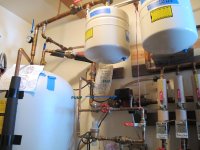
The heat source is nothing more than an electric 50 gallon Hot Water Heater filled with half water/half propylene glycol. I chose a Marathon brand because they have a fiberglass/epoxy body and won't rust.

This type of heat is simple and cheap initially, but does cost electricity. It wouldn't be reasonable longterm where electrical costs are high because an electric HWH doesn't put out many BTUs compared to a natural gas or propane boiler. It is a darn good way to get up and operating though....

So although these hydronic floors we built would be up to the task if they were carrying warmer water, the HWH itself just won't keep up. An on-demand type hot water heater run off nat gas or propane would probably be a good compromise between what I have and a real boiler like the Munchkins.

Remember, we built using the cash we made as we built. Didn't want a loan or debt. So we built with alternatives.... the HWH was cheap to install, but I also plumbed in some extra fittings fluid fittings, along with a propane line (capped) and a outside vent all into the utility room so we can put a real boiler in there any time we want. It would only take an afternoon. So far, this works OK.

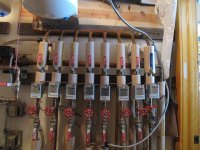
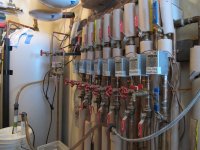
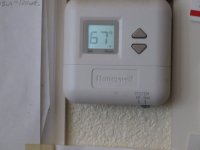
Yes, there are 8 zones in the house - all come off of the central manifold you see in the first photo. The zones are balanced for resistance by making each zone have the same length of heating pipe buried in the cement . The main room of each zone has a simple thermostat placed on the wall of the main room in that zone. Each thermostat then controls its own electrically-operated on/off flow valves which you can also see in the photo of the zone manifold. And since I like to tinker, each valve also has a manual over-ride so I can take any zone out of the system without affecting the rest.

Each thermostat can call for flow or not - or I can override it. Note that the zone manifold itself is simply made of plumbing fittings soldered together. Making up the manifold one weekend saved a few grand right there.
The pump for the whole system runs continuously any time any thermostat is calling for heat....it seems completely sufficient - which surprised me since doesn't run any faster or slower if all eight zones want heat at the same time. I've included a photo showing the pump. It is very small and quiet.

Any hydronic system is slow to change temperature and this one even more so. There's a lot of mass and not many BTUs. There's advantages to that. And one of those advantages to a low heat hydronic is that the floor and walls and room air are all about the same heat give or take a degree or two. So a simple cheap wall thermostat works fine for temperature control.

HOW DOES IT WORK??
Today it is about 20F outside and the system easily keeps the house at 67F with the HWH running all the time and creating hotwater/glycol that I control to be 110F . But that's about its limit. If it drops to zero tonight, the house will drop into the low 60s inside. And no matter how warm the winter day - say it is is 60F outside, this system will only push the room heat up to somewhere in the high 70s.

I do have two areas in the house (center of living room and kitchen) where I poured the concrete floor an inch lower so I could install a thin hardwood floor with the heat pipes directly beneath the wood. That was to be my "fast reacting" hydronic heat. But after all that effort, it is not noticibly any faster or slower thatn the rest of the floor. Looks nice, though...

This one was a winner, and hats off to the old plumber "Bertie" who helped me lay out the piping and find the best buys on material. He didn't believe that a HWH would work, but was willing to try as long as I also plumbed to accessory inputs "just in case". And I'll admit is part of the reason a HWH works as well as it does is because the house if built very heavy and well insulated as is typical in a cold climate. So far it has run for 15 years without any maintenance at all of any kind. In the winter my $150 monthly electrical bill can climb up to the $450 to 500 dollar/month range if I use the floor for all the house heat. Maybe half that much if I run the wood stove in the living room. It pretty much heats 2/3 of the house all by itself.

Bottom line is some things you try work and some don't.... But this system is excellent. I'd do it exactly the same way again.
rScotty
 

Attachments

  • Zones.JPG
    Zones.JPG
    548.6 KB · Views: 169
  • HWH & Zone Control.JPG
    HWH & Zone Control.JPG
    527.3 KB · Views: 128
  • Showing pump.JPG
    Showing pump.JPG
    451.2 KB · Views: 144
  • Thermostat.JPG
    Thermostat.JPG
    361.5 KB · Views: 138
  • 1a House.JPG
    1a House.JPG
    436.2 KB · Views: 151
  • 2016_c.JPG
    2016_c.JPG
    1.3 MB · Views: 141
   / Shouse Build #53  
Oh wow.

First, I apologize for wandering off the topic of this thread.

Second, rscotty your hydronic floor heat system is extremely inefficient. I validate that statement based on your comment that it's 20F outside and your system will keep the house at 67F if it runs all the time.

I don't want to distract from this thread anymore than I already have. Again, I apologize to the OP.

rscotty, come over to my thread regarding my house build and we'll discuss your floor heat system at length if you wish.

https://www.tractorbynet.com/forums/projects/404870-new-house-build.html?highlight=
 
   / Shouse Build #54  
Oh wow.

First, I apologize for wandering off the topic of this thread.

Second, rscotty your hydronic floor heat system is extremely inefficient. I validate that statement based on your comment that it's 20F outside and your system will keep the house at 67F if it runs all the time.

I don't want to distract from this thread anymore than I already have. Again, I apologize to the OP.

rscotty, come over to my thread regarding my house build and we'll discuss your floor heat system at length if you wish.

https://www.tractorbynet.com/forums/projects/404870-new-house-build.html?highlight=

I didn't think it was off topic to talk about how to build an owner-built house, but I'll stop posting on floors and let it get back to the OP. And will join you at the other thread.

But first I need to clear up a common misconception about efficiency.

No, the system I described is not inefficient at all. Just the opposite, In fact. It is very efficient at turning electricity into heat and then conserving that heat. It just isn't very powerful. Power and efficiency are completely different ways of measuring things.

Remember, the goal was to make an inexpensive & efficient system that would require no maintenance & provide a baseline temperature when we weren't at home for months. It does that. Yes, It would be easy to to make it more powerful by inputting more BTUs, but then efficiency would suffer. It is not designed to heat the house, only to provide a base temperature to the house if I'm not there for long periods.

It is so efficient that it actually does better than we expected, but that wasn't the goal. The bonus is as much due to building shape. sealing, double wall construction, and over-insulation than simply to the hydronics.
rScotty
 

Tractor & Equipment Auctions

240156 (A56859)
240156 (A56859)
2013 Nissan Juke SUV (A59231)
2013 Nissan Juke...
Informational Lot - Financing (A56438)
Informational Lot...
2016 DRAGON SAND CONVEYOR (A58216)
2016 DRAGON SAND...
1992 Talbert 70 Ton Lowboy Trailer with Removable Gooseneck (A56438)
1992 Talbert 70...
2013 Ford Explorer SUV (A59231)
2013 Ford Explorer...
 
Top