Should I put in my driveway myself?

   / Should I put in my driveway myself? #1  

geobar

Member
Joined
Jul 31, 2006
Messages
41
I need to put in a new driveway to a new house that will soon be going up. The first 300 feet is an existing solid driveway, but I will need to go another 1000 feet to the new location. Three years ago, I used my 2wd Case 580 TLB with 7/8 yard front bucket along with my compact 28 hp 4wd tractor/loader with a 6 ft rear blade to spread and level 220 tons of modified for the site of a new barn. They worked great for this purpose, but I am wondering if the driveway is too big a project for this equipment or if a dozer will be required. How much money can I expect to save by doing it myself, or should I just let someone with the right equipment do it right off the bat.

I am told that the grass and other organic matter will have to be scraped off the driveway path. The route is dry with only a slight grade. If I scrape with the TLB, would downhill be much preferential to uphill? The pitch of the tractor backblade can be changed to slightly dig as it is pulled, and of course, it can be angled to the side. Weights are easily added as well. Would just running this back and forth accomplish anything? I kind of like this idea better then the TLB if it will work.

If anyone has experience using this equipment to do this type of work, your input and suggestions would be appreciated. How much top soil should be scraped off? Thanks.
 
   / Should I put in my driveway myself? #2  
I built our driveway which is about 700 feet long and 13 feet wide. There is also a wide area in the back that is about 26 feet wide so maybe a total of 900-1000x13 feet. It was built with the JD4700 which is a 48 HP tractor. Did it with the 4n1 bucket and the boxblade.

My soil is rock and clay. Some places more rock than clay. part of the drive is through woods. The mistake I made was trying to get all of the rocks and roots out of the way. Not really possible and all I did was make a 13 foot wide shallow ditch that had to be filled up with ABC gravel. I only made that mistake for a few hundred feet of the drive.

I use geotextile fabric and most of the drive only has 3-4 inches of ABC. I need to put down more since it would raise the drive enough to help keep water off. You can see the fabric here and there where there was a rock or root. It would be nice to cover it up. :D

The drive way handled hundreds of tons of gravel deliveries, cement trucks, logging trucks and construction traffic just fine. That is a because of the fabric.

The big question for you is do you have to remove the topsoil. And that I can't answer.

I don't see why you cant do the drive with your equipment. I certainly would do it and save the money. The last section I did was done in less than a day.

Later,
Dan
 
   / Should I put in my driveway myself?
  • Thread Starter
#3  
Thanks for your reply, Dan. I was told that unless the organic matter within the top so many inches were removed, then soft, spongy, eventually muddy areas would develop in the driveway and I would be sorry for not doing it right the first time. That to do the job right, 4 to 6 inches should be removed, replaced with stone, then topped with modified (sometimes called quarry run?). Since 4-6 inches 12 feet wide over 1000 feet is a lot of material, I wonder if my equipment is too feeble or it will just take too long to do, or not worth the wear and tear on the machines, or not be able to do the job properly (nicely pitched, level surface).
 
   / Should I put in my driveway myself? #4  
I need to put in a new driveway to a new house that will soon be going up. The first 300 feet is an existing solid driveway, but I will need to go another 1000 feet to the new location. Three years ago, I used my 2wd Case 580 TLB with 7/8 yard front bucket along with my compact 28 hp 4wd tractor/loader with a 6 ft rear blade to spread and level 220 tons of modified for the site of a new barn. They worked great for this purpose, but I am wondering if the driveway is too big a project for this equipment or if a dozer will be required. How much money can I expect to save by doing it myself, or should I just let someone with the right equipment do it right off the bat.

I am told that the grass and other organic matter will have to be scraped off the driveway path. The route is dry with only a slight grade. If I scrape with the TLB, would downhill be much preferential to uphill? The pitch of the tractor backblade can be changed to slightly dig as it is pulled, and of course, it can be angled to the side. Weights are easily added as well. Would just running this back and forth accomplish anything? I kind of like this idea better then the TLB if it will work.

If anyone has experience using this equipment to do this type of work, your input and suggestions would be appreciated. How much top soil should be scraped off? Thanks.


My driveway is 20ft wide x 330 ft long. Roadbed is Tehama Co roadbase (IIRC 3/4" crusher run). The contractor used a JD 210 LE TLB with a big Gannon box to do the excavation. About 6" of soil was removed.

DSCF0003Small-1.jpg


The roadbase was laid in 2" lifts.

DSCF0031Small.jpg


Mike, the ace TLB operator, dropped the Gannon box and picked up a float to spread the roadbase.

DSCF0047Small-1.jpg


The lifts were sprayed with water

DSCF0022Small-1.jpg


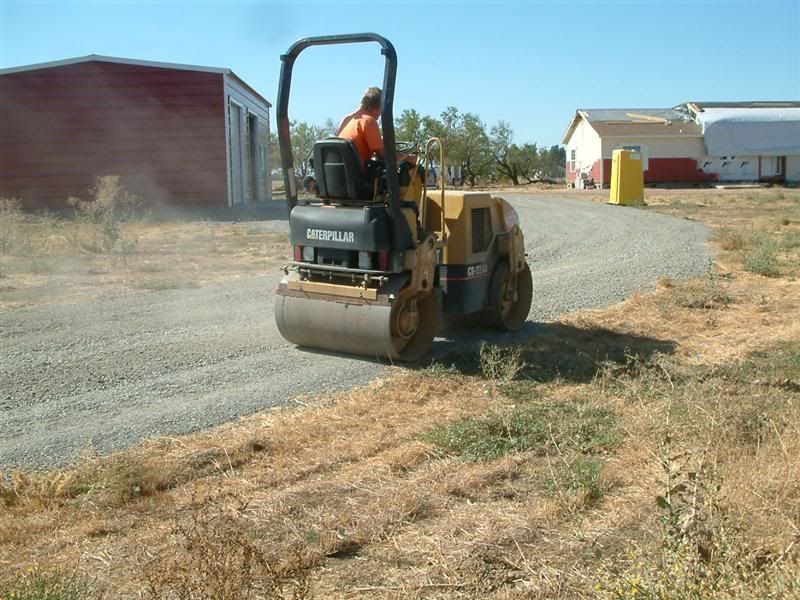
and then compacted with a vibrating roller

DSCF0083Medium.jpg


It's been 3.5 years since the driveway was installed. No ruts, Zero maintenance.
Cost about $7K to do the job right.
 
   / Should I put in my driveway myself? #5  
An easy and overlooked way to dig a drive, is to run a moldboard plow along the path, at the depth you want, and simply scoop out the dirt with a loader. I have found it to be cheap, fast and easy.

What ever you do make sure you use the fabric, under the stone.
 
   / Should I put in my driveway myself? #6  
An easy and overlooked way to dig a drive, is to run a moldboard plow along the path, at the depth you want, and simply scoop out the dirt with a loader. I have found it to be cheap, fast and easy.
I used a rototiller. It works very well for this also.
 
   / Should I put in my driveway myself? #7  
I would scrape the topsoil - 4" to 6" deep and put down the stone. We put in our driveway (about 1300') and put on about 6" of creek rock. We drove on it for a few years while building the house (along with delivery trucks, concrete trucks, and heavy equipment). After we moved in, we put a few loads of dense grade on it. It still needs a few more loads to smooth it out, but it's solid enough, and right now I'm too poor to buy more rock.
 
   / Should I put in my driveway myself? #8  
You should remove all of the topsoil before placing fabric and/or gravel. Your right about the organic mater creating soft spots and mudholes.

If I were you I would definately do this myself with the 580. If the ground is to compacted to do with the loader, I'd spend the time stripping the topsoil and removing any boulders with the backhoe. It might take more time, but would come out nice. Then compact, rol out some fabric, spread gravel over it, grade and finally compact.
 
   / Should I put in my driveway myself? #9  
Thanks for your reply, Dan. I was told that unless the organic matter within the top so many inches were removed, then soft, spongy, eventually muddy areas would develop in the driveway and I would be sorry for not doing it right the first time. That to do the job right, 4 to 6 inches should be removed, replaced with stone, then topped with modified (sometimes called quarry run?). Since 4-6 inches 12 feet wide over 1000 feet is a lot of material, I wonder if my equipment is too feeble or it will just take too long to do, or not worth the wear and tear on the machines, or not be able to do the job properly (nicely pitched, level surface).

If you have a TLB I think you have enough equipment. Even the smaller tractor you mentioned should be able to do the work it just might take longer. Moving gravel is not hard on a tractor. The dump truck and back up and slowly dump the gravel so you don't have to move as much material with the tractor.

Since I use fabric I have them just dump in one spot and then use the tractor to move the gravel. Its a bit more work but it keeps the fabric from moving with my soil conditions. I have seen crews building roads driving the dump truck on the fabric with no problems but they have nice smooth compacted soil with not rocks and roots.

In NC I use what is called ABC gravel. Its a mixture of rock from fine dust to maybe 2 inches. The dust is very important since it locks the bigger gravel togather. Its almost concrete when its been compacted and dried a bit. I compact the gravel by traffic. Nothing special. ABC is what is used here as the road base before concrete or asphalt is laid down.

I simply don't know about your local soil conditions to know if you should removed the organic material. If it would be good material for a garden or to put in the yard it might need to be moved. But it will cost that much more to fill the trench with material for the drive.

Later,
Dan
 
   / Should I put in my driveway myself?
  • Thread Starter
#10  
Thanks for all the help, I think that I may try it myself. It is amazing how many names there are for the dust to stone stuff that comes from the quarry, as you hear from around the country. One last question -- what type of outlet or source will I find the driveway fabric?
 
   / Should I put in my driveway myself? #11  
... I was told that unless the organic matter within the top so many inches were removed, then soft, spongy, eventually muddy areas would develop in the driveway and I would be sorry for not doing it right the first time. That to do the job right, 4 to 6 inches should be removed, replaced with stone, then topped with modified (sometimes called quarry run?). Since 4-6 inches 12 feet wide over 1000 feet is a lot of material, I wonder if my equipment is too feeble or it will just take too long to do, or not worth the wear and tear on the machines, or not be able to do the job properly (nicely pitched, level surface).


First it's important to know where you are located. A road that freezes isn't built the same as one that never sees any snow. It's also important to know what type of soil you have where you are building the road.

Grass cut short is fine if you have a solid soil like clay, sand or gravel that it's growing in. For those conditions, you don't have to do anything to the soil, and in allot of instances, you can cause more problems by removing dirt and then replacing it with gravel. The reason is that you want the gravel to create a solid survace when it becomes compacted. If it's not high enough over the existing land, then water will pool into the rock and underneith it. This is the biggest cause of failure on all roads, except for those that are not thick enough to start with.

If you have a loam type soil, then you have to remove it. There might be a rule of thumb on how deep you have to go, but I know of those who have taken out over a foot of it and where going to take out more. Some places have very deep top soil. The Pacific Northwest is famous for this. If you have to take out feet of soil, then it's allot cheaper to replace that soil with clean fill soil. Rock is more expensive then good fill dirt. I added a thousand yards of clay to my driveway to build it up for an even crown and to replace a swampy, wet area that rarely dried out.

Why are you making it12 feet wide? That's nice for cities and highways, but for a driveway, ten feet is plenty and you can get away with 8 feet if it's just your own personal vehicles. Of course, some areas reaqure a certain width for emergancy vehicles, so that would be the final call on how wide it has to be. But like you mentioned, 12 feet wide for a thousand feet is allot of material to have to buy. Cut it down to ten feet and you save 1/6th of the expense.

For the road to last, you have to have a way for the water to get away from it as quickly as possble. Trenches are the most common method for this. Wide and shallow are the most attractive, but sometimes you have to work with the space you have available. Standing water will always be an issue, so be sure to address that before anything else. Drainage, drainage, drainage is the three secretes to a good road. The rest is pretty basic, but you HAVE to get rid of the water.

Be sure you have at least 4 inches of rock. The rock has allot of differnt names all over the country, but it all does the same thing. It should be in size from very fine, almost dust like to rocks several inches in diameter. The rock has to have sharp, jagged edges so that when compacted, it wil all interlock and form a solid mass. At 4 inches, this will be strong enough to support any size load that you will drive across it and also shed water when it rains.

Never drag a finished road to smooth it out. All this does is thin it down and break up the compaction, which will speed up the process of failure. If done right, you should have to add rock to it about every five years, depending on traffic usage. When adding rock, it's a good idea to break up the existing rock so it will all compact again into one solid mass. When a road develops potholes or low areas, then add new rock to that area. NEVER drag existing rock from the road to fill a low area. That just makes the area you draged the rock from weaker. When adding rock to a pothole or low area, break up the existing rock so that it will bind with the new rock and then compact it.

Your tires will compact the rock over time. If you are paving it or expecting sever weather right away, you should roll the rock or at least run a vibritary compactor over it. If you have good weather and are not paving it, then just driving over it with your auto or tractor a bunch of times will get it done. I like to put a load of dirt in my loader bucket and drive over the area I'm compacting with my front tires. This works great on gravel patches and holes that I'm filling on things like stumps that I've removed.

A dozer is not the best tool for spreading gravel. In fact, it's near the bottom of the list for this. The best tool would be a grader. Most of the gravel guys around here also have a grader for this. If you want it smooth and level, that's the tool for the job.

The use of fabric seems to be popular in the norther parts of the country, but here, the only time I've seen it used is on wet conditions when speed is more important then money. On a solid base, gravel will not sink into the dirt. It will float over it and form a solid mass.

Good Luck,
Eddie
 
   / Should I put in my driveway myself? #12  
Some stone suppliers sell it. You can also get it from landscape suppliers, and paving brick suppliers.

There are different grades. Obviously, the heavier the better. In my experience the woven seems to be the strongest. All seem to work. If you can, compare they different types available to you. There are web sites that also explain the differences in Geo-tex.

Last time I bought it, (about 3 years ago), I paid $2/ linear foot. Worth every penny, the fabric will pay for its self many times over.

A few strategically placed roofing shingles facing up, work well to keep the wind from blowing the fabric away during installation, if necessary.

I use a guy with a single axle dump, and have him tailgate the stone right out over the fabric in 2-3" layers. Moisten the stone and compact, (drive on it if that is all you got). Repeat.
 
   / Should I put in my driveway myself? #13  
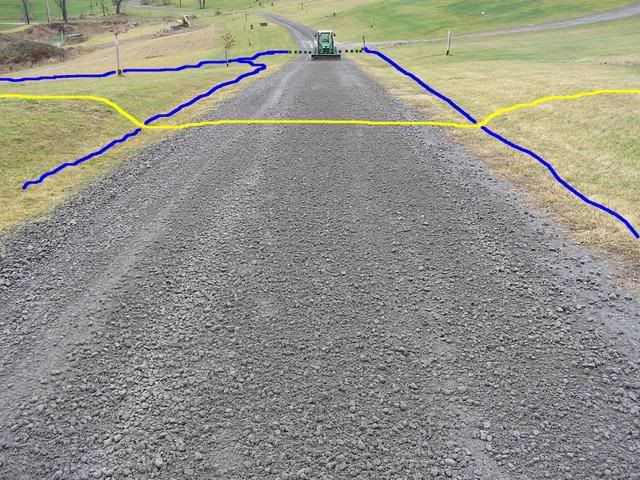
Build,grade and put in proper drainage so your road will stay dry and it will save you thousands of dollars in the future. You won't have to add stone every year like a lot of people do.

Here's a pic of a properly constructed road showing the profile contours and drainage.

gradingroad4thpass.jpg
 
   / Should I put in my driveway myself?
  • Thread Starter
#14  
Thank you to everyone for their input. I am going to give it a try. I will put extra weight on the back-blade of the 4wd tractor and run up and down each side with the blade angled to put material in the center which I will scoop up with the front bucket of the TLB. With the suggestions that I received here, I am going to put down the driveway fabric. After doing an internet search, I found U.S. Fabrics has a local dealer that sells rolls 432 feet long by 12.5 feet wide for $450. I called the manufacturer who recommended the appropriate product for my conditions and that I remove 3-4 inches of top soil, lay down the fabric, and top with 6-8 inches of modified (quarry run). Three rolls will do the drive plus the pad in front of the garage with some left over for landscaping.
 
   / Should I put in my driveway myself? #15  
I was never big on fabric, although I guess it has its applications. I always felt if your subgrade and drainage was done properly the money for fabric was better off spent on more stone. Sounds like you are off to a good start and 6 to 8 inches of stone will make you a good road. A lot of people spend the money of fabric and then skimp on the stone and the road just does not hold up. Spend extra time getting the subgrade and drainage right and you will have a road the will need minimun maintenance and save money in the long run.
Just remember "keep it dry" You can build a road out of good material,but if it gets wet your good material will be bad. Same applies to bad material (wet) you can make it good by drying it out. It all comes down to moisture.
Sincerely, Dirt
 

Tractor & Equipment Auctions

ELECTRIC GOLF CART (A58214)
ELECTRIC GOLF CART...
2019 KENWORTH T680 TANDEM AXLE SLEEPER (A59905)
2019 KENWORTH T680...
2016 FORD TRANSIT T250 CARGO VAN (A59575)
2016 FORD TRANSIT...
2015 Freightliner Cascadia 125 T/A Day Cab Truck Tractor (A59230)
2015 Freightliner...
New Holland 3930 (A60462)
New Holland 3930...
2013 BMW X5 AWD SUV (A59231)
2013 BMW X5 AWD...
 
Top