Scary

/ Scary #1  

Anonymous Poster

Epic Contributor
Joined
Sep 27, 2005
Messages
29,678
Ok Guys, Here it comes.

I picked up my 1610 yesterday afternoon and brought it home on the loaner trailer from my dealer (Scott Lazenby, North Florida, Starke area)

What I know or knew about tractors was strictly what I found from reading this site. I asked questions of the Mechanic (D.J.) who was working because Scott was not available. (he was working on the back forty on his dozer) D.J. was surprised I had so few questions because he said many newbie owners arrived with written lists. Anyway, I asked what I thought was pertinent and he gave me answers for my questions.

When I arrived home, I decided to drive the tractor around just to familiarize myself with its operation. My new 5' finish mower was attatched to the back. (404#)

My property has an area with a incline of about 25% that runs uphill/downhill over about 150'. Anyway I decided to drive up the hill toward my house just to see how it would perform. I raised the mower with the 3 point and started uphill. SUDDENLY, I noticed I was going sideways and turned the steering wheel to the right to straighten up. NO EFFECT!! I looked down at the front wheels and saw they were both about 1 foot off the ground. I think something warm began to trickle down my leg as I stabbed the clutch.

The front of the tractor dropped with a thud. and I sat back down in the seat and my young life (?) flashed in front of my eyes.

I lowered the 3 point and dropped the range down to 1 and the power shift down into 1 and slowy crept up the rest of the incline.

I drove slowly back to my shed and stopped the tractor and contemplated what I had just learned.

NEVER DRIVE UP A STEEP INCLINE WITH AN IMPLIMENT ATTATCHED AND RAISED ON THE 3 POINT HITCH.

I went back to see Scott Lazenby this afternoon and he gave me a few pointers and I also bought three suitcase weights for the front end.

I hope this is the first and last time I have to contemplate the possible dangers of operating a "real" tractor without proper knowledge but Who knows? I survived and hope no one saw me when it happened.

Gary
 
/ Scary #2  
Now we could have told you to keep the implement on the ground, and if the hill's too steep, turn around and back up it, however, experience is always the best teacher if you survive the experience./w3tcompact/icons/laugh.gif You might forget what you're told, but I'll bet you never forget the experience./w3tcompact/icons/wink.gif And I'll bet nearly all, if not all, of us have had some similar experiences. Of course, my own worst scares were learning to use a FEL./w3tcompact/icons/frown.gif
 
/ Scary #3  
That warm feeling progressing down your pant leg is something you and I will never forget..../w3tcompact/icons/grin.gif
 
/ Scary
  • Thread Starter
#4  
Although I haven't done anything really stupid on my tractor yet (leaving the brake on doesn't count), I do remember when I got that feeling when I realized on approach in my airplane the ILS needle was stuck--the needle that tells you how high you are on approach to the airport). Fortunately the needle was stuck up so I was way high. For a moment there I was sure I was in real trouble and might die from something really stupid.
 
/ Scary #5  
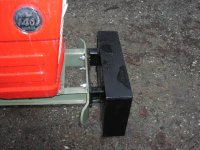
Gary, thanks for the post. It is amazing how unstable a tractor can be if not ballasted properly. On smaller tractors that we sell without loaders we always hang weight on the front. Not having a good source of suitcase weights, we make ours out of plate. We have a local pipe making shop that has tons of 1/2" to 3/4" plate for .06 per pound. We cut up a bunch of squares with the plasma cutter, about 16" by 10" and weld them together, then we weld a piece of 3/8" x 4" flat bar around the edges to make it look nice. It bolts onto the bumber and weighs about 200lbs.

Steel weighs about 500lbs per cubic foot, conrete is just over 100lbs for the same volume, so steel weights are the way to go.

Here is a picture of our shop built weight.
 

Attachments

  • 49-218703-P1010002.jpg
    49-218703-P1010002.jpg
    68.9 KB · Views: 205
/ Scary #6  
Thanks Dave for a wonderful suggestion on how we can keep our "feet" on the ground cheap. I was thinking how I coud do that with my little Shibaura and here you are giving me the answer. What a wonderful site and unselfish people!!

jesse
 
/ Scary
  • Thread Starter
#7  
Well, I now have three suitcase weights hung on the front of my tractor that ,I think, weigh about 44 # each. I have been back up my hill with the new weights in place (but with the mower lowered) with no problem what so ever.

I just received the manuals I ordered from Leonard Shaffer today and notice in the front, in the safety sction, there is a drawn picture of me going up the hill with the mower elevated and the front wheels in the air as well. the drawn operator (me) is shown with sweat popping off his brow. Believe me I can really relate to that picture.

I also discovered yesterday that I have no brakes on the left side. The left pedal goes down to the floor with no resistance, hence no brakes on that side. I am not sure, but I don't think that was in effect when I first got the tractor home.

I called my dealer and left word of my problem but I will be out of town over the holidays and his shop is closed all of next week. I guess I won't know what is wrong untill the week after Christmas

If I understand correctly, the brakes are strictly mechanical with no brake fluid, master cylinder etc. Is this correct?

It appears to me that the rear wheel has to be removed to get to the brakes. I am not sure what the possibilities are for this problem.

I have another question as well. The manual I received(YM226) says the hour meter only operates for time when engine rpms are at or above 2600 rpm. Is this true? Is it possible the previous operator/owner could run his tractor at, say 2300 rpm for 1000 hours without it showing on the meter???

Gary
 
/ Scary
  • Thread Starter
#8  
If you leave the parking brake on when you drive the left brake wears out.
 
/ Scary #9  
No that is not correct about the meter, It has to be around 2400 rpms to be right, other wise it does not tell you the true hours, and the left brake not working is just probably adjustment. You notice the left brake is where it locks on to hold the tractor when you want it to be a set brake. Or you can lock them both together to hold both sides. Well, some people lock the left one only, and forget its on, and operate the tractor. So the left one will need adjusted then. It's not that hard to do, but not sure how on your tractor, one of the guys that has one like it or a dealer can tell you. But no you don't have to pull the real wheel.
 
/ Scary
  • Thread Starter
#10  
The only adjustment I see in the manual is turning a turnbuckle underneath the tractor for adjustment on the pedal travel. Is this what needs to be done? I would like nothing better than to not have to take my tractor back to the dealer for repair on the brakes. I have not had the opportunity to get under the tractor myself to see. Today was spent Christmas shopping with the wife. I certainly hope you are correct about not having to remove the rear wheel to work on the brakes.

I certainly am capable of running the tractor with the brakes locked but I have only run the tractor about 30 minutes total running time to this point. I doubt I have worn out the left side brakes in that time. I dont even think I have run it with the parking brake lock on. It would seem that it would at least pull to the left if I had done so.

The part in the manual about the hour meter seems to only say that time run below 2600 rpm is not accurate. Whats up with that? It only shows 45 minutes per hour if run at 2000 rpm????

Gary
 
/ Scary #11  
That adjustment, should do it. All I know is try it first, and see. If its not that then it will involve more work so you should try the turnbuckle first. And I couldn't tell you the percent for the RPMs and meter, but you have the right idea.
 
/ Scary #12  
If one pedal goes to the floor when depressed, something is probably unhooked. The dealer probably never had reason to unlatch the 2 pedals and never knew it, which you probably wouldn't either with the pedals latched together. You are correct about the hour meter. If it records 1 hour at 2600rpm, it will record 1/2 hour at 1300rpm. The important thing is how many revolutions the engine has turned, not how many hours it has run.
 
/ Scary #13  
<font color=blue>have another question as well. The manual I received(YM226) says the hour meter only operates for time when engine rpms are at or above 2600 rpm.</font color=blue>

I thought the hour meter worked whenever the engine was running, regardless of RPM. I may be wrong.

Reminds me of the time I had an hour meter installed on my little GT235. The mechanic messed up, and hooked the meter to a lead that was always hot. I went out few days later, and was astounded that my tracter now had a few hundred extra hours on it! He apologized profusely, and correctly re-wired the meter. :)

I *think* my 4300 runs the hour meter whenever the engine is running.. but I might be wrong. I've never really checked that....

What would be the point of only registering hours run over a certain RPM? Especially such a high RPM? Some of us run at low RPM a lot of the time, and only bring it up to normal speed when the PTO is engaged. And my RPM for the PTO is, I think, less than 2600. So this meter would *never* register a single hour on my tractor if it were designed as you suggest. ???

Bob

Bob
 
/ Scary
  • Thread Starter
#14  
Engine wear is related to the number of turns of the engine or its easier to wire that way. Airplanes use the same type of hour meters for service, but you don't use that meter to decide how much gas you have left (timing by a clock is better, and a fuel flow meter is the best).
 
/ Scary #15  
Turnbuckle is the only adjustment. The manual says pedal travel should be between 1 to 2 inches max. If something is not disconnected/broken/excessively worn, then you should be able to adjust the pedal travel.
Jim
 
/ Scary #16  
I like mechanical hour meters. They tell you what you really want to know, namely how much wear is on the engine/tractor. 800 hours at PTO rpm (lets say 2400rpm) is about 115 million revolutions. 800 hours on an electrical meter may mean they key was left on for a month. I know, the battery would probably go dead first, etc, but you get the point. Our forklifts use Hobbs meters (electrical) and I guess that is why a tractor often needs a rebuild at around 5000 hours and a forklift will go 10-12K. Perhaps it is the same actual time? OK, I'll put my calculator away....
 
/ Scary #17  
2600rpm sounds high to me too, for PTO or engine speed. If I had a choice between buying a tractor cruising around the yard at 2500rpm's under no other load than drive train resistance, and a tractor run at 2000rpm under heavy, jarring loads such as tilling, I think I would take the cruiser;o) I think a cheap and meaningful way to operate an hour meter could be from a simple oil pressure switch. Then you would know it's only registering when the motor is actually turning. I guess the info from an hour meter is pretty vague, but sometimes it's all you have.
 
/ Scary
  • Thread Starter
#18  
Well, the brake adjustment did the trick. The only adjustment is a lengthening or a shortening of the actual linkage. There is a long threaded nut with threads running in opposite directions on each end. Mine was apparently submerged for years and thus was frozen tight. I had to remove the linkage from the tractor, soak the retaining nuts and turnbuckle nut in WD 40. I finally resorted to heating with a torch and it came free.
I shortened the linkage almost an inch and now I have brakes on both sides .

As far as the analog hourmeter, I quote from the manual:

"The needle of speed-hourmeter indicates engine revolutions per minute (rpm) whenever engine is running.

The meter reading below needle indicate the total hours the engine has been running at engine speed 2600 rpm. If engine is running at less than 2600 rpm, the meter indicates total running hours less than actual total running hours."

Gary
 
/ Scary #19  
<font color=blue>I *think* my 4300 runs the hour meter whenever the engine is running.. </font color=blue>

I'd take bets that it is, too. Of course, IF it has an electric hour meter, like my B7100 did, you could turn the key off, which turned off all the electrical power, and the engine would continue to run, but no time registered on the meter.
 
/ Scary #20  
Hi Bird,

<font color=blue>...IF it has an electric hour meter, like my B7100 did, you could turn the key off, which turned off all the electrical power, and the engine would continue to run...</font color=blue>

Turning off the key doesn't shut down your engine?? How did you shut the thing down? There is probably some advantage to this arrangement, but it escapes me. Under what circumstances would it be advantageous to be able to shut down all electrical power and leave the engine running?

BTW, the more I think about it, it must be an electrically operated hour meter ... it's an LCD display! /w3tcompact/icons/smile.gif

Bob
 

Marketplace Items

Sterling AT (A61307)
2014 VOLVO VNL (A60736)
2014 VOLVO VNL...
Bestway Ag 50 Gallon 12V UTV Skid Sprayer (A60463)
Bestway Ag 50...
Year: 2016 Make: Jeep Model: Renegade Vehicle Type: Multipurpose Vehicle (MPV) Mileage: 117,889 (A61569)
Year: 2016 Make...
(3) Good Year 480/80R38 Tires w/ Rims (A60463)
(3) Good Year...
2014 Ford Escape SE SUV (A61569)
2014 Ford Escape...
 
Top