Rons Grader

   / Rons Grader
  • Thread Starter
#21  
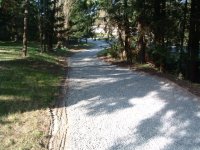
Here is the turnaround after. That is 3/4 crushed rock with fines. When driven on, it packs down real smooth. The grader did a pretty good job of blending the colums left by the dump truck and with the rear gate down, dragged the thicker spots to the thinner ones nicely.
 

Attachments

  • 874639-turn2.jpg
    874639-turn2.jpg
    83 KB · Views: 1,640
   / Rons Grader
  • Thread Starter
#22  
Here is a shot down the hill. I used around 22 CU/YD total but I think I will have another 2 yards or so delivered to do a matching walk and fill in one thin spot down near the road. I think it came out pretty well considering this project started as a pile of metal 2 weeks ago.
 

Attachments

  • 874640-drive1.jpg
    874640-drive1.jpg
    91.2 KB · Views: 1,513
   / Rons Grader #23  
That turned out really well, good job!

I was really surprised how well the dump drivers can lay down an even spread of gravel. I have about 300 feet of uphill driveway. The first truck went up the hill dropping his load, the second did it going downhill. When they were done, I didn't need to do a thing!
 
   / Rons Grader #24  
Ronmar so a grader like what you made would be good for in on a woods road with high points and low points to scrape it flat and fill in the dips. I have a old woods road that is settling in a lot of places with these dips and high points .So after the ground is scrapped and the low points are filled they settle and after a while and have to be filled again ?
 
   / Rons Grader #25  
Ron, that grader looks perfect! I am going to start collecting metal for one myself. Thanks for posting the pics.
 
   / Rons Grader #26  
Ronmar,
That grader is a beauty! The proof is in the work it does, and it looks like it does a great job.

Would it be too much to ask for an overhead picture of it so we can see the angle?
 
   / Rons Grader
  • Thread Starter
#27  
fiddler kelly said:
Ronmar so a grader like what you made would be good for in on a woods road with high points and low points to scrape it flat and fill in the dips. I have a old woods road that is settling in a lot of places with these dips and high points .So after the ground is scrapped and the low points are filled they settle and after a while and have to be filled again ?

Thanks guys.

Fiddler:
Well if the road is going to settle, it is going to do so regardless of what you do to it... This grader does do a pretty good job of moving the high spots to the low ones.

The only snag I really ran into using this thing on my property is that I am on the side of an old creek valley. It is a lot of sand and a LOT of round river rock. On the first couple of passes, the leading edge would bite enough to dislodge the rocks(softball sized?) then like large ballbearings, the flat bottom of the front blade would ride up and roll across them at times. Once they were out of the ground it was fine and they would collect in the box or in front of the blade. It was when they rolled out of their hole that there was a problem. This of course lift's the whole box and dumps it's contents. Once these big rocks were picked out of the ground, it worked well.

I put in 400' of 2" pipe from the irrigation ditch at the top of my place down toward the middle. When the pipe was in, I had a trench, with a semi packed mounds on either side from walking on the trench dirt as we placed the pipe. I dumped a bucket of dirt at one end to load up the grader, then backed the grader over it and started dragging with the rear gate down. This cut the packed dirt on either side and either put it in the trench or kept the grader full and the material in the bucket filled in the trench. 2 passes and it was done.

SkunkWerX: I will see about some overhead pics, I may have some in the pics folder.
 
   / Rons Grader #28  
The first time I've seen one of these graders is on this site. How does this grader compare to a box grader for maintaining a gravel road? What's good and what's not good about this kind of grader if you don't mind sharing your experience?
 
   / Rons Grader
  • Thread Starter
#29  
2manyrocks said:
The first time I've seen one of these graders is on this site. How does this grader compare to a box grader for maintaining a gravel road? What's good and what's not good about this kind of grader if you don't mind sharing your experience?

These have been around for a while, "Duragrader" and "Bad Boy" immediately come to mind as manufacturers(modeled mine loosely after the bad boy). there was one other I can recall, but can't think of the name just now. It used "V" blades, one spread the material outward and the second wider blade spread it back inward and evened it out. Someone posted a pic asking about it a few weeks ago on one of the forums.

I have never used a regular box for maintaining a gravel road so I may not be of much help:) But in my box experience, they don't shave as well with the single blade back at the rear. They are good, in conjunction with scarifier teeth, at breaking up soil, which is collected in the box for relocation, filling in low spots along the way. Because of the blade all the way at the back, a steady release of material in my opinion is also a little more difficult to control and adjust. But I also havn't tried to do too much of that with one either, just rip and relocate. I have read here of some having good results when adding gauge wheels to their box. This would seem to me to give very fine release control to a regular box blade.

With the blade up front, I look at it more like a hand planer or block plane. it's amount of cut is less, but can be very accurately controlled with the toplink. The cut material builds up, spreads out and rides up and over the first blade. In doing so, it breaks up and loosens the material. The same thing happens with the second blade and the end result is a smooth level re-distribution of the surface material. High spots get shaved, low spots get filled and scraped smooth. I added a fold down gate for mine as I saw a need to capture and relocate the shaved material at times like a traditional box.

When dragging or grooming gravel, the material spreads out across the blades and flows over evenly leaving a smooth surface. It blends a center hump into the ruts on my drive, but so does a chain harrow on this established gravel surface. One thing I did find interesting while cutting my circular drive thru grass was that the grass and dirt as it passed over the blades, broke up very nicely, leaving the soil and separating the grass and roots which tended to hang up on the top edge of the triangular blades or was left on top of the dragged area for easy collection with a rake.

It takes more passes to remove material with one like mine as apposed to a regular box. In my opinion, kind of like the difference between a belt sander(traditional box blade) and a finish sander?
 
   / Rons Grader #30  
Thank you. I think I understand now.

My impression then is that an adjustable rear blade would be suited for cleaning up a badly rutted road and ditches, the standard box blade would be suited for general leveling and moving more material on a flat surface but not ditches, and then a grader like yours would be used for fine grading of a flat surface.
 
   / Rons Grader #31  
Ron,

So, if I can paraphrase your words:

-A Box Scraper is more of a Cut N Fill tool, for doing COARSE work.
-A Grader is more of a levelling device, for doing more Precision work.

A Box Scraper can do some precision levelling of the Grader, but may take more input and time.
A Grader can do some of the coarser work of the Box Scraper, but may take more time and passes.

Is that a reasonable way to loosley describe it?
 
   / Rons Grader
  • Thread Starter
#32  
SkunkWerX said:
Ron,

So, if I can paraphrase your words:

-A Box Scraper is more of a Cut N Fill tool, for doing COARSE work.
-A Grader is more of a levelling device, for doing more Precision work.

A Box Scraper can do some precision levelling of the Grader, but may take more input and time.
A Grader can do some of the coarser work of the Box Scraper, but may take more time and passes.

Is that a reasonable way to loosley describe it?

Yes I would agree with that.
I attached a pic from above, at least of the front blade. The rear blade is a little hard to see under the crossmember and fold up gate and the back end is pushed into a berry bush behind my barn right now:) The very first pic I posted back in April 06 is a side view that shows the blades pretty well also. they are perpendicular to the line of travel, front edge of front blade is 3/4" lower than the side rails.

2manyrocks said:
Thank you. I think I understand now.

My impression then is that an adjustable rear blade would be suited for cleaning up a badly rutted road and ditches, the standard box blade would be suited for general leveling and moving more material on a flat surface but not ditches, and then a grader like yours would be used for fine grading of a flat surface.

I think a grader like mine would do pretty good on a rutted road, it did on the ruts in my lower drive... A rear blade might not, due to it's lack of weight which sometimes limits it's digging ability. I think blades are more suited for material that is already loose. Also controlling the amount of cut on a rear blade can be a problem since it has no sidewalls to ride on/lever against with the toplink. IMO, a rear blade as well as a landscape rake would be more controllable when fitted with gauge wheels to control the bite, just like a commercial road grader has the blade suspended between the front and rear wheels.

A box would do pretty good on shallow swale type ditches. The regular blade again would be limited by it's weight, but being able to angle the material up and out of the ditch could be an advantage for removing the material elsewhere. The tractor also has to run in the ditch, so tilt angle limits the depth. A grader like mine would also cut a ditch, it would just be slower at it than a box, particularly if you could lower the scarifier teeth on just the ditch side of the box. I have seen some pretty functional swales cut with a box scraper by tilting the 3PH arms/box. The spoils most likley would need to be scooped out with a loader though each time the box got full. In cleaning out an existing ditch, a rear blade that could offset to one side AND angle to draw the material up on to the roadway would be excellent.
 

Attachments

  • DSCF0047.JPG
    DSCF0047.JPG
    306.5 KB · Views: 1,064
   / Rons Grader #33  
Ron, thanks.

I see some people build theirs with blades perpendicular, others, like the commercial ones have the angle.

Ron, here is a hypothetical question, if you built another one.....
Would you stick with your basic design, or make the blades angled?
Anything else you would do, based on your current one's performance?

I have an asphalt driveway, so I would be doing more landscaping, yard and dirt levelling.
 
   / Rons Grader
  • Thread Starter
#34  
I would add more weight in the form of taller sidewalls. I also think it might work better with slightly narrower side skids(less than 1"). These 1 1/2" sides sometimes ride up on the rocks that get broke free. A narrower skid might work it's way down in amongst the rocks better. I used the box tube because it was cheap and available. I might also move the front blade back a few inches. I would occasionally, while ripping out the grass, fill the front area with the lighter grass clumps and dirt'rootwads and spill a little out the sides and under the skids. This dosn't happen with just dirt or rocks.

I don't see any reason to angle the blades.
 
   / Rons Grader #35  
RonMar said:
I would add more weight in the form of taller sidewalls. I also think it might work better with slightly narrower side skids(less than 1"). These 1 1/2" sides sometimes ride up on the rocks that get broke free. A narrower skid might work it's way down in amongst the rocks better. I used the box tube because it was cheap and available. I might also move the front blade back a few inches. I would occasionally, while ripping out the grass, fill the front area with the lighter grass clumps and dirt'rootwads and spill a little out the sides and under the skids. This dosn't happen with just dirt or rocks.

I don't see any reason to angle the blades.

Sounds like wise words of wisdom, especially the part about angling the blades, it will be much easier to build them perpendicular to the sides, that is for sure.

I was thinking about adding a weight tray for stacking weights , centered over the center support cross bar, for mine, which will be overall a smaller unit, to match my 23HP tractor.

Thanks again!
 
   / Rons Grader #36  
Since I already have a box blade, now you've got me thinking about adding gauge wheels instead of building a whole new grader. But before going there, I've got this question I'll toss out.

I'm wondering if anybody pulls a grader like yours someway off the drawbar and uses the 3 pt lift to adjust the cutting angle instead of using a separate cylinder? I guess one could attach the grader to the tractor in a two point fashion someway and put gauge wheels on the back of the grader so the 3 pt lift could be used to adjust the cutting angle.
 
   / Rons Grader #37  
2manyrocks said:
Since I already have a box blade, now you've got me thinking about adding gauge wheels instead of building a whole new grader. But before going there, I've got this question I'll toss out.

I'm wondering if anybody pulls a grader like yours someway off the drawbar and uses the 3 pt lift to adjust the cutting angle instead of using a separate cylinder? I guess one could attach the grader to the tractor in a two point fashion someway and put gauge wheels on the back of the grader so the 3 pt lift could be used to adjust the cutting angle.
I'm sure that is very possible to do in both scenarios. However, depending on the attachment, using the gage wheels to adjust might not give as much angular difference as using the toplink, IMHO.
 
   / Rons Grader #38  
I think it could be towed with the 2 lower points if it also has adjustable gauge wheels.

Angle adjustment could be made, but would require adjusting the wheels each time, because as you lift/lower the 2 lower Links, you are also raising/lower the grader. In other words, as you change the angle, you would also be affecting th cutting height, which would then need counter-adjustment using the wheels to keep the grader "on plane".

However, with that said, these two-bladed graders wouldn't have a very wide angle-adjustment range, as you would begin defeating it's design.
-Angle it for Nose Down would begin lifting rear blade from surface.
-Angle it for Nose Up would be lifting the front blade.

From what I have been reading, the graders are mostly designed to run flat and level to the surface, so that both grading edges are in contact.
 
   / Rons Grader #39  
Yes, that makes sense.

I read elsewhere that the curvature of a road grader blade helps remix the larger material with the fines.http://www.dirtandgravelroads.org/

Is the two flat blade design of graders like Ronmar's intended to accomplish the same thing as a curved blade on a road grader?

Looks like hydraulic adjustments for tilt, depth and angle would be what we'd all want if we could afford them.
 
   / Rons Grader #40  
2manyrocks said:
I'm wondering if anybody pulls a grader like yours someway off the drawbar and uses the 3 pt lift to adjust the cutting angle instead of using a separate cylinder? I guess one could attach the grader to the tractor in a two point fashion someway and put gauge wheels on the back of the grader so the 3 pt lift could be used to adjust the cutting angle.

This setup will be a pain in the arse to keep level. as soon as the tractor wheel hits a pothole, the blade will agressively duck and make a transversed rut in your road.
 

Tractor & Equipment Auctions

Peterbilt Tandem Axle Road Tractor (A47477)
Peterbilt Tandem...
Sterling AT (A56438)
2014 Aerway Aerator (A55973)
2014 Aerway...
2006 Ford Explorer 4x4 SUV (A59231)
2006 Ford Explorer...
2015 New Holland T4.95 MFWD Cab Tractor (A55314)
2015 New Holland...
2024 CATERPILLAR 306CR EXCAVATOR (A60429)
2024 CATERPILLAR...
 
Top