Roller "Ol iron sides"

   / Roller "Ol iron sides" #1  

Chances R

Bronze Member
Joined
Dec 20, 2007
Messages
58
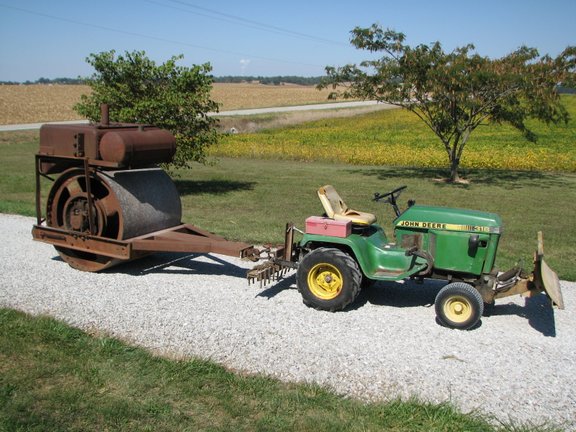
Nope I didnt build it, found it on ebay and i really liked the looks of it. Fits in well with the rest of my old rusty tractors.
IMG_1263.JPG

IMG_1266.JPG
 
   / Roller "Ol iron sides" #2  
dude that thing is HUGE!
 
   / Roller "Ol iron sides" #3  
I would take it too. Looks like everybody needs one:)
 
   / Roller "Ol iron sides" #4  
Love it!!:D

Hope you didn't have to pay shipping! :eek:

Sherweld
 
   / Roller "Ol iron sides" #5  
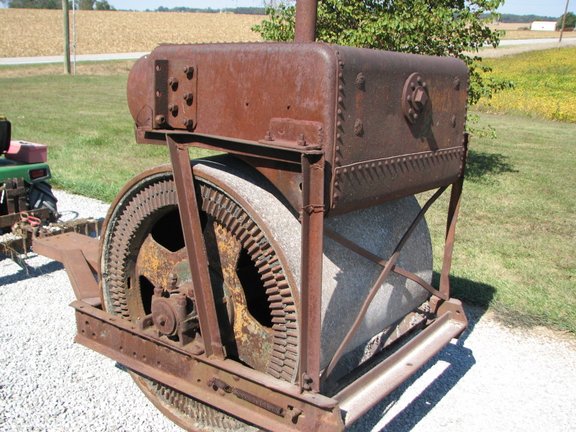
Ok was that thing built that way on purpose or is it just a mish-mash of parts to get the weight up?
Like if it was supposed to have two tanks on top, what were they for?
The support structure doesn't look like it was designed to hold those tanks up there if they were full.
Anyway it looks very cool. Sort of steam-punkish.
 
   / Roller "Ol iron sides" #7  
I like it! Do you know anything about its history? Any guess what it weights? How the heck did you get it home?

MarkV
 
   / Roller "Ol iron sides"
  • Thread Starter
#8  
Glad you guys like ol iron sides. I believe the one large tank on top was the origional weight tank mounted on the origional roller. I am not for sure were the little tank came from. I doubt that I ever fill them with water. It weights 3200 lbs. dry. I picked it up on a trip that I was going to pick up a old L Case tractor. The old L Case didnt end up being what it was suppose be so I left it behind. Total miles driven to get the roller 750. Yes that hurt.
 
   / Roller "Ol iron sides" #9  
the little tank might be a gas tank for a motor that powered the vibrator...

I have worked at a road construction company, they had two pull type rollers to compact road foundations. They had a 3 cylinder Deutz engine for the vibrator, and needed to be pulled by a medium farm tractor or wheel loader.
 
   / Roller "Ol iron sides" #10  
I'm thinking at least one of those tanks was to keep the roller wet to prevent sticking.
 
   / Roller "Ol iron sides" #11  
I'm thinking at least one of those tanks was to keep the roller wet to prevent sticking.

Agree with that.

Also it would appear that this roller was modified from the original. It looks like this was the "drive roller" from a former life as a street roller. The gear teeth around the rim makes me think of a bevel gear drive.

Also, one of the tanks may have been used for fuel in it's previous life, and the whole thing put together as now for a second go.

Kind of interesting to speculate on these things, eh? :D

Sherweld
 
   / Roller "Ol iron sides" #12  
You better hope that tractor is fast on any downhill grades!!:eek:
 
   / Roller "Ol iron sides"
  • Thread Starter
#13  
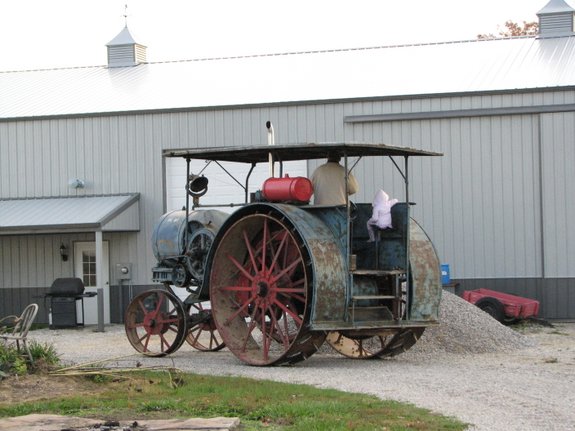
I was wondering when someone was going to notice the John Deere 318 pulling it. The ground was flat and it was not a problem pulling or stopping it. I would not want to go down any grade at all with it behind a lawn tractor. :eek: When it comes time maybe I can pull it behind the 1918 Aultman Taylor. I can compact 9 feet wide path then. :)
IMG_0712.JPG

Most of the time it will pulled behind a leveler which will be pulled by a John Deere 3020.
 
   / Roller "Ol iron sides" #14  
Wow, that looks like something Wyle Coyote gets run over with and flattened. :D No, really very cool!
 
   / Roller "Ol iron sides" #15  
Dude!! You've got some awesome stuff!! I'm soooo jealous!!
 
   / Roller "Ol iron sides" #17  
That drive drm and tank look like part of and old Buffalo Springfield Roller or my be and old Hyster with the bevel drive. We use old roller fron split rims to make landfill compactor wheels at work.
 
   / Roller "Ol iron sides" #18  
I don't know where you are Chances Are; but if you wander through Wray, Colorado, be sure to stop and look at the Rumely "oil pull" tractor they have in the city park on the main east-west drag through town. I think "oil pull" is the proper term.
 
   / Roller "Ol iron sides" #19  
I thought I would add this beast to the discussion.

Big Lizzie

Big Lizzie played an important part in the clearing of Red Cliffs and this is a brief outline of it's history. In early 1915 Frank Bottrill commenced construction of Big Lizzie to replace the camel trains which carried wool and other heavy loads in the sandy terrain. Fabrication and assembly of the huge prime mover and two trailers was carried out by Bottrill over a period of 12 months
Early in 1916 Big Lizzie left Richmond expecting to be in Broken Hill by early 1917. The route chosen was via Kilmore, Heathcote, Elmore and Echuca, where it was proposed to cross the Murray River. The first major problem occurred when the prime mover broke through a bridge near Kilmore causing a dent in the drinking water tank which is still evident to this day. When Lizzy reached the flooded Campaspie River a suitable crossing site was located below the weir near Elmore. It took 3 weeks of de-snagging and earthworks to cross the river.

Bottrill was unable to cross the Murray at Echuca because of floods, and the lack of permission to cross the approach bridge to the town, so he headed for Swan Hill. He arrived at Kerang in January 1917 and spent 5 months there carrying out modifications, it was August 1917 before he reached Ouyen. In October 1917 Big Lizzie reached Mildura to find the Murray River in flood, so without a bridge to cross the river completing his journey was out of the question for several months at least. As Bottrill had not yet earned one penny in income he sought work in the area.

In 1920 Big Lizzie commenced clearing scrub for the proposed 6,000 ha irrigation area of Red Cliffs. This was to provide 700 Soldier Settlement blocks for veterans of World War 1. A gang of up to 16 men was employed to handle the four heavy cables which were attached with loops and hooks to as large a number of trees or stumps as possible. Repairs to damaged cables etc was carried out on the front platform of Big Lizzie, which was equipped with blacksmith's forge, anvil and toolbox.

Clearing work at Red Cliffs was completed in 1924 and Big Lizzie was driven to Western Victoria to find more work clearing land. In 1938 the Blackstone engine was sold and moved to Pyramid Hill where it was used to drive stone crushing equipment until 1942. It was finally broken up for scrap in 1945. In 1971 (the year of Red Cliffs Golden Jubilee) a committee was formed to negotiate the purchase and return of Big Lizzie to Red Cliffs. Big Lizzie and one trailer now hold pride of place in Barclay Square Red Cliffs. The second trailer awaits restoration. The shelter over Big Lizzie was erected in 1988 by Mildura Shire Council as a Bicentennial project.

Specifications
Length: 34 feet, Height: 18 feet, Weight: 45 tons
Turning radius - 200 feet, Complete train - 98 feet long
Powered by 60hp Blackstone crude oil engine
Four Forward Gears - 1/2 - 2 mph, Two reverse gears - 1/4 - 1/2 mph
Carrying capacity: 80 tons.

Lots of information on it can be found by googling Big Lizzie

Cheers

Rohan
 

Attachments

  • Big_Lizzie_at_Red_Cliffs.JPG
    Big_Lizzie_at_Red_Cliffs.JPG
    481.7 KB · Views: 461
  • mp011458.jpg
    mp011458.jpg
    33.5 KB · Views: 546

Tractor & Equipment Auctions

2012 TOP HAT TRAILER GOOSENECK FLATBED TRAILER (A58214)
2012 TOP HAT...
IRET13 ELECTRIC TRICYCLE (A58214)
IRET13 ELECTRIC...
JOHN DEERE 750 (A58214)
JOHN DEERE 750...
Unused 2025 CFG Industrial MX12RX Mini Excavator (A59228)
Unused 2025 CFG...
Brock 48'x16' Flat Bottom Grain Storage Tank (A57148)
Brock 48'x16' Flat...
2013 MAXX-D BUMPER PULL TRAILER (A58214)
2013 MAXX-D BUMPER...
 
Top