Rock extraction with FEL

/ Rock extraction with FEL #1  

jodebg

Platinum Member
Joined
Mar 4, 2012
Messages
671
Location
New Hartford, CT
Tractor
Kubota B-2650
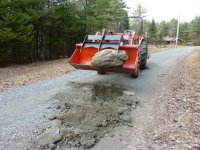
New to tractors and removed my first rocks today.

There were several rocks on our dirt road that rock the
tractor when I drive over them. What appeared to be small rocks
that would be easy to extract with the FEL turned out to be large
rocks buried deep.

Spent considerable time working on them, but all the time I was
wondering how good this is for the tractor?

Trying to get them out put a strain on the tractor and the engine
shut off once and slowed down on a few occasions.

I was running a Kubota B7800/ 30HP. After a while it seemed that 2200 rpms
seemed to be a good speed to operate at?
 
/ Rock extraction with FEL #2  
Be careful to not bend the bucket (bow it in the middle)
 
/ Rock extraction with FEL #3  
The engine SHUT OFF? That doesn't sound great.

If they are huge rocks it really may be simpler to just build the road up a bit in that spot. Is it nice and flat otherwise? If you dig 'em out you're just gonna have to fill 'em back in anyways, might save some trouble to get some crushed pit run or something (or even just some hard packed dirt) and level the road off above the rock. Sounds a little bassackwards I know, but if a little rise in the driveway doesn't bother you then it may be a practical solution.
 
/ Rock extraction with FEL #4  
The engine SHUT OFF? That doesn't sound great.

I was wondering if you might have been running lower than the 2200 rpm at the time - or, I know if I forget to drop into low-range, I would be more susceptible to stalling under a heavy load.
 
/ Rock extraction with FEL #5  
I was wondering if you might have been running lower than the 2200 rpm at the time - or, I know if I forget to drop into low-range, I would be more susceptible to stalling under a heavy load.

Or he was leaning in the seat to see better, and the seat safety switch shut down the injector pump.

Another option to what you suspect are large rocks sitting up "proud" is to knock the crap out of them with a sledge hammer. Sometimes all it takes is one or two hits to knock the tops off of them..gone. Be sure to wear safety glasses as you make "little ones out of big ones"..
 
/ Rock extraction with FEL #6  
When working a tractor hard, either ground engaging or FEL lifting, it's good to run it at a good rate...I typically choose 2000 to 2500 RPM, depending on the task.
 
/ Rock extraction with FEL #7  
My b-i-l took me over to a corner of his parking area out in the Black Hills. He pointed down to a small rock about 6 inches across. The guy building his driveway and parking are (local road contractor) told him that little rock determined the elevation of the entire are. He couldn't move it with his excavator.
 
/ Rock extraction with FEL #8  
New to tractors and removed my first rocks today.

There were several rocks on our dirt road that rock the
tractor when I drive over them. What appeared to be small rocks
that would be easy to extract with the FEL turned out to be large
rocks buried deep.

Spent considerable time working on them, but all the time I was
wondering how good this is for the tractor?

Trying to get them out put a strain on the tractor and the engine
shut off once and slowed down on a few occasions.

I was running a Kubota B7800/ 30HP. After a while it seemed that 2200 rpms
seemed to be a good speed to operate at?

I dug about 100 ton of rock out of my property in the 3 years since building my house. Sizes ranged from softballs to bean bag chairs. Some were too big to fit into the bucket so I rolled them to the pile. The trick is to dig deep enough to get the bucket lip under it, sometimes ramp one side and push up the ramp from the other. Once an area was dug, I would drag a grading blade over the area and seed lawn.

I stalled the tractor a few times because I stayed in power too long and should have backed off sooner. Kubota B2320 has 460 hours on it now and still ruNs like new but I do fluid and filter changes ahead of the recommended schedule.

Not a whimper out of the front end even though I admit to slipping into the hole a few times and slamming against the rock. Bucket is fine other than normal paint wear. I do not ram anything, you will get a feel for easing into the dig with steady pressure, and know when to back off and dig more dirt to free the rock.

You cannot be surgical with the bucket, you're gonna dig more dirt than you probably want to dig but thems the breaks. Just backfill and regrade to finish the job.

I had some massive rocks where only the "tip of the iceberg" showed. I dug around them and drilled and split the tops off a foot below grade--- you'd never know they were there.

I built on a real "mean" piece of land, now the top of my hill almost 2 acres looks like a park. Three year project up top, now I am working on the lower area but it's more a hobby than a must-do project.

Coincidentally, when I built the house, a contractor told me he would grade and seed the top for $30,000 to $40,000 "depending on what I run into". My wife and I did it for the price of grass seed and a Kubota-- and we still have the tractor.
 
/ Rock extraction with FEL #9  
Coincidentally, when I built the house, a contractor told me he would grade and seed the top for $30,000 to $40,000 "depending on what I run into". My wife and I did it for the price of grass seed and a Kubota-- and we still have the tractor.

For that kind of money, you could have bought 2 tractors, or a tractor and a bass boat, or at least a really good down payment on one!
 
/ Rock extraction with FEL #10  
I have taken out more than my fair share of road rocks, all sizes, with my tractor. If your road freezes solid in winter and then you have a muddy season when the frost starts to come out; that is the absolute best time to get the rocks out. It seems they almost float out in the mud and water that fills the holes. Once the road drys out it is much harder to free them.
Also in addition to your tractor you would be surprised at what a heavy 5 foot bar can do to help you.
Up to this size is easy. Bigger ones are more work. I took this when I was testing my new grapple. That is why the road is dry.

RockGrubing.JPG
 
/ Rock extraction with FEL #11  
I have taken out more than my fair share of road rocks, all sizes, with my tractor. If your road freezes solid in winter and then you have a muddy season when the frost starts to come out; that is the absolute best time to get the rocks out. It seems they almost float out in the mud and water that fills the holes. Once the road drys out it is much harder to free them.
Also in addition to your tractor you would be surprised at what a heavy 5 foot bar can do to help you.
Up to this size is easy. Bigger ones are more work. I took this when I was testing my new grapple. That is why the road is dry.

View attachment 372304
I have also dug out rocks that size and larger with my FEL(no grapple) on my LS P7010 but it is not easy on the FEL and takes a much larger hole than the rock to be able to get under them. Around here the big mother rock is usually surrounded by a bunch of smaller babies so it is really hard to dig them out with the FEL. Now I use my Kubota B26 TLB with hydraulic thumb to dig up any rocks I find that I cant pry out with my "pickle fork" that I carry around in my RTV. I have removed all of the big ones that are showing so now it is just the new crop that shows up every spring. I am thankful that I have the TLB as it was a bit hard on my LS trying to dig them out with just the FEL. The last really big one I got out was so large that I couldn't lift it with the Kubota backhoe. I managed to get the rock rolled around to the edge of the pit, put the LS bucket under the edge of the rock and used the backhoe to slide it in the LS FEL bucket. Sometimes it is great to have two tractors, especially if you have one stuck in the mud or something.

P.S. I did find one that the point was under a pine tree that I had knocked down. I started digging around it and after about 8 feet in length and 5 feet in depth and still no end in site, I filled in the hole with the dirt minus the smaller rocks that were around the big one. I used the smaller stuff for my creek crossing "bridge".
 
/ Rock extraction with FEL #12  
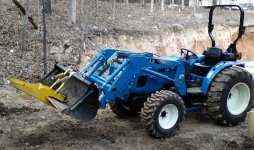
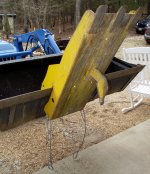
For removing rocks I've had good luck with a Rip & Dig.

RipDig3.jpg

It comes with a ripper tooth that can catch a rock and I've flipped them out the size of suitcases w/o having to dig around them first.

RipDig4.jpg

It does put a strain on the FEL and the attachment method will dimple and deform the bottom of the bucket. I welded on some 3" wide 5/16" steel plate as reinforcing ribs on the bottom of the FEL bucket. When in use, you see a lot of strain to the FEL cutting edge but so far is has snapped itself back to straight.

It ain't a backhoe but for $350 I've gotten a lot of use out it. The reason I bought it was to break up the crust on old construction waste piles so the FEL could easily scoop up and move the dirt. Works well. The scoop extends out 2' for digging. I've also used it for planting shrubs, worrying out 8" stumps, short trenches, obliterating wild rose & blackberry patches, and a pet cemetery task.

Bob
 
/ Rock extraction with FEL #13  
My favorite tools for the big rocks are backhoe for digging 'em out, pallet forks for moving them.
 
/ Rock extraction with FEL #14  
Keep in mind that a FEL is a front end loader, not a dozer or a digging machine. Yes you can do some digging and we all do, but machines that are designed for digging are normally yellow, like the JD industrial, the Cat machines, the NH industrial machines, etc. These machines generally cost about double what a normal tractor with a loader will cost.

A skid steer, if you look closely will dig well because when you are digging the main boom is tight against the body of the machine. The digging force gets transferred through the frame. On a farm type tractor of any brand while digging or dozing we are putting a lot of strain on the loader upright supports. They really aren't made for a heavy duty cycle of that sort of work.

Like I said, we all do it, but be a little gentle when you do. And if you are under a rock with the bucket with the front axle in the hole and the back tires light or in in the air and you pop the clutch or hammer the HST pedal, that popping noise you just heard is an axle shaft or gear, or the ring/pinion. It is an expensive sound. That scenario puts an incredible strain on a front axle, and the front axle shaft probably has less than 25% of the cross sectional area as does a rear axle shaft. In this situation the tractor can do several things; it can stall, it can spin the front tires, it can drive out of the hole pushing the rock, or it can break. Generally it will not spin the front tires as you are in a maximum load/traction scenario. Many of today's tractors have quite a lot of HP for their size so they do not always stall. That leaves you with the options of success or breakage. Be gentle.

They say it is good to learn from your mistakes. It is even better to learn from other's mistakes/experiences.
 
/ Rock extraction with FEL #15  
Keep in mind that a FEL is a front end loader, not a dozer or a digging machine. Yes you can do some digging and we all do, but machines that are designed for digging are normally yellow, like the JD industrial, the Cat machines, the NH industrial machines, etc. These machines generally cost about double what a normal tractor with a loader will cost.

A skid steer, if you look closely will dig well because when you are digging the main boom is tight against the body of the machine. The digging force gets transferred through the frame. On a farm type tractor of any brand while digging or dozing we are putting a lot of strain on the loader upright supports. They really aren't made for a heavy duty cycle of that sort of work.

Like I said, we all do it, but be a little gentle when you do. And if you are under a rock with the bucket with the front axle in the hole and the back tires light or in in the air and you pop the clutch or hammer the HST pedal, that popping noise you just heard is an axle shaft or gear, or the ring/pinion. It is an expensive sound. That scenario puts an incredible strain on a front axle, and the front axle shaft probably has less than 25% of the cross sectional area as does a rear axle shaft. In this situation the tractor can do several things; it can stall, it can spin the front tires, it can drive out of the hole pushing the rock, or it can break. Generally it will not spin the front tires as you are in a maximum load/traction scenario. Many of today's tractors have quite a lot of HP for their size so they do not always stall. That leaves you with the options of success or breakage. Be gentle.

They say it is good to learn from your mistakes. It is even better to learn from other's mistakes/experiences.
Very true Dave,

When I was digging all my rocks I learned early to be patient and dig enough soil to free the rock. It got to the point that I could feel the rock through the hydraulic lever and knew when it would yield and when it wouldn't. I did accomplish all my work without breaking the machine. For what it's worth, I would not let anyone operate my tractor the way I operated it. I did not have much choice but to do it, and now that the work is done, I just stick with less demanding work such as snow removal, firewood, landscaping etc.
 
/ Rock extraction with FEL #16  
Two things come to mind when equipping our type tractors for rock engagement: 1. a tooth bar to help strengthen a relatively weak area (bucket lip) and 2. a middle buster to initialize the rock removal procedure. As mentioned, the back of these tractors are much stronger than the front. The hardest part is freeing up the rock from the earth so why not take advantage of the strongest part of the tractor. The middle buster does an excellent job of this. Many come with a shank attachment for tighter spots.
 

Marketplace Items

New/Unused ATS T460 Mini Skidsteer (A65583)
New/Unused ATS...
Caterpillar 299D3 (A64126)
Caterpillar 299D3...
(INOP)1989 NISSAN D21 EXTENDED CAB TRUCK (A64280)
(INOP)1989 NISSAN...
2019 Freightliner 122SD (A62679)
2019 Freightliner...
2014 International WorkStar 7300 4x4 Altec A55F 55ft. Material Handling Bucket Truck (A60460)
2014 International...
Yale 5K Forklift (A63688)
Yale 5K Forklift...
 
Top