You are using an out of date browser. It may not display this or other websites correctly.
You should upgrade or use an alternative browser.
You should upgrade or use an alternative browser.
pto slip clutch
- Thread starter Bedlam
- Start date
- Views: 29308
More options
Who Replied?
/ pto slip clutch
#21


Soundguy
Old Timer
- Joined
- Mar 11, 2002
- Messages
- 52,424
- Location
- Central florida
- Tractor
- RK 55HC,ym1700, NH7610S, Ford 8N, 2N, NAA, 660, 850 x2, 541, 950, 941D, 951, 2000, 3000, 4000, 4600, 5000, 740, IH 'C' 'H', CUB, John Deere 'B', allis 'G', case VAC
For special applications, there are some slip clutches with quick release ends on the tractor pto side.
Soundguy
Soundguy

greg_g
Super Member
- Joined
- Dec 18, 2003
- Messages
- 6,126
- Location
- Western Kentucky
- Tractor
- JD3720 Cab, 300X loader with 4-in-1 bucket
Soundguy said:For special applications, there are some slip clutches with quick release ends on the tractor pto side.
I imagine there are exceptions to just about any rule folks can dream up. But for safety considerations, a forward mouted friction type slip clutch is probably employed only in the instances where there's insufficient rotational clearance on the implement end. In the final analysis, I'd consider that circumstance to be a design deficiency.
//greg//
Soundguy
Old Timer
- Joined
- Mar 11, 2002
- Messages
- 52,424
- Location
- Central florida
- Tractor
- RK 55HC,ym1700, NH7610S, Ford 8N, 2N, NAA, 660, 850 x2, 541, 950, 941D, 951, 2000, 3000, 4000, 4600, 5000, 740, IH 'C' 'H', CUB, John Deere 'B', allis 'G', case VAC
A design deficience? I wouldn't go that far. Just because it was designed that way doesn't make it a bad design. Deere is know for some pretty darn good equipment.. The geometry of their drag mowers, shields and gear box setups at the fron, keeping in mind driveshaft angle and geometry.. there simply isn't much room left for a torque limiter right at the rear coupling point. That's why it is at the front of the pto shaft.
Since the tractor has a pto stub shield.. I don't see the issue.
Another thing.. with a large implement.. you are probbaly ( should be ) using a large tractor. Due to that geometry, the operator is not in a direct line of fire from flying peices in the event of a torque limiter failure. I.E... If I look back, I can't see the pto stub/driveline connection point on my larger tractors... thus no direct line for shrapnel. If it were mounted farther back there would be some chance.. but still low, agan.. due tot he geometry and size of the tractor. I have a feeling this would all be very different on a SCUT or even CUT.. where.. the torque limiter being ont he implement side gets it farther way from the operator. And due to geometry and size.. the operator is probably in a bad line of fire no mattter where the torque limiter is in the drive train... so they opted for the lesser of 2 evils.
Ergonomically. the torque limiter being on the tractor end does make for a few extra pounds to lift when attaching the pto shaft... that said though, those big metric #6 and larger drive shafts are already a bear to lift. A few extra pounds doesn't mean much.
Soundguy
Since the tractor has a pto stub shield.. I don't see the issue.
Another thing.. with a large implement.. you are probbaly ( should be ) using a large tractor. Due to that geometry, the operator is not in a direct line of fire from flying peices in the event of a torque limiter failure. I.E... If I look back, I can't see the pto stub/driveline connection point on my larger tractors... thus no direct line for shrapnel. If it were mounted farther back there would be some chance.. but still low, agan.. due tot he geometry and size of the tractor. I have a feeling this would all be very different on a SCUT or even CUT.. where.. the torque limiter being ont he implement side gets it farther way from the operator. And due to geometry and size.. the operator is probably in a bad line of fire no mattter where the torque limiter is in the drive train... so they opted for the lesser of 2 evils.
Ergonomically. the torque limiter being on the tractor end does make for a few extra pounds to lift when attaching the pto shaft... that said though, those big metric #6 and larger drive shafts are already a bear to lift. A few extra pounds doesn't mean much.
Soundguy
OP

Bedlam
Veteran Member
- Joined
- Feb 28, 2005
- Messages
- 1,883
- Tractor
- Ford and Kiotie
Just got two responses from two different sales offices they are:
grflowers@agri-supply.com AL,SLIP CLUTCHES GO ON THE IMPLEMENT END OF SHAFT. THANKS,GENE
and sales@ssbtractor.com Al, It goes on the tractor shaft end so more than one implement may be used for the set up.
Looks like a tie at this point.
grflowers@agri-supply.com AL,SLIP CLUTCHES GO ON THE IMPLEMENT END OF SHAFT. THANKS,GENE
and sales@ssbtractor.com Al, It goes on the tractor shaft end so more than one implement may be used for the set up.
Looks like a tie at this point.
heehaw
Veteran Member
- Joined
- Sep 15, 2000
- Messages
- 2,076
- Location
- russellville, arkansas
- Tractor
- Kubota M4900, B7510 and RTV
i like the idea of it being on the tractor, that way you have one clutch for several applications: but i haven't ever seen them there??
heehaw
heehaw
Soundguy
Old Timer
- Joined
- Mar 11, 2002
- Messages
- 52,424
- Location
- Central florida
- Tractor
- RK 55HC,ym1700, NH7610S, Ford 8N, 2N, NAA, 660, 850 x2, 541, 950, 941D, 951, 2000, 3000, 4000, 4600, 5000, 740, IH 'C' 'H', CUB, John Deere 'B', allis 'G', case VAC
The only torque limiters i see at the tractor end are those that are pre-attached to specific drivelines.. etc. Like for my jd 1517 batwing.. etc. ( and similar setups.. )
Soundguy
Soundguy
neverenough
Silver Member
rcmike said:I just leave mine on the tractor and slip the pto shaft onto it. It is no harder than attaching it without the clutch.
Yes, if you leave it on the tractor all the time, then hooking up to it would be no different than with out it. As long as the clutch is calibrated for all the equipment it is required to protect, then you will be fine.
rickmacheske
Gold Member
I don't understand why you couldn't leave this one on the tractor all the time... http://www.agrisupplyco.com/cgi-bin/cgiitmls?m=ThisP&p=31951.000000&l=1
Looks like it would fit perfectly. What am I missing?
Looks like it would fit perfectly. What am I missing?
greg_g
Super Member
- Joined
- Dec 18, 2003
- Messages
- 6,126
- Location
- Western Kentucky
- Tractor
- JD3720 Cab, 300X loader with 4-in-1 bucket
Primarily the safety factor; eight protruding springs and hex nuts, spinning at 540 rpm right behind the operator. But if safety is not an issue with you, the female end is not splined. http://www.agrisupplyco.com/Graphics/31951.jpg. Note that it says "Ideal for adding a slip clutch to rotarys cutters with shear pin protection". That means the female end (bottom) is round and has a bolt hole. It's compatible with the smooth transmission shafts found on some implement transmissions, and is held in place with a shear bolt. On the above model, you can just make out the shear bolt hole to the below and to the left of the center spring. That makes this particular device incompatible with the splined PTO shaft you'll find sticking out the rear end of many/most tractors.rickmacheske said:What am I missing?
Even if the female were splined, adjusting a slip clutch on the tractor end would be problematic. That is, assuming it's safely under a PTO shroud. In that configuration, it would be difficult to impossible to get a wrench on the backside hex heads. Adjusting the clutch off the tractor defeats your purpose for putting it there in the first place.
//greg//
rickmacheske
Gold Member
My bushhog has shear pin protection and uses a splined PTO connection. I don't understand how it's automatically round if it's 'ideal for adding slip clutch to rotary cutters with shear pin protection'. I thought that bolt was for mounting the clutch to the tractor without the PTO easy attach. I'll have to call to see if it's splined.
I do have a shroud around the PTO shaft on the tractor 'bota L3400 so that is less of an issue. I wouldn't adjust very often, hopefully, so taking it on and off for adjustment wouldn't be much of an issue.
Just my $.02.
I do have a shroud around the PTO shaft on the tractor 'bota L3400 so that is less of an issue. I wouldn't adjust very often, hopefully, so taking it on and off for adjustment wouldn't be much of an issue.
Just my $.02.
greg_g
Super Member
- Joined
- Dec 18, 2003
- Messages
- 6,126
- Location
- Western Kentucky
- Tractor
- JD3720 Cab, 300X loader with 4-in-1 bucket
Nope. Think about it for a minute; HOW can a double splined connection slip in the first place? Only way could be if you've bolted a female spline over a male round, or vice versa. When applied correctly, it should be an either-or situation. Either your rotary cutter transmission is shear pin protected, or it's slip clutch protected. And if you use the wrong bolt in a shear pin protected driveline, you have no protection at all. The bolt hole in a splined female slip clutch fitting is for fastening only, and the bolt used should be of a hardness NOT to act as a shear pin (typically GR5 or 8). Implement transmission input shafts that are smooth and round have a a single hole, through which a soft grade bolt (typically GR2) is use as a combination fastener AND shear pin.rickmacheske said:My bushhog has shear pin protection and uses a splined PTO connection. I don't understand how it's automatically round if it's 'ideal for adding slip clutch to rotary cutters with shear pin protection'.
And the reason I said "many/most tractors " was because only one of the last four tractors I've owned had a bolt hole drilled horizontally through the center of the PTO spline. And I noticed you skipped over the slip clutch adjustment point I made. If/when you ever buy one, it's a very good bet the operating instructions will include a recommendation to adjust the friction plates every six months - which pretty much goes against your "put it on and leave it on" concept. Slip clutches will almost universally be easier to adjust and maintain when mounted correctly on the implement end of the PTO shaft.
//greg//
rickmacheske
Gold Member
Greg,
That is probably your configuration. My bush hog attaches with a splined connection. Internal to the bush hog (under the steel cover) is where the shear bolt is. They basically provide a break in the drive train where it is attached together with the shear bolt. I use the proper bolt.
I'm guessing there are different configurations.
That is probably your configuration. My bush hog attaches with a splined connection. Internal to the bush hog (under the steel cover) is where the shear bolt is. They basically provide a break in the drive train where it is attached together with the shear bolt. I use the proper bolt.
I'm guessing there are different configurations.

firemanpat2910
Platinum Member
Greg you are assuming all shear bolt set ups look like yours. There is a very crude pic of my set up with 2 splined shafts shear protected in another thread about shear bolts. rickmacheske what grade bolt do you use in your set up? mine will only work with a grade5 2s pop as soon as you engage it.
greg_g
Super Member
- Joined
- Dec 18, 2003
- Messages
- 6,126
- Location
- Western Kentucky
- Tractor
- JD3720 Cab, 300X loader with 4-in-1 bucket
Sorry guys, but I've had several variations of both types over the years. With the possible exception of implements like a PHD where driveline clearance is a factor, I wouldn't even own a shear bolt rig anymore. Once I graduated to slip clutches, I never looked back.firemanpat2910 said:Greg you are assuming all shear bolt set ups look like yours.
It's your money...spend it as you see fit.
//greg//
rickmacheske
Gold Member
I use 2's and have never had a problem. I have only broke a bolt twice, 1 large rock and 1 chuck of metal while bush hogging.
Soundguy
Old Timer
- Joined
- Mar 11, 2002
- Messages
- 52,424
- Location
- Central florida
- Tractor
- RK 55HC,ym1700, NH7610S, Ford 8N, 2N, NAA, 660, 850 x2, 541, 950, 941D, 951, 2000, 3000, 4000, 4600, 5000, 740, IH 'C' 'H', CUB, John Deere 'B', allis 'G', case VAC
Both of my mowers with built in-line slip clutches had a metric splined driveshaft input on the gear box.. on my KK mower with a shear pin.. the input shaft is round, as greg mentions. ( just kicking that out there.. lots of different setups.. of my 2 mowers with slip clutches.. one is by the gearbox.. one is inline near the pto stub... both are oem setups.. )
Soundguy
Soundguy

flusher
Super Member
- Joined
- Jun 4, 2005
- Messages
- 7,572
- Location
- Sacramento
- Tractor
- Getting old. Sold the ranch. Sold the tractors. Moved back to the city.
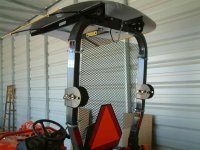
rcmike said:Not trying to argue with you, I am just a little confused. If a bolt happens to break or the nut came off wouldn't the spring shoot away from the clutch? If that is the case I would think you would want it pointed away from you towards the implement. If it was on the implement end it would fly towards the operator. Or is there some other danger with the springs? I have one on the tractor pto basically to protect my tractor. I have a 4010 and a 4 ft KK rotory cutter. Whenever I would kick in the pto the shock would break a roll pin in the universal joint on the driveshaft from the engine to transmission, even at idle. Now it kicks in smoothly without the jolt. I can't imagine what would happen if I hit something big with it without the clutch.
I prefer not to guess which way the (possible) shrapnel is going to fly. I just protect my backside (see attachment).
Attachments
rickmacheske
Gold Member
BTW...I called Agrisupply.... http://www.agrisupplyco.com/cgi-bin/...951.000000&l=1 is splined on the male and female end. They have another that is not splined on either end.
OP
Bedlam
Veteran Member
- Joined
- Feb 28, 2005
- Messages
- 1,883
- Tractor
- Ford and Kiotie
so this http://www.agrisupplyco.com/cgi-bin/cgiitmls?m=ThisP&p=31951.000000&l=1
is splined on female and male?
is splined on female and male?


