Pond Questions

/ Pond Questions #1  

tractorshopper

Veteran Member
Joined
Dec 29, 2009
Messages
1,146
Location
Upstate South Carolina
Tractor
Kubota BX2380
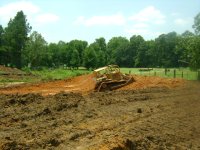
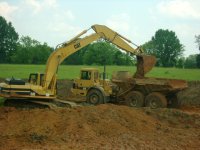
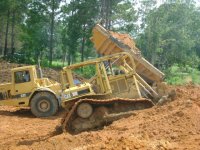
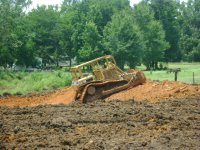
I built a pond just before Christmas. Put in about 16 hrs on the tractor. Had fun doing this. Pictures here are horrible, but they're the best I've got. Had to rush to finish since rain was coming. Filled up and actually overflowed the 2nd night. Now is leaking down. Is it normal for a pond to "settle" in? I can't find any water leaking around the dam at all. I've read many threads on ponds here including Jinman's, Bindian's, and of course, Eddie Walker's.

I dug a key trench to about 4' deep in most places where the dam is now to ensure I was in clay with no top soil to interfere anywhere that I dammed. I refilled wity clay and packed in layers of about 4" each by driving over and over, etc. The highest point of the dam in these pictures is only about 4' higher than the land behind it (I'm raising it more now). The deepest part in these pictures is about 7.5' right where the water enters from the drainage ditch. Boy do I get a lot of runoff. More than I thought. I had put in a couple 4" pipes because that was all I had at the time but was picking up some 8" smooth wall culverts to put in to do properly. It overflowed the 4" ones and topped the dam (nearly a foot higher) the first night, but since I had packed so well, it didn't much damage at all. Since these pictures, I've started installing the two 8" culverts and have built up what I can, but it's been raining a minute amount every 2-3 days now so it's so slick I'm not getting far right now. I'm putting the bottom of them about 6" higher than where the 4" pipes are in these pictures and will remove the 4" corrugated pipes. Basically since that first big rain and no real additional runoff from the small rains since, the pond is down about 4' in just over a week now. Is this normal, or will I have to line it? As you can see from the pictures, I have a lot of clay and thought this would hold well. There is a vein or two of loamy stuff, but it was very hard packed and not on the dam side. Basically, current water level is now at the bottom of the island.
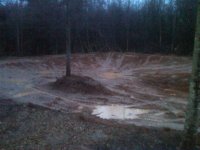
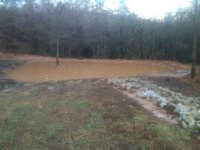
Pond1.jpgPond2.jpgPond3.jpg
 
/ Pond Questions
  • Thread Starter
#2  
I also meant to ask how to clear up water. The runoff is actually pretty clear coming in, but the filling of the pond obviously mixed up mud from the new dig and I was hoping it would clear up. It has cleared up some, but is still more red than I had hoped.
 
/ Pond Questions #3  
Nice work! It won't clear up until you get some vegetation established around the water line. After that, you can place straw bales every few feet. As they decompose, they make the clay particles clump together and settle to the bottom.

When I dug my pond, it lost water for several months. I think once the bottom was saturated enough to the water table it quit losing water. Where is the water table relative to the pond bottom?

Also, having the runoff channel thru a grassy waterway will help too.
 
/ Pond Questions #4  
How deep is it in total? You said it is down 4' and it dont look much deeper than that in total??? The mud should eventually settle out of the water, but everytime it rains it is going to look like that until you get the area around seeded and established.

As to the water level dropping, I am no pond expert, and this is exactally why I like to have a pro at least survey the area, look at some test holes, and look at a soil map. If it isnt leeching through the dam, it must be leaching into the ground. There is a good chance that vein of loamy stuff you mentioned it where it is going. Around me, there are areas that have what they call "piping". Which is veins of sandy gravely stuff that basically acts like field tiles and carries the water our of the pond.
 
/ Pond Questions
  • Thread Starter
#5  
LD1, it's down I'm guessing about half way. It's only about 7.5' at the deepest point in the pictures, but I'm raising another 6-8" above that as I install the actual culverts, so the deepest point in the future will be about 8' or so. This total area by my best calcs is about 4,526 ft2, so about a tenth of acre I guess. At worst, if it doesn't stop settling, I'll line it with a poly liner and throw more clay on top of that when it's way down this summer, but I'm hoping this is just a normal saturation process that will fix itself, kind of like what sld said. Maybe just wishful thinking though. The natural terrain basically runs at the same slope in the same direction another 200 ft. I'm honestly not sure about the water table in the area. I didn't hit one while digging this. I just know that I get a lot of runoff and it seemed like a good idea to make an eye pleasing setting out of it and get some play time on the tractor.
 
/ Pond Questions #6  
ts - I wonder if that tree in the middle of the pond could be your problem. From reading about pond projects I got the message that trees will eventually die when surrounded by water. In your case I wonder if the root structure of that tree is acting like a drain. Might have been better to have removed the tree and small island and covered that area with clay. JMO - PAGUY
 
/ Pond Questions #7  
www.thepondboss.com is like TBN but for mud / clay ponds.
Koiphen.com is also like TBN is more for liner ponds, but ya might get some contact info for someone locally to come out and look at things as well.

some things right off....

i do not see any sort of "overflow pipe" and i do not see any sort of "run off" area when overflow pipe gets clogged. without them. one good rain, and water erods out the dam, and entire pond water goes with it.

your island tree, is going to get nailed pretty hard possibly. from erosion, to point of possibly loosing tree all together.

7.5' depth is going to hurt ya in dry seasons, as in droughts. and just having a muddy mess, possibly. depends on inflow of water.

the rocks you have for water coming into pond. can help reduce erosion, but having a good rock base, and grass ways around things to help filter the water. and reduce erosion is critical.

your overflow pipe, for pond most likely going to be much larger. pending on local area, a 4" pipe is way to easy clog up. with a stick or leaves, frog, fish, etc... getting say 12" or slightly bigger overflow pipe. might be more advisable. less chance of clogging up. and can flow a good wealth of GPM (gallons per minute of water) if it needed to.

2 single 8" culverts, vs going with a single larger culvert pipe for a overflow. again there is a difference with clogs. larger pipe much easier to deal with, and less head aches down the road.

=============
i would seriously say get a hold of some actual pond/lake installers. and get them out there so they can physically walk around and take a look at things. if you wait a couple years from now. you will more likely be at more $$$$$ compared to getting the lake drained down now. and being able to get in there and fix things easier.

digging hole is the easy part. it is all the little things. that can bite ya in the rear. call up a few folks, both through internet and locally and get a couple companies / folks out there and look at things. internet pictures / videos does not really give a pond your size justice of what can be seen and obtained, vs being there in actual person.
 
/ Pond Questions #8  
Did you core the dam? Check with the soil conservation people in your area. they have maps that will give you a clue whether an area will hold water or not. They can core certain places to see soill makeup. You can haul in clay and pack a foot thick that may help. First you have to find out where the water is going. If is is leaking through bottom of pond, use clay or liner. If through dam, recore dam, find leak and spread sodium bentonite in leaking area. There is a subscription you may want to look into. Pond Boss magazine that is a good information source. I dug a pond on our place that the soil conservation guys said would not hold water; however, after spreading clay around certain areas, it holds perfectly. Neighbors dug one that will not hold water, go figure.
 
/ Pond Questions #9  
Thanks for the pictures
 
/ Pond Questions
  • Thread Starter
#10  
Thanks guys. I have 2 8" smooth wall culverts now and am slowly installing due to raining every 2-3 days right now and not being able to do tractor work in the muck. It's hard to see, but there are 2 4" corrugated pipes that I temporarily installed prior to the first rains which filled and overflowed the dam, but the dam held due to all the packing as I noted earlier. I think the comments about the tree in the island may be very well problematic. I don't know what that tree will drink daily, but to be honest, I left it because it's currently too big to take out with my tractor. I think it may eventually cave and fall and if/when it does, I'll chain up to it and pull it out can cut in sections. We got rain again last night, about 1/2 to 3/4" and the pond is back up to 3/4 full again and that was a slow soaking rain. I'm just going to play it by ear between now and summer and see if it will saturate itself in or not and if not, will line it. I can tell you the dam is done right and will continue to be as I finish it with the larger pipes and spillway. I did the temporary thing before the rains and it worked well other than being too small to take that amount of water.

I really did this project on a whim because I had wanted to do it for a while. If I have to line it, that's fine. No seepage anywhere on the dam or wet spots around it. Worse case, I put a liner in for it to retain the runoff it gets. A little rain periodically will keep filling it up. It is/was a fun project to do in spare time, which I don't get much of these days with having kids in middle school.
 
/ Pond Questions #11  
Not sure what is located downstream from your pond but in the event of a failure and sudden release of water...you will be liable to any downstream property damage. Hopefully that will not be any issue with your location. Any storm sewer pipe smaller than 18" is prone to plugging. As far as sealing it goes...old timers claim ducks actually seal ponds to protect their water source. Might be the concentration of duck pooh.
 
/ Pond Questions #12  
Here in Arkansas the conservation folks require that any pond built to their specs (they pay a bit of money if you build it to state specs) has an overflow on the upper end. They say you cant properly spec and overflow pipe due to unexpected rainfall conditions. You have to install an upper end (at the inflow end)spillway rather than pipes. They work pretty well and you dont get any dam erosion from overflows and no material cost other than some rocks to line the spill way to prevent erosion till grass gets started.
Your drainage problem might cure itself as fine clay particle wash in and settle. You likely have a sandy area that is filtering the water back underground. If it doesnt stop naturally, you could spread Bentonite clay in the sandy area when it dries up and work it into the existing soil structure. It will expand when wet and seal off the area.
I have heard the same thing about duck and goose poo sealing up leaking ponds but you need a lot of poo if you are loosing water like you say.
 
/ Pond Questions #13  
You could leave your outlet pipes and install an emergency overflow along the dam and a slightly higher elevation. The emergency overflow is nothing more than a lower area where the water will spill over before overtopping the dam. Rock placed in the overflow channel or even well established vegetation can minimize and erosion during an emergency discharge event.
 
/ Pond Questions #14  
I ran into something similar. Dug a pond in a day just before Sandy. Didn't get time to finish it. No overflow and no culverts. Although there was no dam per say, I dug down and put a packed clay key in on the downhill side. I say no dam per say because the lower end is at ground level. It filled up over night but within a week it was dry. I think I got too aggressive and went down too far and broke through the clay. After it dried out I went back and and packed clay in the bottom. It seems to be holding now. I'll slowly build up the downhill side so that it is raised and will put in the overflow then.

Here are some pictures of the first attempt if they load properly and aren't too big:

IMAG0154.jpg

IMAG0148.jpg

IMAG0151.jpg

IMAG0152.jpg

IMAG0145.jpg

IMAG0146.jpg
 
/ Pond Questions #15  
Not to rain on anyones parade but one thing I have learned from digging my own ponds(8, all range from 6' to 12' actual "low" water level measurement) and talking with the prodiggers, you'll want to be down no less then 4' but deeper is better. If you're to shallow sooner or later you will have weed problems, especially cattails.

As far as the leakage problem it's hard to tell what is going on without seing it up close. Not all clay is equal and if it's not solid (bad mixes) it'll leak. You can find liners that will fit, I perfer a good clay, but if in a bind would use a liner. Your pond looks good but from the pictures seems much shallower then 7', how did you come up with the measurement? I'm just asking because I have had guys tell me they went down 12 feet but when a true measurement was takin they might be 6 to 8'. Of course it's hard to know what the actual water level depth is until the pond fills, sits for a time and then a dry(not drought) spell comes along. I know one thing I've learned deeper is better, when I dig now I get to a depth I like then add to it, atleast a few more feet. The nice thing about going deeper is IF a drought comes knocking and the pond is stocked you'll have atleast some what of a chance in keeping your fish population. Some say going too deep, over 12-15' water level depth, is not worth the time, I completely disagree. If the fish don't like the depth they stay shallow but if a drought happens they'll be happy for the depth. Another plus to going deeper is build up of sediment, especially if your located near trees. I have had many folks tell me they knew for a fact there pond was ____deep when it was dug but for some reason now it's not even half that depth? I will write dredging is a pain, better to over build in the beganing then have to go back and fix later. As you can see your water is already chocolate color you'd be surprised at how much dirt is running/filling back into your pond, from the fresh dig. Again another reason to go a bit deeper, until the fresh build has a chance to grow in. Sorry for the long post, wish I could help more with your leakage problem, but like I wrote to many variables to figure without seeing in person.
 
/ Pond Questions
  • Thread Starter
#16  
Nice pond Super Cobra. Your soil looks a lot like mine. 20 20 - I measured the depth. The pictures stink, but the deepest part is closest to where the water comes into it from the ditch. I did that on purpose to have a deeper spot to catch sediment. I have a shallower end on one side too, but I'd say average depth to bottom of drain is 4.5-5' except shallow end near island, which is mostly like 2-2.5'.
 
/ Pond Questions #17  
I had a second pond dug into my property, the first had/has issues.

After speaking with a number of people (Professionals in our area) they eluded to the fact that if you dig the pond too deep into the ground and hit rock that you'll never get it to stop leaking...... I hope this isn't your issue. My lower pond, without adding lime or bentonite, sealed itself in about 9 months (The part that leaked was the actual dam face since the pond was cut into a wide gully.

In the past 6 months or so I've been taking a small portion of our stream and having it pumped into the upper pond (The one with problems). That additional water source brought a lot of organic material/s into the pond. With this change the pond is leaking less and doesn't go dry in summer and I'm starting to see algae, frogs, dragon flies and other plant matter slowly starting to develop which is helping to further sealing the pond (I notice that less water is needed to keep it full).

As far as clarity of the water, I think that kinda depends on your area (from what I've seen). Runoff can make it suddenly cloudy and then in about a week it would settle and clear (in TN), but further south (TX) my pond waters would never clear unless I added lime and brought the pH up to around 9. It could be that your runoff is what's making it cloudy (Hard to know without studying it a bit).

Culvert -- I added a 8" pipe into the face of the dam to handle the runoff. It was cheaper than repairing the dam face if it overflowed and cut into the soil.
 
/ Pond Questions #18  
The proper way to core a dam is to dig a minimum of 6 feet below grade and pack with good clay until you build it up to desired height based upon amount of area you want to contain water.
I had a second pond dug into my property, the first had/has issues.

After speaking with a number of people (Professionals in our area) they eluded to the fact that if you dig the pond too deep into the ground and hit rock that you'll never get it to stop leaking...... I hope this isn't your issue. My lower pond, without adding lime or bentonite, sealed itself in about 9 months (The part that leaked was the actual dam face since the pond was cut into a wide gully.

In the past 6 months or so I've been taking a small portion of our stream and having it pumped into the upper pond (The one with problems). That additional water source brought a lot of organic material/s into the pond. With this change the pond is leaking less and doesn't go dry in summer and I'm starting to see algae, frogs, dragon flies and other plant matter slowly starting to develop which is helping to further sealing the pond (I notice that less water is needed to keep it full).

As far as clarity of the water, I think that kinda depends on your area (from what I've seen). Runoff can make it suddenly cloudy and then in about a week it would settle and clear (in TN), but further south (TX) my pond waters would never clear unless I added lime and brought the pH up to around 9. It could be that your runoff is what's making it cloudy (Hard to know without studying it a bit).

Culvert -- I added a 8" pipe into the face of the dam to handle the runoff. It was cheaper than repairing the dam face if it overflowed and cut into the soil.
 
/ Pond Questions #19  
The proper way to core a dam is to dig a minimum of 6 feet below grade and pack with good clay until you build it up to desired height based upon amount of area you want to contain water.

I agree that properly coring the dam is the most important part of building a pond or second only to picking the right location. Remember that a leaking dam may not necessary shown up as a wet spot on the dam. Sometimes a leak will run underneath the dam and it may not surface to several hundred feet below the dam. If it continues to leak, you may want to check the areas below the dam.

Here are a few pictures of my newest pond. Dug in 2010.


Pond 006.jpg

Pond 025.jpg
Pond 039.jpg
Pond 030.jpg
 

Attachments

  • Pond 004.jpg
    Pond 004.jpg
    133.3 KB · Views: 164
/ Pond Questions #20  
I agree with Paguy all trees should be removed , once they die and rot they cause a natural drain though their root system. Any new trees beginning to grow
on the pond bank as well as cat tails should be removed.
If cat tails are not controlled they will soon take over your pond.


PAGUY
Silver Member
Join DateAug 2007Posts191Locationsoutheastern PATractorKubota BX2200, Gravely mower
Re: Pond Questions
ts - I wonder if that tree in the middle of the pond could be your problem. From reading about pond projects I got the message that trees will eventually die when surrounded by water. In your case I wonder if the root structure of that tree is acting like a drain. Might have been better to have removed the tree and small island and covered that area with clay. JMO - PAGUY
 
 
Top