Plywood for concrete forms

/ Plywood for concrete forms #61  
Yea, it isn't a very good blog. The fact that cement is a hydrated compound that incorporates water (or OH) in it's structure. There may be excess water in the pour, more likely with lazy finishers without a design mix. A modern high stregth design mix may actually have close to zero excess water.
Actually, the amount of water/Portland cement is relative to the required slump for the application (job) and workability...not just the end result strength of the pour...Good luck getting a stiff mix (high slump) into intricate forms or through a concrete pump etc...
 
/ Plywood for concrete forms #64  
My Son In Law works with concrete in very complex situations. I listen to him talk about it in silence with my mouth hanging open. In practical application He's forgot more about concrete than I'll ever know. :)
 
/ Plywood for concrete forms #65  
/pine your post is misleading as it leaves out the first part of the discussion of the water needed for the chemical reaction. Your post is about the excess water remaining in the concrete

Thanks. I was hoping someone would correct that. Water that becomes hydrates the the CEMENT is there to stay. It does not "dry out".
 
/ Plywood for concrete forms #66  
Thanks. I was hoping someone would correct that. Water that becomes hydrates the the CEMENT is there to stay. It does not "dry out".
FYI...there was nothing to correct...The text is technically spot on...you're missing the point in context...I cited the page because of the layman's terms...
 
/ Plywood for concrete forms #67  
/pine your post is misleading as it leaves out the first part of the discussion of the water needed for the chemical reaction. Your post is about the excess water remaining in the concrete

This link is also part of the myths and misconceptions. it is also wrong in stating the water is not incorporated into the concrete. The Cement/water ratio is a chemistry calculation and adds enough excess water to be able to work the mixture. The weight of calculated amount of water to complete hydration of the mix components does become added to the weight of the dry components of the final concrete. There are many variables the chemist has to account for when designing a specific mix, even the water on the surface of sand/rock components. This whole subject is way beyond the knowledge base and/or comprehension of those not intimately involved in the processes that occur prior to the concrete arriving at the job site. Most folks are not aware of the final weight of a cubic yard of cured concrete being in excess of 4000# and do not consider its effect on what the concrete sets upon.

For the OP; you will need an appropriate foundation under that wall unless you want a sinking floor.

I am not a chemist or engineer; but, have attended many forums on concrete mix design, inspection and final construction; been a concrete designer, placement inspector, and construction manager. All of the proper terminology for concrete design, mixing, and placing alone is a huge learning curve. Notice I used "placing" instead of the common term "pouring".

Ron
 
/ Plywood for concrete forms #68  
This link is also part of the myths and misconceptions. it is also wrong in stating the water is not incorporated into the concrete. The Cement/water ratio is a chemistry calculation and adds enough excess water to be able to work the mixture. The weight of calculated amount of water to complete hydration of the mix components does become added to the weight of the dry components of the final concrete. There are many variables the chemist has to account for when designing a specific mix, even the water on the surface of sand/rock components. This whole subject is way beyond the knowledge base and/or comprehension of those not intimately involved in the processes that occur prior to the concrete arriving at the job site. Most folks are not aware of the final weight of a cubic yard of cured concrete being in excess of 4000# and do not consider its effect on what the concrete sets upon.

For the OP; you will need an appropriate foundation under that wall unless you want a sinking floor.

I am not a chemist or engineer; but, have attended many forums on concrete mix design, inspection and final construction; been a concrete designer, placement inspector, and construction manager. All of the proper terminology for concrete design, mixing, and placing alone is a huge learning curve. Notice I used "placing" instead of the common term "pouring".

Ron
Did you read it all? I suspect not because technically it is 100% correct in a non scientific vernacular...and again, none of the above is germane to the point I was regarding that was excess water NOTHING AT ALL about the amount of water required for (optimal) curing...
 
/ Plywood for concrete forms #69  
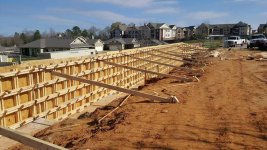
FB_IMG_1513108779900.jpg I just saw this picture on FB and thought it showed what it takes to support concrete with plywood. I'm guessing this is a four foot tall wall. Eight foot would be a lot more work.
 
/ Plywood for concrete forms #70  
Storm Shelter Construction.jpg

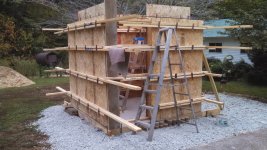
This is my 8' square x7+' high storm shelter wood layout for my storm shelter. It is not complicated but need snap ties and double 2x4s around inside and out every 2'. But can be reused later for other things.

Once the wall is done I pulled it all off and made the roof.
 
Last edited:
/ Plywood for concrete forms #71  
View attachment 531734

This is my 7+' storm shelter wood layout. It is not complicated but need snap ties and double 2x4s around inside and out every 2'. But can be reused later for other things.

Once the wall is done I pulled it all off and made the roof.

Did you use any vertical bracing or any legs to keep it from leaning?
 
/ Plywood for concrete forms #73  
It's pretty standard practice to remove all forms, of the concrete, as soon as the structural integrity is there. Concrete needs to cure and if plywood forms are there indefinitely, they only serves to weaken the concrete.

No way, man. Concrete is strongest if the forms are NEVER removed.
 
/ Plywood for concrete forms #74  
I couldn't bare to read all these but it sounds like a perfect job for ICF. I built my home with ICF, 3 stories, 400 cubic yards of concrete. Really DIY. bracing is only needed to keep it plumb. Each block has the ties so no bulging walls. You can get blocks with as small as 4 in cores. The ties are made to hange sheet rock, every 8 in OC.
 
/ Plywood for concrete forms #75  
View attachment 531734

This is my 8' square, 7+' tall storm shelter wood layout. It is not complicated but need snap ties and double 2x4s around inside and out every 2'. But can be reused later for other things.

Once the wall is done I pulled it all off and made the roof.

Did you use any vertical bracing or any legs to keep it from leaning?

I see I have a leaning brace on the back side and maybe one other side.

All the horizontals 2x4s, which I overlapped at every corner inside and out, made it very sturdy.

Once one side is set level and plumb and nailed together by those horizontals they hold up very good. I believe I nailed in corner to corner 2x4s to help keep it square.

I did not put vertical double 2x4s like someone else's picture showed, but this worked out nice anyway with no bulges in plywood. The hardest part was knowing someone who would let me use the snap rod connectors.
 
/ Plywood for concrete forms #76  
View attachment 531734

This is my 8' square x7+' high storm shelter wood layout for my storm shelter. It is not complicated but need snap ties and double 2x4s around inside and out every 2'. But can be reused later for other things.

Once the wall is done I pulled it all off and made the roof.

Do you have any more pictures of this? I'm curious about how you did your roof and the door. Have you had to use it yet? My thinking was to build mine in my garage so we would be more likely to use it instead of hesitating because it's pouring rain outside. I have a client with one in the ground behind their house and they have never used it because it's raining too hard when the storms hit, and they just post how scared they are all huddled in the bathroom together. Crazy, but it's what they do. I also have four dogs that I want to go into it with us, and having it in the garage will make that a lot easier.
 
/ Plywood for concrete forms #77  
Do you have any more pictures of this? I'm curious about how you did your roof and the door. Have you had to use it yet? My thinking was to build mine in my garage so we would be more likely to use it instead of hesitating because it's pouring rain outside. I have a client with one in the ground behind their house and they have never used it because it's raining too hard when the storms hit, and they just post how scared they are all huddled in the bathroom together. Crazy, but it's what they do. I also have four dogs that I want to go into it with us, and having it in the garage will make that a lot easier.

I agree that placement of shelter is important. Built mine between garage and house using filled CMUs for walls and poured (placed) concrete for roof. It has two steel doors that open in.

Dave
 
/ Plywood for concrete forms #78  
Man, this got stupid
Yeah.
If you actually want to know something about it that is correct, ask Rock Knocker a question.​
 
/ Plywood for concrete forms #79  
I've had forms bust open. Not pretty!

I too have wondered about leaving formwork on below grade as it's sometimes quite involved to remove. My guess is, it's best to leave formwork on as long as practically possible. Drying out is not good for curing concrete. Concrete does NOT dry, to cure. It's a chemical reaction.

I would be concerned about having wood next to concrete where it might freeze though.

I think often forms are removed ASAP just to move the construction process along. The contractor wants to finish, get out of there and bill that job. And most often, the forms are reuseable. Forms are more easily stripped off green concrete and, I'm just guessing, maybe easier to clean up, sooner rather then later. So, I don't think this is best for the concrete but a compromise.


View attachment 531867

A little project from the fall. A lamp post mount. The footing is jackhammered into bedrock and I saw no need to remove the forms down there.
 
Last edited:
/ Plywood for concrete forms #80  
Yeah.
If you actually want to know something about it that is correct, ask Rock Knocker a question.​
:laughing:
You mean like:
...There may be excess water in the pour, more likely with lazy finishers without a design mix. A modern high stregth design mix may actually have close to zero excess water....
??:laughing:

The water/cement ratio (design mix) has to be adjusted for the amount of excess water required for applicable "workability" modern design mixes state a minimum and maximum slump...

Good luck placing a conc. mix (that only has enough water required for the hydration of the cement) in a form and around multiple rebars etc....
 
 
Top