Metal Thickness?

   / Metal Thickness?
  • Thread Starter
#21  
Vigo327 thank you for your reply and input.

skip all the skepticism and just talk about the actual project. That's my opinion, anyway..

Mine too!!!

I do think it's a borderline reasonable idea to build a vehicle underneath a towable hoe...I have thought of using a zero turn mower as a basis for something like this with the caveat that the original transaxles wouldn't support any side radial loading of any kind

I though of this too, and agree.
I came to the conclusion it would be too weak for the complication.
If I'm going to build a tracked machine, I would want the beauty of 360 degrees of rotation. After the cost of the rotary union, turret bearing, motors, track and rollers, I would be better off going to the Kubota dealer.


As far as the material thickness, throw yourself into the rabbit hole/bottomless abyss of excavator arm design a little and i think you will be surprised how thin some of the sections are. But, there is almost always something going on internally that is not obvious from the outside on a commercial excavator arm. Only the homebuilt or the towable type stuff actually uses 'just square tube' for arm sections. But to answer your question, 1/4" wall thickness on the arms of a small digger is more than adequate. I have two small backhoes here and neither of them has 1/4" wall thickness ANYWHERE on either arm of either hoe, except where i am adding some (and not because the thinner stuff failed) or where the material is doubled because of the pin brackets welded to the arm walls.

Thats what I was curious about. I didnt think the arms were that strong, or needed to be, but the pin mounts I think I'll need to add material too.

As far as size, my experience with small backhoes is that UNLESS the thing easily and conveniently propels itself, then you should really build the arms (thus the whole machine) to a length that doesn't make you constantly have to reposition the machine.

And thats the problem, they all suck for this reason.
But they are cheap becasue of it. As Ive now learned, the driveline is the complicated/expensive part.

A short arm is fine on a real excavator where you can scoot yourself around effortlessly, but it's irritating on a backhoe where you have to change positions to move the machine. Narrow is one issue but if you aren't trying to fit it through a particular gate or doorway then that is a small issue. Length, on the other hand, has a huge impact because it changes the leverage your machine weight has on the fulcrum point created by the front blade.

Oh its worst than that, as I want the 360 degree rotation, It'll need to be long and wide.

Making a machine of the same weight longer will make it 'stronger' in that sense. Real excavators often need to be built as heavy as possible in their footprint to achieve 'zero swing' or something close to it where the entire back half of the machine basically stays in the same radius as the corners of the tracks no matter how you spin it. They usually have counterweights a lot like a forklift where most of the stuff on the very back of the machine is built out of solid metal to fit as much weight into the footprint as possible while reducing rear 'swing'. If you aren't concerned about that type of maneuverability, just adding length on the backside will reduce how heavy you actually need to build it.

Looking at the design of my example, the engine and operator are the counter weight.
I think fully boomed out, with material in the bucket, you are at its tilting limit. Should you step off, over it goes.
I really do think the operator is the intended counter weight here.

When trenching, I don't think the minimal self propelled limit would be an issue, moving the machine across the yard would be the worst part.
I planned on adding a detachable trailer/handle bar, so I could insert it, and tow it with my mini dozer, then remove it when on the dig site.
Or, by hand by just tucking the boom in and lifting.

Here is my idea for the base (top view)
And it'll be easy enough to swap out should I ever want to add a drivetrain.
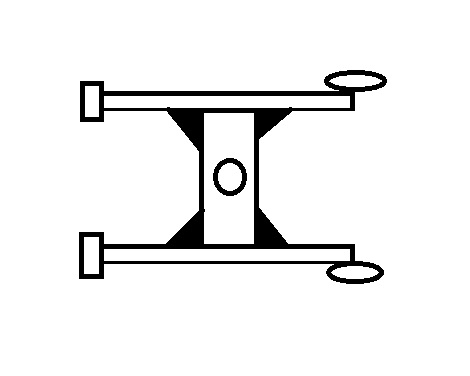
topview.jpg
 
   / Metal Thickness? #22  
...I really like the idea of building my own though.
Not for practically, but for the experience.

I do that lots of times and have collected lots of “junk” over the years to build things for virtually free. May even save some money because my hands are busy.

If I want to build something, first thing I do is research “them” and pick “the good ones” and go spend some time looking them over, a tape measure & caliper can also be a nice thing to have as well as your cell phone, so you can take photos too.

Another thing I also suggest you do is put the project together on paper, all the little things you don’t have already. Add them up on paper BEFORE you buy a single thing.

Even if you already had an engine with hydraulic pump mounted to it and a couple sheets of steel plate, it’s nice to know even a surplus open center 6 spool valve is over $800 and you’ll need another couple hundred more in hose and fittings before you jump in.

Now, that I have a dollar amount, I look at the used market (craigslist and the like) to see what I can just go buy one (even a broken one) that might be less cost and work than a “from scratch“ build.

As far as building things from steel, using hydraulics, “How strong?” or “What cylinder?” Can’t be answered until you let us know how much force they are going to see and what direction(s) (tension/compression/side loads).
 
   / Metal Thickness?
  • Thread Starter
#23  
Yeah! Real crap. More of a garden tractor with a blade. But its so old, and so neat I can't let her go.
Works perfectly fine, once you get past the lack of breaks and antiquated levers for operation.
...it was never equipped with breaks, but with steering breaks - which work if you are fast enough, and remember which way to pull the levers, making sure to do both before you drive it into a ditch (which I've done) Mostly, you "blade down" to stop, which works fine, unless you are too close to the ditch and in you go.

Screenshot 2022-12-06 121434.jpg
 
   / Metal Thickness?
  • Thread Starter
#24  
If I want to build something, first thing I do is research “them” and pick “the good ones”

Exactly, and pick the features you like, then ditch the ones that you can't duplicate or are too complicated, and assemble!

Another thing I also suggest you do is put the project together on paper, all the little things you don’t have already. Add them up on paper BEFORE you buy a single thing.

Even if you already had an engine with hydraulic pump mounted to it and a couple sheets of steel plate, it’s nice to know even a surplus open center 6 spool valve is over $800 ... Now, that I have a dollar amount, I look at the used market (craigslist and the like) to see what I can just go buy one (even a broken one) that might be less cost and work than a “from scratch“ build.

Surplus Center only has one higher quality spool; a 6-8 open center is $150-$200 imported.
Pricing is the start of any idea I have.

As far as building things from steel, using hydraulics, “How strong?” or “What cylinder?” Can’t be answered until you let us know how much force they are going to see and what direction(s) (tension/compression/side loads).

Yeah I don't know any of these things, which I why I came here.
 
   / Metal Thickness? #25  
I would have to agree with other posters about the tremendous amount of engineering and iterative improvements involved in something of this complexity. Additionally, it sounds like you don't have much in the way of welding or fabrication experience, hydraulic design and sizing, etc. If all that is true, this sort of huge project may not be the best idea unless you enjoy it and are doing it as a hobby.

Have you thought about buying a basket case/ready to scrap commercial machine and repairing it? That way you don't have the initial cash outlay but you benefit from all the engineering and you can expect reasonable residual value after repair. The skill set and tools required for repair of an existing complete pre-engineered machine is much lower than that required for complete design and fabrication of a new one from zero.

If you are set on designing and fabricating it: in answer to your initial question -the base that the boom attaches to will need to be stronger than just single thickness 1/4 plate as it will take a lot of stresses. Note in the commercial version it is made of several plates welded together. Another thought is you should buy your plate steel from a place with a waterjet or plasma table and have the plate precut for all your pieces -this will be well worth the relatively small additional charge with the handling and attempting to cut to size yourself
 
   / Metal Thickness?
  • Thread Starter
#26  
Have you thought about buying a basket case/ready to scrap commercial machine and repairing it? That way you don't have the initial cash outlay but you benefit from all the engineering and you can expect reasonable residual value after repair. The skill set and tools required for repair of an existing complete pre-engineered machine is much lower than that required for complete design and fabrication of a new one from zero.

Ive been looking for years.

Thats how I got my dozer and Ditch Witch. I even have a Case 500 front end loader.
Which is way to big for anything I need, but makes quick work of moving large objects; you just dare not leave the hard pack, or you'll get stuck.
And pulling a 9,500 pound machine out of the sand with no help and a ranger is not a fun task. I tried selling that clunker a few times with no luck.
It seems I am the market for 50 year old machinery.

But I want a small digger, not a big one; mini diggers are few and far between.
 
   / Metal Thickness? #27  
You might want to make it heavier since the weight is all that's going to stop it from moving while digging, especially in harder ground. Might be better off finding one of them pull behind backhoes Northern use to sell for around $5000 years ago.
 
   / Metal Thickness? #29  
There they still sell them pull behind backhoes $3500.
 
   / Metal Thickness? #30  
I dunno, a running mini dozer of any kind would have to be a real pile of crap to not be worth $2500 here in South Texas.. what is it?!
I bought a Case580 Construction TLB when I built my house, ran it for 5 years, then sold it for more than I paid for it. I've been fortunate that way with equipment several times now. My experience is if you buy a decent, desirable used machine it will hold it's value. It might cost more up front, but it's better to use the right tool for a job instead of pissing around trying to fix old, worn and broke. Time is money too. Downtime costs even more.
 
   / Metal Thickness? #31  
BxB301,

Of course, you will do what is right for you, which, is as it should be. Some of us write here simply out of a goodwill sense of caution. Yes, I built my own house, aircraft hangar, and workshop, as well as a lot of equipment over the decades. I have also owned a mini excavator since 1998, with about 2500 hours on it, doing all the maintenance and a few modifications myself.

Consider one aspect, when comparing what you've built: House, excellent! but, when something doesn't quite work , you can still live in the house, and most likely fix it ('cause you know it so well!) - I've lived since 1990 that way, it's excellent - I have never hired a repairman! But, when your mini-ex stops working, it's 100% not usable, and probably stuck where it is, taking your time, and not producing any outcome. That's fine, if it's home, and you have the time for loss of use, and to fix it. I completely rebushed and repinned mine shortly after buying it. All new Yanmar bushings, and I made all new pins, turned, hardened and ground to a couple of thou clearance to each joint. It was a lot of work, but well worth it, I've got 2500 hours of use out of it! When I think of making all of those joints to a good tolerance new, I understand, and shudder at the amount of work.

I suggest, if you have not already, find a mini-ex to run for a while. While you're running it, pay very close attention to "loose" joints, both boom and controls. Is it okay for you? Can you make your joints that good? If you're going to make your project with only one pump, practice digging with the mini-ex using only one control (motion) at a time. This will give you an idea of what to expect from a single pump machine, no or very little compound motion.

As for the weight of the machine, consider the balance of the machine when you start to pull on a tree root fully extended. My mini-ex is 3000 pounds (so very small), and I can drag it across the ground when pulling against a tree root, or football sized rock in the ground. A lighter machine would be even less useful this way. And, (having flopped mine twice), consider a seatbelt and roll bar. Sadly, we humans have a terrible habit of trying to prevent what we're on from flipping, by extending an arm or leg. That's a super terrible idea when you're on a digger of any kind! As the saying goes, if you think safety is expensive, try an accident.

When my student crashed us in his plane crashed us five years ago, I was wearing my seatbelt. I pulled it out of the airplane as I was ejected. 3 mounts later, I was well enough to begin walking again. Two broken ankles are not nice, don't let something you built bite you! Mini-ex's flip a little too easily!
 
   / Metal Thickness? #32  
Yeah I don't know any of these things, which I why I came here.

The first part of a design is to have an objective.

How much weight do you want it to lift?
 
   / Metal Thickness?
  • Thread Starter
#33  
The first part of a design is to have an objective.

How much weight do you want it to lift?

A 5 gallon bucket of sand - so depending on moister content, 70-90 pounds.
 
   / Metal Thickness?
  • Thread Starter
#34  
BxB301,

Of course, you will do what is right for you, which, is as it should be. Some of us write here simply out of a goodwill sense of caution.

I suggest, if you have not already, find a mini-ex to run for a while. While you're running it, pay very close attention to "loose" joints, both boom and controls. Is it okay for you? Can you make your joints that good? If you're going to make your project with only one pump, practice digging with the mini-ex using only one control (motion) at a time. This will give you an idea of what to expect from a single pump machine, no or very little compound motion.

I apricate everyone's caution, I really do.
I guess I'm just lost in the complexity of this.
That being, I don't see it being complex at all, and really, probably the simplest machine one would make.
Even the design, it not shifting the boom to the left or right so you wont have that side load to worry about. Sure, the center bearing needs to be beefy, but less so than the complexity of a rotating boom.

For the pins, I planned on getting a 1" ID pipe (or whatever the pivot pins will wind up being) and welding that into the boom - inside and out, then using a sand paper grinding wheel, grind the outside flush. If the pipe doesn't fit, you'll know your holes are off.
For the boom pivot on the body, you drill a hole to the OD of the pipe on both sides, run the pipe strait through the 2 sections, check for equal distances from pipe to body, weld the outside, and inside, then cut the center out of the inside, and grind flush - Perfectly aligned pivot points.
The boom needs to be straight, but the cylinder pins can be "auto corrected" with the use of a cylinder with an eyelet.
I didn't plan on using one, but I don't see why I couldn't?

The topic of the single pump has come up previously as well; and again I'm lost.
I guess you guys just have better experience than I. Every small or large machine I have operated or rented has been this way. Pull one lever, and it works great, pull a second at the same time, it starts to suck. Only exception is the JLC bucket lift I rented. You could use every hydraulic button your finger could reach and they would all work the same.
Forklifts, same way - if you're going up and trying to shift sideways, both slow down. On hydraulic propelled machines, going forward and then going up, you slow to a crawl and it hardly lifts.


....Actually, I take that back, my front end loader can lift and dump or tilt without any slowing down.
I never do, but now that I think of it, it can. However its pump is bigger than the Honda motor I plan on using with this proposed machine.
 
   / Metal Thickness? #35  
Towable backhoe complete $3500: 9 HP Towable Backhoe

This guy sells plans for them -should have most of the bugs worked out:

With the plans at least you would have schematics for the boom and Dipper stick that you could use even if you want to make it self propelled
 
Last edited:
   / Metal Thickness? #36  
Ive been looking for years.

Thats how I got my dozer and Ditch Witch. I even have a Case 500 front end loader.
Which is way to big for anything I need, but makes quick work of moving large objects; you just dare not leave the hard pack, or you'll get stuck.
And pulling a 9,500 pound machine out of the sand with no help and a ranger is not a fun task. I tried selling that clunker a few times with no luck.
It seems I am the market for 50 year old machinery.

But I want a small digger, not a big one; mini diggers are few and far between.

Excavators don’t get stuck like other equipment especially old 2wd backhoes will. I’ve had excavators in bad mud holes and I’ve never had to get a second machine to recover one. It sounds like you might be better suited with a better trencher though.
 
   / Metal Thickness? #37  
Towable backhoe complete $3500: 9 HP Towable Backhoe

This guy sells plans for them -should have most of the bugs worked out:

With the plans at least you would have schematics for the boom and Dipper stick that you could use even if you want to make it self propelled
Following some plans will eliminate 1000 wrong moves. You still make some, just lots less. o_O
 
   / Metal Thickness? #39  
A 5 gallon bucket of sand - so depending on moister content, 70-90 pounds.

You could do that with pneumatics if you have an air compressor. An 1800+ psi hydraulic unit sure wouldn’t take much cylinder.
 

Tractor & Equipment Auctions

7021 (A55851)
7021 (A55851)
UNUSED IRGC80 Battery Powered Golf cart (A55272)
UNUSED IRGC80...
2022 John Deere R4023 (A60462)
2022 John Deere...
Dodge Charger (A56859)
2019 FREIGHTLINER CASCADIA TANDEM AXLE SLEEPER (A59905)
2019 FREIGHTLINER...
Chevrolet 2500 Flat bed (A56438)
Chevrolet 2500...
 
Top