Machining metal parts

/ Machining metal parts #41  
Collets are fairly limited in number of sizes and not many drill bits are going to successfully fit in them, but when you can, sure it can help. And most people who own a round column mill/drill are not going to have a collet set in 1/64's increments either... 1/8,1/4, 3/8, 1/2...are what you will probably have.
My R8 set is 1/32 increments. Never had a problem.
 
Last edited:
/ Machining metal parts #42  
Collets are fairly limited in number of sizes and not many drill bits are going to successfully fit in them, but when you can, sure it can help. And most people who own a round column mill/drill are not going to have a collet set in 1/64's increments either... 1/8,1/4, 3/8, 1/2...are what you will probably have.

If you have something that won’t fit any collets on hand, use the Chuck. You are drilling at that point NOT putting a side load on the Chuck, like you would be trying to use a drill press as a mill. End mills, even if the cutting surfaces are odd, will have a common shank. 1, 3/4, 1/2, 3/8, 1/4…
 
/ Machining metal parts #43  
Now you are gonna go an confuse new people.

There are literally dozens of different tool holder types.

R8 with drawbar seems the most common on the Bridgeport type Mills that a home hobbiest would be interested in.

Mine has quick switch tooling with er style collets.

Just going to an ER tool holder instead of directly in the r8 collet may be enough length that you can swap from Mill tooling back to a drill chuck without having to constantly raise and lower the table
If they are this far they'll have to learn it sooner or later anyways!

I have an ER32 adaptor I use in my knee mill with R8 spindle, overall length is a little shorter then a standard N14 chuck. What gets you is the length of a jobber drill bit is most likely longer then the end mill you'll be using, so unless you're using screw machine length bits you'll probably still have to change the Z axis.

Agreed there's a lot of different style tool holders, but I'd say currently the most common, especially in the hobby side, is the R8 and ER collets.

Sent from my SM-G715U1 using TractorByNet mobile app
 
/ Machining metal parts #44  
A couple good sites for the original poster: hobby-machinist.com, The Home Machinist! - Index page
You'll find some good info there, more than you'll need.

My advise for a new hobby machinist who's just wanting to turn out some parts for himself, do repairs, etc...just get some Chinese machines from Enco or Grizzly. Do your due diligence obviously, read some reviews to make sure you don't buy machinery everybody has problems with, but yes I would start with the Chinese machines.
 
/ Machining metal parts #45  
Buy a Bridgeport milling machine.
Come from a 40 yr. Retired machinist here.
You should be more specific for this guy, actual bridgeport or a bridgeport-type (knee mill)? Around here, buying an actual bridgeport generally means a project of some sort, coz it's gonna be a clapped out machine. I think that's too much for a newbie to take on, extra expenses and all that...he's better off getting a chinese clone. A well-running bridgeport is a beautiful machine though, I'll give you that!
 
/ Machining metal parts #46  
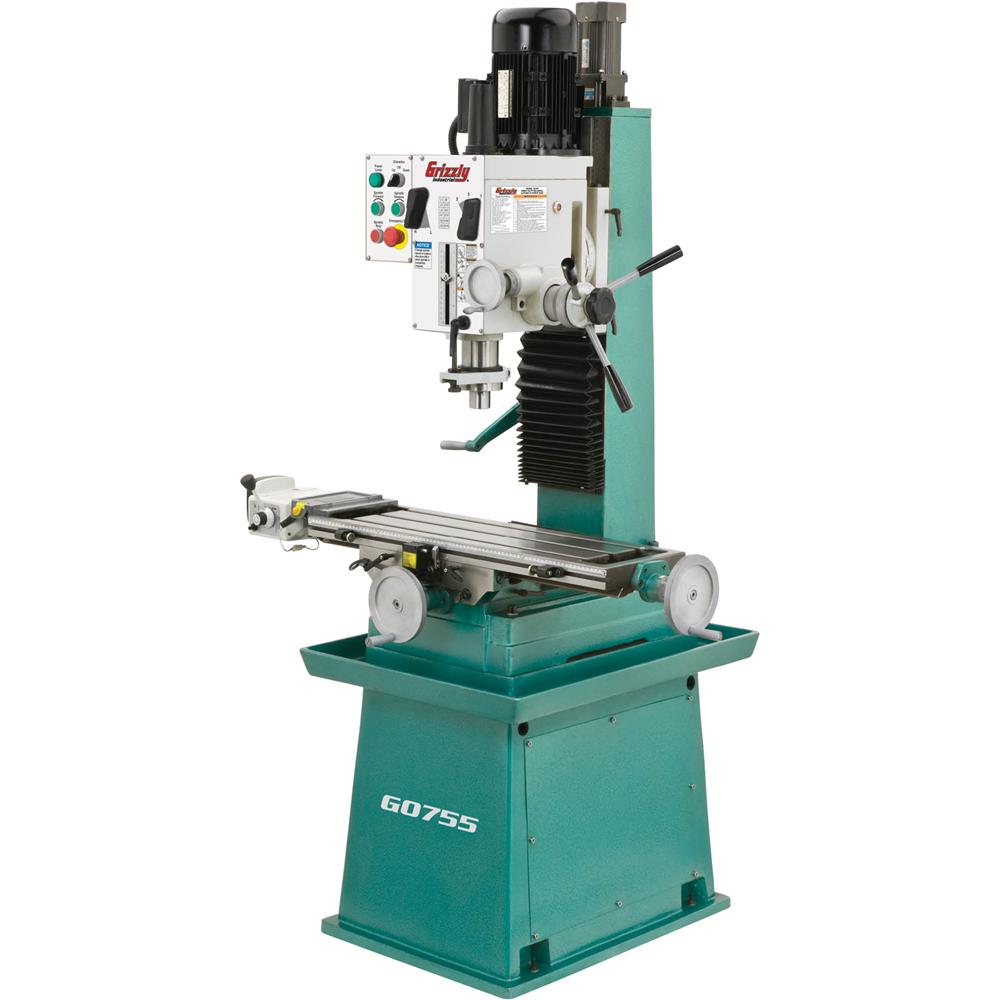
Gene, same situation around here - after spending about 8 YEARS looking for a semi-local (100 mile radius) and finding only over-priced, "rode hard and put away wet" (if not just left in the rain) Bridgeports or clones, I finally gave up and bought this


(price is now almost a grand higher than I paid) - the R8 collet set I have is in 1/16" increments, so far haven't needed more. Added an 8" rotary table, 6" 3-jaw adapter for the rotary, small angle table (for when I don't wanna hafta re-tram), replaced the crap drill chuck with my 3/4" Jacobs super chuck, 3" boring head, Fowler centering gauge, plus a bunch of other goodies as I learn about 'em...

So far it does all I need, so it's a win. Now, if I can just save more than the price increases for the "companion" size lathe (and find a place for it), then yay fer me :=)... Steve
 
/ Machining metal parts #47  
Depending on where you are, there are deals to be had if you know what you want and willing to jump in the truck and drive asap to look and put a deposit on decent mills.
I bought this Sharp 3hp, varispeed, R8, Mitutoyo DRO, power feed on table, Kurt vise ready to work for $1500. It was running, wired and a guy just finished up a quick job with it, company was going out of business. Had to move it the next day promptly, but was worth the effort. IMO it’s value is worth twice what I paid but I was in the right place at the right time with cash.
 

Attachments

  • 092B37BF-8A21-423D-86A4-E5149ADE9C44.jpeg
    092B37BF-8A21-423D-86A4-E5149ADE9C44.jpeg
    191.7 KB · Views: 149
  • 86156EC6-8D6C-457B-B6C8-D326D6822882.jpeg
    86156EC6-8D6C-457B-B6C8-D326D6822882.jpeg
    261.7 KB · Views: 163
/ Machining metal parts #48  
Depending on where you are, there are deals to be had if you know what you want and willing to jump in the truck and drive asap to look and put a deposit on decent mills.

I think that hits the nail on the head. A newbie isn't likely to have a great idea of what they want & an even worse ability to evaluate if a machine has some hidden issues or is even just plain worn out. Deals are definitely there to be had, but you need to be able to capitalize on them.

I'm setup to haul 7-10k lbs of tractor & impliments at the drop of a hat. But don't have any equipment to load or unload a 3k lbs + Bridgeport. I might be able to get it in pipe rollers & winch it on, but don't have a toe jack decent pry bar & other stuff offhand. They aren't well balanced machines designed for frequent moving.

Where you are factors in massively as well. People out East seem to forget that's where the majority of manufacturing was before it left the country. Way fewer older machines the further west you go.

I've been looking for a mill for a few years at various degrees of seriousness & been frustrated. The Denver area is better than many for avalibility too. Lots of clapped out machines out there or stuff that's way to expensive, sometimes both. I ended up with a new Tawanese Precision Matthews lathe for that reason. Still looking for a mill & may get another Taiwanese one there.
 
/ Machining metal parts #49  
Macine shop near me was upgrading mills and had 6 mills at auction. Paid $1375 out the door for this 3400lb 3hp ACRA with pnuematic draw bar, power feed, VFD speed control, and DRO. It was in production until the day before the auction closed.
20210810_094300.jpg
20210730_152616.jpg
 
/ Machining metal parts #50  
Macine shop near me was upgrading mills and had 6 mills at auction. Paid $1375 out the door for this 3400lb 3hp ACRA with pnuematic draw bar, power feed, VFD speed control, and DRO. It was in production until the day before the auction closed.View attachment 721019View attachment 721020
That's a nice piece

Looks like it has an extra long y-axis compared to most knee mills
 
/ Machining metal parts #51  
Let's talk a little about buying a machine tool. The truly most versatile machine tool is the lathe. But to take advantage of this you must be experienced using the lathe. For an inexperienced user, a beginner using machine tools, a knee mill, also known as a turret mill in the Bridgeport type mill configuration, is probably the most useful, though still not the most versatile, machine tool to buy. And this is because lots of turning work is not usually required to make or repair most of the stuff for the folks reading this.
So a mill is to be the first purchase. Once again versatility is in the picture. But this time versatility and usefulness go hand in hand. The most useful will also be the most versatile. And the most versatile will also be the most useful. In my opinion, as a machinist with over 45 years experience machining stuff, getting a Bridgeport type mill is the by far best decision. Even for someone with limited funds. Especially for someone with limited funds. I know, prices are different all over the country. Still, it really makes a huge difference, more than offset by the price difference, to have a machine tool that can do so much more than a lesser machine.
If you can, then you should, look at several machines before buying one. If you can pay a machinist to look at a particular machine that's good. Maybe even better is if you can get a machinist to show you a good and a worn machine side by side or at least close is proximity time wise. Then you can look at machines on your own and not pay for every mill you look at. Maybe then you can make the purchase decision on your own or at least whittle down the prospects so that your paid consultant doesn't need to be paid that much.
If you are for sure going to buy a mill then you will need some inspection equipment. You will need a test indicator And a magnetic base for the indicator. And a 1 inch travel indicator. These same inspection instruments are also extremely useful for evaluating the condition of the mill you are thinking about buying. You should then buy these for yourself ahead of time. Learn how to use them. This may make it possible for you to evaluate a machine on your own. Doing your own evaluation, if you are confident in the use of these inspection tools, may make it possible for you to take your time evaluating a machine, to really take your time, and so make a better decision.
I know, there are other folks with different opinions. They mean well, as do I. And there it is.
Cheers,
Eric
 
/ Machining metal parts #53  
Its 10x54 bed instead of 9x42.
Still just looks like it has wat more travel than most knee mills I see. Like almost more travel than the head can compensate for by running it in and out
 
/ Machining metal parts #54  
The truly most versatile machine tool is the lathe. But to take advantage of this you must be experienced using the lathe. For an inexperienced user, a beginner using machine tools, a knee mill, also known as a turret mill in the Bridgeport type mill configuration, is probably the most useful
I can’t see being without either as both are pretty important in my projects. Other tools as well.

As this is the welding forum, the pantograph I built is one of the more handy projects I have made. Saves hours of time.


Wrap your head around milling something like this out, without a CNC. Now think about shaping it from plastic sheet then duplicating it in steel, one after another, using the torch or plasma you already have.

A5456540-E243-4296-ABE5-CD0B7D1E1AEE.jpeg
090C7838-1CAD-4EA0-B7B1-94B7834EBC56.jpeg


Other than boring and turning lathes can also thread ID as well as OD and you don’t always have to single point.


Drilling and tapping can be done on drill presses as well, some are made just for the job and in today’s CNC world can be picked up for scrap prices.


That said, none of the above can replace a good mill, the machines complement one another.
 
Last edited:
/ Machining metal parts
  • Thread Starter
#55  
I've been following along on this discussion and have looked up the things you've mentioned that I didn't know about, such as the coaxial indicator. I've also been looking at the youtube videos and have learned a bunch. I want to get a "reasonably good" machine. I'm in the camp of a newbie staying away from "cheap" (like harbor freight) machine tools because they'll only get frustrated. I'm reasonably good with wood turning and have good quality tools in that area, I've given demos using harbor freight lathes and can make it look good. BUT, I know the tool limitations and can accommodate them. For example, repeatability, on my equipment I can take the work off the machine and put it back on and it is still lined up properly, can't do that with cheap tools so you have to plan your work differently. For my wood working, Grizzly is the brand on most of my tools so I'm looking at them for the metal working, but I wonder if it's good enough. Tolerances on metal working are much tighter than on wood working.

After seeing the videos on how DROs are used, that seems that it would be in the really, really should have category. I'm also aware that the recommended 1st machine tool is a lathe, but I can't imagine what I would do with it so I'm looking at a mill.
 
/ Machining metal parts #56  
A mill or lathe w/o a DRO, it's like multiplying compound fractions w/o a calculator. There's no way I'd go back to working without a DRO!

BukitCase, that Griz of yours is a perfectly fine machine. I have limited head room in my shop, so needed a more compact mill myself, bought a Precision Matthews PM935. A Taiwan knee mill, maybe has a little more capability than yours, but not by much.

Lathe, mine's a Prototrak toolroom CNC lathe.
 
/ Machining metal parts #57  
Gene, thanks; so far it's not dissapointed. I generally try to buy tools that I am the limitation, NOT the tool - so far, so good. When I was looking, I had the good sense to listen to someone who had BTDT and worn out the T shirt, so my choice of mill has the power up/down on the head, square column, powered X axis. So far I've not been sorry.

DRO - couldn't agree more. I have all the components to implement, but it hasn't reached the top of the (excruciatingly long) project list (the GOOD news: boredom will NOT be happening before somebody "pats me in the face with a shovel", so I'm calling that a "win".

For those who aren't afraid of tech, you can save around $1000 on a 3 axis DRO - here's a way to do it wireless (sorta) and you can add the lathe DRO later for just the cost of the scales and wifi pieces


I haven't been on his site for a while, but I can't imagine when Yuri sleeps; seems like he's constantly answering questions and adding features to the app... Steve
 
/ Machining metal parts #58  
I dunno about Yuri's kit (sounds like he's from my part of the world, per his name), but I installed DRO kits before, ones I bought from Shars. They weren't all that hard to install.
 
/ Machining metal parts #59  
A mill or lathe w/o a DRO, it's like multiplying compound fractions w/o a calculator. There's no way I'd go back to working without a DRO!

BukitCase, that Griz of yours is a perfectly fine machine. I have limited head room in my shop, so needed a more compact mill myself, bought a Precision Matthews PM935. A Taiwan knee mill, maybe has a little more capability than yours, but not by much.

Lathe, mine's a Prototrak toolroom CNC lathe.
Agree they are nice....but It would be much easier to give up my DRO on the lathe.

For the mill.....it is SOOO much faster precisely locating everything, drilling holes in a specific pattern, depth of cuts, etc.

But the lathe.....I can use the single hand wheel for each pass which is spot on. And if I need an exact measurement for the carriage, I can simply stick on my magnetic dial indicator.
 
/ Machining metal parts #60  
Still just looks like it has wat more travel than most knee mills I see. Like almost more travel than the head can compensate for by running it in and out
@LD1 I'm sorry, i read X axis when you said Y axis. The travel on the head of this mill is 24". I keep it set near the mid point
 

Marketplace Items

2013 JOHN DEERE 772G MOTORGRADER (A60429)
2013 JOHN DEERE...
500 BBL FRAC TANK (A58214)
500 BBL FRAC TANK...
2017 Ford F-650 Service Truck (A59230)
2017 Ford F-650...
UNUSED ZJG ZJ-08 MINI DIGGER (A60430)
UNUSED ZJG ZJ-08...
2-Row Peanut Inverter (Chain Drive, PTO, 3-Point Hitch) (A61307)
2-Row Peanut...
2017 Freightliner M2 106 AWD Terex Hi-Ranger 5TC55 55ft. Insulated Material Handling Bucket Truck (A60460)
2017 Freightliner...
 
Top