LOOONNNGGG Underground Cable Run

/ LOOONNNGGG Underground Cable Run #21  
Did the same thing with bout 1000'. Sch 40 in ground sch 80 out of ground. Primed and glued joints, to co-op standards. Had elect inspector ok it before I filled in the trench. Then filled the trench. Then took orange hay twine and sucked it through with a regular shop vac, worked like a charm. Co-op won't use your pull rope, they will use your rope to pull their rope through. They provided all the lubricant etc for pulling wire. In 1000' pull I did not have to install pull boxes. Hope all goes well.. Also got a trick if you get water in the line how to get the rope through.. If you get into that predicament message me....
 
/ LOOONNNGGG Underground Cable Run #22  
Do I understand you to say the step down transformer will be on the pole and you will then run the low voltage service 1500 from the pole to where you need power?

Why not put a pad mount transformer near your service drop location and have the power company run an UG distribution service to it?
 
/ LOOONNNGGG Underground Cable Run #23  
I can't imagine a power company being willing to install a secondary run 1500' as some have stated earlier this is a job for the overhead ie poles and wire to be brung in closer or if you don't want that you could have them bring underground primary in that 1500' of pipe and have them place a padmount transformer closer to your house. Whatever you do don't go with direct burial, you have the right idea putting it in conduit and most definately glue the pipe joints, put glue on both the bell end of the conduit and the end that you slide into the bell. Good luck you will need it with a run of secondary cable that long.:D
 
/ LOOONNNGGG Underground Cable Run #24  
I cannot speak to exactly your situation as posted, but I can "me too" a couple of things.. All conduits will fill with water buried in the ground. for reasons already stated about condensate. Not saying you should not glue them tho, as you dont want them to accidently pull apart when backfilled. All that I have ever pulled in after a period of time were full of water. And I have successfully sucked a "mouse"with a vacuum cleaner thru 400 foot conduits many times easily.. I think it could go much longer, but 400 foot is the longest I have pulled in. After the vacuum gives out, comes "jetline" CO2 power that shoots a ball thru longer conduits. I don't know the limit though. The voltage drops worry me also. you can calculate it yourself by looking up the resistance of the wire, and estimating the current load, and plugging it into the Ohms law formula. I too dont understand why the power company is not bringing the high voltage feeder to you. Sorry I could not directly answer you questions.

James K0UA
 
/ LOOONNNGGG Underground Cable Run #25  
1500 ft isn't a problem

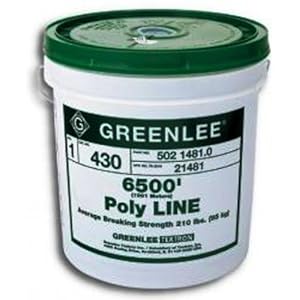
Use a bucket of jet line and a plastic bag stuffed with more bags to make a mouse the bucket of line will be less than $40.00 and a vacuum cleaner to suck the "mouse" through the pipe!
513tY3ggCkL._SL500_AA300_.jpg

Amazon.com: Greenlee 37959 Poly Fish Line, Red Tracer, 2200': Home Improvement


I think you would be better if the transformer was closer to the house
(100') and run the high voltage to it.
I would do it all under ground with any second thoughts.

Just a opinion of a 30 year electrician!

Tom
 
/ LOOONNNGGG Underground Cable Run #26  
No problem with the underground, most of the ones I have seen have the transformer at the house end for that long (and the power company maintains the line to the transformer).
 
/ LOOONNNGGG Underground Cable Run #27  
No problem with the underground, most of the ones I have seen have the transformer at the house end for that long (and the power company maintains the line to the transformer).

Exactly what I have, but only 450' long underground from power pole to the transformer set near the future house.
 
/ LOOONNNGGG Underground Cable Run #28  
:confused::confused2:.. Go to your local utility that is going to do the work and "ASK" what they want and what they are planning to supply,, Some of the infomation here is going to out in left field somewhere,,


Just which part of the information I have provided
here is going out into left field???????:mad:
 
/ LOOONNNGGG Underground Cable Run #29  
I cannot speak to exactly your situation as posted, but I can "me too" a couple of things.. All conduits will fill with water buried in the ground. for reasons already stated about condensate. Not saying you should not glue them tho, as you dont want them to accidently pull apart when backfilled. All that I have ever pulled in after a period of time were full of water. And I have successfully sucked a "mouse"with a vacuum cleaner thru 400 foot conduits many times easily.. I think it could go much longer, but 400 foot is the longest I have pulled in. After the vacuum gives out, comes "jetline" CO2 power that shoots a ball thru longer conduits. I don't know the limit though. The voltage drops worry me also. you can calculate it yourself by looking up the resistance of the wire, and estimating the current load, and plugging it into the Ohms law formula. I too dont understand why the power company is not bringing the high voltage feeder to you. Sorry I could not directly answer you questions.

James K0UA


Gotta love those pipeline piggys!!!!!!:thumbsup::laughing:
 
/ LOOONNNGGG Underground Cable Run #30  
My electric coop was reluctant to do "underground primary" because of the cost. But I insisted and they finally agreed. I had to provide a 4 foot deep trench from their takeoff point to wherever the lines come up above ground at the transformer pad. They provided the 4" conduit, wire, transformer and manpower to put it all together up to the transformer. I also had to have the wiring from the transformer, to the meter and main disconnect installed before they would do their part. I was only 200 amps and less than 500'. They would do any length I wanted but would require pull boxes every 500'.

Be sure that the conduit bells all face the same direction - especially the bends.
 
/ LOOONNNGGG Underground Cable Run #31  
Hi,

You really didn't say the power company was going to pull 1500 feet of low voltage (220) line, right? Undoubtedly they will pull high voltage line and put a transformer near your house. Believe me, stay in continuous communications with the electric company because their specs are absolute, but will change daily depending on who you talk to!!! I found that inconsistency to be infuriating.

I wanted 3800 feet underground, 7000 volt coaxial cable, Big transformer at my end. I had to provide a 4.5 feet minimum depth trench at least a foot wide, boxes at 'turns' (following a road right of way), and continuous conduit box to box. That depth requirement required a big trencher ($$$) or a very long backhoe dig.....so I got a contractor to trench it and lay in the continuous conduit, and 6 pull boxes. The longest pull was about 900 feet and the elco provided the pull twine, sucked through with a shop vac as others mentioned, then their rope (some of that expensive Dyneema stuff!). They did the pulling (winch truck) and used their own lube, probably 15 gallons!

You might consider the same decision, get a pro to do it. The contractors follow the electric company rules and regs, know the elco people they work with every day so they can negotiate small changes, and take the load off your shoulders.

For me it was worth every cent to turn-key the electrical job (but I ran the 1-1/4" water line that same distance myself)

Bob

I've got a huge job coming up, and I could use advice on technique.

After years of petitioning, the Power Company has consented to provide electricity to my isolated acreage in the VA mountains.

I have agreed to trench 36" underground from my service drop location to the nearest power pole, and put in 3" conduit with pull rope so that when the Power Co comes, they only need to pull the main feed (600A) cable from the nearest pole to my service drop.

Here's what makes it interesting: This is not going to be like pulling Cat5 through 40-50 feet. It's going to be a 1500 foot-long distance. With BEEG honking cable. Power Co has to pull the cable (thank Dog) but what is the best way to set up rope to pull through 1500 feet of 3" schedule 40 electrical conduit in a trench?

How do the pros do this? In 30 50-foot segments? 15 100-foot segments? Clearly I can't get a 1500 foot rope (and if I could, can you imagine trying to pull a cable that big that far? Ay yi yi...)

If I want the PowerCo guys to be able to work uninterrupted, do I need 30 50-foot ropes? What seemed conceptually simple (how hard can it be, you thread rope through a 3" pipe) becomes not so simple when I get to the details.

Who's been there? What's the right way to do this (besides subbing the job out)? I'm all ears, friends. Can you help me figure this one out?
 
/ LOOONNNGGG Underground Cable Run #32  
On my road, we only have a single 13 KV line running up the poles, anyone over two hundred feet gets a transformer set on a cement pad within 50 ft. from the house. I don't know what transformer they put on the pole if any before it gets to the transformer in the yard.
 
/ LOOONNNGGG Underground Cable Run #33  
We are about 1800 feet off road. In 2002, I installed (glued) conduit myself (4 foot deep trench required) and fed a Greenlee pull string through as we went. Yes, did it the hard way.

Our co-op required a pull box every 1000 feet max, and when walking job with their field engineer we decided to put an extra one on each side of a creek we went under, as the line elevation dropped several feet into the creek and then back out. This required two extra pull boxes, but eliminated elbow down into creek and back out. Still had to have one from the vertical down creek bank and back up other side. They also required all the elbows to be metal long sweep elbows, not plastic for that length of pull. We used 2 inch conduit.

The co-op ran main line voltage (7160 volts, IIRC) to near house, with a pad transformer stepping down to secondary that comes into meter base. They only used string I put in to pull a larger rope, then turn around and pull their pull line through, which was used to pull the conductor.

Your part is very doable.

My free advice, for what it is worth, is to contact the Co-op installation folks, get with their field engineer or job planner and walk the job. He will know capabilities of installers, and probably have some recommendations that will help make sure it goes smoothly.

Last thing you want to have is for them to show up on installation day and say "this is not gonna work and you're gonna have to redo something."

Nice thing about being underground is 1) don't see it and 2) protected from storm damage. When we had the major ice storm here in 2009, folks at end of long above ground service lines that fed single homes might have not had power for as much as 4 to 6 weeks if the service line was damamged. Once power was restored to main line voltage, we were back on here.

Good luck!
 
/ LOOONNNGGG Underground Cable Run #35  
I only read the first page so excuse me if you have the answers. I wouldn't go over 500-600 feet with secondaries. Now I've pulled 10,000's of miles of overhead and underground wire/cable. I would pull a single primary cable, say 1/0. A pull box would make it easier. The rope or winch will burn thru plastic 90's on a long pull. 20' Definatly. As far as rope, you can use blowline or mule tape for the utility to use. They will then use that to pull their line in. I prefer mule tape but blowline is cheaper. We use a air compressor to blow the mouse in (the blowline is attached to the mouse before you blow. You can take a handful of the plastic grocery bags, stuff them into another one, tie a not in it, attatch the blowline to it and stuff it into pipe and use compressed air to blow Line in. The homemade mouse should be slightly smaller than the pipe.
 
/ LOOONNNGGG Underground Cable Run #36  
For what it's worth, I'm a consultant to the electric utility industry and can offer some suggestions. As several have stated, this will need to be a primary cable run; it's much too far to run 240 volts directly. Also, don't go with direct buried cable. While some utilities will allow it, any problem or fault in the future will require a backhoe and excavation to fix the problem. That takes more time and money and can be very disruptive if they have to dig up your sidewalk or paved driveway (they won't likely let you dig up a powered, high-voltage cable, and you don't want to do it). Use conduit and make it easy on everyone to replace the faulty cable. But you can't get the specifications of what you need to do from any of us on this forum, because utilities don't all have the same standards. You need to contact YOUR electric utility to get the following information. At minimum, ask them these questions:

1. What size conduit do they require? Around here, the utilities usually insist on 4" or 5" conduit -- few would allow 3" conduit.

2. How deep must the conduit be buried? Different utilities will have different standards. You don't want to trench for 36" and find that your particular utility demands 42" deep or 48".

3. How far apart do they want you to install handholes (pull boxes)? This is going to be a truck pull -- it's very unlikely that human beings are going to attempt to manually pull heavy power cables hundreds of feet between hand holes. Again, different utilities have different standards and different pulling equipment.

4. What strength pulling rope do you need to place between handholes? Your utility will want some minimum strength rope and will use it to pull through the actually rope with which they will pull the cable.

5. Where on your property do they recommend putting the transformer pad? Where I live on the east coast, most utilities around here are using or upgrading to 13,800 volt primaries. Some utilities are experimenting with 23,000 volt primaries. Regardless, they'll have certain safety constraints and won't want the transformer right beside your house.

The engineer designing your installation will decide on the cable to be used and that will determine the size of the conduit and its bend radius. When you trench and install the conduit, use large sweeping bends. That will reduce the pulling friction.

Don't do any of this without talking with your utility first and meeting their requirements or you'll be risking spending time and money for nothing. I hope this helps.
 
/ LOOONNNGGG Underground Cable Run #37  
1. What size conduit do they require? Around here, the utilities usually insist on 4" or 5" conduit -- few would allow 3" conduit.

On the first bullet, I'm going to retract my comment about utilities generally wanting a bigger than a 3" conduit. Normally, we're running to much bigger loads than a house or farm, so the conductors are larger. For your application 3" may be satisfactory. Still, you do want to ask that question so the utility will specify what they'd like you to put in.
 
/ LOOONNNGGG Underground Cable Run #38  
Several people have already stated the fact that you need to contact the local utility and find answers to most of your questions, with that being said I would be quite suprised if they require you to use bigger conduit for single phase primary than 2" or 2 and1/2", I have worked in this industry for over 25 years and here in the SE that is pretty standard, now for your secondary run to the house if it's more than 100' it's pretty standard to use 3" if less most will let you use 2and1/2". We routinely pull 600' runs of single and 3 phase primary between manholes and or pull boxes ranging from #2str to 1000 MCM cable and we pull our rope and or steel cable in with nothing more than jet line. Don't let this project overwhelm you as it is very doable, with the proper information from your local utility. Good Luck.:thumbsup:
 
/ LOOONNNGGG Underground Cable Run #39  
This is definately doable. I know because I did the same thing 28 years ago. We live in New Hampshire so I dug a 4 foot trench from the placement of where the transformer would be to the electrical pole (a distance of about 1300 feet. Then laid one foot of sand on the bottom of the trench (just pushed it in with a backhoe) the full distance of 1300 feet. Then laid two telephone wires on top of the sand and backfilled one more additional foot of sand over the telephone wires. NOW COMES THE HARD PART. I used SCH 40, 20 foot lenghts and laid one pipe on top of the sand starting at the location where the transformer would be located. The I took a monkey wrench and tied it with Polypropylene submersible rope, 1/4 inch 1200 lb test, twisted 1000 ft reel, Part number SR25-1 (The American Granby Company was the manufacturer). I then threw the tied up monkey wrench thru the 20 foot SCH 40. At that point I threw the tied up monkey wrench thru the next 20 footer. At this point I went back and GLUED the first SCH 40 to the second SCH 40. I kept following thus cycle until I reached the electrical pole. Next I backfilled an additional foot of sand over the SCH 40 and then place YELLOW WARNING TAPE over the sand and then one foot of loam over the yellow warning tape. Hope this helps.
 
/ LOOONNNGGG Underground Cable Run #40  
When establishing the new electrical service at my vacant property last year, I met a power co rep at the property to discuss it. I assumed they'd want to install an overhead line from the roadside pole the 450' to the new transformer ... & that I'd have to "persuade" them to install it underground. Not so: They told me that costs have changed over the years to where it's cheaper overall for them to install it underground. I said great! :thumbsup: She told me I had to clear a 6' path from the power pole to the transformer location, which my L3940 gladly helped me do. Power co saved costs on: No pole(s) to install; No 20' clearing (they require 20' for overhead lines :(), not to mention they shifted the clearing job from them to me (which was OK with me); No return trips to re-clear the right-of-way; No trips to repair the line after storms, etc. The install foreman told me the aluminum cable they installed would last about 25 years. No idea if that's a reasonable estimate.
 

Marketplace Items

TIRE RACK WITH DIFFERENT SIZE TIRES/WHEELS (A67714)
TIRE RACK WITH...
Terex PT70 Posi-Track (A64911)
Terex PT70...
2012 JOHN DEERE 304J Wheel Loader (A67714)
2012 JOHN DEERE...
2023 JCB 3TS-8T TELESKID (A65053)
2023 JCB 3TS-8T...
2014 MAC FLAMELESS HEATER TRAILER (A67714)
2014 MAC FLAMELESS...
Woods 3pt 5' Mower (A64912)
Woods 3pt 5' Mower...
 
Top