Home Generators

   / Home Generators #1  

whistlepig

Elite Member
Joined
Jan 1, 2009
Messages
4,310
Location
Preble County, Ohio
Tractor
Kubota B7800 with FEL
When you read some of the threads you would think preparing your house for a home generator is like building a nuclear power plant and costs as much. It's not all that difficult or expensive. For sure have a qualified electrician check every step of the way. There are $1,400 power management systems that are available. These are very nice. One get by with a lot less money spent.
 
   / Home Generators #2  
Yea it didn't cost much for my setup and I understand there may be some danger involved if someone other than me did it at my home. I've been doing it for 30 years. Most of the time with just a 1200 watt Generac. I've had the newest one for three years. It's a 5500 watt.

When my power goes out and I decide, after determining the problem, that I want to use the generator I go to the outside breaker box and cut off the main house circuit breaker. This is the 120 volt. I leave the water heater breaker on and the A/C/Heater on and the oven. This way I know when the power comes back on because the air will come back on or the light on the oven will catch my attention.

I then take the gererator outside, crank it up and plug it to a heavy duty cord with male plugs on both ends. The other end goes into a plug in my shop. This gets power to the entire house. This is one thing I don't understand. Sometimes only half the house has power and I have to bridge it with another cord with the male plugs. I have to cut my water pump to my booster pump off as it will cause the breaker on the generator to trip. We still have water just a little low on the pressure. We usually forget the power is even off till it runs out of gas or the A/C comes on.

I let it run the fridge and freezer, TV and sat. receiver and whatever lights we need on, the ceiling fan and if we need it the attic fan. We don't try the microwave oven.
 
   / Home Generators #3  
This is one thing I don't understand. Sometimes only half the house has power and I have to bridge it with another cord with the male plugs. .

You are only feeding one side of the 220 volts, so 1/2 your breakers have no power. Sometimes something that runs off 220 is feeding the other side, but at reduced voltage. Always feed both sides or you risk damaging equipment.

I guess you are aware of the safety issues doing it this way, so I won't explain them.
 
   / Home Generators
  • Thread Starter
#4  
Here we go again. People trying to back feed a house from a generator. If you are lucky your house won't burn down and you won't electrocute a linesman. Don't back feed your house. It's illegal in most states and should be. You can hook a portable generator up in such a way that it is isolated from your house wiring and to keep your house the linesmen safe. Not that expensive and not that difficult. You have to have people that are wise to help you.
 
   / Home Generators #5  
When you read some of the threads you would think preparing your house for a home generator is like building a nuclear power plant and costs as much.

It is funny.

You also have the guys that start screaming about backfeeding an entire grid.:eek: I guess in Michigan our generators are the only ones with 30 amp breakers. Every time I try to use too much in my own house it trips. I can only imagine how well it'd supply voltage to a whole neighborhood.:D
 
   / Home Generators #6  
Greetings, I've done a couple. Useing a Transfer Switch can make it safe for the house and for anyone working on the line. when the power goes out you start your generator, throw the switches on the transfer box and there you are. Each switch you throw
seperates one leg from panel. I installed a small Transfer Switch at our place 8 switches. Two banks each with a hot leg. So two are used for the well {220v] and the remaining 6 are one each for the kitchen, heater and garage, front room, barn, ect. Not every thing is powered. With a large enough generator you can power every thing you have. I installed a larger box at my sisters [more stations] that required a larger generator. You match your transfer Switch to your generator. None of you guys are backfeeding are you? If you don
t throw you main you are. A T switch does it for you. Richard
 
Last edited:
   / Home Generators #7  
It is funny.

You also have the guys that start screaming about backfeeding an entire grid.:eek: I guess in Michigan our generators are the only ones with 30 amp breakers. Every time I try to use too much in my own house it trips. I can only imagine how well it'd supply voltage to a whole neighborhood.:D

It can be done, I've seen it. If you backfeed a transformer than until the gen dies (and it will, seen that also) you are feeding 7200 out the otherside of the transformer. Only takes a split second to kill a lineman.

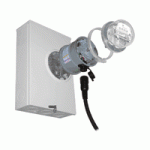
I just ordered this one with a 200 amp auto tranfer switch : Yanmar Powered 6,875 Watt Diesel Generator

No more pto back feeding for me. Tired of hooking it up in the rain etc.....
 
   / Home Generators #8  

Attachments

  • 100315_lg.gif
    100315_lg.gif
    6.9 KB · Views: 215
   / Home Generators #9  
You have to break the seal on the meter. Thats good while your building before you tie in. Methinks the transfer switch is the best. We set a dieses unit at the old Harras mansion Tahoe, owned now by a private party. It senses a power out throws its own Transfer Switch starts the engine and powers on. When it senses power in, it turns of the diesel and throws the transfer switch and she is back on line.
 
   / Home Generators #10  
Woodchuckie, You are powering only one leg of your house, when you plug in the second cord you are sending power to the other leg. Your newer generator is 220v I'm sure. Once exceede what your generator can cover you blow a breaker on the generator. Hope this helps.
 
   / Home Generators #11  
When my power goes out and I decide, after determining the problem, that I want to use the generator I go to the outside breaker box and cut off the main house circuit breaker. This is the 120 volt. I leave the water heater breaker on and the A/C/Heater on and the oven. This way I know when the power comes back on because the air will come back on or the light on the oven will catch my attention.

I then take the gererator outside, crank it up and plug it to a heavy duty cord with male plugs on both ends. The other end goes into a plug in my shop. This gets power to the entire house.


I don't get this part... how do you turn off your mains but still have your A/C come on when line power is restored? Does your entire house run off a sub panel with the exception of the A/C, stove etc. that you leave 'on'?


My bummer is my well if off a separate transformer at the other end of the property so I would have to have two generators :(
 
   / Home Generators #12  
My bummer is my well if off a separate transformer at the other end of the property so I would have to have two generators :(


Yep, that's a drag. I have a Champion travel trailer for my camper that I use for the pole-barn/well. Then, one of those big, loud, annoying Briggs 5500 watt generators for the house.

This thread reminds me of something... I probably need to get some fuel stabilizer added pretty soon, they've been sitting all summer.
 
   / Home Generators
  • Thread Starter
#13  
I don't get this part... how do you turn off your mains but still have your A/C come on when line power is restored? Does your entire house run off a sub panel with the exception of the A/C, stove etc. that you leave 'on'?


My bummer is my well if off a separate transformer at the other end of the property so I would have to have two generators :(

You can put disconnect boxes on anything or everything if you have enough generator. These disconnect boxes have a pigtail wired in to them. When you pull the bar on the disconnect box this isolates this circuit from the rest of the house wiring. Then the generator is plugged in to the pigtail. If the power comes back on it doesn't matter to what's on the disconnect and the pigtail to the generator. It is isolated from the house wiring. This the cheapest and safest way to go with out an expensive power management system. This is the set up I use. My 220V well pump is on a disconnect with a pigtail. When the power goes out I pull the bar on the disconnect and plug the generator in the pigtail. The pump is powered directly from the generator. I researched back feeding a house. That's a very ugly thing that I want no part of. The power management systems are the way to go but they are expensive. Honda makes an awesome power management system that I priced at $1,400 installed. We don't have that many power outages here. I've already got $2,500 invested in my generator. But we do have to have a generator here in the country. No well pump means no toilets flushed and no water for the livestock.
 
   / Home Generators #14  
I don't get this part... how do you turn off your mains but still have your A/C come on when line power is restored? Does your entire house run off a sub panel with the exception of the A/C, stove etc. that you leave 'on'?

some could. but thats likely a standalone "transfer pannel"
6_5000.jpg


those are the only circuts on the gen power. then when the power comes back on the rest of the lights come back on and you know to switch back over to grid for the other circuts.

but for the "back feed a 220v breaker" setups then no you generally kill the entire house to run it off the generator. and just have to rely on seeing your neighborhood lights are back on etc.
 
   / Home Generators #15  
backfeed a 14470 pot with a generator and you will make 14470. A step down transformer works both directions. Isolate completely.

Our power company provides isolation switchs at every meter set.
 
   / Home Generators
  • Thread Starter
#16  
some could. but thats likely a standalone "transfer pannel"
6_5000.jpg


those are the only circuts on the gen power. then when the power comes back on the rest of the lights come back on and you know to switch back over to grid for the other circuts.

but for the "back feed a 220v breaker" setups then no you generally kill the entire house to run it off the generator. and just have to rely on seeing your neighborhood lights are back on etc.

This is a power management system. Best thing going. $1,400 installed here at home. So like I am going to shell out $2,500 for a generator and another $1,400 for a power management system? I think not.
 
   / Home Generators #17  
This is the set up I use. My 220V well pump is on a disconnect with a pigtail. When the power goes out I pull the bar on the disconnect and plug the generator in the pigtail. The pump is powered directly from the generator.

OK, that makes more sense... I didn't pick up from your original post that you have some type of disconnects on certain circuits.
 
   / Home Generators #18  
The electrcian who put in my wiring used a mechanical lockout in the main panel. This is a special main disconnect breaker/switch. As long as the lockout is in normal position, you can't turn on the breaker that connects generator power to the panel.

To flip generator 220v breaker on, you have to turn off the main disconnect breaker, then slide the lockout plate, which allows you to flip the generator breaker on.

This is safe and not expensive, and pretty fool proof - no fancy gizmos to breakdown. Plus you have generator power to every circuit in the panel, it is up to you to manage the current draw on the generator by deciding what to run or not. You can also turn on/off circuits using their breaker in the panel.

I have a Honda 6500W generator, bought it in 1996 and it is still giving good service. It provided the power to build our current house and garage while waiting a couple months for the power company.
 
   / Home Generators #19  
You can always buy a 40k diesel generator in it's own sound attenuated housing, put it behind your barn, give it a feed line to your 550 gallon diesel tank, feed power to your home breaker box via 0000 copper wiring laid underground in it's own conduit and then have all auto switches installed, including a generator 'exerciser'. Or, you could always use that same money on a new Mercedes... :eek:
 
   / Home Generators #20  
The electrcian who put in my wiring used a mechanical lockout in the main panel. This is a special main disconnect breaker/switch. As long as the lockout is in normal position, you can't turn on the breaker that connects generator power to the panel.

To flip generator 220v breaker on, you have to turn off the main disconnect breaker, then slide the lockout plate, which allows you to flip the generator breaker on.

I just finished building my place a few months ago and wired my panel for this exact thing.... I actually found out about it on another post on TBN. It's called a generator interlock kit and it's UL listed. Generator InterLock Kit - Introduction

At $150 it's certainly worth the cost for me to manage the power load myself versus having a transfer switch that's sized for the generator.
 

Tractor & Equipment Auctions

Massey Ferguson 9250 (A56438)
Massey Ferguson...
CAT930K (A58214)
CAT930K (A58214)
2016 Ford F-150 Ext. Cab Pickup Truck (A59230)
2016 Ford F-150...
2020 Nissan Rogue SUV (A59231)
2020 Nissan Rogue...
2018 FORD F-150 XL EXTENDED CAB TRUCK (A59823)
2018 FORD F-150 XL...
2018 Forest River Flagstaff Pop Up Trailer (A59231)
2018 Forest River...
 
Top