Grapple project OPEN SOURCE

/ Grapple project OPEN SOURCE #21  
Seriously start adding up all the materials you think you would need, find them online, and price them. Add in shipping and tax (finding local to you will probably be the same or more). Seriously, shipping steel can cost the same or more as the steel itself. Now price ALL the hoses and hydraulic fittings. These add up fast. Find actual hydraulic cylinders, with retracted and extended lengths that will work for the range of motion and power you need. Add in the cost of about 10 lbs. of welding rod and a couple 10-packs of grinder cutoff wheels.

Now assume that you are going to break and mis-cut some, order some wrong fittings and a wrong hose here and there...it is seriously not that far out of line to add 50% more to your existing tally.

OK, you are talking about plasma cutting...do you own a plasma cutter yet? Have you priced them yet?

Have you seen what everything attachments has listed for grapples under the attachments forum?
 
/ Grapple project OPEN SOURCE #22  
Let me put it another way:
Build what you want, for you. We'll help where we can. Just don't expect everyone here to jump in on your project with your enthusiasm.

Bonus idea for you:
Making something the least expensive way that still works is what manufacturers do, and they have a team of experienced people doing it. The fact they make enough at the end of the day to keep the lights on and buy lunch is simply survival. Thinking you can teach yourself how AND do it for less is not realistic, no matter how hard you want it be.

It can be fun. It can get you something no-one makes for you. It can take you from something you already have closer to what you need. But don't think that beating the pros at their own game will be easy.
 
/ Grapple project OPEN SOURCE #23  
There is a big difference between producing a single (one time) product and mass producing a similar product...you really can't make a realistic comparison...
 
/ Grapple project OPEN SOURCE
  • Thread Starter
#25  
Let me put it another way:
Build what you want, for you. We'll help where we can. Just don't expect everyone here to jump in on your project with your enthusiasm.

Bonus idea for you:
Making something the least expensive way that still works is what manufacturers do, and they have a team of experienced people doing it. The fact they make enough at the end of the day to keep the lights on and buy lunch is simply survival. Thinking you can teach yourself how AND do it for less is not realistic, no matter how hard you want it be.

It can be fun. It can get you something no-one makes for you. It can take you from something you already have closer to what you need. But don't think that beating the pros at their own game will be easy.

I mentioned before that beating with pros is not in my interests. Neither I believe that they charge too much. They do what they have to do. But if I can save the labor, the business expensess, and the shipping expenses that a commercial model has, and at some point to have a model with BOM and instructions that someone else can replicate, I will be satisfied. For example you can check the CEB PRess we built in Open Source Ecology. Since it was done for a compresses earth block machine, a grapple will be a toy. I really have no expectations from people. There is not much anyway. I am a little confused in some points (like why some designs have pins when some grade 8 bolts can offer similar function) but nothing much really. Last week I had no idea what a grapple was, today I have a 80% done CAD design.
About plasma cutting. Not yet. I see GREAT reviews on the CUT50 models that cost $250, that will suffice on 3/8" steel. I do not calculate it cost because I am going to buy one soon anyway (I have developed a CNC machine that I want to add the Plasma on when I overcome the Torch Height Controll obstacle). I really do not think these are problems.
Similarly when I tryied to finance a tractor few months ago, and FSA rejected my loan application, I end up fabricating a log arch to use with my ATV, and I had never welded before. Seriously I went to HF and bought a flux welder. The log arch still works, (well, it just retired since I got the tractor with a winch).
My "dissapointment" is when simple people -not pros- are not wiling to share a CAD file. Which is what motivates me. When I will finish the CAD, it will be available to whoever wants to jump start. 3 people refused to give me their designs. Whatever, I spent these 2 raining days in front of the computer and I have it almost ready. Take it from there, and improve it.

You say that I will have to add 50% cost to my projected one. MAybe, maybe not. Thats why I research, and thats why I CAD. To avoid mistakes in real life. But still, I may make some mistakes. When I document everything, the next one guy, will not make the same ones. Thats one step forward.
 
/ Grapple project OPEN SOURCE #26  
This is going to be a steep learning curve for you. Many drawings have failed when construction was applied. It's hard for a fabricator to convince a designer that something won't work. So who is going to be the person that spends the money to see if your drawing will work? Anxious to see physical progress. :)
 
/ Grapple project OPEN SOURCE #27  
This could be a very good 3rd Year Mech. Engineering Design project at a 4 year Tech College to design, build, test evaluate and critique.
Involves almost everything but thermodynamics and dynamics, so maybe design a Pilot valve and spool control valve along with the Grapple and integrate it to a tractor.
Develop the BoM, manufacturing routing, purchasing, subcontracting, schedule, a lot to be learned hear.

The reason is this need to be a 3rd year project, is that it will end up being a senior project to finish, that if you don't finish it, you don't graduate.

Welcome to the real world.
 
/ Grapple project OPEN SOURCE #28  
Re bolts vs pins:
You can get tighter tolerances with a pin and you generally want it to stay stationary with one part of the hinge so you can grease the part that moves. To do that they are often pinned at one or both ends. Also want to consider among other things shear load, shock, operating environment (water, salt, dirt, etc), and useful life when selecting the materials, sizes, and design. Mechanical engineers get paid lots of money figuring these things out. Or copy an existing design.

That's the great thing about forums like this. Post up your design and people from varying backgrounds will point out the problems.

As others have said, if your primary goal is cheap, you're better off building the design around the parts you can find cheaply. For example, if you find surplus hydraulic cylinders that are some oddball size you might save 60% vs a common size. That comes with the drawback that you are married to an oddball size cylinder if you ever break it, or you have to modify.

I'll be interested in your BOM when you get it finished. My guess is you'll be well over $500 in raw materials, plus another $50-100 in consumables. Plus some unknown budget for "rework". If you like doing the CAD work, cutting, welding, grinding, adjusting, painting, modifying, then you can write off those 30+ hours as "free". Remember that buying plate you have to fit your design into readily available sizes like 4x4 or 4x8'. You may have to re-design shapes to waste less sheet material. It all takes time.

For me, I use projects like this as justification to buy a new tool or tools, so my projects usually end up costing similar to a commercially available equivalent, but I get a new tool too.
 
/ Grapple project OPEN SOURCE #29  
The beauty of releasing a design under a GNU General Public License is anyone can improve or add to the original design and re-release it...anyone that understands software release protocol has to love the approach...
 
/ Grapple project OPEN SOURCE
  • Thread Starter
#30  
This is going to be a steep learning curve for you. Many drawings have failed when construction was applied. It's hard for a fabricator to convince a designer that something won't work. So who is going to be the person that spends the money to see if your drawing will work? Anxious to see physical progress. :)
Thats me :) :)

Re bolts vs pins:
You can get tighter tolerances with a pin and you generally want it to stay stationary with one part of the hinge so you can grease the part that moves. To do that they are often pinned at one or both ends. Also want to consider among other things shear load, shock, operating environment (water, salt, dirt, etc), and useful life when selecting the materials, sizes, and design. Mechanical engineers get paid lots of money figuring these things out. Or copy an existing design.

That's the great thing about forums like this. Post up your design and people from varying backgrounds will point out the problems.

As others have said, if your primary goal is cheap, you're better off building the design around the parts you can find cheaply. For example, if you find surplus hydraulic cylinders that are some oddball size you might save 60% vs a common size. That comes with the drawback that you are married to an oddball size cylinder if you ever break it, or you have to modify.

I'll be interested in your BOM when you get it finished. My guess is you'll be well over $500 in raw materials, plus another $50-100 in consumables. Plus some unknown budget for "rework". If you like doing the CAD work, cutting, welding, grinding, adjusting, painting, modifying, then you can write off those 30+ hours as "free". Remember that buying plate you have to fit your design into readily available sizes like 4x4 or 4x8'. You may have to re-design shapes to waste less sheet material. It all takes time.
For me, I use projects like this as justification to buy a new tool or tools, so my projects usually end up costing similar to a commercially available equivalent, but I get a new tool too.
Your last sentense will serve as a great argument to get my wife's approval! ahahahahah
I will stay awa from any odd part, since it will not be replicable by others.
Your estimation fits my budget! Hopefully you will be right.

The beauty of releasing a design under a GNU General Public License is anyone can improve or add to the original design and re-release it...anyone that understands software release protocol has to love the approach...
Exactly!! I cannot agree more! And I believe it is time to expand the Open Source into Hardware. It will a great thing :) The revolution in software has increased bu a lot. My CNC runs open source program, my computer runs only opens source, and I would never imagine myself building a CNC or 3D printer without some other people releasing their hardware designs!!
 
/ Grapple project OPEN SOURCE
  • Thread Starter
#31  
Ok, one question plz. As it looks like there are only details left to be done

a) About the cylinder. Is it a good practise, when the cylinder extends full, the tips of lids to be just before the tines , exactly, or meet the tines just before it extends fully? I mean will it shorten the life of the cylinder (I doubt it since the tines will have some flexibility anyway)? I guess pinching will be a usefull thing.
 
Last edited:
/ Grapple project OPEN SOURCE
  • Thread Starter
#32  
Question #2 :)
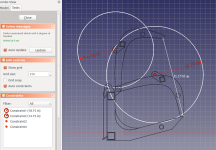
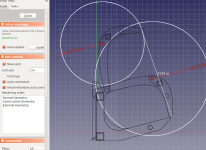
Take a look at these 2 different designs. It shows the tines both opened and closed. The white measurement is the opening to grab material. The white circles with the red measurement is the cylinder in the fully retracted and full extended position.
At the 1st image I used this cylinder with 4" bore, 2nd image with 6" bore. They cost the same.

The main difference that I think that is important is the place that the base of the cylinder mounts the grapple. With the 6"cylinder its about 1.5" higher. If I recall well from my high school, by having the base of the cylinder higher it will create more torque correct? Since the distance from the pivot point is longer.

Would you go with the 2nd design approach too? I feel more clamping force will be a good thing. Any other concerns on that matter?

Thank you guys!
Screenshot from 2017-10-27 08-42-25.png
Screenshot from 2017-10-27 08-40-13.png
 
/ Grapple project OPEN SOURCE #33  
When you said 4" bore and 6" bore think you mean stroke.

Both of your designs are gonna have very minimal clamp force because your pins are two much in align.
 
/ Grapple project OPEN SOURCE #34  
When you said 4" bore and 6" bore think you mean stroke.

Both of your designs are gonna have very minimal clamp force because your pins are two much in align.


Yep, I noticed that in his second drawing. It portrays using a 4" stroke to complete cycle. It will have almost no clamping force in the first half of the cycle from open to closed. The cylinder stroke needs to be 8" or more. The more, the stronger.

This example is where the designer meets the fabricator/user. As the latter, the fact that the former doesn't already see that gives me little comfort. :)
 
/ Grapple project OPEN SOURCE
  • Thread Starter
#35  
Thank you guys, I will redesign it with more distance between the pins
 
/ Grapple project OPEN SOURCE #36  
Thank you guys, I will redesign it with more distance between the pins

I'll assume you simply misquoted. The distance between the pins isn't the problem exactly. I'll let you correctly describe what needs changed. :)
 
/ Grapple project OPEN SOURCE #37  
I'll assume you simply misquoted. The distance between the pins isn't the problem exactly. I'll let you correctly describe what needs changed. :)

Hopefully he'll, um, leverage what he's learned on these forums.
 
/ Grapple project OPEN SOURCE #39  
One thing that can be frustrating about hydraulic cylinders is how much space they can take up when retracted.

Not sure if you already know this or not, but there are two types, single acting (commonly used on snow plows and some dump trucks) and double acting. Double acting take up more space, and require twice as many hoses...but move under power in both directions.

One of the easier sizes of cylinder to find, often cheaply or scrounged from other equipment is sometimes called an "ag cylinder", and has a 2" bore and an 8 or 10" stroke. Very common to see them used for simple things like wheels on disk harrows, and they are freaking everywhere. Shorter lengths are usually going to be harder to find, and may even be more expensive. 2-1/2" and 3" bore are available too, but they will be heavier. Every pound at the end of your machine counts against you.

Places to source from:
Look at
Surplus Center
Bailey Hydraulics
and look at the specifications for retracted and extended lengths. Also look at the pin sizes. It's not a bad place to start from to draw two circles centered on the base pin and design your mount locations and lever lengths from there.

The other nice thing about ag cylinders is the retracted and extended lengths are often the same across brands, which will make your design more useful for more people.

As to your other question, I think you are better off planning to have a little pressure on the tips to squeeze. The hydraulics will go to "relief" and stop pushing when hard resistance is met to protect the pump, valve, and cylinders, and the pinch is a very useful thing.
 
Last edited:
/ Grapple project OPEN SOURCE #40  
Hint #1: calculate the force of a hydraulic cylinder in an angle.

Hint #2: your 3 pins comprise a triangle. That is your cylinder angle to figure above.

Hint #3: the grapple teeth are beyond where the cylinder is pushing on them. Simple leverage once you figure out #1 and #2 and you will arrive at your bite force. Which as you have designed now....will be nil
 

Marketplace Items

2006 FRAC TANK 500BBL WHEELED (A60736)
2006 FRAC TANK...
2014 MASSEY FERGUSON 5612 DYNA-4 TRACTOR (A59823)
2014 MASSEY...
2026 Quality steel dump truck (A56859)
2026 Quality steel...
2019 Chevrolet Tahoe SUV (A60352)
2019 Chevrolet...
2013 FORD F-350 FLATBED (A58214)
2013 FORD F-350...
Giyi GY-TB47 Forklift Telescopic Boom (A60463)
Giyi GY-TB47...
 
Top