ditch digging attachment

   / ditch digging attachment #1  

Stomper

Gold Member
Joined
Jul 1, 2017
Messages
356
Location
Saskatchewan, Canada
Tractor
2017 Kubota L2501
I need to landscape my yard better for drainage. I have to dig up the front yard for some sewer issues I am having anyway so since it is going to be messed up, I want to smooth it out some of the high spots and fill some of the low spots and slope the area for better drainage towards the culvert under my driveway. On the other side of the driveway I want to dig out the ditch a bit deeper and make it a more gentle slope so its a bit more user friendly for mowing. I have a freind that has a pto tiller that I will be able to borrow to till up the ground for replanting the grass. I will eventually be doing the same for by back yard. The back yard is fairly good already but I would like to create a gentle ditch to control the rain and snow melt better. Right now it kind of goes all over the place. also the driveway could use some better sloping also. I could probably do all this with my loader but I think it would be much easier and quicker with one of the following impliments. What would be the best tool for the job. Land plane, box blade or rear blade. My tractor is a L2501 and the rear tire width is 62". How wide of impliment should I go with. I have no experience with any of these impliments but from researching them I think the rear blade would be best and it might come in handy for moving snow in the winter. Thankfully it's the cheapes. New 6' land plane is $1800. New 5' box blade is $1200. New 7' rear blade is $600
Any help will be greatly appreciated.
 
Last edited:

   / ditch digging attachment #2  
I think a box blade would be more capable than a rear blade for ditching and moving dirt.I also own a rear blade and use it mostly for snow removal,some road grading/leveling.The learning curve is a little greater with a box blade but they are a great tool.
 
   / ditch digging attachment #3  
Not trying to bust a bubble but please be aware...any of the proper attachments designed to do the type of landscaping you want...(a plane is not really suited for the tasks) will require some learning for a novice...

Hydraulic top and tilt greatly mellows the learning curve and the type of landscape grading you mention requires a bit of experience to prevent a lot of out of the seat hand work...

Good Luck...
 
   / ditch digging attachment #4  
If you are wanting gentle, you are grading, not digging. A land plane smooths & levels out high or low spots. Great for a driveway or smoothing a field, not for grading. A loader is for loading loose material, there is a reason it's not called a digger. While you could make it work, it will beat up your machine & give you poor results.

A box blade, or maybe a heavy box blade is the right tool. They are designed to grade off small layers at a time & move material around. With practice & patience they can smooth things out well too.
 
   / ditch digging attachment #5  
I think you got some pretty good answers already.

I do not have a box blade so I cannot recommend one, but when I extended a heavy haul road last year, and did a lot of swale construction in the same area, I used my Kubota (same sized as yours) with the front end loader and a grader blade. I also used a turning plow to loosen the soil, sometimes a few times to get the deep cuts in. It worked well.

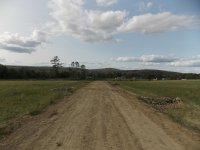
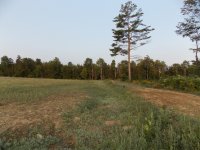
You will be surprised what you can do with your tractor with a little time and skill. Here are a few pictures of the ditching, rock dams, swale building, etc work that I did last year.
 

Attachments

  • DSCN5168.JPG
    DSCN5168.JPG
    3.6 MB · Views: 257
  • DSCN5182.JPG
    DSCN5182.JPG
    3.7 MB · Views: 216
  • DSCN5187.JPG
    DSCN5187.JPG
    3.5 MB · Views: 245
   / ditch digging attachment #6  
I think you got some pretty good answers already.

I do not have a box blade so I cannot recommend one, but when I extended a heavy haul road last year, and did a lot of swale construction in the same area, I used my Kubota (same sized as yours) with the front end loader and a grader blade. I also used a turning plow to loosen the soil, sometimes a few times to get the deep cuts in. It worked well.

You will be surprised what you can do with your tractor with a little time and skill. Here are a few pictures of the ditching, rock dams, swale building, etc work that I did last year.

A box blade has scarfier teeth built in, so you just lower the teeth all the way & do a pass. Or lower them part way, tilt the box forward (trivial if you have TnT) & do a pass. Either loosens up the top layer to scrape off. A box blade is generally a fair bit heavier than most back blades. This makes them cut better with or without the scarfiers.

The side plates on a box blade keep material contained to move it easier with less spillage.

The one thing a box blade doesn't do well is put a crown on a road (LPGS is in the same boat). As it's straight, even if you tilt the box, it won't roll material to the high side. To do that you need a back blade of some sort that can be angled.
 
   / ditch digging attachment #7  
A box blade has scarfier teeth built in, so you just lower the teeth all the way & do a pass. Or lower them part way, tilt the box forward (trivial if you have TnT) & do a pass. Either loosens up the top layer to scrape off. A box blade is generally a fair bit heavier than most back blades. This makes them cut better with or without the scarfiers.

The side plates on a box blade keep material contained to move it easier with less spillage.

The one thing a box blade doesn't do well is put a crown on a road (LPGS is in the same boat). As it's straight, even if you tilt the box, it won't roll material to the high side. To do that you need a back blade of some sort that can be angled.

I had a grader blade, but it did not work well at grading my road at all. The problem was, when the tractor goes into a hole, the grader blade did too, and when it comes up, so does the grader blade. With a lot of work on the 3 point control lever, some of this can be worked out, but it was hardly ideal, and took a lot of passes to get something that was nowhere near as smooth as I wanted.

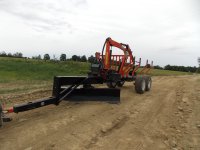
I had my log trailer though, and it has a walking beam suspension with 4 wheels (the same as a real grader). So I cut apart my useless grader, and instead fabricated up a grader that bolted onto my log trailer. Now whenever my grader blade kicks up a rock, the axle wheels pivot over it, and keeps the blade flat on the ground at all times. At the same time, it is now 18 feet long with the grader blade centered between the tractors rear tire, and the center point on the walking beam suspension. This means I get a really flat roadway because the blade only travels half the distance between the rise and fall of those two points.

In practice, it takes two passes to grade my road now. The first might cut in deeply in places, and skip over other places altogether, but it is a cut and fill sort of operation. The next pass just skims over the entire surface and smooths the roadway right up. It really has to be seen to be appreciated. I am strange that way, if I do not like the results I am getting, I figure out what i have and turn it into something that works.
 

Attachments

  • DSCN5127.JPG
    DSCN5127.JPG
    3.5 MB · Views: 213
  • DSCN5126.JPG
    DSCN5126.JPG
    3.5 MB · Views: 255
   / ditch digging attachment #8  
I had a grader blade, but it did not work well at grading my road at all. The problem was, when the tractor goes into a hole, the grader blade did too, and when it comes up, so does the grader blade. With a lot of work on the 3 point control lever, some of this can be worked out, but it was hardly ideal, and took a lot of passes to get something that was nowhere near as smooth as I wanted.

I had my log trailer though, and it has a walking beam suspension with 4 wheels (the same as a real grader). So I cut apart my useless grader, and instead fabricated up a grader that bolted onto my log trailer. Now whenever my grader blade kicks up a rock, the axle wheels pivot over it, and keeps the blade flat on the ground at all times. At the same time, it is now 18 feet long with the grader blade centered between the tractors rear tire, and the center point on the walking beam suspension. This means I get a really flat roadway because the blade only travels half the distance between the rise and fall of those two points.

In practice, it takes two passes to grade my road now. The first might cut in deeply in places, and skip over other places altogether, but it is a cut and fill sort of operation. The next pass just skims over the entire surface and smooths the roadway right up. It really has to be seen to be appreciated. I am strange that way, if I do not like the results I am getting, I figure out what i have and turn it into something that works.

Ya, that is the drawback of a box & grader blade. A LPGS has really long skids to counteract the attitude of the tractor. But that comes at the expense of being able to move rather than just smooth material. Wheels behind a back blade or landscape rake whelp on a similar manner. So I assume sticking your blade under an appropriate trailer would work out as well. Back in the day they put them under the tractor. Then stretched the tractor for, then they became road graders.

Going really slow along with skill/experience makes the 3pt blades work better at least for a smoother more even finish. At least compared to the finish you can get with a LPGS on rough ground moving fast.
 
   / ditch digging attachment #9  
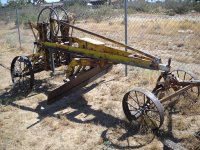
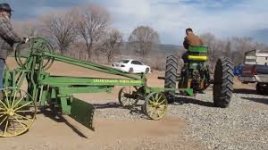
Oooo, I LIKE that. Reminds me of the old horse drawn graders they used to build and maintain roads in the old days. I almost bought one several years ago, simply because it was very cool. These babies can be converted to tractor wor as well.

1 forecast.jpg 1 hard knocks.jpg
 
   / ditch digging attachment #10  
BTW, I like my rear blade but mainly for cutting ditches. My ranch was a mile of road and a thousand feet up from my mailbox on my very own dirt road with a steep canyon on one side and a 15' high hillside cut on the other. Needless to say, ditch maintenance was a must.
 
   / ditch digging attachment #11  
From my experience, I would use the tiller to make a nice soft work area and have a small dozer with a good operator come in and do it all in short order. You'll get a beautiful job for very little money and will be more satisfied with the long term result. There is a big learning curve to using small implements and until you gain experience and smaller tools will not always do what we want. Once your grass is in, fixing those errors is a big event because it all has to be torn up again.

I get to fix landscape issues like this and most agree they should have brought in a tiller and bulldozer early on. You already have the tiller. Just my two cents here.
 
   / ditch digging attachment
  • Thread Starter
#12  
Thanks for your comment sixdog, I appreciate it, but with all due respect, doesn't it kind of defeat the purpose of having a tractor/loader and landscaping equipment, if I hire someone to bring in equipment to do the work for me. I realize it takes time and skill to use some of this equipment to get a nice finish but time in the tractor seat for me is my happy place.
 
   / ditch digging attachment #13  
Thanks for your comment sixdog, I appreciate it, but with all due respect, doesn't it kind of defeat the purpose of having a tractor/loader and landscaping equipment, if I hire someone to bring in equipment to do the work for me. I realize it takes time and skill to use some of this equipment to get a nice finish but time in the tractor seat for me is my happy place.

Only use the dozer for the heavy lifting. You need a tiller for the prep work, a landscape (rock) rake for the post dozer grade finish and seed prep and then a packer and seeder. So you'll spend most of the time on the job getting the finish the way you want it. I use my stuff for everything but moving large amounts of dirt is almost beyond the scope of lighter equipment. A dozer has the mass to move the dirt over a long stretch and put it in the right place while smaller equipment will cause the dirt to hump up and wind up where you don't want it. Plus, the dirt will or could be packed inconsistent and that could cause it to settle that way and not remain smooth.

The fact of my own life is I did NOT hire out to a dozer years ago when we built and have been spending a great deal of effort since then trying to fix my own problem. For one area, I've now decided to chisel plow it, rototill it smooth and bring a dozer in to push it around. Then I'll be back for the finish grade and prep. That uses enough of my equipment to keep me happy and yet I will have a good job. What especially makes the dozer work is the soft, tilled dirt that has been prepped first.

When I correct someone else's issues like this, it is common for people to stop and take pictures during the work and when the grass starts coming in. I get many positive comments and lots of "maybe you can fix my place" invites. Mostly, I can't because the trees have grown and other obstacles are in the way.


Now, you can do this yourself but there is a multi-year learning curve that involves learning through error. You could do it yourself but it's hard to get that long heavy sweep that a dozer can do. There is plenty for our equipment to do and I look for every way I can. In fact, most of my equipment has been "free" by my not paying to hire out many jobs. I'm just reluctant on grading and swales because of what I have seen with landscaping on new property and dozers. If you do it yourself, however, count me in on doing all I can for whatever advice you may ask to do a good job with your equipment. Call me a team player. :)
 
   / ditch digging attachment #14  
Only use the dozer for the heavy lifting. You need a tiller for the prep work, a landscape (rock) rake for the post dozer grade finish and seed prep and then a packer and seeder. So you'll spend most of the time on the job getting the finish the way you want it. I use my stuff for everything but moving large amounts of dirt is almost beyond the scope of lighter equipment. A dozer has the mass to move the dirt over a long stretch and put it in the right place while smaller equipment will cause the dirt to hump up and wind up where you don't want it. Plus, the dirt will or could be packed inconsistent and that could cause it to settle that way and not remain smooth.

The fact of my own life is I did NOT hire out to a dozer years ago when we built and have been spending a great deal of effort since then trying to fix my own problem. For one area, I've now decided to chisel plow it, rototill it smooth and bring a dozer in to push it around. Then I'll be back for the finish grade and prep. That uses enough of my equipment to keep me happy and yet I will have a good job. What especially makes the dozer work is the soft, tilled dirt that has been prepped first.

When I correct someone else's issues like this, it is common for people to stop and take pictures during the work and when the grass starts coming in. I get many positive comments and lots of "maybe you can fix my place" invites. Mostly, I can't because the trees have grown and other obstacles are in the way.


Now, you can do this yourself but there is a multi-year learning curve that involves learning through error. You could do it yourself but it's hard to get that long heavy sweep that a dozer can do. There is plenty for our equipment to do and I look for every way I can. In fact, most of my equipment has been "free" by my not paying to hire out many jobs. I'm just reluctant on grading and swales because of what I have seen with landscaping on new property and dozers. If you do it yourself, however, count me in on doing all I can for whatever advice you may ask to do a good job with your equipment. Call me a team player. :)

I disagree with this assessment, but only because I am all about doing as much as a person can for themselves.

Last year i had a contractor come in and give me a quote on what it would cost to build that road in this thread, and it came back at $7000. I was shocked as the gravel came from my own pit. Then I realized I had the gravel, I just needed to move it, but all I have is a 1 cubic yard dumpbox and I needed 350 cubic yards of gravel for surfacing. That is easy math; 350 trips!

I can't do that!

Or can I?

If I used my tractor to load the dumpbox with 1 cubic yard of gravel, and my wife hauled it into place with our Ford Explorer, and we did 10 loads every day, in 35 days...just over a month we would be done. And that is just what we did. Some days we did 60 yards, and some days we did none, but in a month it was done. It was never a big job, it just seemed like one because I was looking at the whole job, and not talking it one step at a time.

Why PAY someone to do something you can do yourself, and have fun doing it?
 
   / ditch digging attachment
  • Thread Starter
#15  
I am definately a DIY guy myself. I am 50 yrs old and I can count on one hand the times that I have hired someone to do work for me and that includes any fixing or maintenance on any of my vehicles, automotive and recreational. Two of those times I did hire someone was to mud and tape the drywall in my house a my garage. I found out the hard way that I hate mudding and taping. When I did a comlpete renovation of my house I even designed and built my own kitchen cabinets and countertops from scratch. Saved myself $10,000 just on the kitchen cabinets and I have a whole bunch of cool tools now because of it. I'm not sure if that is a good thing or not because sometimes things are alot more work than it looks like, but I get extreme satisfaction from doing stuff myself. I blame this mind set on a good freind of mine of which I worked with for 7 years. He tought me that there is no such thing as "I can't" and with a little time , patience and practice you can almost do anything. Some stuff may take longer to do than someone who does it for a living but for me it's the adventure of the learning that I love. It's just not in me to pay someone my hard earned money to do something that I know I can do.
Sixdogs, you make some great points and I do agree with you that there are times you should leave things to the professionals and the more experienced. Thats why I hired the mudders. But a bit of quality seat time on the tractor doing some landscaping is a fun and easy task compared to some of the projects I have taken on.
The area that I will be working isn't that big at all. Front area is about 30 x 50 yards and the back is slightly bigger so it's just a bit of removing material here, adding some there. Some leveling here and some grading there.


Tractor & Equipment Auctions

1983 INTERNATIONAL S SERIES WATER TRUCK (A57192)
1983 INTERNATIONAL...
Classic 1969 Massey Ferguson 135, newly rebuilt engine, refurb front end, 3-pt blade.
Classic 1969...
2002 Ford E-450 Enclosed Service Van (A59230)
2002 Ford E-450...
2021 SANY SY265C LC LONG REACH EXCAVATOR (A59823)
2021 SANY SY265C...
2017 Autocar Xpeditor T/A Heil V-161 Front Loader Garbage Truck (A59230)
2017 Autocar...
2004 Ford F-150 Ext. Cab Pickup Truck (A59230)
2004 Ford F-150...
 
Top