Front-End Loader Difference in FEL's?

/ Difference in FEL's? #1  

woodlandfarms

Super Member
Joined
Jul 31, 2006
Messages
6,151
Location
Los Angeles / SW Washington
Tractor
PowerTrac 1850, Kubota RTV x900
Maybe this is a bit of a newbie question, but some of the tractors I am considering have the "new" bowed FEL arms, and some have straight arms. I see that one of the advantages is a less obstructed view, but are their others?

I know measurements are sort of relative (Lift capabilites are often "adjusted") so are their mechanical things to look at or consider on determining the proper FEL? Like how they mount? If they are 3rd party?

Hopefully this question makes sense.

Carl
 
/ Difference in FEL's? #2  
There is a trend toward curved-arm loaders and away from
"dog-leg" loaders. This same trend is happening with backhoes.
The only advantage I see advertised is a less obstructed view, in
both cases.

If there is indeed a less obstructed view, I have not found that to
be of significant importance with the tractors I have operated.
Maybe they use less steel for a given capacity?
 
/ Difference in FEL's? #3  
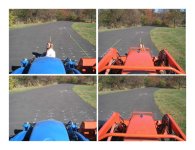
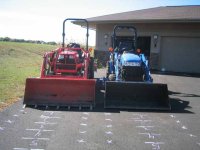
I'd say there is a huge difference in the actual use of the curved loaders versus the straight/dogleg loader arms. And people who have experience on both types will typically tell you that you get used to either one, but most seem to prefer the curved arms after using both. I happen to have both, I can tell you that I can get work done faster with the curved arms, the visiblity is vastly improved. Much of the advantage of the curved arms comes from not just the curved arms, but also the curved & sloped hoods of the tractors. They work together as a system to improve the visibility so much that you can actually see your work, that seems like a small thing but in actual use I have found it to be a time saver (and time/labor savings is why I own tractors).

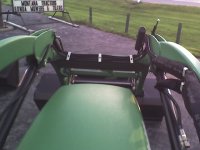
The photo comparision may not be perfect, but it illustrates the point. It should be pointed out that the Kubota/NH have very similar FEL capacities. The Kubota blocks your view to signifcantly farther out, you also can't see the bucket corners on the Kubota. The Kubota grill guard blocks the view to just under 7' in front of the cutting edge of the bucket. On the NH, the ground is visible at just under 3' in front of the bucket. The photo of the green tractor (photo 3) is a Montana. This is not a good comparison because the bucket is NOT flat on the ground, however the loader arms really bock the view because they are mounted much higher so you lose much of the sight advantage with the Montana. I also don't like the plumbing on the Montana, I much prefer rigid pipe over hose on a loader, costs more to pipe it but never has to be replaced and is harder to damage (in my experience).

I'd also point out that not all curved arm/sloped hood tractors are created equal. Some (like Deere, Montana & Kioti) don't have hoods that curve down as steeply or curve side-to-side as New Holland or Case which I believe offers the best view. Kioti is probably the next best hood shape, Montana probably the most traditional of the hood shapes and offers less of a view. Deere offers a good view over the hoods of their new tractors (good not great) but their loader arms are 2 part curved arms and offer a more obstructed view.
 

Attachments

  • NH-KUBOTA4plex.jpeg
    NH-KUBOTA4plex.jpeg
    71.7 KB · Views: 490
  • NH-KUBOTA front.jpg
    NH-KUBOTA front.jpg
    55.9 KB · Views: 466
  • montana.jpeg
    montana.jpeg
    58.5 KB · Views: 454
/ Difference in FEL's? #4  
There is another side to the story that lies in manufacturing. It may apply to this topic?
The advantages of curved shapes and sleeker lines have been used more and more in recent machining technologies. In the "old days" it was very hard and time consuming to generate curves, radii, etc. on conventional milling machines and other machinery. In order to machine molds and dies with curves, they had to be stepped off and hand worked in or "pantographed" using a traceable model. Even the models and patterns had to be made that way. Now, model making is phasing out because of the new technology in machining. Most machining paths were "straight line" or 90° angles because that's what most conventional (manual operated) machinery does.
Nowadays with all the CNC machining centers and CAD programs that design in 3D it's a snap to design and machine all kinds of curves and shapes. They are so accurate that hardly any "hand fitting" is needed afterwards. The ease of this new ability has allowed design engineers to persue those curved shapes that offer advantages in strength, material savings and ergonomics. Even though we had those shapes back in the "old days" they were 100 times more difficult to generate than today...so we see more of it.
 
/ Difference in FEL's? #5  
Bob_Skurka said:
I'd say there is a huge difference in the actual use of the curved loaders versus the straight/dogleg loader arms. And people who have experience on both types will typically tell you that you get used to either one, but most seem to prefer the curved arms after using both. I happen to have both, I can tell you that I can get work done faster with the curved arms, the visiblity is vastly improved. Much of the advantage of the curved arms comes from not just the curved arms, but also the curved & sloped hoods of the tractors. They work together as a system to improve the visibility so much that you can actually see your work, that seems like a small thing but in actual use I have found it to be a time saver (and time/labor savings is why I own tractors).

I see some visibility advantages to a sloping hood, but that is independent
of the curved arm loaders. I regularly use my curved-arm Kioti and my
dog-leg Deere and I just don't see any major advantage.
 
/ Difference in FEL's? #6  
3RRL said:
.....those curved shapes that offer advantages in strength, material savings....

Yes, I see there are newer abilities to manufacture more complex shapes
efficiently. A motivating factor is the ability to reduce steel content
for cost and weight, while maintaining strength. We have already seen
this in tapered box shapes of thinner guages, versus standard uniform
shapes like rectangluar tubing. Curved box shapes are the next step
and the curved loaders seems to use less steel for the same duty. The
curved b/hs actually seem to use more steel.
 
/ Difference in FEL's? #7  
dfkrug said:
This same trend is happening with backhoes.
The only advantage I see advertised is a less obstructed view, in
both cases.

I believe the trend in backhoes is actually related to capacity and reach. It has been a design feature of excavators for a long time. The curve in the main boom creates a "pocket" that allows the full bucket to be curled up tighter to the boom allowing the boom to be raised higher, and allowing a tighter swing radius. It also allows the hoe to be folded up more compact for transportation. The straight-boom backhoes and excavators have limitations in these regards because the bucket will interfere with the boom at a much lower angle.
 
/ Difference in FEL's? #8  
LC Brewing said:
I believe the trend in backhoes is actually related to capacity and reach. It has been a design feature of excavators for a long time. The curve in the main boom creates a "pocket" that allows the full bucket to be curled up tighter to the boom allowing the boom to be raised higher, and allowing a tighter swing radius. It also allows the hoe to be folded up more compact for transportation. The straight-boom backhoes and excavators have limitations in these regards because the bucket will interfere with the boom at a much lower angle.

I know that industrial excavators have had curved booms for a long time.
I can see how you can get a higher unloading height for a full bucket. And
I can see that a curved boom hoe can fill a bucket better at full reach.
I still don't see the visibility advantage claimed. I noticed from detailed
study of the Woods GB7500 and the new BH-80X that there is no additional
digging power.
 
/ Difference in FEL's? #9  
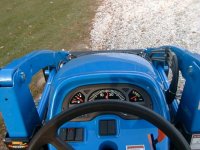
The main reason I like the curved loader arms is visibility. This picture really speaks for itself, and I think you'll see the difference for yourself.
 

Attachments

  • tc13.jpg
    tc13.jpg
    57.5 KB · Views: 356
/ Difference in FEL's? #10  
PineRidge said:
The main reason I like the curved loader arms is visibility. This picture really speaks for itself, and I think you'll see the difference for yourself.

Your additional visibility is gained by the sloped hood, not the loader arm
design. If your NH had a Woods loader, your fwd visibility would prob
be the same.
 
/ Difference in FEL's? #11  
dfkrug said:
Your additional visibility is gained by the sloped hood, not the loader arm
design. If your NH had a Woods loader, your fwd visibility would prob
be the same.

The Woods loader arms would obstruct your view. (ie blind spots) The combination of the slopped hood and the curved loader arms work in conjunction for better visibility.
 
/ Difference in FEL's? #12  
dfkrug said:
Your additional visibility is gained by the sloped hood, not the loader arm
design. If your NH had a Woods loader, your fwd visibility would prob
be the same.

While you are entitled to your opinion there are a few of us that own or have owned curved arm loaders that I'm sure don't agree with your comparison.
 
/ Difference in FEL's? #13  
I agree with Redneck Randy, the sloped hood and curved loader arms work in conjunction to provide better visibility. I have curved arms on my old Yanmar but it has a straight boxy hood and visibility is limited by that. I do like the hoods on those NHs.
 
/ Difference in FEL's? #14  
I have a new "sloped" hood NH with a "boxy" rhino loader....

i can see over the hood fine, seeing the bucket on the other hand.... not as easy.

but as others have said... curved arms put the bucket farther out front FOR BETTER visibility.

if you look at the rhino literture it looks like they make the same loader that NH sold as "theres"

between the old square kind and new curved arms they are essentally the same capacity with diffrent dimentions... with the biggest diff being they bumped the psi rating on the curved versions 500psi to make up for it being farther out front if you ask me.

i still find my bucket to be "in the way" with it as close to me as it is... cant imiagine what it would be like with it farther out front, or even FURTHER out front if i had supersteer.

would i trade better visiblity for worse "in my way" performace... no way. Pluss with all other things equal (psi wise) i think mine will lift more because its closer to me... (less stress on the arms, mounts etc)
 
/ Difference in FEL's? #15  
I'd say there is a huge difference in the actual use of the curved loaders versus the straight/dogleg loader arms. And people who have experience on both types will typically tell you that you get used to either one, but most seem to prefer the curved arms after using both. I happen to have both, I can tell you that I can get work done faster with the curved arms, the visiblity is vastly improved. Much of the advantage of the curved arms comes from not just the curved arms, but also the curved & sloped hoods of the tractors. They work together as a system to improve the visibility so much that you can actually see your work, that seems like a small thing but in actual use I have found it to be a time saver (and time/labor savings is why I own tractors).

The photo comparision may not be perfect, but it illustrates the point. It should be pointed out that the Kubota/NH have very similar FEL capacities. The Kubota blocks your view to signifcantly farther out, you also can't see the bucket corners on the Kubota. The Kubota grill guard blocks the view to just under 7' in front of the cutting edge of the bucket. On the NH, the ground is visible at just under 3' in front of the bucket. The photo of the green tractor (photo 3) is a Montana. This is not a good comparison because the bucket is NOT flat on the ground, however the loader arms really bock the view because they are mounted much higher so you lose much of the sight advantage with the Montana. I also don't like the plumbing on the Montana, I much prefer rigid pipe over hose on a loader, costs more to pipe it but never has to be replaced and is harder to damage (in my experience).

I'd also point out that not all curved arm/sloped hood tractors are created equal. Some (like Deere, Montana & Kioti) don't have hoods that curve down as steeply or curve side-to-side as New Holland or Case which I believe offers the best view. Kioti is probably the next best hood shape, Montana probably the most traditional of the hood shapes and offers less of a view. Deere offers a good view over the hoods of their new tractors (good not great) but their loader arms are 2 part curved arms and offer a more obstructed view.


Hey Bob,
How do u do to collect much such info?so meaningful for us!
__________________
Watch The Good Heart Movie Online Free
 
/ Difference in FEL's? #16  
There also is a trend of moving the loader arms closer to the engine compartment. This was evident on the LA402 and LA504 Kubota loaders. Personally I prefer the wider set loader arms as I believe they offer more strength for the bucket and I often use the area between the arms and the engine compartment to see what I am doing when using Loader Buddy. As far as the curved boom on the backhoe goes, I do not think this is a visibility enhancement. It allows you to dig closer to your tractor when the hoe is deeper thus creating more of a vertical hole close in vs. the slanted hole of the straight boom models. This may be important for some but not all situations.
 
/ Difference in FEL's? #17  
I have a new "sloped" hood NH with a "boxy" rhino loader....

i can see over the hood fine, seeing the bucket on the other hand.... not as easy.

but as others have said... curved arms put the bucket farther out front FOR BETTER visibility.

if you look at the rhino literture it looks like they make the same loader that NH sold as "theres"

between the old square kind and new curved arms they are essentally the same capacity with diffrent dimentions... with the biggest diff being they bumped the psi rating on the curved versions 500psi to make up for it being farther out front if you ask me.

i still find my bucket to be "in the way" with it as close to me as it is... cant imiagine what it would be like with it farther out front, or even FURTHER out front if i had supersteer.

would i trade better visiblity for worse "in my way" performace... no way. Pluss with all other things equal (psi wise) i think mine will lift more because its closer to me... (less stress on the arms, mounts etc)

The design of the system should be such to account for the additional stress of having a bucket farther out. I dont think concern over additional stresses is well founded.

Also most new loaders are designed for "quick detach". Now I havent personally used these systems but it feels as if it wouldnt be too much of a hassle to drop the loader when you arent using it which eliminates the bucket problem altogether.

From the perspective of visibility to the bucket obviously anytime you can see the work you can work with more precision and accuracy. If that means getting th ebucket farther out and sloping the hood and arms then so be it, provided theres an easy option to get the bucket out f the way when you dont need it....ie....quick detach.

Now the properties of this design cannot be argued. Its capabilities mirror more traditional designs and it allows better control of the work and more visibility.

However the advantages of that certainly can be argued. To some this wouldnt matter one whit, to others it would be very clear benefit.
 
/ Difference in FEL's? #18  
 

Marketplace Items

2018 KENWORTH T680 6X4 T/A SLEEPER TRUCK TRACTOR (A59910)
2018 KENWORTH T680...
YALE VERACITOR 50VX STRAIGHT MAST FORKLIFT (A63276)
YALE VERACITOR...
CENTRAL PNEUMATIC 21 GALLON ELECT. AIR COMPRESSOR (A62131)
CENTRAL PNEUMATIC...
UNUSED WOLVERINE PFF3-13-45W UNIVERSAL MAST (A62131)
UNUSED WOLVERINE...
Bulk Lot of over 600 NEW Motorcycle Sprockets - 1980s to Present (A63118)
Bulk Lot of over...
2018 HINO SA (A58214)
 
Top