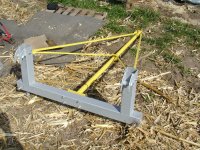
Built my boom pole today

   / Built my boom pole today #21  
The beam is going to buckle where the brace from underneath meets the beam. This is where the opposing forces are all greatest. Putting the truss support directly above this point sandwiches that point so that the truss support above pushes down to help counter the force of the brace pushing up.

Exactly. If the upwards and downwards forces are on the lower support then there is less stress on the main beam. There are calculations available to figure the capacities with and without the supports but you would need to know how much force a given piece could take. Important thing to know is that it dramatically increases the capacity.
 
   / Built my boom pole today #22  
By doing this aren't you adding more total forces to this area therefore making it the weak point ?

Correct that you are adding more total forces. Incorrect that you are making it the weak point. The purpose is to create opposing forces that cancel each other.
 
   / Built my boom pole today #24  
Correct that you are adding more total forces. Incorrect that you are making it the weak point. The purpose is to create opposing forces that cancel each other.

How my thick head works is this. I am looking at the pole part let say 2x2x1/4" wall as being an undersized member for what he needs for the design. So he adds a truss to increase the stiffness and load carrying capacity to match that of a 2x4x1/4"wall pole. So regardless of which pole he uses the capacity would be the same and the failure point would be the same at the lower support leg.The only way to increase the load capacity would be to move the lower support leg to shorten the pole length not change the truss support leg location.
 
   / Built my boom pole today #25  
It is still interesting to see the boom mounted on the bucket...Plus educating. Good deal.
 
   / Built my boom pole today #26  
As long as you guys are doing structural analysis on boom poles, you might as well look at mine too. Here's about the only pic I have of it. Compared to others, it may seem upside down (but is setting upright in the pic below). Its all built on a dedicated subframe (no bucket required) which directly quick-hitches to my JD CX300 loader. The main tube is 2.5 inch OD, with about a 3/16" wall. The main struts are 1/8" wall three-quarter inch square tube. The jury struts are 1/2" square tube, welded to the clamp, the clamp is clamped around the main tube (not welded to it) at mid span. OK, I admit it, there is some aircraft building experience blended in here.

Its fully tested. My loader can lift about 2000 lbs. at the pins. Last year I was trying to lift a 36 foot steel k-bar truss (~500 lbs) off the tops of a couple of 6x6 poles set in the ground. Due to a forgotten fastener or two or four, the poles both broke before I lifted the truss off. It was 12 feet to the top of the truss from the ground. I was lifting in the middle, with a chain in a "V", spaced about ten feet apart to two points on the truss.
 

Attachments

  • P3210305.JPG
    P3210305.JPG
    692.4 KB · Views: 495
   / Built my boom pole today #27  
As long as you guys are doing structural analysis on boom poles, you might as well look at mine too. Here's about the only pic I have of it. Compared to others, it may seem upside down (but is setting upright in the pic below). Its all built on a dedicated subframe (no bucket required) which directly quick-hitches to my JD CX300 loader. The main tube is 2.5 inch OD, with about a 3/16" wall. The main struts are 1/8" wall three-quarter inch square tube. The jury struts are 1/2" square tube, welded to the clamp, the clamp is clamped around the main tube (not welded to it) at mid span. OK, I admit it, there is some aircraft building experience blended in here.

Its fully tested. My loader can lift about 2000 lbs. at the pins. Last year I was trying to lift a 36 foot steel k-bar truss (~500 lbs) off the tops of a couple of 6x6 poles set in the ground. Due to a forgotten fastener or two or four, the poles both broke before I lifted the truss off. It was 12 feet to the top of the truss from the ground. I was lifting in the middle, with a chain in a "V", spaced about ten feet apart to two points on the truss.

500 lbs at the end of that pole , looks like 6' or so ,is putting +/-3000lbs pounds of force on your connections and the load would be a load greater than your tractor lifting capacity ?
 
   / Built my boom pole today #28  
As long as you guys are doing structural analysis on boom poles, you might as well look at mine too. Here's about the only pic I have of it. Compared to others, it may seem upside down (but is setting upright in the pic below). Its all built on a dedicated subframe (no bucket required) which directly quick-hitches to my JD CX300 loader. The main tube is 2.5 inch OD, with about a 3/16" wall. The main struts are 1/8" wall three-quarter inch square tube. The jury struts are 1/2" square tube, welded to the clamp, the clamp is clamped around the main tube (not welded to it) at mid span. OK, I admit it, there is some aircraft building experience blended in here.

Its fully tested. My loader can lift about 2000 lbs. at the pins. Last year I was trying to lift a 36 foot steel k-bar truss (~500 lbs) off the tops of a couple of 6x6 poles set in the ground. Due to a forgotten fastener or two or four, the poles both broke before I lifted the truss off. It was 12 feet to the top of the truss from the ground. I was lifting in the middle, with a chain in a "V", spaced about ten feet apart to two points on the truss.


I like it. Good design, making better use of materials. The only suggestion I would make is to weld the struts to the center of the tube instead of clamp them.

a long structural member has 3 basic modes of stress. Tension(pulling), Compression(pushing) and shear(bending). Tension is the strongest mode, and you will get the most out of the material used. Compression is the next strongest, but considerably weaker than tension. Shear is the weakest mode. A good design always strives to place as much of the design load as possible in tension or compression. The above design illustrates this perfectly. The top angled struts are in tension, therfore are much stronger for their weight. The tensioned top struts place the main boom pole in compression. A column in compression will usually fail or buckle in the middle of it's span(compress a toothpic or matchstick between your fingers). The secondary struts lend support to the column at it's weakest point. Since the struts are offset to the side, this gives side to side support. Triangles are our friends.

You avoided shear alltogether... Well done sir...
 
   / Built my boom pole today #29  

Attachments

  • DSC102594.jpg
    DSC102594.jpg
    423.6 KB · Views: 313
   / Built my boom pole today #30  
How my thick head works is this. I am looking at the pole part let say 2x2x1/4" wall as being an undersized member for what he needs for the design. So he adds a truss to increase the stiffness and load carrying capacity to match that of a 2x4x1/4"wall pole. So regardless of which pole he uses the capacity would be the same and the failure point would be the same at the lower support leg.The only way to increase the load capacity would be to move the lower support leg to shorten the pole length not change the truss support leg location.

You are correct that no matter where the truss support is, the trussed beam is still stronger than the un-trussed beam. It's just going to be strongest if the support is directly over the leg. True that moving the leg out will create even more support than moving the truss support in, but that's due to other factors.

Take a look at the sketch that BCP posted (post #13). It's a good illustration of the principle. In that sketch the beam is able to bend without bending or breaking any other member of the structure. Imagine if the truss support were directly over the leg. The only way it could bend in that instance is for a weld to break or for some other member of the structure to stretch, bend or break.

In this particular instance the beam is plenty heavy for the application. We're splitting hairs a bit for the sake of discussion and for future reference.
 
   / Built my boom pole today #31  
Originally Posted by RonMar
Triangles are our friends.

But only when all the corners meet other corners. In my sketch, the support brace meets the side of a triangle, so the full benefit is lost.

Bruce
 
   / Built my boom pole today #32  
This looks like it's going to be a good rainy day thread for me. ...love this kind of *****.

I had a boom on my old 7274 Cub Cadet's bucket. It was not really long, but simplicity itself. I am setting up my R4010 LS the same. I simply mounted a receiver hitch tube on top of the bucket back to accept a five foot piece of 2X2X1/4 square tube. It lifted 300 pounds with only a little flex.

There is a bonus with this setup as it allows me to slip in a trailer ball and push trailers around.

My only concern is, in the short time I've had my LS, using my homemade forks, I find the bigger tractor cannot lift as big a log as the old CC. The tilting torque of the quick release bucket seems much less. I can see that the leverage from the tilt rams' connection points to the front of the bucket is greater with the quick release structure in between. I'm disappointed, seeing how much bigger the new hydraulic pump is, and considering the 14 more HP I just bought. I don't know how to tweek the hydraulics for more power, or if it's even possible.

Of course, using a boom, this tilting torque is all important.
 
Last edited:
   / Built my boom pole today #33  
a long structural member has 3 basic modes of stress. Tension(pulling), Compression(pushing) and shear(bending). Tension is the strongest mode, and you will get the most out of the material used. Compression is the next strongest, but considerably weaker than tension. Shear is the weakest mode....

I would put it a little differently. Tension and compression are similar for metals (concrete being different because it is markedly weaker in tension than compression). Shear stress failure is what it sounds like, the separation of material by opposing forces. Bending and shear stress are not exactlyl the same. Bending forces result in local tension, compression and shear stresses. Bending is bad because it results in very high stress components in a very localized area, leading to failure. A bending mode failure could fail from tension, compression or shear depending on the shape of the member and load application (although shear might be the best candidate).

The original design shown isn't optimum because of having the brace away from the top truss support, but it is still providing a lot of support because it is reducing the moment arm that creates the bending forces. All these designs look like they have a lot of margin for small tractor use.
 
   / Built my boom pole today #34  
"I like it. Good design, making better use of materials. The only suggestion I would make is to weld the struts to the center of the tube instead of clamp them. "

The idea of only clamping the jury struts was to avoid welding there. As you also said, the main tube will fail (if it ever fails) in compression. I figured I could keep it in column with the clamped method, without weakening it by welding to it at that critical mid span region.
 
   / Built my boom pole today #35  
You are correct that no matter where the truss support is, the trussed beam is still stronger than the un-trussed beam. It's just going to be strongest if the support is directly over the leg. True that moving the leg out will create even more support than moving the truss support in, but that's due to other factors.

Take a look at the sketch that BCP posted (post #13). It's a good illustration of the principle. In that sketch the beam is able to bend without bending or breaking any other member of the structure. Imagine if the truss support were directly over the leg. The only way it could bend in that instance is for a weld to break or for some other member of the structure to stretch, bend or break.

In this particular instance the beam is plenty heavy for the application. We're splitting hairs a bit for the sake of discussion and for future reference.

I just try to fully understand these concepts and get people's thought's and opinions. Thanks for your input!

Do you have any idea what the increase in capcity would be if he changed his original design to the optimum ?
 
   / Built my boom pole today #36  
Do you have any idea what the increase in capcity would be if he changed his original design to the optimum ?

I don't. Rough guess: about half again as much.

Is there someone out there more versed in this stuff than I am that could chime in?
 
   / Built my boom pole today #37  
Anyone care to do some 3-D modeling and finite element analysis ,anyone ...?


Bueller ...?
 
   / Built my boom pole today #38  
Do you have any idea what the increase in capcity would be if he changed his original design to the optimum ?

I'm betting that the sub-optimal layout could exceed the machine's capability.

The sides of the beam contain unseen small triangles between where the lower brace supports the beam and where the beam supports the truss king post. Assuming I'm seeing that the beam is square tubing, the tube is itself a small truss, with the top under tension, and the bottom under compression. For the tube to fail in that few inches of reach from the brace to the king post would be after the rear wheels of the tractor were in the sky. Be careful of your front drive axle's innards when you have a heavy load on the boom. They weren't made to handle those kinds of stresses (ask me how I know :().

The failure illustrated in the sketch would not happen unless the truss itself failed first, as either the king post failed under compression, or the top cord failed under tension, or both. Yes, I'd say the layout isn't optimal, but it's still way stronger than not being trussed.

I hope I don't come across as an uppity newbie.
 
   / Built my boom pole today #39  
Maybe someone with some Mechanical engineering experience could comment on my idea of instead of the top chord and king post of welding a continous say 1 inch x 3/16 stiffener bar vertically on top of the 2 x 2 main beam? I am guessing that the 2 x 2 stiffened in this manner would also outperform the actual lifting force of the machine and be easy to do. Any thoughts?

James K0UA
 
   / Built my boom pole today #40  
But only when all the corners meet other corners. In my sketch, the support brace meets the side of a triangle, so the full benefit is lost.

Bruce

Bruce, you are absolutely correct. That structure would fail right where the lower structural support meets the boom pole, by collapsing the side that triangle forms. As mentioned, it should be out under the base of the kingpost, which will keep the kingpost in compression so it can support the tension on the forward running guy and rearward backstay(kingpost truss, common in bridge and crane construction, as well as older aircraft wing design).

Jimgerken: Properly welded attach tabs will only add to the cross section of the column at that location, increasing it's strength

For the OP, that structure will probably bend the formed rear structure of the kubota bucket(stamped component instead of a closed boxed structure), before the boom fails... I was a little disappointed by that Kubota bucket design:(

As for rainy day reading, this is not a new subject on TBN. Search "boom Pole" and you will come up with pages of further reading material, and some examples of really what not to do:)
 

Marketplace Items

2001 Ford F-150 4x4 Pickup Truck (A59230)
2001 Ford F-150...
2011 Freightliner Cascadia 113 S/A Day Cab Truck Tractor (A59230)
2011 Freightliner...
2019 INTERNATIONAL LT625 TANDEM AXLE SLEEPER (A59904)
2019 INTERNATIONAL...
JLG 600 AJ SKYPOWER BOOM LIFT (A60429)
JLG 600 AJ...
2018 Chevy Traverse 3rd Row Seating (A61306)
2018 Chevy...
2016 Nissan Quest Van (A59231)
2016 Nissan Quest...
 
Top