Berta flail mower

   / Berta flail mower #41  
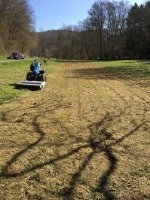
Please help me understand the setup pictured, what is the Zanon attachment and does its output shaft drive the Berta? :confused3:
Thanks! :drink:
The Zanon is my finish mower,hooked to the tractor. The Berta is just parked, unhooked, in front of the Zanon. The Berta has disc brake rotors bolted to the front for extra weight to keep it on the ground when mowing steep ground.
 
   / Berta flail mower #42  
The Zanon is my finish mower,hooked to the tractor. The Berta is just parked, unhooked, in front of the Zanon. The Berta has disc brake rotors bolted to the front for extra weight to keep it on the ground when mowing steep ground.

Now I see it - duh! :)
At first look I thought all three were somehow connected.
Thanks.
 
   / Berta flail mower #43  
That would be an awesome, power hungry machine.
 
   / Berta flail mower #44  
Take my money on that dual mower!
 
   / Berta flail mower
  • Thread Starter
#45  
Hi ;)

I have had my Berta flail mower for some 1 1/2 year now, and I have used it for almost 50 hours.

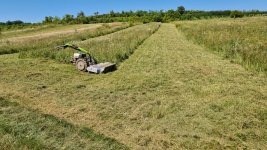
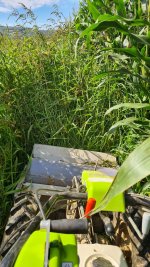
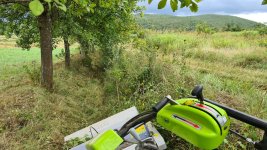
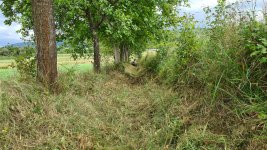
Like other members, I have experienced that the flail mower tends to rise when mowing uphill. This is physics, and it is what we might expect with all front-PTO implements. For me it begins to be critical when approaching around 20 degrees of slope, and then I only mow downhill, and walk idle uphill. With a light implement like a sickle bar mower, I mow across the slope up until around 20-30 degrees, and then again only downhill. I haven’t been able to successfully mow across a slope with heavier mowers, like the Berta flail or my Zanon lawnmower. Gravity is simply stronger than this old man :cry:

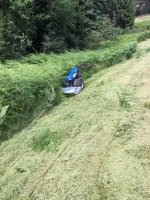
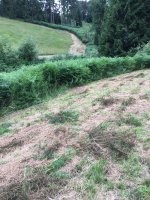
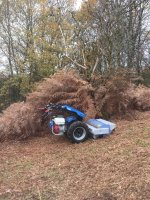
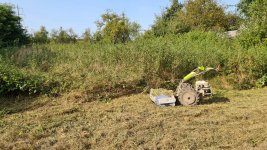
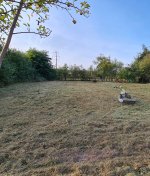
One task where the flail mower has proven very efficient, is getting rid of up to 2 m (6 1/2’) tall eagle fern, which tend to invade some of our meadows:

IMG_0860.jpg IMG_0868.jpg IMG_1062.jpg

I mow with the cutting hight set at its maximum of 5 cm (2’’), and then I mow in first gear taking half cuts. This way the Honda engine stays on top of things, and the cut material gets a second treatment.

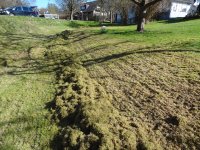
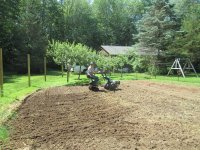
As mentioned in some of my earlier posts in this thread, I also use my Berta as a sort of scarifier/de-thatcher, to remove moss and old/dead plant material. This foto is from a lawn, where the moss had taken control:

DSC05816.jpg

This one is from my meadow, where after the grass had been mowed and removed, I used the Berta to prepare the plot for seeding wild flowers for the insects:

IMG_1157.jpg


Best regards

Jens
 
   / Berta flail mower #46  
Nice! I have around 90 hours on my flail mower and wouldn't be without it. I find that my hammers need some touchup work every fifty hours or so and that it helps immensely with cut speed. Dull hammers suck more power which means a narrower cut.

I haven’t been able to successfully mow across a slope with heavier mowers, like the Berta flail or my Zanon lawnmower. Gravity is simply stronger than this old man :cry:

I find I can mow side-hill pretty well on, I guess, a 30 degree slope. I find the key is to have the downhill to the right (because my clutch is on the left handle bar), then on the hill, I straighten my left arm out and "hang" off the bars to the right, pulling the back end downhill and the mower uphill. Of course I also have diff-locks on and use the steering brakes to help.

I don't get a perfectly straight line with ideal overlap, but I get it cut without doing endless circles of wasted mowing. I find this technique doesn't work near as well with the downhill to the left, possible because I can't reach the steering brakes.

The steepest sections are still downhill though, but I try to work it into a circular pattern to minimize covering ground repeatedly.
 
   / Berta flail mower
  • Thread Starter
#47  
Hi travisbb ;)

Thank you very much for your hints about mowing on a slope! I will try them out when spring arrives, and I can begin mowing again (y)

Luckily I have few places to mow which are in the 20-30 degree range, and you are right, it is of course a waste of time only to mow when driving downhill. But if you only mow with the downhill to your right, you have the same problem I guess, when you come to the end of your plot? :unsure:

Like you, I often use the differential lock on slopes, and on level ground too. I am a bit confused though, as I get the impression that you use the steering brakes at the same time. - Am I right?

When the differential lock is engaged, the two separate axle parts powering either wheel becomes mechanically interlocked, essentially creating a solid axle. In that situation steering brakes loses their purpose I think, as braking one wheel only slows down the tractor, and doesn’t turn it uphill? :unsure:

Over the 10 years that I have had my BCS 740, I have made the same experience as you, when it comes to the benefits of mowing in a circular pattern - especially on slopes. As most of us have 2-wheel tractors without live PTO, disengaging the clutch to select reverse, also disengages the power to the PTO. With high-inertia mowers like flails and other rotating types, this is normally not a big problem on level ground when shifting direction fast, as they keep spinning on their own until power is restored. On a slope on the other hand, things are different, as with a bit of bad luck, one might get stuck in neutral when changing direction, potentially creating a very dangerous situation!

Due to the very low gears that we have on our tractors, the inner friction normally prevents the tractor from moving when the clutch is disengaged - but only as long as the tractor is in gear! When we change direction - or select an other gear - we have to pass neutral, and then the wheels are free to roll, and gravity might take control! When working on slopes, I always try to find a spot where I can place the tractor perpendicular to the slope if I have to change direction or gear. In that case the tractor will stay put, and not start rolling down the slope, should I get stuck in neutral.


Best regards

Jens
 
   / Berta flail mower #48  
Luckily I have few places to mow which are in the 20-30 degree range, and you are right, it is of course a waste of time only to mow when driving downhill. But if you only mow with the downhill to your right, you have the same problem I guess, when you come to the end of your plot? :unsure:

In my case, the steep side-hill has a pretty wide flat spot on the top. So for the most part I mow counter-clockwise: steep side-hill where I hang to the right, then not so steep straight up the hill, then pretty flat at the top of the hill, then quite steep straight down the hill, then start again.

Like you, I often use the differential lock on slopes, and on level ground too. I am a bit confused though, as I get the impression that you use the steering brakes at the same time. - Am I right?

When the differential lock is engaged, the two separate axle parts powering either wheel becomes mechanically interlocked, essentially creating a solid axle. In that situation steering brakes loses their purpose I think, as braking one wheel only slows down the tractor, and doesn’t turn it uphill? :unsure:

It's my experience with my Grillo G110 that the differential isn't 100% locked, but does allow some slip. I use the steering brakes to take advantage of that slip to turn uphill a little bit. It's only good for fine tuning though.

Due to the very low gears that we have on our tractors, the inner friction normally prevents the tractor from moving when the clutch is disengaged - but only as long as the tractor is in gear! When we change direction - or select an other gear - we have to pass neutral, and then the wheels are free to roll, and gravity might take control! When working on slopes, I always try to find a spot where I can place the tractor perpendicular to the slope if I have to change direction or gear. In that case the tractor will stay put, and not start rolling down the slope, should I get stuck in neutral.

I nearly never get out of gear to turn around. Instead if I can't take an easy turn, I disengage the diff-lock, push down slightly on the handlebars, give a steering brake all it'll take, and run around in a semi-circle nearly as fast as I can. I admit this is not a technique for everybody.

Now my Grillo may have a different transmission setup, but I'm never worried about getting stuck in neutral while the wheels are moving. As far as I can tell, the driving gears always spin with the tires, so consistent, gentle pressure always pops into gear sooner than later. Now I wouldn't try this while driving up a steep hill where the tractor could roll back over me or stall when changing gears. I do rolling, clutched shifts fairly frequently on more level ground though.
 
   / Berta flail mower #49  
My bertha setup,strong flail mower.before and after.
 

Attachments

  • 20200919_155936.jpg
    20200919_155936.jpg
    4.9 MB · Views: 238
  • 20200919_181400.jpg
    20200919_181400.jpg
    3.7 MB · Views: 254
   / Berta flail mower
  • Thread Starter
#50  
Hi again travisbb ;)

It sounds like you have found a very good pattern when you are mowing your plot, allowing you to mow in a circular manner, downhill at the steepest parts, uphill on the not so steep parts, and when mowing along the slope, hanging to the right. - Sounds perfect to me (y)

As said, I will try to remember your hints, and also try out the steering brakes even when I use the differential lock. I am still puzzled though, but at the same time curious and eager to learn.

As you have probably seen already, steering brakes have been a frequent topic over the years in this forum. Some members use them a lot, others hardly use them at all. Personal taste differs, and perhaps they also make more sense to use with some implements, and less with others. I don’t use mine much, as I prefer to have a firm grip on both handles at all time, and steer with a light sideway pressure on the handlebars. Since I got the Berta flail mower though, I use the steering brakes a little more, as I often mow in 1st gear now, and feel more comfortable using the steering brake when driving slowly. I have often read posts praising the use of steering brakes when working across slopes, and this has always puzzled me a little. In order to prevent the tractor from turning downhill, one might brake the uphill wheel, but that is the wheel having the least traction, reducing the effect of braking accordingly. This is just one of the advantages of the 2-wheel tractor models with hydrostatic transmission, as they can run the downhill wheel slightly faster than the uphill one, thereby maintaining direction. - Perhaps I have missed something here? :unsure:

Like you, I also try to turn without having to use the reverse gear, whenever possible. I have had a few scary moments where the reverse lever got stocked in neutral, either because the lever got tangled in low hanging branches or due to my own clumsiness, and on a slope, that can really get your attention! Turning like you describe is a very good alternative to reversing I have also found, especially if one makes the turns uphill.

I also only change gear when on more or less level ground, to avoid getting stuck in neutral. There might be a difference in the way the reverse mechanism on a BCS and a Grillo works, I don’t know. On my BCS, the reverse handle has to pass a detent halfway between forward and reverse. At this detent there is a neutral, preventing forward and reverse to be selected at the same time. If the change of direction is made swiftly, all is good as neutral is passed in a split second. If on the other hand the handle for some reason get stucked, the wheels are free to spin just like when neutral is selected with the gear lever. This might come as a very unpleasant and dangerous surprise! ;)


Best regards

Jens
 
   / Berta flail mower #51  
Hi ;)

I have had my Berta flail mower for some 1 1/2 year now, and I have used it for almost 50 hours.

Like other members, I have experienced that the flail mower tends to rise when mowing uphill. This is physics, and it is what we might expect with all front-PTO implements. For me it begins to be critical when approaching around 20 degrees of slope, and then I only mow downhill, and walk idle uphill. With a light implement like a sickle bar mower, I mow across the slope up until around 20-30 degrees, and then again only downhill. I haven’t been able to successfully mow across a slope with heavier mowers, like the Berta flail or my Zanon lawnmower. Gravity is simply stronger than this old man :cry:

One task where the flail mower has proven very efficient, is getting rid of up to 2 m (6 1/2’) tall eagle fern, which tend to invade some of our meadows:

View attachment 721165 View attachment 721168 View attachment 721170

I mow with the cutting hight set at its maximum of 5 cm (2’’), and then I mow in first gear taking half cuts. This way the Honda engine stays on top of things, and the cut material gets a second treatment.

As mentioned in some of my earlier posts in this thread, I also use my Berta as a sort of scarifier/de-thatcher, to remove moss and old/dead plant material. This foto is from a lawn, where the moss had taken control:

View attachment 721171

This one is from my meadow, where after the grass had been mowed and removed, I used the Berta to prepare the plot for seeding wild flowers for the insects:

View attachment 721172


Best regards

Jens
It looks like you're running duals there Jens. I'd like to fit duals on my 739 because I have a little trouble running my disk harrow in the spring when the soil is muddy. I usually put manure down and plow it under as soon as I can in the spring. Then I have to disk it down to a relatively flat surface before I can plant anything. But the soil is still wet and the tractor tends to get stuck in the plowed soil.

I don't want to buy the BCS wheel spacers because I'm not sure if they'll work for the wheel spacing I have set on my tractor and they're pretty expensive. So I want to make some. How far apart are the tires on your dual setup? At the closest point?

Thanks. Nibana
 

Attachments

  • IMG_0644.JPG
    IMG_0644.JPG
    2.9 MB · Views: 296
   / Berta flail mower
  • Thread Starter
#52  
Hi ppea ;)

Thank you very much for your fotos of your Grillo and Berta in action - also the ones from last summer! It seems like you have quite a lot of mowing to do, and that you put your Berta to good use. I have the impression that you, like the rest of us, are impressed by the performance of the mower, and I also hope that you are happy that you got the bigger 85 cm model?

Looking closely on your fotos, I get the impression that you have done all the right things to your Grillo to get the most traction and the best stability possible: you have extended the wheel spacing to just within the working width of the Berta, you have added wheel weights, and finally I have the impression, that you might have larger than standard wheels on your Grillo - perhaps 23’’? Perfect (y)

In an earlier post in this thread you mention that you are concerned whether wheel weights might affect engine power. Basically, the engine „vaste“ power to move every kg/pound of weight from the tractor and the implement around, power that could otherwise be used to drive the implement. Therefore one should not „over ballast“ any tractor, especially when working with power-hungry implements. On the other hand, most modern 2-wheel tractors are very light compared with the ones made some 60 or so years ago, and they therefore often struggle to transmit the engine power into useful traction. A clear indicator of to little weight on the wheels, are that the wheels loses grip and start spinning. Here wheel weights usually are an easy cure, and for tractors having small wheels, swap them for larger ones, as they have a longer contact patch. Wheel weights have the added advantage, that they don’t change the balance of the tractor, and also don’t put extra stress on the axles, compared to weights mounted to the tractor direct. Your Grillo G110 weighs only around 110 kg I guess with the Honda GX 390 engine, whereas many older 2-wheel tractor from the 1950s with a similar engine power, easily had a weight of 400 kg or more available for traction. Except when using the most power hungry implements, most modern 2-wheels tractors will run out of traction before they run out of engine power.

Based on my experience combined with your fotos, I would expect you to mow in 1st gear most of the time in order not to stall the engine. When working with the Berta, you probably run your engine at full throttle - or close to full throttle, in order to get peak engine power. In 1st gear the mower will do a much nicer job, and the lower speed also gives you more time to avoid large stones, concrete or other obstacles that might be hidden in the vegetation. I have only been able to mow in 2nd gear a few times, when mowing short grass for instance.

I’m impressed by the way you have managed to put 2 tires on each rim. - Not bad! (y)


Best regards

Jens
 
   / Berta flail mower #53  
In the first photo for example i mow with 2 gear with no problem,in the second photo with 1st gear.(5.00- r12 wheels).In the last photos you can se the benefits of the weight and the adjustable wheel extensions.I smoke the clutch several times,but still work fine.The wheel weight with extension is aprox 22-23 kg per wheel.Engine i run close to full throttle most of the time.


Attachments

  • 20200803_124051.jpg
    20200803_124051.jpg
    4.3 MB · Views: 309
  • 20200813_160602.jpg
    20200813_160602.jpg
    3.6 MB · Views: 301
  • 20200825_114518.jpg
    20200825_114518.jpg
    3.9 MB · Views: 290
  • 20200825_115954.jpg
    20200825_115954.jpg
    5 MB · Views: 294
  • 20200825_115956.jpg
    20200825_115956.jpg
    4.4 MB · Views: 302
   / Berta flail mower #54  
In the first photo for example i mow with 2 gear with no problem,in the second photo with 1st gear.(5.00- r12 wheels).In the last photos you can se the benefits of the weight and the adjustable wheel extensions.I smoke the clutch several times,but still work fine.The wheel weight with extension is aprox 22-23 kg per wheel.Engine i run close to full throttle most of the time.

That is a lot of area to mow with a two wheeled tractor. Kudos to you. How many acres do you mow? Just curious. Nice looking fields.
 
   / Berta flail mower #55  
I mow in 2 summer with bertha,aprox 5 acres per year ,and some areas 2 times or 3 per year.This year i bought a mower for 4 wheel tractor,and with bertha i mow only in small places or in places that can't go with the tractor.
 
  • Good Post
Reactions: Lnk
   / Berta flail mower
  • Thread Starter
#56  
Hi NibbanaFarm ;)

You are right about me running duals, but it’s kind of „discount duals“ :ROFLMAO:

As I was looking for a 2-wheel tractor in 2011, I sadly didn’t know this great forum and all the information available here. This meant that I got my BCS 740 with the small 5x10x20’’ standard wheels. Had I known this great forum then - and had I had the experience that I have now, I would have skipped the standard wheels altogether, and opted for the 6.5x12x23’’ wheels as duals from the beginning. As I primarily use my tractor for mowing, I was looking for more ground clearance, and also a wider track for added stability on slopes. With the 23’’ wheels I got a pair of 4.5’’ factory axle extensions, and mounted the wheels in the widest possible manner. This worked fine, but I felt sad every time I saw my 20’’ wheels just sitting in the garage doing nothing, and wondered if I couldn’t use them somehow. That’s when I decided to try to see if I could use them as „extensions“ inside the 23’’ wheels. After a little back and forth, and with the help of a few extra washers, I have mounted the 20’’ wheels as close to the tractor as possible, and the 23’’ with the 4.5’’ extensions as close to the 20’’ wheels as possible. The limiting factor towards the tractor is the gear quadrant, which the tire just barely clears.

The inside distance between the tires on the 20’’ wheels is around 8.5’’, and on the 23’’ wheels around 18.5’’. The outside distance between the 23’’ wheels is around 30’’. I hope this makes sense? :unsure:

I can see that you have quite a lot of weight on your wheels, which is good for traction, but you are right; in muddy conditions duals might help you with more flotation. The added weight of the duals will ad a little extra traction as a little bonus 👍

Comparing your latest foto of your disk harrow with the fotos from 2015, I get the impression that you have added a disk on either side, to a total of 8?

I look forward to see what you come up with, and what kind of spacers you will make/use.


Best regards

Jens
 
   / Berta flail mower
  • Thread Starter
#57  
Hi ppea ;)

Thank you for your latest photos! It’s always a pleasure to see how clean you work, and it seems that you put your Grillo and your Berta to good use (y)

A closer look at your first photo reveals that you have raised the front protection to its uppermost position. I did the same thing a few month ago, hoping that the mower will ride less when I mow tall and woody material, like up to 2 m (6 1/2’) tall eagle fern. When mowing tall and dense material, I expect the mower to ride a little in order to push the material down first before mowing it, but I hope the raised front protection will minimize this tendency a little. In such situations I usually mow only half cuts, and the stalks left from the first pass are then cut in the second pass.

It doesn’t sound right to me that you have smoked the clutch several times :unsure:

The clutch on the Grillo G110 is of the dry conical type I think, and if you see it smoke - or smell it - that means that the clutch is slipping excessively, and that’s not good, as it’s an indication that the clutch is torque overloaded and getting very hot :cry:

The clutch is designed to slip for a short amount of time, to allow the PTO to „catch up“ with the running engine when engaged. It is not meant to slip for seconds, as this will damage the clutch facing over time. When the turning part of the clutch is pressed against the non-turning part, the excess energy from the engine is converted into heat due to friction. The smoke you see or smell, is an indication that the clutch is too hot, and that’s not doing it any good in the long run.

A slipping clutch is a clear indication that the clutch is torque overloaded, and in that case, I would change down a gear if possible, or mow with a bigger overlap to reduce the load on the clutch. A slipping clutch is a good protection for the entire powertrain in an emergency though, should the mower catch a big stone or so, and come to a sudden stop. In that case, a slipping clutch might save you a damaged mower or tractor.


Best regards

Jens
 
Last edited:
   / Berta flail mower #58  
Hi NibbanaFarm ;)

You are right about me running duals, but it’s kind of „discount duals“ :ROFLMAO:

As I was looking for a 2-wheel tractor in 2011, I sadly didn’t know this great forum and all the information available here. This meant that I got my BCS 740 with the small 5x10x20’’ standard wheels. Had I known this great forum then - and had I had the experience that I have now, I would have skipped the standard wheels altogether, and opted for the 6.5x12x23’’ wheels as duals from the beginning. As I primarily use my tractor for mowing, I was looking for more ground clearance, and also a wider track for added stability on slopes. With the 23’’ wheels I got a pair of 4.5’’ factory axle extensions, and mounted the wheels in the widest possible manner. This worked fine, but I felt sad every time I saw my 20’’ wheels just sitting in the garage doing nothing, and wondered if I couldn’t use them somehow. That’s when I decided to try to see if I could use them as „extensions“ inside the 23’’ wheels. After a little back and forth, and with the help of a few extra washers, I have mounted the 20’’ wheels as close to the tractor as possible, and the 23’’ with the 4.5’’ extensions as close to the 20’’ wheels as possible. The limiting factor towards the tractor is the gear quadrant, which the tire just barely clears.

The inside distance between the tires on the 20’’ wheels is around 8.5’’, and on the 23’’ wheels around 18.5’’. The outside distance between the 23’’ wheels is around 30’’. I hope this makes sense? :unsure:

I can see that you have quite a lot of weight on your wheels, which is good for traction, but you are right; in muddy conditions duals might help you with more flotation. The added weight of the duals will ad a little extra traction as a little bonus 👍

Comparing your latest foto of your disk harrow with the fotos from 2015, I get the impression that you have added a disk on either side, to a total of 8?

I look forward to see what you come up with, and what kind of spacers you will make/use.


Best regards

Jens
Thanks Jens.

After reading what you wrote I wish I had done the same thing and stepped up to bigger wheels in the beginning. They would probably buy me enough extra traction, clearance and flotation to get me through those difficult times in the spring when it's a little bit too muddy to pull the disk harrow or even sometimes, the rotary plow. And I still could do that. Unfortunately, most of the , pretty many, attachments I made for the tractor are height dependent. So I would have to modify all of them to work at a higher height. Which I'd rather not do if I can avoid it.

Your setup, and any other dual setup, would be too wide for me to run my 26" tiller. So I would only be using the duals for harrowing and plowing.

I understand now that you don't have an "official" dual wheel setup. (Although I think you would get some functionality if you started to sink in deep mud.) I was wondering what the distance is between the tires on a pair of duals. I am sure the tires don't touch but I don't know how far apart they are supposed to be so I know how long to make the wheel extensions. Looks like maybe a centimeter or two from the pictures but it's hard to tell.

Nibbana
 
   / Berta flail mower
  • Thread Starter
#59  
Hi Nibbana ;)

That’s life I guess. We probably all do what we think is the best at the time, and hopefully it often is - but sometimes it isn’t. As a quote from Oscar Wilde begins: „With age comes wisdom …“ :unsure:

That on the other hand, is one of the wonderful things with a forum like this one. We don’t need to do all mistakes ourselves, but we can learn from one another, and hopefully all make better decisions in the end.

You’r right, I also don’t see how you could install duals less than 26’’ wide, as mine are as narrow as they can be. If you run your BCS 739 with the standard 5x10x20’’ wheels, installing 20’’ duals as narrow as they can, will give you an outside width of around 27 1/2’’. I have an outside width of 30’’, because the 2 outer 23’’ wheels are slightly wider than a 20’’ wheel.

As said, I thought of using my 20’’ wheels as extensions and added weight, but you are right, they do give me a smoother ride on uneven ground, when the 23’’ wheels hit a hole or sink in.

The two pairs of duals sit absolutely tight together. The tires do touch - they are even pressed against one another! I did this on purpose, first of all to stay within the working width of most of my implements, and secondly to minimize the space needed in my garage for parking. This way I only needed one 4.5’’ axle extension on either side, and not two, as are needed if you do it the „official way“.


Best regards

Jens
 
   / Berta flail mower
  • Thread Starter
#60  
Hi ;)

I just realize that I have made a conversation error regarding the BCS axle extensions - sorry :cry:

Each axle extension is 6 cm (roughly 2 1/4’’), making a pair roughly 4.5’’.

After living more than 60 years with the metric system, converting to and from the imperial system is still a challenge sometimes. I apologize for any confusion and inconvenience caused :cry:


Best regards

Jens
 

Tractor & Equipment Auctions

2018 JLG 742 TELESCOPIC FORKLIFT (A60429)
2018 JLG 742...
TOOTHED BUCKET ATTACHMENT FOR MINI EXCAVATOR (A58214)
TOOTHED BUCKET...
2009 Kubota RTV1140 (A57148)
2009 Kubota...
500 BBL FRAC TANK (A58214)
500 BBL FRAC TANK...
Willmar 4550 Wrangler Articulating Loader (A56438)
Willmar 4550...
UNUSED FUTURE 16" HYD AUGER (A52706)
UNUSED FUTURE 16"...
 
Top