ARC Fault Breakers. Your Experiences.

/ ARC Fault Breakers. Your Experiences. #61  
Your first point is correct, Grev, but not the second. Arc-faults act as a check on some of the electrician's work. Poor connections that generate an arc will cause the breaker to trip when it's energized and the electrician will have to find the problem.

Arc-fault breakers also protect against homeowners driving screws and nails into wires in walls and rats chewing wire insulation in attics.

Chris

Chris,
I understand, up until I came to SoCal I didn't know about ARC Fault Breakers.

I've wired two complete houses and two barns complete, used GFI but never an ARC Fault, funny.

My Barn here in SoCal, uses standard breakers and GFI Breakers but I will look into the ARC Fault, maybe a good thing.

Ltr
 
/ ARC Fault Breakers. Your Experiences. #62  
Like many on TBN, we live in a place where the house will be a complete loss by the time that the fire department arrives. I weighed the potential benefit of arc-fault breakers against the cost (which is not insignificant) and decided in favour of them. In a couple of years of use we've never had a single nuisance trip of any of the 31 CAFI or combination CAFI/GFCI breakers (Square D QO type (not bought at Habitat for Humanity!))

This was done during replacement of a FPE (Stab-Lok) panel like Tom has commented on. There have been many documented problems with these panels/breakers. If you're not sure of the type of panel in your house, this site is worth a read:
The Federal Pacific Electric FPE Stab-Lok(R) Panel Circuit Breaker Hazard, Repairs, Electrical Panel Replacement Electricians Directory for Stab-Lok(R) Repairs

Chris


Lots of Federal Pacific here. It was put in almost universally late 50's and 60's... no recalls yet
 
/ ARC Fault Breakers. Your Experiences. #63  
Lots of Federal Pacific here. It was put in almost universally late 50's and 60's... no recalls yet

From what I read on that website, the Federal Pacific company that produced those panels and breakers no longer exists. I don't know how product recalls work in the US, but I'm guessing that they don't happen if the company is no longer around to foot the bill.

Again, from that website, there is a "Federal Pacific" (Home - Federal Pacific), but it apparently isn't the same company:

"There is currently no "FPE Corporation" to whom consumers can easily presently direct a complaint unless they participated in the New Jersey Class Action. A separate and currently live corporation, the Federal Pacific Company, owned by the Electro Mechanical Corporation, is not the Federal Pacific Electric Company and is not related to nor a successor of Federal Pacific Electric."

Chris
 
/ ARC Fault Breakers. Your Experiences.
  • Thread Starter
#64  
When I worked hi rise elecrical contruction back in the early 80s, often to shut off a circuit, we would just short it out, rather than find the panel. It was scary, how hard some circuits were to trip. I have fuses in my house and don't regret that in any way. They have never failed.
 
/ ARC Fault Breakers. Your Experiences. #65  
Year back and I do mean YEARS Back, my parents house had two glass fuses, one for the kitchen and one for the rest of the house.
We couldn't use the Christmas Lights at the same time we watched TV... They had the panel upgraded when they bought their first electric stove, to a Major Fuse Holder insert and two glass fuses, didn't change much but they got to use the stove.

When I got out of the Army and was living home for a while, I rewired their whole house, we had 13 extension cords after the rewire.
The only power in the bed rooms were the center light in the ceilings, funny thinking on that now.

When the panel was put in, by me, they had three circuit for the kitchen, and a separate circuit for each rooms receptacles but no ceiling lighting, mom didn't light that.

Any how, the panels held up, with regular circuit breaks of the time, for over 50 years before the house was sold and had a complete redo on the electrical.

I understand the GFI thing, but if the system is put together well, circuits are separated and not over loaded, why is this ARC Fault a must have thing ?

My house in MA was wired in the same manner, a 200 amp box with plenty of circuits for every room and for expansion, and no problems, GFIs on all exterior receptacles and full GFIs in the kitchen except for the Frigerator, the Dishwasher, and the Compactor. We got by without the ARC Fault.

I can understand the possibility of saving someone from Electrocution or at least a jolt that might cause problems but I don't see the need. Yes if there was a fire I too would be in trouble, but if the system is installed properly, wires are tightened properly, no aluminum wire, and no overloading, there shouldn't be any trouble; at least that is the way I look at it !

Sorry got carried away AGAIN !
 
/ ARC Fault Breakers. Your Experiences.
  • Thread Starter
#66  
When you see mass produced receptacles costing .39 and specification or hospital grade ones costing ten bucks a piece (I'm guessing) you know the ones used in house construction are probably garbage! AND with push in connections to save EVEN more time and money! But as ususal, don't focus on the problem. Just think of the price to use good fixtures over the cost of arc fault breakers.

My Amalgamed Fuse Panel probably has thirty circuits. Pull out doubles for the 220 circuits.
 
/ ARC Fault Breakers. Your Experiences. #67  
Like many on TBN, we live in a place where the house will be a complete loss by the time that the fire department arrives. I weighed the potential benefit of arc-fault breakers against the cost (which is not insignificant) and decided in favour of them. In a couple of years of use we've never had a single nuisance trip of any of the 31 CAFI or combination CAFI/GFCI breakers (Square D QO type (not bought at Habitat for Humanity!))

This was done during replacement of a FPE (Stab-Lok) panel like Tom has commented on. There have been many documented problems with these panels/breakers. If you're not sure of the type of panel in your house, this site is worth a read:
The Federal Pacific Electric FPE Stab-Lok(R) Panel Circuit Breaker Hazard, Repairs, Electrical Panel Replacement Electricians Directory for Stab-Lok(R) Repairs

Chris


My 290 year old house would also "be a complete loss", by the time the FD arrived.

Solution: Replacement value insurance on EVERYTHING!
No fire worries.
Covers EVERY fire situation,.... not just an extremely rare ARC fault fire.

I once had a total fire loss (1987).
Replacement value covered it all.
At the time, I calculated that I could pay my insurance premium for 200+ years, before the total premiums paid would equal the payout.
 
/ ARC Fault Breakers. Your Experiences. #68  
Stab loc breakers were better than Zinsco breakers..lol now those were real garbage. Their ad stated “our breakers never trip”
 
/ ARC Fault Breakers. Your Experiences. #69  
I understand the GFI thing, but if the system is put together well, circuits are separated and not over loaded, why is this ARC Fault a must have thing ?

Only one real answer..... Corporate America... (Sorry but it is true)... A "Company" got it passed into code to sell product... ARC Fault has been a complete nuisance in my field; way to many failures / false trips... (but I'm bitter on the subject.... don't even get me started on lead paint laws)
 
/ ARC Fault Breakers. Your Experiences.
  • Thread Starter
#70  
Also, possibly that "they" have lost control of unlisted (or counterfeit) consumer electrical products coming into the country. If many of those things fail, like cheap extensin cords and power bars, they will probably ARC before catching fire.
 
/ ARC Fault Breakers. Your Experiences. #71  
Year back and I do mean YEARS Back, my parents house had two glass fuses, one for the kitchen and one for the rest of the house.

Sorry got carried away AGAIN !

Don't even have to go way back as there are plenty still around...

Looked at a 3 bedroom 1 bath 1100 square feet Craftsman Bungalow circa 1922... all original 1922... meaning bath, kitchen, windows, electric and plumbing...

The main for this 650k home was a single glass 30 amp fuse... the panel one 15 amp light circuit and one 20 amp plug circuit... each room had a lamp and outlet... the bathroom had a lamp with in fixture outlet.

No GFCI or ArcFault or circuit breakers... etc... home was overbid too...
 
/ ARC Fault Breakers. Your Experiences. #72  
According to a Web Search, 1999 was the first year for the AFCI.

After reading some of this stuff, I checked my Main Panel, my house was built in 2009, and has the AFCI for all of the Bedrooms but nothing else. When I purchased this house in SoCal in 2013, and remodeled the whole interior, I had to have an Electrican evaluate and do some of the work, he let me assist. I saw the AFCI's and asked about them and was told only the bedrooms needed them, which goes along with the 1999 Electrical Code. There were no GFCI for the outside receptacles, no GFCI for the Kitchen or the bath, which is something I thought was the accepted practice, well before 2013.

I asked if it was something that is acceptable and was told it was a good practice, so I have some more GFCI for those rooms.

In 2014, I just missed it, the Electrical Code changed to all living spaces require AFCI... are they better than the GFCI ?
I understand the differences, per this Thread, but wondering if they are better, not just suppose to be !
 
/ ARC Fault Breakers. Your Experiences. #73  
In 2014, I just missed it, the Electrical Code changed to all living spaces require AFCI... are they better than the GFCI ?
I understand the differences, per this Thread, but wondering if they are better, not just suppose to be !

GFCI and AFCI do different things, so they can't be compared to say that one is better than the other.

GFCI potentially protects people from being electrocuted.
AFCI detects arcing, so can potentially prevent a fire.

You can buy circuit breakers that are GFCI, AFCI or both. Are you asking if AFCIs are worth installing?

Chris
 
Last edited:
/ ARC Fault Breakers. Your Experiences. #74  
AFCI will catch arcing between hot and neutral (such as if you ran an extension cord under the rug, or if you have an electric blanket or heating pad that has a element that is starting to fail and overheat at the break).
GFCI only looks to see that the power going out on the hot matches the power coming back on the neutral.

Aaron Z
 
/ ARC Fault Breakers. Your Experiences. #75  
In 2014 Code bathrooms, and unfinished basements didn't need AFCI.
In 2020 this has been changed to ALL 120V, 1-phase 15/20 amps outlets in dwellings.

Are they better than GFCI? Are apples better than oranges?
They really do different things. And solve different problems.

With most short circuits where you have "good grounds" (green wire connected to metal parts), and a short circuit to that metal part occurs, the "good ground" lets such a large amount of short circuit current to pass that the standard breaker trips or a fuse blows. It's sort of counter-intuitive that you WANT a LARGE amount of short circuit current to occur. So you give it a nice (green wire) path.

GFCI's solve the problem when you have bad grounds (no green wires, or poor, etc..) and the short circuit current doesn't have a good path back to the transformer and current is not large enough to trip the breaker and the metal enclosure stays energized waiting for someone to come along and touch it. GFCI's trip on the tiniest of stray ground fault current.

Like other have said AFCI's compensate for poor contractors.
AFCI's are for the problem where all the current stays IN the proper wire path (i.e. no ground fault for a GFCI to detect), but a poor wiring connection creates electrical resistance at a connection. This is equivalent to creating a mini-heater at that connection (switch, receptacle, junction, etc..) in series with the normal load being operated. This heat can melt things and catch surrounding materials on fire. AFCI's are suppose to detect the arc that comes with these poor connections.
...but note: for this "mini-heater" to be created, the "normal" load has to be pulling enough current that it creates heat at the bad connection.

For most loads like lighting and motors, if there's a bad connection that adds resistance to the circuit (and reduces the voltage the load sees) the user will detect that full voltage is not getting to the load and know there's a problem (lights may flicker, motor may not start, etc..) hopefully before the "mini-heater" bad connection ignites.
But if your running a (say) space heater, you're not going to detect that it's only putting out 1000 watts instead of 1600W, meanwhile the receptacle connection is putting out 300 Watts of heat, etc...(made up numbers). GFCI's or standard breakers can't detect this mini-heater in the circuit because no current is leaking elsewhere, and there is no overload happening (the current might actually decrease with the increased circuit resistance).

If you confident wiring was installed properly, my GUT feeling is GFCI's protect better for future unintended events (like dropping radio in bathtub, insulation on a extension cord getting nicked, etc..). Again: apples and oranges.

:2cents:
 
Last edited:
/ ARC Fault Breakers. Your Experiences.
  • Thread Starter
#76  
The stupid thing about GFIs is that they start to cause problems in EXACTLY the locations they were meant to serve. Hardly a point running outside extension cords in the wet, X-Mas lights or a block heater. They will trip every time!
 
Last edited:
/ ARC Fault Breakers. Your Experiences. #77  
The stupid thing about GFIs is that they stat to cause problems in EXACTLY the locations they were meant to serve. Hardly a point running outside extension cords in the wet, X-Mas lights or a block heater. They will trip every time!

Our Xmas lights tripped off two nights ago in a thunderstorm.
The protected plug for the outside, is actually wired through a GFCI inside the garage, behind my stored trailer.
The Xmas lights are thus already done for this year.
I ain't movin all that shxt!
 
/ ARC Fault Breakers. Your Experiences.
  • Thread Starter
#78  
You need to repost that in the "Just Not Feelin It" Thread.

Many people get messed up when multiple outside recepticals are fed off one GFI.
 
/ ARC Fault Breakers. Your Experiences. #79  
I never thought farmers would know much about AFCI's and GFCI's I was wrong.:shocked: I never had problems with GFCI outlets if the connections were not soaked in water.. even then, dielectric grease on the plug and socket of an extension cord will prevent the water from tripping the outlet..
 
/ ARC Fault Breakers. Your Experiences.
  • Thread Starter
#80  
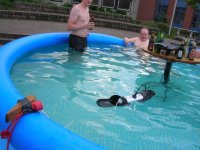
GFI.jpg

I hope these guys remembered to grease up their plugs. lol
 

Marketplace Items

New/Unused AGROTK YC-32G Horizontal Band Sawmill (A65583)
New/Unused AGROTK...
Lonestar Panel (4) 24ft. Free Standing Panels (A65640)
Lonestar Panel (4)...
Club Car Emergency Cart (A64557)
Club Car Emergency...
ROAD GEAR ALUMINUM HEADACHE RACK (A64277)
ROAD GEAR ALUMINUM...
2009 International 4300 Box Truck 24' (A62613)
2009 International...
John Deere R15 Rotary Cutter (A64047)
John Deere R15...
 
Top