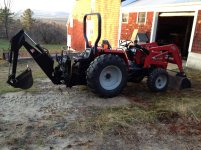
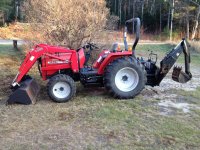
Ballast almost flipped the tractor, really need some help!

/ almost flipped the tractor, really need some help! #221  
I have a B26 Tractor Loader Backhoe. I have just ordered a tiltmeter at Tractorbynet. I need to go up and down some steep hills. The tractor seems to have little inclination to go over frontwards with the FEL, but going uphill makes me nervous because of the weight of the backhoe. Is there a way to safely determine what angle the tractor can go up before the accident happens?
 
/ almost flipped the tractor, really need some help! #222  
Hey RapidRobert, :welcome:
Maybe that should be welcome back? You joined a year ago but this is your first post :confused:

I got no idea about your question though.
 
/ almost flipped the tractor, really need some help! #223  
Is there a way to safely determine what angle the tractor can go up before the accident happens?

Extend the backhoe outwards so it will catch you if you tip. Then drive up steeper and steeper hills until it happens. Then use the backhoe to push you back down. :rolleyes:

PS: DO NOT DO THIS. I'm just kidding.

All kidding aside, it seems like there are too may variables to be able to say 100% "yes this is a safe angle, but this isn't." Let's say you parked the tractor on a turntable and slowly tilted it until it tipped over, and you determined that 18 degrees was safe. Well, what if you're in the real world and you hit a gopher hole that dips one wheel and takes you over the edge? What if you've got a bucket of dirt? What if you've got a bucket of compost? What if you've got a bucket of WET dirt?

I'm not an experienced operator, so I just take. it. slow. whenever I'm in a remotely sketchy situation. Rollovers happen very quickly when they happen, but if you are moving slowly, chances are that you will get some warning before everything turns pear shaped. Your front end may start to slide downhill just a bit, requiring you to turn uphill to counteract (WARNING! DANGER!). You may go up on three wheels for a second (WARNING! DANGER!). Your front end may get a little bit bouncier than it usually is going up a hill (WARNING! DANGER!). And so forth. The slower you go, the less likely you are to end up upside down without any warning.

The other mistake that I think inexperienced operators make is ignoring or missing the warnings. If you start to get warning signs, pay attention. Don't just put the pedal down and trust in your guardian angel to make everything all right.

Bottom line: stay within your comfort zone. If something doesn't feel right, stop. Assess the situation. Determine the best course of action, and proceed slowly to the nearest safe position. Determine how you're going to get from point A to point B before you start going, don't just charge in and get surprised. Once you know an area real well, you can tear around it willy nilly if you want to. If you were to see how I get from some points on my property to other points, you might think I was taking the long way around, but what you don't know is that the obvious way has a steep hill, or a bunch of ground-hog holes, or a slippery muddy spot, or whatever. My way may be longer, but it keeps the tractor with all four wheels down, and that's what matters most. No job is worth not going home at the end of the day.

If you get to the point where you are a very experienced operator, you may come to ignore some of these rules, but from your question, you sound inexperienced like me.
 
/ almost flipped the tractor, really need some help! #224  
And when you get really experienced like me (20 years 5 tractors) that's when the really bad stuff happens to you. Complacency can get you hurt just as fast as ignorance. Never get comfortable, always think about what might happen.

James K0UA
 
/ almost flipped the tractor, really need some help! #225  
I can do wheelies on my tractor without the fel but hoe installed. It's fun. I always back up really steep hills (like 45 degrees steep).
 
/ almost flipped the tractor, really need some help! #226  
joshuabardwell said:
Extend the backhoe outwards so it will catch you if you tip. Then drive up steeper and steeper hills until it happens. Then use the backhoe to push you back down. :rolleyes:

PS: DO NOT DO THIS. I'm just kidding.

Actually it works great if you are at the base of a non cambered hill :)
 
/ almost flipped the tractor, really need some help! #227  
I would say only to the extent that they want your ROPS to function as designed if you tip over. However, what you do to get yourself to that point is entirely beyond their control.

If you look at the Rimguard web site they show that for a tire size 17.5L-24 (MX5100 rear R4 per tractordata) 75% full will give 588lbs for each tire (1177lbs total). Your loader can lift 2443 lbs. I think someone posted force diagrams earlier in the thread. Look at these with these numbers in mind. On flat ground you are probably OK because you will have the weight of the tractor and tire ballast behind the front axle pivot helping to offset the opposing force from the bucket. A downward slope, a raised bucket can change this. If it were me, I would (and do) have rear tires filled and extra weight on the 3 point hitch for heavy work with the loader and ALWAYS keeping the bucket as low as possible when travelling with a load in it.

Thanks for your input JohninCT,,,,can I assume that at 90% water in tires that i should be able to lift 20% more TO 2932 lbs at FEL? Also advise my rear tires will be set at their widest, so would that improve or reduce capacity?
 
Last edited:
/ almost flipped the tractor, really need some help! #228  
Thanks for your input JohninCT,,,,can I assume that at 90% water in tires that i should be able to lift 20% more TO 2932 lbs at FEL? Also advise my rear tires will be set at their widest, so would that improve or reduce capacity?

The difference between ballasted wheels and ballast on the 3ph is that ballast on the 3ph takes weight off the front axle and puts it onto the rear axle, in addition to making you less likely to tip over. You should refer to your tractor or loader's owner's manual for recommendations and specific capacities, or your dealer, but in general, for FEL capacity to be maximized, you want weight on the 3ph more than you want weight in the tires. My tractor's manual recommends both 3ph ballast and filled tires for best performance.

I have also heard it recommended to fill tires no more than 75%, because at least 25% air is needed to maintain proper shock absorption and so forth. To accomplish this, put your valve stem at the 12:00 position and continue to fill until it reaches that level.
 
/ almost flipped the tractor, really need some help! #229  
Thanks for your input JohninCT,,,,can I assume that at 90% water in tires that i should be able to lift 20% more TO 2932 lbs at FEL? Also advise my rear tires will be set at their widest, so would that improve or reduce capacity?

The difference between ballasted wheels and ballast on the 3ph is that ballast on the 3ph takes weight off the front axle and puts it onto the rear axle, in addition to making you less likely to tip over. You should refer to your tractor or loader's owner's manual for recommendations and specific capacities, or your dealer, but in general, for FEL capacity to be maximized, you want weight on the 3ph more than you want weight in the tires. My tractor's manual recommends both 3ph ballast and filled tires for best performance.

I have also heard it recommended to fill tires no more than 75%, because at least 25% air is needed to maintain proper shock absorption and so forth. To accomplish this, put your valve stem at the 12:00 position and continue to fill until it reaches that level.
 
/ almost flipped the tractor, really need some help! #230  
thinggy42 said:
Hey guys
First time posting here and I really need some help!
We have quite a steep block of land. Around 5 acres with the steepest part being 40 degrees or so.

I recently purchased a John Deere 4105 with a FEL to do some hobby farming / mowing. There were a few delivery delays for the FEL so at first I only had the tractor. She worked like a charm and I managed to mow all the lawn and get started ripping / tilling. FEL arrived and the whole dynamic changed.

It feels like the tractor actually has trouble going up the hill now? A lot more revs required and she seems unstable.

I'd never driven a tractor before but hydrostatic was simple enough. Did a good 30 hours before the FEL. I had no idea about counterweighting on the first day with the FEL and this happened ( photos )

I didn't get hurt but **** was I shaken up. The FEL is large at 6 foot and the path I cut was only 5 so it didn't fit lowered. I raised it and it just tipped forward.

I thought the ripper would be enough counterweight but it wasn't. The tyres arnt filled either as some have suggested.

I don't want to add so much counterweight the tractor has more trouble going up the slopes?
Its a skid steer loader so ive been dropping it when going on the slopes so ive been hesitant to fill the tyres.

What do you guys recommend??
How much weight should i put at the back?

It should say in your manual how much ballast to use. Also I would have your tires filled, it adds a good bit of traction. Also consider getting wheel weights for the back. And put something on your 3 point hitch!!!
 
/ almost flipped the tractor, really need some help! #231  
I have also heard it recommended to fill tires no more than 75%, because at least 25% air is needed to maintain proper shock absorption and so forth. To accomplish this, put your valve stem at the 12:00 position and continue to fill until it reaches that level.

GillysChilliFarm - You should heed this advice.
 
/ almost flipped the tractor, really need some help! #232  
Thanks JohninCT, can you set out the negative issues so i can raise the issues with my dealer to see how he responds, then contact the Kubota importers to see how they respond dealers responses.. Thanks
 
/ almost flipped the tractor, really need some help! #233  
Ballast in a full time backhoe (hoe or FEL never is removed) should not be required in most cases and has a major downside. FEL use only then ballast in rear tires makes sense but if you can moved it back another three foot (3PH weight) that makes the same weight a lot more of a counter weight.

While it is much larger our 2WD JD 310B backhoe since 1983 has been dry.

Major down side as I see it I would be hung all the time on soft ground. Since I washed the wire screen hydraulic pick up filter and got the water out of the system I can lift and shift the rear over a dug ditch if it is narrow enough. Filled tires would make this hard to lift/shift the rear axle out of its tracks.
 
/ almost flipped the tractor, really need some help! #234  
GILLYS CHILLI FARM AUSTRA said:
Thanks JohninCT, can you set out the negative issues so i can raise the issues with my dealer to see how he responds, then contact the Kubota importers to see how they respond dealers responses.. Thanks

Read Joshua's post he has explained the reasoning. The idea is that you don't want your tires hard as a rock. But bottom line is your tractor your decision. You can also refer to the following

http://deltafarmpress.com/proper-tire-ballasting-improves-tractor-performance

http://www.orangetractortalks.com/2009/01/how-to-ballast-your-kubotas-tires/

http://www.rimguard.biz/FAQs.html

http://m.moderntiredealer.com/Article/?id=1035
 
/ almost flipped the tractor, really need some help! #235  
Doing so with the bucket rasied the loader becomes a large pry bar. And the action of pushing at a tree with the loader rasied high can have the opposite effect. And cause the tractor to push over. It has happened to me. I was trying to push over a tree that I cut. It was hung up in another tree. As I pushed against it my tractor suddenly tilted off the ground and I almost flipped it. So you would be wise not to use the loader in that fashion. My tractor is a JD 4720 with the heavy duty loader. Picture that tipping over.

Another surprise disaster mode: You can raise the bucket as high as you think correct and then ease into a tall tree that may be dead or seem fragile and looks like you might be able to push it over. I have many times. However, I did that once with a JD4700 (the 2001 variety, 48hp compact tractor) and had the high part of the tree above the bucket get momentum in the wrong direction due to inertia when I shoved it -- back over top of me. It did not come all the way over and I got the heck out away from it but I can see getting killed that way. The danger may not be what the machine can or can't do but rather what you knock down that may fall on you.
 
/ almost flipped the tractor, really need some help! #236  
I cannot believe that I sat through and read this whole thread at one time...
I am addicted...
Just a few thoughts...
Most of the comments on here are spot on...
I was raised on a farm with 2WD tractors and we have never had an issue with a FEL lifting the rear end...
We only used our farm tractors for lifting round bales but always had ballast on the rear...
Those older 2WD tractors also had a longer wheel base than typical 4WD compacts do also...
I currently have a NH 1720 and keep about 600# counter weight on the rear end...
Never had an issue with a light rear end picking up loads with the FEL...
I think that in my case 40 plus years of experience driving tractors on the farm has a lot to do with that...
And believe you me that statement is not one of cockiness...
I keep my FEL bucket as low as possible to the ground when moving heavy stuff and proceed at a very safe speed with the FWA always engaged...
I try to keep off hills as much as possible also...
I am glad that no one was injured...
 
/ almost flipped the tractor, really need some help! #237  
I will admit I didn't read the ENTIRE thread:ashamed:

Firstly, I'm glad yer okay.

Secondly, thanks for posting it as it made a VERY good wake-up call.

Though many if not most guys here have more experience than I, I must admit I liked what some Dude said about putting in 4WD not being a silver bullet. When you go down hill with too much front weight, it puts incredible strain on the front axle. Onless you're on an articulating tractor, the tires are getting an incredible workout. Now, imagine turning the wheel - maybe accidently as in hitting a hidden coblestone - and what is going to happen.

In the OP's defense . . . the first time I popped the rear wheels up (Rim-guard rears, but no counter weight at that moment) I also didn't think fast enough to drop the FEL. I got bailed out because the machine was squared to the hill, and the bucket stoped the roll-over.

This post is a great wakup call for me. I often have to travel across slopes. Though I have figured out to keep the bucket inches off the ground - and right hand on the stick - I need to remember to keep the flail mower-my heaviest rear implement- on.

Oh, um. . . you DID have your seatblt on, yes? If that had gone sideways and you'd had no seatbelt on, I might have never benefitted from your story!!
 
/ almost flipped the tractor, really need some help! #238  
MF1433 with Woods 7500 2.jpgMF1433 with Woods 7500.jpg

First time poster here who had a similar scary moment when I was new to my 1433V (even with ballast box). Everyone is who stated that you do not think logically or have the reaction skills that first time, is right! I tried to bail off and the seat safety cut the engine and stopped my eminent roll over. That was pure luck and a safety device doing its job. I learned a lot that day!

That was before adding the Woods Groundbreaker backhoe. I leave the hoe on all the time and think it is just great for counting the FEL. I feel very stable. For very heavy loads in the FEL I can load the hoe bucket with weight and also extend the boom and dipperstick out. 100 pounds in the hoe bucket extended out and low, can help significantly with heavy front bucket loads. I love that backhoe!

P.S.
Not sure if all backhoe subframes are designed this way but my Groundbreaker backhoe subframe attaches at several points to the tractor and to the 1466 front end loader frame so the two frames are married to be essentially joined as one large subframe. That's pretty cool.
 
Last edited:
/ almost flipped the tractor, really need some help! #239  
thats what happens when you transport a loaded bucket with it up in the air. Also, why you need a tow to get the back tires on the ground? just lower the darn bucket. Hope you learned from your mistakes so you dont get injured or killed from lack of experience
 
/ almost flipped the tractor, really need some help! #240  
View attachment 289227View attachment 289223

First time poster here who had a similar scary moment when I was new to my 1433V (even with ballast box). Everyone is who stated that you do not think logically or have the reaction skills that first time, is right! I tried to bail off and the seat safety cut the engine and stopped my eminent roll over. That was pure luck and a safety device doing its job. I learned a lot that day!

That was before adding the Woods Groundbreaker backhoe. I leave the hoe on all the time and think it is just great for counting the FEL. I feel very stable. For very heavy loads in the FEL I can load the hoe bucket with weight and also extend the boom and dipperstick out. 100 pounds in the hoe bucket extended out and low, can help significantly with heavy front bucket loads. I love that backhoe!

P.S.
Not sure if all backhoe subframes are designed this way but my Groundbreaker backhoe subframe attaches at several points to the tractor and to the 1466 front end loader frame so the two frames are married to be essentially joined as one large subframe. That's pretty cool.

Welcome to TBN! I am glad your scare didn't result in injury or damage. I don't know if you are still a newby or not, but always remember that flimsy looking seat belt is a real life saver when your tractor has a ROPS, as yours does. Also, a hoe can provide stability in some scenarios and cause instability in others, so take it slow, keep your ROPS up, and your seat belt tight.
 

Marketplace Items

2019 Chevrolet Malibu (A61574)
2019 Chevrolet...
FREIGHTLINER GRAIN TRUCK (A63291)
FREIGHTLINER GRAIN...
2010 International 4300 Truck Altec DM47TR Insulated Material Handling Digger Derrick Truck (A64194)
2010 International...
Caterpillar C18 Industrial Diesel Engine - Serial N8F01109 - Arrangement 385-7728 - Pump Takeout (A63689)
Caterpillar C18...
Cummins 6-Cylinder Diesel Engine with Transmission (A59230)
Cummins 6-Cylinder...
2018 FREIGHTLINER CASCADIA  125 6X4 T/A SLEEPER TRUCK TRACTOR (A59912)
2018 FREIGHTLINER...
 
Top